Blog Archives
Daylight Saving Time – yes or no?
This might seem a bit of an unusual topic for a softball blog but bear with me. Over the past few days (because of the changeover this weekend – hope you changed your clocks) I’ve been hearing a lot of talk in the media about getting rid of Daylight Saving Time (DST).
As a longtime softball coach, I would hate to see that happen. Wouldn’t you? Yeah, it’s kind of a pain to lose an hour of sleep in the first weekend of March. But the tradeoff is more softball time at night in the summer.
Where I live, for most of the summer it stays light outside until about 9:00. That means plenty of light to start a game at 6:00 and have it go for two hours without lights on the field. Even if it goes a couple of extra innings there’s plenty of extra light.
But without DST, by the time late July comes along you’d be pushing it to have enough light to finish a two-hour game. That seems wrong.
We have a summer sport. We need the extra daylight. If you’re given the opportunity to take a poll, be sure you say “yes” to DST!
So what have you been hearing? Would losing DST affect your season?
Softball instructors are like Google Maps for players
A recent series of discussions on the Discuss Fastpitch Forum has been debating the need for or value of private instructors. Perhaps the best way to explain what private instructors bring is to liken them to using Google Maps. (FULL DISCLOSURE: I am a private instructor myself, so naturally I am a little biased on the topic.)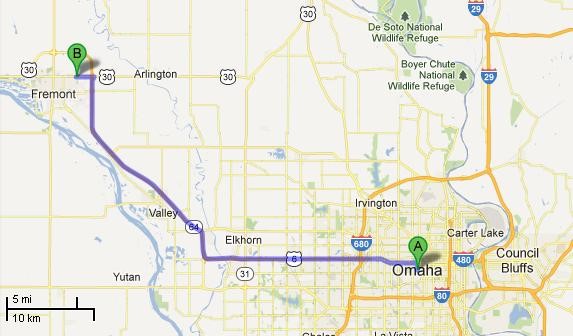
Let’s say you live in Cleveland and you decide you want to drive to Omaha. How are you going to get there? One way to do it is to hop in your car, point it west, start driving and hope for the best. You’ll probably get there sooner or later, but odds are it will take you longer than if you had used one of the other choices.
Another option is to pull out a paper Atlas (like we used to in the old days) and map out your route on paper. That will be better than just randomly driving, but for best results you need to be pretty good at reading maps. Not everyone is. If you misinterpret the map, or the roads have changed since your Atlas was printed, you could end up getting lost. (Think Clark Griswold in the first Vacation movie.) If you do lose your way, you may not even realize it for a while, in which case it will probably take a bit of backtracking to get you back on the right road.
Then there is using Google Maps (or your mapping application of choice). You can plug in your starting point and destination and the entire route will be laid out for you step-by-step. If you’re using a PC you can print it out and take it with you, without all the extraneous information that is in an Atlas. If you’re using it on your smartphone, a pleasant voice will guide you turn-by-turn to your destination, with easy-to-read visuals along with it. If you happen to make a wrong turn anyway, or the roads have changed, Google Maps will recognize you’re heading in the wrong direction and immediately guide you back to where you need to be.
Those are the things a private instructor will do as well. You don’t absolutely need one to get to where you’re going, but like Google Maps an instructor will help you get there faster.
A private instructor will lay out a good foundation using techniques, drills and cues that have proven successful before – but adjust to the specific needs of the player. The instructor will offer that same sort of turn-by-turn guidance that helps players stay on the path to success rather than wandering off into dead ends. If something gets “off” due to any of a dozen reasons, the instructor will help guide the player back onto the right path.
This isn’t just for beginners, either. Even accomplished players need a little help now and then. Every professional team has position coaches and instructors who are there to help players improve their games and overcome problems. When Tiger Woods was at the top of the golf world, he still had a swing coach who worked with him to help him stay there.
In his book The Talent Code, Daniel Coyle lists the three essential elements to achieving excellence. One is motivation, and another practice. But the third is coaching. Not that the coach has any special magic to offer. But because the coach can help make sure that players spend their time practicing the right things in the right way rather than trying to feel their way through the process.
Again, it’s not for everyone. If you’re just planning to drive around your own neighborhood you don’t need Google Maps – or at least you shouldn’t. But if your goals are to get out into the larger world, you might want to have a guide by your side.
The Way It Ought To Be
The other night when I got out to my fastpitch softball lessons I had a pleasant surprise waiting for me. My first lesson was with a high school senior pitcher, and her high school coach was there to observe.
I couldn’t have been more pleased! All too often it seems the relationship between private coaches and team coaches – either in high school or travel ball – is contentious. I’m not sure why but it’s not uncommon. 
It’s much smarter for there to be a sense of cooperation. Private coaches work with players on an individual basis far more than a team coach ever will have the time for. They teach specific skills and learn what cues trigger performance and success for those players.
If the player (or her parents) have chosen wisely, that player comes onto the team with an advanced skillset built over many hours of practice. At the same time, there will be players who have put little effort into learning their skills. That is where the team coach can make a difference. Focusing their limited time on raising the skill levels of those players will pay the best dividends. Because, of course, the chain will only be as strong as its weakest links.
In this particular case, I invited the coach into the cage with us so he could hear the instruction and ask questions if he had any. He brought his iPad in with him and shot video as we went along. I periodically asked if he had any questions, and he had the opportunity to see how I interacted with my student/his player.
It was a very pleasant half hour. I left the coach with an open invitation to come back any time. Kudos to the pitcher’s parents for setting it up, incidentally.
Of course, it’s easy for me to take this position as a private coach. But I have also experienced it from the other side. While I wasn’t able to attend an actual lesson, when I was a team coach and had pitchers who were not my students, I would contact their pitching coaches to learn what to look out for, what cues they used and what they were teaching those pitchers. It may not have been what I taught, but that’s ok. I wanted to work with what they had learned and what they were supposed to be doing rather than trying to re-make according to what I teach.
Presumably, everyone – team coach, private coach, parents and the player – want the same thing. They want the pitcher to be successful. Working together is far more likely to make that happen than constant territorial battles.
Video like an MRI for coaches
After experiencing the healthcare system myself not long ago and having my wife take a visit to the ortho yesterday, I had a realization today. When doctors are trying to diagnose a joint injury they will talk to the patient, try a few manipulations and overall eyeball the problem. More often than not, though, they will send the patient for an MRI to see what they can’t observe with the naked eye.
The coaching equivalent is video. No matter how much experience a coach has, there’s nothing like being able to slow things down and take an in-depth look at a pitch, a swing, a throw, a fielding play or some other technique. And these days it’s easier than ever.
When I first started coaching, shooting and analyzing video meant hooking a handheld video camera on a tripod up to a laptop. If you were planning to shoot video throughout the day or evening, it also mean running an extension cord to a power strip. If you wanted to change angles it could take a few minutes to get everything set up again.
Nowadays all you need is a smartphone or tablet and an app, such as Coach’s Eye, RVP or Ubersense. You can shoot the video, run it back and forth in slow motion and even draw lines, measure angles and perform other actions. And with the advances in the devices, you can shoot at high frames per second rates that make everything very clear and easily visible.
Over the last few days I’ve used my new iPhone 6 and Coach’s Eye to do some valuable analysis – and show the players what we’re looking to do. They weren’t big mechanical issues, but instead the small details that make the difference between good and great. We were also able to see all the things they’re doing right, which was a feelgood. Like the MRI, it exposes things you may not see otherwise – and share them with the player.
Being able to show rather than tell can be incredibly valuable, especially for younger players who may be more visual than audible learners. Showing them what they’re doing often helps them understand what you’re trying to describe as a coach. With modern technology, you can do it instantly – which is what every study of coaching will tell you is most effective.
Doctors love their MRIs. Coaches should love their video apps. They can really help shortcut the learning experience for your players.
Set egos aside at showcases
Softball is a competitive sport, and as competitors we like to win. But if you’re a coach taking your team to a college showcase it’s best to put your ego aside and focus on showing off your players rather than on the outcome of the game. Even if it means you lose the game.
Bunting is a good example. You may be down a run, and believe the smart thing to do late in the game is to bunt a runner from second to third with no outs to put your team in a position to tie (or win). Now, at a regular tournament, where one team will be declared the champions at the end of Sunday, I say have at it.
But at a showcase, all that bunt is doing is robbing your player of a chance to show some college coach who could use her what she can do. It’s not that they don’t bunt in college. Sure they do, and they expect their players to lay it down. But they’re not at a showcase looking for a kid who can lay down a sacrifice bunt. To paraphrase that saying popular among Dominican Republic baseball players, no one ever bunted their way onto a college roster. Unless, of course, they’re a lefty short game specialist. But even they aren’t going to get anywhere with a sac bunt.
No, even if it’s the right thing to do game-wise, it’s better to let your player swing away. She’s far more likely to generate collegiate interest with a run-scoring double than a sac bunt. Not only will it show her hitting skills, but also her mental toughness.
The same goes for pitchers. Even if your pitcher is presently dominating with her curve or rise, you want to give her the opportunity to showcase her other pitches as well. Call some pitches you might not call in a tournament game. You never know. You may find a whole other dimension to that pitcher.
Truth is no one particularly cares what your record is at a showcase. Well, at least no one who knows anything about showcases. Whether you are 5-0 or 0-5 you’re not going home with a trophy. But if you give your players a chance to show their stuff they might go home with some interest from college coaches – which is the reason you signed up for the showcase in the first place. I’m not saying playing to lose, or put your team in a position to look bad. Just remember your purpose for that weekend and make decisions accordingly. Even if they hurt.
Of course, if you do plan to go that way, be sure to explain to the parents ahead of time that your purpose is to help their daughters be seen rather than to win every game. You’ll save yourself a lot of grief and aggravation from ultra-competitive parents who believe winning is the only thing.
That “Moses” kind of feeling
Ok, so what does a Bible story have to do with softball? Bear with me – I swear it has a point.
Pretty much everyone knows the story of Moses – either directly out of the Bible or the over-the-top Cecil B. DeMille movie TV runs every Easter, starring Charlton Heston. The key part here is what happens to Moses at the end. After leading the Hebrews out of Egypt they wander the desert for 40 years. When they finally reach the Promised Land, Moses is not allowed to enter.
That’s the feeling I get sometimes when I go out to watch my students play in games. I’m wondering how many of you who teach but don’t coach a team feel the same way.
What I mean is I will hear about how great one of my students is doing. If she’s a pitcher, she dominating the hitters, giving up only a couple of runs and maybe one walk. If she’s a hitter, she’s pounding out extra base hit after extra base hit – even going yard now and then.
But when I come out to the game to watch, something happens. I don’t know if they get nervous when I’m there or it’s just bad timing, but suddenly the pitchers are getting hammered, or having trouble finding the strike zone. And the hitters are popping up, grounding out or even striking out.
Hence my Moses reference. I seem to be able to get them to the Promised Land of great play ok. I just don’t get a lot of opportunities to enjoy it with them. It’s gotten to the point where I sometimes try to hide when I go to a game so as not to throw them off.
Of course, when I am coaching a team this phenomenon makes things a bit worse. Tough to win games when your players aren’t playing the way you know they can play.
So now I throw it out to you. Am I the only one who has experienced the “Moses effect?” Or have you seen it as well?
Congratulations to Jan Pauly, new VHHS varsity softball coach
Today’s post will be fairly meaningless to many of you, but I wanted to share some good news with the rest. My friend and fellow IOMT Castaways coach told us this week that she has been named the new varsity head coach at Vernon Hills High School.
I’ve known Jan for several years, starting from when I coached her daughter Erin, and I can tell you Vernon Hills has found themselves a winner in several ways. First, Jan is very knowledgeable about the game. She played through high school and college, and coached travel ball for several years. the good thing about her is that she doesn’t just rely on the way things used to be, but also keeps up with the current thinking on the game.
More importantly, though, she genuinely cares about the players in her charge. Not just as softball players but as people. She’s a huge believer in team over individual glory, although if an individual has a problem or concern, softball or otherwise, they can bring it to her.
Of course, no discussion of Coach Jan would be complete without talking about how intense she is during games. She can look like she’s pretty angry at times, especially if things aren’t going right. But she’s not angry, actually. She’s just focused. Once players understand that I’m sure they’ll enjoy playing for her – and learning from her.
I’m personally looking forward to seeing what she does with team. So congratulations, Jan! I know you’ll be great.






 Life in the Fastpitch Lane