What the WCWS Can Teach Us about the Changeup

Whenever I see one of my students after a tournament weekend, the first question I usually ask them is “How did it go?” Knowing how they performed in game situation is very helpful in determining what we’re going to work on in that lesson.
Hopefully I get more than “good” or “fine” or “terrible” as a response.
The next question I ask pitching students is “What pitches did you throw?” (assuming they have more than just a basic fastball). That’s where it can get a little dicey.
The answer I least like to hear is “Mostly just my fastball,” especially if that pitcher has also developed (or is developing) a decent (or better) changeup. Sorry, I know that was a lot of parentheses in one sentence but hopefully you followed it.
Now, I know that pitchers these days, especially the younger ones, often don’t have a lot of input into the pitch calling process. But I will still ask them why they didn’t throw their changeups more.
The typical answer are:
- The other team couldn’t hit my fastball so my coach didn’t want to give them a slower pitch to hit
- I threw one but it rolled in/went high/went wide so my coach didn’t want to throw it anymore
- I had a little trouble with it during warmups so my coach didn’t want to chance it in the game
- My coach says he/she doesn’t like the changeup or prefers to go with speed
- I threw a few but when one got hit my coach quit calling it
- I dunno
I get the thinking behind most of these reasons (except the last one). Coaches want to win games so will tend to go with what they think will accomplish that goal.
They also tend to be risk-averse, and often view a pitch that looks so different from everything else in the pitcher’s arsenal as too risky to throw, particularly in close games.
I hope those coaches were watching the #2024WCWS (Women’s College World Series). Because it was a veritable clinic on how effective a changeup can be – and how often it can be used.
I’ve commented to a number of people that I think I’ve seen more changeups thrown in one inning by some of these pitchers than I’ve seen in total over the last five years. It was like someone suddenly remembered how great the changeup is and passed a memo along to all the top D1 college teams in the country.
Stanford’s NiJaree Canady, to me, was the poster child for this display of pitching chicanery. Because she wasn’t just throwing a couple per inning.
No, she was often throwing at least a couple per HITTER!

She also did a great job of wiping out excuse #1 above. Canady was consistently throwing all her other pitches at 70 mph+.
I don’t care how good a hitter you are, that’s going to be tough to catch up to, especially if you can locate the ball to match the hitter’s weaknesses. At one point I saw a quote from Monica Abbott saying she thought Canady could be the first female pitcher to throw 80 mph in a game in a couple of years.
Yet Canady and the Stanford staff didn’t go there and try to blow everyone away with speed. They actually used that speed to set up her changeup, which is where she was getting a lot of her strikeouts. If it’s good enough for one of the last teams standing in the WCWS…
Another thing I saw was various pitchers (including Canady) throw some sub-par changeups. They would throw them for close balls in tough counts.
I remember at least one pitcher (I think it was Nicole May in the final game of the championship series, a pretty important time) roll the ball in on a change at least once, maybe twice. Yet the Oklahoma coaches didn’t quit calling it.
I also remember a few along the way going high, going wide, and (gasp!) even getting hit – occasionally for a home run. But those pitchers’ coaches didn’t quit calling it, because they understood that’s going to happen, even to very high-level pitchers, and that the next one in the zone will still be effective.

There were also times when a pitcher might not be throwing her best changeup. But again, on softball’s biggest yearly stage, the coaches understood that changing speeds that way could be effective even if the pitch didn’t go for a called strike.
After all, nobody wants to look bad on national TV swinging through a changeup, so it gets in the hitters’ heads. If a highly accomplished, high-level hitter can feel that way imagine the psychological pressure a changeup can put on a 12U, 14U, or even older hitter.
Probably the only argument against the changeup that the WCWS didn’t answer directly was the coach wants to call the pitches he/she thinks will win the most games. And throwing a changeup on a regular basis doesn’t give us as much assurance of winning this game right now as throwing a speed pitch does.
So here’s my question: where do you think all these high-level pitchers learned to throw their changeups in pressure situations? I can pretty much guarantee that it wasn’t at the WCWS, or even during the college regular season.
Those pitchers most likely had youth coaches who believed in them, and believed in developing them to become the best they could be. I don’t have direct knowledge of the circumstances but I’d bet pretty good money that NiJaree Canady, Kelly Maxwell, Nicole May, Teagan Kavan, and all the other pitchers we watched this past weekend who throw in the high 60s and low 70s didn’t have youth team coaches who told them to just go out and blow the ball by everyone.
My guess is their coaches threw the changeup even when they didn’t need to, because they knew it would help those players (and countless others) become the best they could be. They also knew one single pitch rarely determines a tournament outcome so they could always come back with something else or change strategies if the changeup didn’t work.
All those young women throwing changeups in the WCWS were given ample opportunities to develop that pitch so it would be ready for when it mattered most.
Hopefully today’s youth coaches were paying attention, and saw how effective the changeup can be when it is called early and often, sometimes a couple of times in a row, even against some of the best hitters in the game.
If you have a pitcher who can throw a changeup, even if it isn’t the greatest in the world right now, take advantage of it and use it. If you let her develop it now I guarantee it will help your team win more games in the long run.
And you might just get the pleasure of watching one of your pitchers throw it on TV someday.
Re-Thinking the Traditional Batting Order

One of the most important responsibilities a team coach has is putting together a batting order that will produce runs. Yet all too often these same coaches become so bound to a particular way of thinking that they don’t take advantage of opportunities that might be available to them if they’re willing to think a little bit outside the box.
Let’s start with what is the norm for most teams. The traditional batting order usually looks something like this:
- Leadoff – Fastest girl who can put the ball in play reliably; often a slapper if one is available; tends to hit mostly singles; often called a “table setter”
- Two hitter – Primary job is to move the leadoff along when she gets on base, either by hitting a single, bunting, or hitting behind the runner; mostly puts the ball in play on the ground
- Three hitter – Best all-around hitter on the team; can hit for power, hit for average, doesn’t strike out much; her job is to bring the table setters in
- Cleanup – Your most powerful hitter, the girl who is a threat to go yard any time she steps up to the plate; not too worried about average so it’s ok if she strikes out a lot as long as she hits those deep balls
- Five hitter – Second-best all-around hitter on the team; she’d be the three hitter if three wasn’t there; maybe has a little lower average or slugging percentage than three but still a huge threat at the plate
- Six hitter – She’s ok and you hope to get her on base but you also know it’s not as likely; mostly a singles hitter, might be good at drawing walks
- Seven hitter – Great defensive player
- Eight hitter – Shows flashes of being good but not strong enough to make the top five; probably there to drive in six and/or seven in case either one is fortunate enough to get on base
- Nine hitter – Second base candidate for leadoff; while she thinks you put her there because you think she’s bad, you’re actually hoping she gets on base so the top of the lineup can drive her in; generally fast, could be a developing slapper; OR, your worst hitter who you’re trying to limit in how many times she comes to the plate
That’s a lineup that has worked for many teams for decades, and certainly a valid approach. But it’s not the only one.
One of the determining factors should be your personnel, i.e., your players and how they hit. A smart coach will look at who he/she has available and will try to take the best advantage of them regardless of what the “experts” say.
And in doing so, he/she may just catch the more traditional-thinking coaches off guard as they call pitches based on their assumptions. Here are a couple of examples.
More power at the top
Instead of opening with a couple of table setters, try taking a traditional five hitter and batting her at leadoff. She hits for average so will likely get on base, and since she also hits for power she could lead off the game with a double or triple.
That way you already have a runner in scoring position after one batter and have three outs to bring her in. Statistically you’re more likely to score in that situation than if you get a runner on first and sacrifice her to second. You also deflate the opposing team (and especially their pitcher) psychologically by opening with a big hit.
Then put your traditional three hitter in the two spot. A second big hit in a row scores the first one and probably leaves this hitter in scoring position as well.
Worst case you have two runners on base with no outs, with one or both already in scoring position. Then put your cleanup hitter in the three slot.
If she goes yard you have three runs before you have any outs, and even if she just hits a deep fly ball that’s caught you score one and probably advance the other runner to second or third where you still have two outs to bring her in. Worst case she strikes out but you still have two more outs to score at least one run.
From there, you can bunch your traditional one, two, and nine hitters to see if you can scratch a couple more runs together. You might want to put two in the four spot so that the traditional four, if she gets on base, isn’t in the way of your speedsters.
With this lineup you maximize the number of at-bats your best hitters get while minimizing the at-bats of your weakest hitters. It does create a potential hitter desert at the bottom of the lineup so you have to hope the top does its job so you’re not depending on the bottom to win a close game.
But hey, no risk, no reward.
Focus on speed
What if you don’t have any (or at least not many) big hitters? In that case you might want to bunch your fastest players (who can hit) at the top and try to create havoc and errors with aggressive baserunning.
Your leadoff hitter would be the same as a traditional lineup. But then bring the traditional nine up to the two slot, and follow her with another speedster in the three slot.
With three girls who can get on base with a slight bobble you are putting a lot of pressure on the defense to perform. And as we’ve all seen, errors often happen in bunches.
Force one bad throw that results in an extra base or two, then keep applying the pressure, and you may get another, or a fielding error as the fielder tries to rush her play on the ball. You could easily end up with a run or two without the ball leaving the infield.
You could also end up with demoralized opponents, especially if the opposing coach has to stop the game to yell at his/her players about making plays.

After those first three, put in whoever is closest to a traditional three (great power, great average) to see if you can clear whoever is left off the bases. You can then start again with speed, or if you have a traditional cleanup hitter put her in there before going back to the speed game.
The 5-4 lineup
There is probably a better name for this one but this is what I call it.
Basically what you’re doing is structuring the lineup so the first five hitters follow the tradition lineup. But then then next four act like a second top of the lineup.
In other words, your six hitter would probably be your traditional nine – the girl who would be leadoff if you didn’t have your one hitter. The seven hitter will be a traditional six – decent hitter but not good enough to crack the top five.
The eight hitter would be the same, a budding traditional three or five. Then the nine spot would be that great defensive player. You’re basically willing to take the out, or maybe that’s a good spot for the designated player to add one more decent bat to the lineup.
The turtle parade
This one is definitely driven by your personnel. And as you can probably guess by the name, while your team can hit pretty well it’s not exactly blessed with speed.

In this case I’d say take your fastest player who can get on base regularly and put her in the leadoff spot. She may not be all that fast, but compared to the others she’s a rabbit so give her the opportunity to run.
From there, if everyone is about 4 seconds or more down to first, base your lineup on batting averages – highest in the two spot, second highest in the three spot, etc. Figure you’re going to mostly be running station-to-station, so give the most reliable hitters the most at-bats.
Just be sure not to put the slowest turtle in the nine spot, because if she gets on base your only girl with any speed at all is going to be stuck behind her.
Be creative
Those are just a few options. A lot of what you can or should do will depend on who you have on your team and how consistent they are.
One other thing to keep in mind is how they handle things psychologically. I can tell you from personal experience I was a good three or five hitter, but for whatever reason struggled at four.
I’ve also coached girls who could hit .750 from the seven spot, but put them at one or two and they folded like a cheap card table. When weighing your options be sure to account for those factors.
With a little creativity, however, and a willingness to buck the norms (even when the parents don’t get it) you can find a lineup that helps you produce more runs and win more ballgames. And look like an offensive guru in the process.
How to Increase Your Coaching ROI
If there’s one thing just about every coach complains about when talking about coaching challenges it’s that they simply don’t have enough time.
It seems like there’s always a hundred things to go over in every practice and about 20 minutes to go over them. Hopefully things aren’t really that bad, but it can certainly feel that way.
So with that type of work/time pressure it’s important for coaches to invest their limited time where it will do the most good. Unfortunately, human nature being what it is, many seem to do the opposite of what they ought to be doing.
What mistake is it that so many make? Spending too much time trying to “fix” their best players, i.e., the ones who are performing best on the field, while ignoring or giving scant time to every one else.

I see it and hear about it all the time. Let’s say you have your top three hitters, all of whom are hitting the ball for average and power.
Their batting averages are above .333, which is pretty darned good unless the teams you’re playing are pretty darned bad, and their on base percentages (OBP) and on base plus slugging (OPS) are equally on the high end.
Then you have the bottom part of the order that can’t hit water if they fell out of a boat. (Thank you Bull Durham – one more funny line to add to last week’s blog post.)
Every time one of them comes to the plate in a tight game you suddenly rediscover religion, hoping and praying that somehow they manage to put the bat on the ball, even if it results in a duck snort or a swinging bunt, so for once you can move those runners along and score a little more than you usually do.
So where do you think you will get the best return on investment for your time and effort in practice?
To me, logic says that if you can improve those bottom few players and get them to go from poor to even below average, you’re going to score more runs and win more games. That would be a huge gain that would continue to pay dividends throughout the season.
Ok, now, answer this: where do most coaches tend to spend the bulk of their time? Unfortunately, it’s trying to make incremental improvements with their top three hitters.
Why do they do that? Because A) it’s more fun to work with a good or great player than with one who seems to barely know which end of the bat to hold and B) they often want to get a share in the glory that comes with seeing a player they’ve coached go on to do well. In other words, they want to stake their claim that they helped that player become the star she is today – even if their suggestions were actually getting in the way of that great player playing great.

The reality is it isn’t that hard for a bad coach to screw up a high-performing player. All he/she has to do is give bad advice and then insist that it be followed.
For example, the coach can tell a top-performing hitter that she should widen her stance and not stride, even though her narrower stance and normal stride have been resulting in her hitting bombs. Then the coach stands there during batting practice and forces the hitter to follow the advice he/she gave until that hitter is dragged down to the level of everyone else.
Or there’s the case of the coach who thinks he/she knows everything about pitching and decides to have all his/her pitchers do a certain set of drills he/she saw at a coaching clinic instead of realizing that the top pitcher(s) got that way by doing whatever it is they’ve been doing.
Throwing in an arbitrary set of drills just because he/she can could end up hurting the top pitcher’s performance on the field, creating unnecessary losses. If the coach feels he/she has to contribute to the pitchers, do it with the ones who are already struggling. They have far less to lose – and so does the team.
As the high school and college seasons end and the rec and travel ball seasons begin in most of the country, please keep this idea in mind: You will gain far more benefit by investing the bulk of your time bringing your least-performing players up to an average level than you will by trying to wring a little more performance out of players who are already playing at a high level.
This is a team sport, after all, and no single player, no matter how good they are, can make up for eight others who are below average. But bring the rest, or even a few of the rest, up to a higher level than they were and you’ll stand a much better chance of putting more Ws on the board.
One last thought: don’t assume you know who your best players are just by gut feel. Look at their stats too.
You may just be pleasantly surprised – and it will help you narrow down where you spend your limited time.
Funny Lines for Your Back Pocket

We’ve all experienced this phenomenon at one time or another. You get into an argument or a tense situation and instead of defusing the situation with a witty one-liner you just choke out some nonsense.
Then later on you think of the perfect comeback or bon mot, but by that time it’s far too late to say it because the moment is over.
Well, my softball friends, I have a solution for you. Instead of trying to think up something clever to say on the spot, it’s better to have a set of great one-liner in your back pocket that you can pull out when the occasion warrants it.
But you’re not a funny person who can come up with one-liners even when you’re not under pressure? Or the ones you do come up with tend to thud?
Not to worry, because we’re going to put some of Hollywood’s and the entertainment industry’s best writers on the job for you. Spend a little time committing these lines from movies and TV shows to memory, along with my suggestions on when use them, and you’ll quickly be revered as that person who always knows what to say when the need arises.
I know all the lines aren’t exactly from the movie or TV show, but they have been adapted to match the situation or reference softball or keep it appropriate for all ages. Attributions are in parentheses afterward.
- Your pitcher gives up a home run and you have to make a circle visit #1 – Wow. Anything that travels that far in the air should have a flight attendant on it. (Bull Durham)
- Your pitcher gives up a home run and you have to make a circle visit #2 – Don’t worry, that wouldn’t have been out of a lot of parks. Like Yellowstone, Yosemite, etc. (Major League)
- Your pitcher gives up a home run and you have to make a circle visit #3 – Looks like she launched that one toward South America (Major League)
- You take a risky suggestion from an assistant coach or even a player, then send the team off to do it; you then look at the person who made the suggestion and say – This had better work. (Moneyball and The Imitation Game)
- Pre-game speech before an important game – A win right now takes us to the championship (or whatever) so it’s very important we don’t stink today. (That Thing You Do)
- Answer to the above statement from a player – I make no guarantees. (Also from that Thing You Do)
- Response to a parent who has “a few thoughts” on how you should run the team – I have your phone number. When what you think becomes important to me I’ll give you a call. (NYPD Blue, although that one may not quite defuse the situation. It’s still funny though.)
- When a pitcher throws a wild pitch into the backstop – JUST a bit outside (or wherever it happened to land. (Major League)
- When someone tells a hitter her brain is getting in the way of her hitting – Well, can’t say that’s happened very often. (Tin Cup)
- When the whole team is getting down on themselves or getting nervous – Remember that softball is a game, and games are supposed to be fun. (Mr. Baseball)
- When the team has a particularly bad inning or makes a particularly bad series of goofs on one play – Well, that was a defining moment, and the definition was *poop* – (Tin Cup)
I think that’s plenty to get you started. Just think of the situations you think you’re most likely to find yourself in and focus on those first. Then you’ll be ready for whatever comes your way.
Laughing photo by Hannah Nelson on Pexels.com
Fastpitch Pitching Advice from Taylor Swift

This week’s topic goes hand-in-hand with last week’s blog post about the art of pitch calling. If you haven’t read that one yet I suggest you do; it’s brilliant.
All too often these days it seems like fastpitch pitchers are treated like a vending machine. Someone puts a pitch call in and pitchers are expected to spit it out with zero thought involved.
To me, and I think to most pitching coaches (PCs chime in here in the comments) that is absolutely the wrong approach. Instead, pitchers need to be playing along in their heads, thinking about what that hitter looks like, what’s worked on her in the past (if she’s faced her before), what pitches are working today (and how well), and what she thinks ought to be the next pitch she throws.
Then, if the pitch call lines up with what she’s thinking (more or less), she throws it. If it doesn’t, she takes the advice of the ubiquitous Ms. Swift to:
I know it can be difficult. Sometimes nigh on impossible if the pitcher has a coach who believes in his/her own omniscience when it comes to pitch calling, whether that opinion is justified of not.
But if the opportunity is there the pitcher really ought to be the final deciding factor on which pitch gets thrown next. Just like a pilot is the ultimate decision-maker when the plane is in the air.
After all, it’s the pitcher who is going to have to live with the consequences of her pitch.
Of course, in order to do that effectively someone has to train the pitcher on how to set up a hitter and keep her off balance. In other words, how to make decisions on which pitches work best in which situations.

I like to do this during lessons. Team coaches can do it during bullpens. Here’s how.
Select a type of hitter and a situation. For example, no one on, no one out, left slapper leading off.
Then ask the pitcher which pitch she wants to throw. If she’s not sure where to start, guide her with some parameters such as whether the slapper is experienced or a newly converted righty, whether she runs toward the pitcher or toward first base as she comes out, if she stands tall or squats down, how good the defense is behind her, etc.
You can also give some general hints, such as slapping is about timing and slapper are usually trying to put the ball on the ground between shortstop and third. All of that will factor into which pitch to throw.
The pitcher then makes the call. If it’s a good one, she throws it and the outcome (ball or strike) leads into the next pitch call. If the pitch decision isn’t so good, the coach talks it through with the pitcher a little more to help guide her.
With some regular training the pitcher can become smarter, and thus an active participant in the pitch calling decision rather than just a robot programmed to follow directions.

I understand that it’s difficult for a player to feel confident enough in her own decisions to try to overrule a coach by shaking off a pitch. Doubly if the coach is a parent or teacher or just someone who has a more authoritarian approach to their coaching.
But it’s a skill worth learning. And not just for softball.
There’s a pretty good chance that at some point in her life, that pitcher will face a non-softball decision that involves some risk, or perhaps even a moral dilemma. The easy thing to do will be to just follow along with whatever the person in charge says.
But the easy thing isn’t always the right thing. Gaining experience in being part of the decision process, and standing up for herself when she feels strongly another way, will help her avoid much more serious issues later in life than whether a particular hitter got on base in that at bat.
Again, I know it isn’t easy. But it’s worth learning.
Knowing when to shake off a pitch call, and having the confidence to actually do it, is an important of growing as a player, and growing up.
Don’t just be a pitching vending machine. When pitchers become an active part of the pitch calling decision they’ll find they have more success – and more fun.
Vending machine photo by Jenna Hamra on Pexels.com
The Art of Pitch Calling

Whenever a group of fastpitch softball fanatics gets together to talk about pitching, they (we) often talk about the three S’s – speed, spin, spot. You need a healthy dose of all three to be successful, especially at the higher levels.
Within that, however, there is one significant caveat.
Success with speed and spin is almost entirely pitcher-driven. In other words, when you get into a game the pitcher takes whatever skill she has acquired in these areas and applies it to the best of her ability.
Spot, however, is a little different, because often the pitcher doesn’t really have a choice in which spot she is throwing to. She may want to (or prefer to) throw high and inside in a particular situation, for example, but if whoever is calling the pitches wants it low and out that’s where she’s expected to throw it.

That’s what makes pitching calling such an art. No matter how great the pitcher is at hitting her spots, that alone isn’t enough. The pitch caller also has to be smart enough or experienced enough to call the right pitch in each situation or all that spot-hitting ability is essentially neutralized. Or even detrimental.
So how do you go about calling pitches? That really depends on the level of play and the ability of the pitch caller to determine what will work based on all the available information.
For example, in the P5 conferences, and I’m assuming many other collegiate programs, the team has a wealth of data on each hitter and what her tendencies are. Especially for long-term players. There’s a lot of data science in it.
They know what pitches and locations a hitter strikes out on the most and what she pummels over the fence on a regular basis. They know if she’s susceptible to certain locations based on past performance and they know which pitcher threw that particular pitch.
After all, if a hitter has trouble on the inside against a pitcher who throws 70 mph, it doesn’t mean she’ll always have trouble in that location. The more varying the data is, and the more of it you have, the better chance you have of making a good decision.
That, incidentally, is why some freshmen or newly elevated-to-starter-status players will start out hot and then cool as the season wears on. At first there isn’t much reliable data about them, but eventually it starts to accumulate.
But what if you don’t have the luxury of well-populated spray charts and other data? That’s where it becomes more of an art form.
There are some charts out there (like this one) that offer some guidance based on things you can observe. Most of them are based on common sense, such as if a hitter is crowding the plate try to jam her inside with your fastest pitch.
Again, however, it’s not quite that formulaic. It could be that this particular hitter is crowding the plate because she is awesome at hitting inside pitches and not so good at hitting outside pitches.
You try to smoke her inside and she’s going to turn on the ball and launch a very long, dispiriting home run.
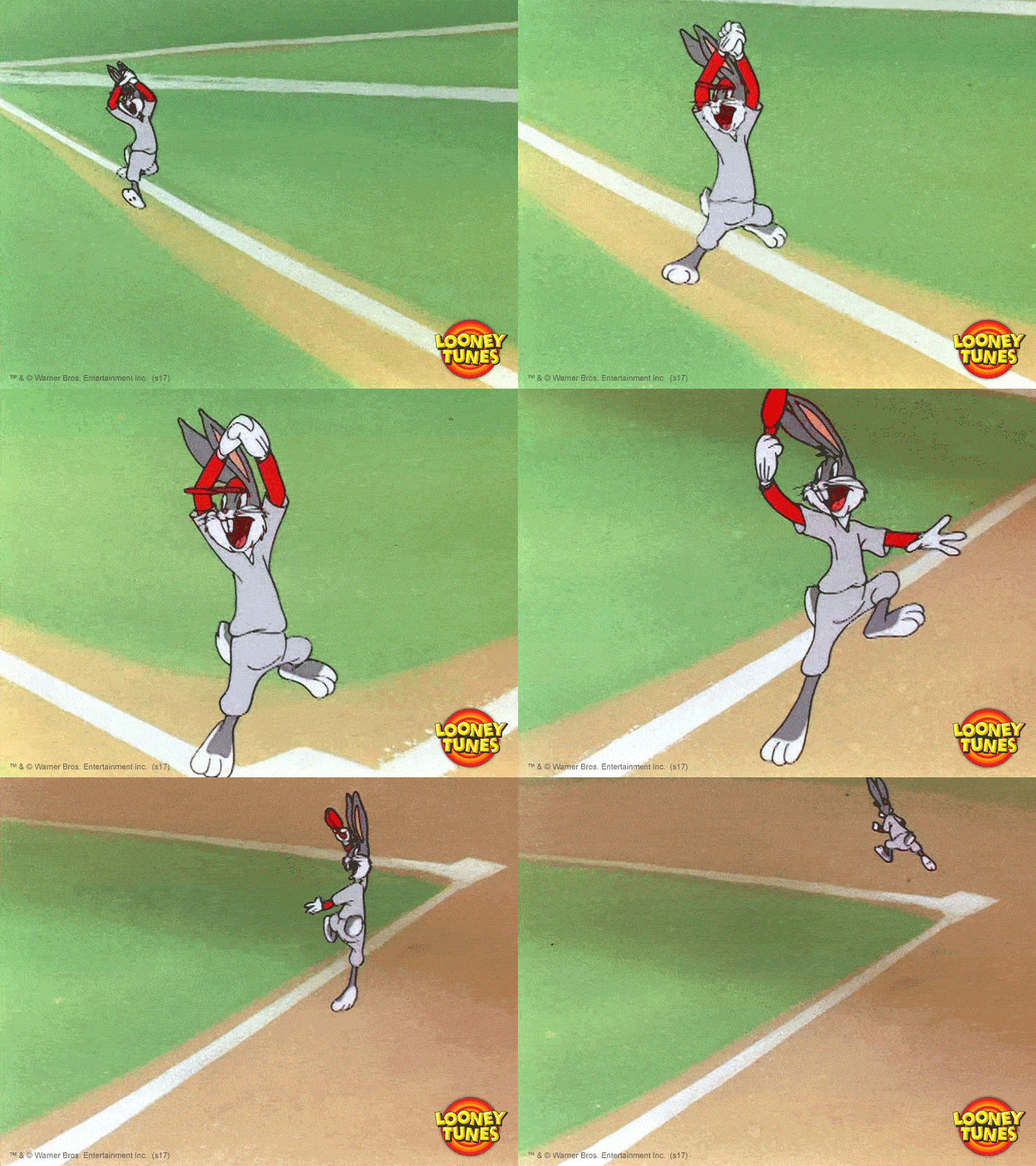
That’s why it’s important to develop a feel for pitch calling rather than simply relying on charts or conventional wisdom or other things from the past. You need to be able to look at a hitter and see what she’s bringing to the plate that day.
Another important skill is learning how to set the hitter up for the outcome you want. For example, if she awkwardly swings at a low outside pitch for strike one, she just showed you she’s probably not comfortable out there.
Try another one a little further off the plate. If that induces strike two, see if you can get her to swing at a curveball off the plate.
If she doesn’t bite, you can try coming inside, then going back outside again if necessary. The idea is to make sure she never gets totally comfortable with what she’s seeing.
Another good strategy is if the hitter fouls a ball straight back on a speed pitch (fastball or drop ball), come back at her with a changeup. If you make her look bad with that she’ll probably figure you’re coming in for the kill with a speed pitch again so maybe throw her another change that falls off as it reaches the plate.
The possibilities are endless. The key is to see where she looks least comfortable and use that information to keep her off-balance and uncertain.
One other key piece of information when you’re calling pitches is to never throw more strikes than you have to. What does that mean?
When you get two strikes on a hitter it’s tempting to try to just put her away right then and there by overpowering her, especially at the younger ages. But unless the other team’s hitters are completely over-matched by your pitcher, that’s a bad idea.
They’ve already had an up-close and personal look at two pitches. If the hitter is any good at all she is starting to figure out your pitcher a little more.
Instead, throw a ball that looks like a strike. It could be a drop or curve or rise that starts in the zone but gets out of it by the time it reaches the plate.
It could be a fastball that’s a ball’s width too high or too wide to be hit effectively. It could be a dying quail of a changeup that starts out thigh-high and then hits the plate or the dirt in front of it.
Just don’t give them anything too good to hit. Work the edges, throw off the hitter’s rhythm, or do something else to make sure she can’t take her best swing at the ball and you’re likely to achieve much better results.
While there is science to pitch calling, at the end of the day it’s still more of an art. And like any art, some people have a knack for it and others don’t.
If you find you’re a don’t-have, find someone else on the team who does have it – an assistant coach, a catcher, even another pitcher – and let them do it. If there are no other options talk to people you know who are good at it to learn their thought processes as to why they call the pitches they do.
That way when you call a spot you’ll not only expect your pitcher to hit it. You’ll be confident it’s a spot worth hitting.
The Best Make Time. The Rest Make Excuses.

As I’m sure you already know, we are at a very busy time of the year.
The school year is almost over, so teachers are diligently working to cram everything they were require to teach but haven’t so far into these last few weeks before the final bell rings for the summer. School, park district, and private organizations are preparing to put on their spring plays/musical recitals or concerts, dance recitals, science fairs, art fairs, and other events.
On top of which rec leagues are launching, travel teams are gearing up for the long summer, and many high schools and colleges are getting ready for their playoffs.
With so much going on it’s understandable that fastpitch softball players might say, “I just don’t have the time” when it comes to the extra work required to help them level up their play. And in many respects they’re right.

But here’s the reality: if leveling up is important to you, somehow you will make the time. If it’s really not, you’ll make excuses.
Take the photo of Madi shown here for example. She has one of the best built-in excuses for not practicing you could have: her left foot is in a boot due to a broken toe.

But instead of saying, “Oh well, if I can’t pitch full-out I can’t pitch” she kept every lesson and worked on what she WAS able to do to help herself get better.
Or how about this Maddy? She could barely walk in the door under her own power due to nerve damage in her leg from taking a couple of hard line drives to the same spot in her shin.

Did she let that stop her? No! We pulled up a stool and she worked on what she could so that when she was able to walk normally again she’d be better than she was before the injuries.
Those are a couple of extreme examples for sure. And their issue was injury, not time-based, so maybe you don’t think it’s quite the same.
The mindset is the same, however, i.e., I’m not going to let anything stop me from getting better.
If your issue is not enough time, then perhaps it’s time to put on your thinking cap and get creative.

One way to do that is to look for short opportunities instead of thinking practice has to be a half hour or an hour. For example, if you have a lot of homework, research shows that taking breaks of 5 to 60 minutes helps keep your mind fresh so you learn better.
Instead of hopping on social media (which doesn’t give your mind the proper break anyway) why not take some practice swings or throw a rolled up pair of socks into a mirror for 10 minutes? The physical activity will help rejuvenate your brain while also helping you improve your softball skills. Three breaks like that and you’ve put in 30 minutes without even thinking about it (pun intended).
Or let’s say your high school team’s practice doesn’t allot enough (or any) time for you to practice a specific skill. When practice is over, hang out a little longer while you’re still warmed up and in softball mode to do a few reps of whatever you need to work on.
What if you’re in the school play? I did those when I was young and I know how much standing around time there is during rehearsals, especially if you’re not the lead.
Go find a corner somewhere and go through whatever mechanics you need to work on, or your band work or other exercises. In most cases you don’t need much more than about a 10′ x 10′ area, or a convenient hallway.
You can even get a little practice time in when you’re standing in line for the school cafeteria or the grocery store with your parents. If you’re a pitcher, work on getting faster, looser pronation at the finish. If you’re a hitter, work on using your hips more effectively.
There are lots of fairly subtle things you can do to make use of the fact that you’re not doing anything else. Sure, people might stare at your funny. But those stares will turn into looks of admiration when you’re out-performing your opponents on the softball field.
The key is to think about practice not in the traditional large block of time way but in smaller bites that you can execute whenever you have a few minutes, or need a few minutes to yourself. Know specifically what you need to work on most, and then make the time to work on it.
All those little on-the-fly practice sessions will quickly add up to the types of big improvements that will help you achieve your goals.
Don’t talk yourself out of greatness. Remember that the best make time and the rest make excuses. Choose which group you want to be a part of.
Beware What You Believe on Social Media

Don’t worry, I haven’t suddenly gone political here on Life in the Fastpitch Lane. But there definitely is a need to be careful about what you find on social media when you’re looking for information on how your daughter or players can become better hitters, pitchers, fielders, catchers, etc.
Here’s the primary issue, which I think many parents and team coaches don’t seem to realize: anyone can call themselves a coach and post videos on Facebook, Instagram, YouTube, Twitter X, or whatever your favorite platform is.
That’s right, anyone. There are no qualifications or tests required to say you are a pitching expert, or a hitting expert, or a fielding expert, or anything else.
Sure, there are certification and training programs; I’ve completed several rigorous programs as a matter of fact. But it’s not like there’s a Board somewhere that checks up on what coaches post on social media and calls them out or pulls their certifications if it’s demonstrably incorrect.
Which means anyone can post anything, whether it’s good, bad, nonsense, or even downright harmful without any overall authority evaluating the validity of that information.
And this can be true of famous names in fastpitch softball as well as someone you’ve never heard of before. It’s amazing how many great players past and present have no idea how they actually do the things they do (or did).
Here’s the second issue that comes into play: social media is a hungry beast. You constantly have to feed it with new posts in order to maintain a healthy social media presence.

That can be harder than you think. So for those who are dependent on social media likes, clicks, and shares to drive their businesses, they must develop and post new content on a regular basis, often multiple times per week, to sustain their presence.
You can see where this is headed. Once they’ve exhausted all their good, proven drills and other material, the need to post is still there.
So they end up posting a lot of crazy stuff that looks cools and draws eyeballs but has little to do with hitting, pitching, throwing, or catching a softball. If it also helps promote their latest product gimmick so much the better.
It’s definitely a case where the buyer must beware, because if you follow some of this garbage down the rabbit hole and your daughter’s/players’ performance suddenly falls off, or she/they get hurt, it’s your daughter/players who will pay the price. In the meantime, the “coach” who posted the bad content moves on to the next crazy drill.
So what are you supposed to do? If you’re a well-meaning parent or coach, how do you separate the good from the bad?
One way to do that is to look for the “why” behind the “what.” Did the poster explain why the drill or other instruction exists, what problem it is trying to solve, how it will solve it, etc.? Or did he/she merely post the demo and say “have at it?”
A coach who is looking out for his/her players/students will want you to understand the purpose behind the drill or technique or product if there is one, as well as exactly how it solves the issue.
It’s then up to you to apply some common sense to determine whether what’s being presented seems like it will actually solve the intended issue or make it worse. Or even create a new, bigger issue in the process (see: the law of unintended consequences).
You might also want to do a little more research on the issue itself to see if what’s being presented in the social media content is aligned with what others are saying, and what you see the best players in the world doing, or if it’s more of an outlier.
Now, if it’s different it doesn’t necessarily mean the new content is wrong. Breakthroughs and new discoveries happen all the time.
But if it goes against the science in particular, you might want to let others try it first to see how it works out for them before jumping into that new technique yourself.
Remember that the great thing about the Internet is that there’s a lot of information out there. And the bad thing about the Internet is that there’s a lot of information out there.

It can be hard to tell the good from the bad.
But if you take a little time to think things through and dig below the surface or the excitement of finding a shiny new object, you can save yourself a lot of wasted time and money in the long run.
Lead photo by Pixabay on Pexels.com

Changeups Work Better When You Call Them

Ask anyone who knows a thing or two about fastpitch softball pitching about the changeup and they’ll tell you it’s one of the greatest weapons a pitcher can have in her arsenal. The ability to take 10-15 mph off the speed of a pitch while making it look like it will be delivered at the pitcher’s top speed works at every level, from rec ball to college to international play.
Here’s the thing, though. Just like a $500 bat works better when you swing it than when you stand there watching pitches go by, the changeup is far more effective when you throw it.
Now, that may seem obvious but from what I hear from frustrated pitchers, parents, and pitching coaches across the country apparently it’s not. For whatever reason, it seems like when many or most coaches are calling games they prefer to try to blow the ball by the hitter with every pitch rather than mixing in changeups and offspeeds.
Even when the pitcher is clearly not capable of blowing the ball by every hitter on the opposing team.
Personally, I don’t get it. One of the fundamental tenets of pitching is that hitting is about timing and pitching is about upsetting timing.
What better way to upset timing than to throw a pitch that looks like it will be fast but actually comes out slow? Not only do you get to make the hitter look silly on that pitch, you’ve now planted the idea that she can’t just sit on the speed and hit it (because she doesn’t want to look silly again), which means you’re now living rent-free in her head.
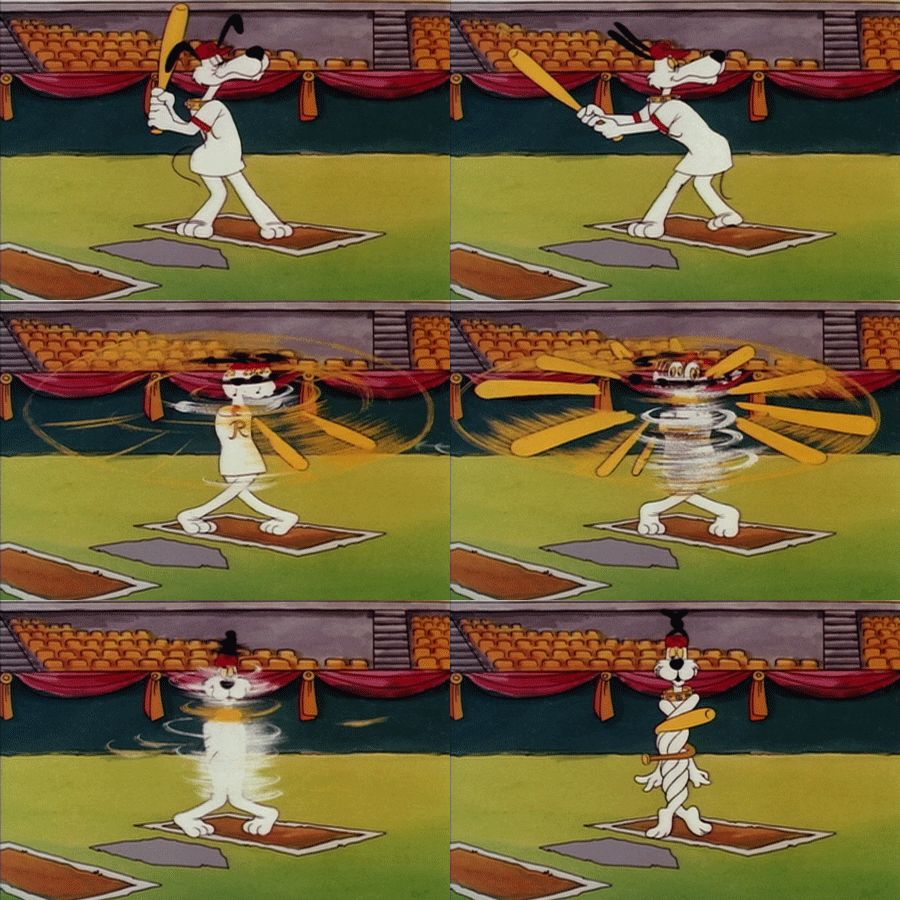
I think in some cases one reason coaches will shy away from the changeup is they try one and the pitcher either throws it toward the sky or rolls it in. They’ll then make the decision it isn’t working so won’t call it again.
That’s crazy though. Does that mean if a pitcher throws a fastball in the dirt or into the backstop they won’t call the fastball anymore?
Of course not.
So why shy away from a great pitch when the first one doesn’t work? Try a few, and if it’s still not working then table it for that game and come back to it another time.
Now, I will admit that some fortunate coaches may have a pitcher who actually can blow the ball by all the hitters on opposing teams so they may feel that pitcher doesn’t need to throw a changeup in games. After all, she’s already successful without it.
But that’s short-term thinking. Because if the pitcher really is that good, and wants to continue playing at higher levels, she’s going to eventually find that speed alone no longer gets the job done.
And if she finds that out in college (as some do every year) she’s then going to be scrambling to try to learn to throw a pitch that she should have been throwing regularly since she first learned how to spot that fastball. It could make for a very rough season.

A good changeup has the opposite effect of a pitching machine. The reason most hitters find it tough to hit off a machine (at least at first) is that the speed of the arm feeding the ball doesn’t match the speed of the pitch coming out.
In other words, the arm moves slowly to put the ball in the feeder, but then the ball comes out at whatever high speed it’s set at. The visual cue of the arm doesn’t match the speed of the pitch and thus the hitter has trouble figuring out when to swing.
A great changeup gets the same effect in the opposite way. The visual cue of a well-thrown changeup makes it look like it will come at the pitcher’s top speed, but then the ball comes out 10-15 mph slower.
By the time the hitter’s brain has processed what’s happening she has either already swung or was frozen in place by the incongruity of what she saw, and doesn’t recover until after the umpire has called the pitch a strike.
None of that goodness can happen, however, unless someone actually calls for the changeup.
My recommendation on how to use the changeup is the same as the instructions for how to vote in Chicago: early and often.
Show it early so the hitters know it’s a possibility, meaning they shouldn’t get too comfortable. Even if it doesn’t work the first time it may just set the hitter up for the next speed pitch, i.e., it will make the fast pitch look faster.
Use it often to keep the hitters off-balance. Again, even if it’s not actually working the best.
Force the hitters to learn to have to lay off of it and maybe you’ll get a few more called strikes on other pitches as hitters and coaches try to guess when it’s coming. A little confusion at the plate goes a long way.
Finally, use it regularly to help your pitchers learn to throw it more reliably in games. Many coaches and programs talk about “developing players.”
Here’s a chance to put your money where your mouth is, metaphorically speaking. Help your pitchers become more effective in the long term by developing their changeups, even if it costs you a win now and then, and you’ll have fulfilled that part of your mission.
It’s easy to think of the changeup as being a “beginner pitch” because it’s usually the second pitch a pitcher learns. And because movement pitches such as drops, rises, curves, etc. seem more impressive.
But the reality is a pitcher who is changing speeds effectively, and at will, without tipping the pitch, is going to be awfully tough to hit at any level. Start calling the change more often and you just might be pleasantly surprised at the results it delivers for your pitcher – and your team.

Character Matters for Coaches Too

We often hear about how fastpitch softball players need to be good teammates and people of good character. Coaches will talk about what they look for during tryouts and recruiting beyond skills, and how they need to be able to hold their players to high standards.
But what about the coaches themselves? Shouldn’t being a person of good character matter for them as well?
What brings up this topic is an article my friend Jay Bolden of BeBold Fastpitch, who is a tremendous pitching coach by the way, passed along the other day. It’s one of several great things Jay has shared lately, so if you’re not following him on Facebook you really should.
The article was about a head coach at a D1 college who was recently arrested for shoplifting and possession of a controlled substance without a prescription. What’s really sad is the shoplifting amounted to less than $70, and she only had a couple of the pills in her possession.
Not the amount matters that much for our purposes – right is right and wrong is wrong no matter the scope – but if you’re going to get caught committing an alleged crime that could cost you your job you would think it would be for an amount that would have people say, “I get it.”
Regardless, though, the real issue here is one of character and leadership.
There is more to coaching than than teaching skills, making up lineups, and running plays. Especially when we are talking about youth and amateur sports, which includes college.
The measure of a great coach isn’t just wins and losses, although that aspect is definitely important, particularly in the college ranks. It’s also whether the coach is making a positive impact on those players, helping them become better people who are prepared to live their best lives.
That’s hard to do when you yourself are not exhibiting good character. There’s an old proverb that says a fish rots from the head down.

I have definitely seen that to be true, not just in softball or sports but in the business world as well. Poor leadership and questionable ethics will lead others in the organization to follow their own worst instincts, or at least make decisions that may not be in anyone’s best interests.
Another example of poor leadership is shifting blame to players for poor performance to cover the fact that the coach really doesn’t know what he or she is doing.
I recently heard about a coach complaining that her team wasn’t hitting the ball well enough and wasn’t scoring enough runs. Rather than try to help them solve the root issue(s), however, the coach merely said, “You guys need to hit better. Figure it out.”
How is that helpful? It’s not. It’s just a coach worried that her players’ lack of performance will make HER look bad.

That’s a sign of poor character. Even if the coach doesn’t know what to do technically, she should either bring in someone who does or at least try to bolster her players’ confidence at the plate so they’re not making things worse by tightening up and making poor swing decisions in the hopes that something good will happen (it usually doesn’t).
I think most teams have a code of conduct of some sort that they expect their players to abide by. Coaches should be held to at least that standard, if not a higher one.
Some simple things coaches can do to demonstrate strong character:
- Not smoking, drinking alcohol, or using other substances in the dugout or parking lot, or really anywhere their players are in uniform
- Not playing favorites with certain players; everyone earns their playing time based on merit, even if the coach doesn’t especially like certain players
- Not talking about some players to other players on the team, or to their parents, whether in-person, through direct communication, or on social media
- Not establishing “overly personal” relationships with anyone on the team;
- Enforcing team rules fairly and equally, don’t treat the rules as rules for non-starters and merely suggestions for starters
I remember hearing a great example of this last point being demonstrated several years ago by Mike Candrea, the former head coach at Arizona.
One of his star players broke a team rule a few days before the team was scheduled to play I believe in Regionals. She was seen as critical to the team’s success, and obviously the game they were about to play wasn’t a throw-away game.
Coach Candrea told the player she would not be joining the team on the trip, which may have come as a shock to the player and probably a whole lot of other people. When asked about it he said the rules are the rules, and they apply to everyone.
That had to be hard, especially because if I recall correctly Arizona did end up losing. But Coach Candrea demonstrated to every player on that team that fairness and integrity are (or at least should be) higher priorities than winning, even if the game is “important.”
It takes a lot of character to make that decision. When asked later if he had any regrets about it Coach Candrea emphatically answered, “No.”
That decision set a standard to which we should all aspire. What a tremendous life lesson for his players, and really everyone who has heard that story.
We are all products of our decisions, good and bad. But when you’re a coach you’re not the only one affected by them.
Hopefully whatever drove the coach in the opening story to do what she allegedly did can be overcome with some help and she can make better decisions in the future. But it does create a learning opportunity.
Just as we demand excellence from our players, so must we coaches also set higher expectations for ourselves as well. While it might be tempting to take a shortcut, or cheat a little here or there, or fudge the facts, or pass the blame onto others it’s important to take responsibility and demonstrate the qualities we want our players to exhibit on and off the playing field.
Character matters.
Photo by Anastasiya Gepp on Pexels.com






 Life in the Fastpitch Lane