Category Archives: Pitching
The biggest thrill an instructor can have
Well, at least this instructor. Every time I teach someone a new pitch and they get it to work consistently I have to admit I get a little charge out of it.
The latest example was last night. I’ve been working with a girl named Shannon for a couple of (or maybe a few) weeks now on developing a curve ball. She’s throwing a good drop and an excellent change, both with very good mechanics, so it seemed like a pitch that would break off the plate when she’s ahead would be just the ticket.
We went through the usual learning steps — starting with the spin (using the frisbee, then a ball), drilling it from close range, then getting back into a full pitch. She’s been working a lot on getting it to spin correctly, which is a combination of wrist movement and overall body control.
Last night we started up on it again, and at first we were getting either bullet spins or more of a 12 to 6 spin like a fastball or drop. Then all of a sudden it clicked for her. She started getting side spin, then faster side spin, and before you knew it she had a pitch that looked like it was going to be an outside fastball until right before the plate then bam! Off it goes, about a ball and a half off the corner. It was a thing of beauty.
I’m not sure who was the most excited — Shannon, her dad Randy, or me! But it was pretty cool. I love it when a plan comes together — and the student actually works on what we do in between lessons!
Why I love this (coaching) job
Last night I had one of those moments that makes it all worthwhile. A couple of weeks ago I had a new student start. Her dad brought her to me for a sample lesson after she’d been with another pitching coach for three years. He said in that time he hadn’t seen her progress.
I had her throw a few pitches and said I could see why. The mechanics she’d been taught were not really in line with what we know now. It looked like it was the theories of 10+ years ago — particularly how she was working so hard to “close the door.” Most of her pitches were in the dirt and inside off the plate, and so-called movement pitches all had a basic 12-6 spin. I told them what I would do if she came to me and explained why. The next day they set up some regular lessons.
But it wasn’t an automatic. At first, as I worked with her to stay open and drive straight in instead of closing the door I could see she was skeptical. That’s ok — what I said totally contradicted what she’d been told for three years, and while she may not have been particularly effective with it she was comfortable with it. But she dutifully complied. After the second lesson I pointed out to her that while she was working on doing what I said in order to comply (rather than totally buying in) her control troubles had gone away.
Still, she wasn’t quite convinced yet. Her dad e-mailed me asking if I could point to some clips she could watch so she could understand what I wanted better. That may have been the reason, or it could’ve been that they wanted to see if my statement that what I teach is what the top-level do was really true or whether I was just feeding them a line. I sent a link to some online clips and told them who to watch and what to look for.
Last night this girl came in for her lesson and she was spot-on with what I wanted her to do. Well, every now and then she went back to the old ways but I’d say 97% were the right mechanics. That effort was rewarded with excellent control and speed. We worked on her changeup, improving that, and got her going on a true screwball — one that spins in toward a hitter rather than 12-6 as she’d been throwing before. She was quite thrilled with the progress and now totally enthused with what we’re doing.
I have to say it made my night. This girl has some talent, and with a lot of work and some proper instruction she should do well. It’s fun when it all comes together.
Some validation
Had a kind of fun experience over the weekend. My daughter attended a half-day pitching camp with Michele Smith and Cat Osterman at the local high school. During the camp, Michele explained the fundamentals of pitching, then she and Cat worked with the various pitchers to try to help them get to where they need to be.
Validation #1 was that what Michele said is what I teach. Not just mostly, but pretty much exactly. While I am confident in what I’m doing, especially with the results I’ve been able to help my students achieve, it’s still good to get that sort of reinforcement.
Validation #2 was what happened when Michele and Cat were walking around working with the girls. When they got to my daughter, neither of them wanted to change anything. Not one thing! Both said she looked very good and should keep doing what she was doing. In fact, the only change was a different grip on her curve ball, which got her pretty excited. She said it was breaking better than ever.
Of course, #2 is more a tribute to her than me. She did the work — I just pointed the way to it. But I was glad to see her get that kind of reinforcement from two pitchers who have achieved so much success.
By the way, Michele is an excellent instructor. Very friendly and approachable while being very knowledgeable. I’m not big on these one-day clinics, but if you’re looking for tweaks rather than learning from scratch, Michele’s is a good one.
It’s like being psychic
Earlier today I put up a post about coaching, and mentioned that being a good (or great) player doesn’t necessarily qualify you to be a coach. I was speaking in general terms at the time.
But tonight I heard what one of my students was told at a clinic that featured some NPF players, including one very big pitching superstar. You would think this woman would know what she was talking about since she’s had a lot of success.
When I asked her what this person said, the first thing my student mentioned was that the woman told her she should touch her hand to shoulder for her follow-through. Ugh! That is horrible advice that will likely lead to elbow trouble. You never want to force a follow-through. You want it to be loose and relaxed. Bill Hillhouse advocates finishing across the body. I’m not too picky as long as it’s loose and natural. Incidentally, this woman, who is still playing, has pretty much no follow-through herself. She definitely doesn’t touch her shoulder when she throws a pitch. But here she’s telling an impressionable young girl to do it.
She also told her to snap her wrist. Now that I know she does herself, but mostly because she has no follow-through. If she finished her pitches, as I’ve mentioned before, the wrist would snap on its own. Again, you’ll hear Bill Hillhouse saying the same thing, and he should know — he’s been there and done that for a long time.
The point is, don’t just take someone’s word for it. Even if they have a gold medal. Make sure whatever you’re told makes sense and you’ll have a longer, more successful career.
Another cue for the backhand change
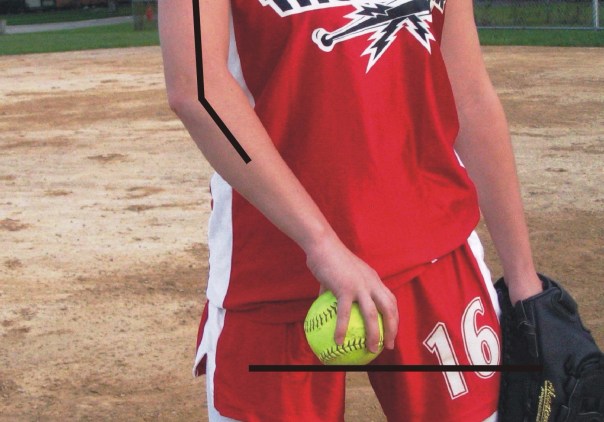
One of the keys to keeping the backhand change low and hump-free is maintaining a slight bend in the elbow as the hand comes through. In this position the ball comes through before the rest of the arm.
Ok, that sounds good in theory. But it can be tough to get the feel of how to get the arm properly bent. Here’s a new cue I’ve found that helps pitchers get in the right position. Have the pitcher bring her thumb across the spot where the hip bone and the thigh bone meet. In practice she can actually touch her hip area at that point. The arm will bend and she’ll be able to keep a flat release.
The myth of the wrist
Emphasis on the wrist snap has been part of the process of coaching fastpitch pitchers since Eddie Feigner soiled his first diaper. Generally it is interpreted to mean that you have to have a strong, powerful wrist snap driven by the muscles in the wrist in order to throw hard.
But how true is that, really? Let’s try an experiment. Have someone grab your forearm with both hands so you can use the wrist muscles — and only the wrist muscles — to throw the ball. Now snap the wrist as hard as you can. No matter how strong your wrist is, and how many fireman rolls you do, the ball is not going to come out that hard, or go that far. It’s because the wrist muscles are relatively weak compared to the rest of the body. Because of this, on their own they don’t really add anything to the pitch, no matter what all those expensive pitching videos might tell you.
It’s not the strength of the wrist, but its flexibility, that is the key to its contribution. Have you ever snapped somebody with a towel? First of all, shame on you. But if you have, you know that if you get the end of the towel to flick fast enough, you can make your teammate, spouse, dog, etc. jump. There is no muscle in the end of the towel. It’s the speed at which it accelerates, and the fact that the previous section stopped moving in the same direction, that creates the snap.
Your wrist is like the end of the towel. As long as it moves quickly it will impart the speed. And the faster it moves over a short distance, the faster the ball will come out. It’s also the most flexible joint in your body, capable of moving 180 degrees back to front, and in a variety of directions. Try that with your knee! Wait, maybe you shouldn’t.
Still not convinced? Try another experiment. Stand with your elbow at your side and your forearm pointing straight up. Now snap your wrist down as fast as you can using the wrist muscles. Doesn’t work too well, does it? Now relax the wrist so the hand is just sort of hanging there, and then abruptly move your arm back and forth slightly. If I’ve described how to do it correctly you’ll see the wrist move much faster. (If I haven’t no telling what you’ll see!) A loose, flexible wrist can move much faster than a tight wrist can be muscled.
So does that mean the wrist can be weak and you’ll throw hard? No. It still has to have enough strength to accept all the power and stress being driven into it by the other, larger muscles in the body. A weak wrist won’t be able to transfer the power. But just as a car needs both a powerful engine and a strong transmission to go fast, so do your pitches. You should strengthen the wrist so it can do its job effectively.
The point, though, is that you don’t need to practice endless strong wrist snaps or concern yourself with muscling the wrist at the end of the pitch. Instead, make sure you’re getting good whip of the forearm (the forearm going quickly from behind the elbow to in front of it at the bottom of the circle) and keep that wrist loose. Done correctly your wrist will snap all on its own, and at the right time, to help you achieve your goals.
Update on the light bulb
Just wanted to give everyone an update on the “light bulb” post. Sometimes as a coach you can effect a change one day, but then the next time you see the player they’ve fallen back on old habits.
I am happy to report that last night that was not the case. The girl I mentioned had a nice, relaxed throwing shoulder and looked very comfortable and smooth. Her dad said she worked on it hard during the week, and it showed.
Definitely good to see.
Seeing the light bulb go on
Last night I got another reminder of the real reason I enjoy coaching so much. It’s the challenge of finding the right way to teach a skill and thrill of seeing it take hold.
I’ve been struggling with finding a way to get one of my pitching students to relax her throwing shoulder so she can use her whole body instead of just her arm to throw. She is a bigger kid for her age, so she’s always been able to throw hard just muscling up on the ball. She would get into an open position ok, but then she’d tilt her head forward, tighten her shoulder, and just fling the ball forward. Not the smooth, relaxed, powerful movement we’re looking for. I’ve tried a half dozen cues or more over the last few months but nothing seemed to really stick.
Then last night I had her hang her arms down like an ape, and said the magic words: get your shoulders out over your toes. This is a cue I’ve used before with various pitchers (and hitters) to explain how to get into the athletic position, and may have even said it to this girl. But last night the light bulb came on. It suddenly seemed to make sense to her.
She started out throwing rather slowly, just to get the feel. She was worried about the loss of speed but I told her not to be concerned — we’ll recapture the speed (and more) later. As the lesson went on she started getting more comfortable with it, and adding speed to it. There were some wild pitches due to a lack of comfort/confidence in the movement, but overall she started to show some consistency. I was elated.
We’ll see for sure how well it took next week. But I have a good feeling about this one. If I’m right, a whole new world of fastpitch pitching just opened up for this very nice young lady. Oh what a feeling!
Warming up to pitch
Yesterday I was reading an online article at Girls Softball about alternatives to private instruction, when pitching warm-ups were mentioned. (This post has been modified to include the link to the article).
In any case, the poster was answering a question about what it takes to be successful in softball. For the most part I agreed with what he said, until he got to one example. In it he mentioned a pitcher whose warm-up routine before a game consisted of 100 fastballs followed by 50 each of her other pitches. He praised the dedication and work ethic of that routine.
I can’t say I agree with that. I’m big on dedication and practice and all, but I also believe that a pitching warm-up should not be a long, involved affair. The reality of softball is a pitcher often must be ready to pitch on short notice. If it takes her 500 pitches to get warmed up, the game may be all but over by the time she’s ready to go. Tournaments often don’t leave a lot of time between games either. Having the ability to get ready quickly is important so you’re ready when the umpire says “let’s go.”
The situation is even more critical in high school ball. Consider the team that has to travel. The game is scheduled to start roughly an hour and a half after school ends. That means everyone has to get dressed, pile on the bus, and ride to the game. If there’s an accident, the driver gets lost, the game is far away, or traffic is heavy, the team may only have 20 minutes to warm up total, including a quick jog and stretch, before the Blue says “play ball.” It’s just the reality of the situation.
You definitely want to take enough time to be sure you’re safe. But if you don’t have your basic mechanics there in, say, 50 pitches, 50 more probably won’t help.
The key is to know yourself, know your body, and know what it really takes to get ready. There’s a difference between quantity and quality. That aside, the post is definitely a good read, and worth checking out.
Keeping the screwball on line
One of the most common problems with the screwball (once it begins to move) is that it starts too far inside and the breaks off the plate. This is usually caused by an arm circle that stays outside of the throwing hand hip instead of getting across the body more.
Still, you can talk about it all you want, but it’s often difficult for the pitcher to understand exactly what this means. Here’s a way to help make the point.
Have the pitcher stand over the plate, with her pivot foot aligned with the center of the plate and the stride foot slightly offset as Meaghan is showing here. Then have her hang her arm straight down, outside of her hip. From here she can see why the ball is starting so far inside.
<IMG style="WIDTH: 308px; HEIGHT: 208px" height=1394 src="/images/55650-48775/Screwball_edge.jpg” width=1675>
The ball is starting on the inside of the plate,
and has nowhere to go but further inside.
Now look at the second picture. Meaghan has her elbow inside of her hip, and the ball is over the center of the plate. This position will allow her to start the ball down the middle, where it can break over the inside corner.
<IMG style="WIDTH: 307px; HEIGHT: 208px" height=1199 src="/images/55650-48775/Screwball_Center.jpg” width=1447>
The ball is now over the center (more or less).
One last point. In order to get it to this position, it helps to offset the arm circle so it moves from pitching hand side toward the glove side, much as you would do for an outside fastball. If you align the circle straight down center it is difficult to reach this position, and thus difficult to throw this pitch for a strike.






 Life in the Fastpitch Lane