Category Archives: Coaching
Repetition in softball doesn’t always equal improvement
One of the most common ways of practicing fastpitch softball is to perform lots and lots of repetitions of the same skill. The idea is that if a little bit is good, more is better.
Yet the truth is that’s not always so. Yes, building skills does require repetition. But that doesn’t mean you have to do one hundred reps of the same skill in a row. In fact, that approach can work against you depending on how engaged the player is.
You see, as the saying goes, practice doesn’t make perfect; it just makes permanent. Say you decide you’re going to hit 100 balls to a player to field. On the first 25-50 her brain is engaged, her motor is running, and she’s all enthused. Then for the next 50, her brain shuts down and her technique starts getting a little sloppy.
Which half of the drill do you think is going to stick with her? There’s a good chance it’s the second half because it’s the last thing she did.
Honestly, it’s better to do 50, or even 25, great repetitions than some good and some bad. What you want to be doing is building an automatic approach – building up the myelin that tells the muscles what to do faster than you can consciously think it. When that occurs, the player has a much better chance of executing the skill during a game. When you do some good and some bad, the myelin never has the chance to build properly and the brain can get mixed messages.
One other good reason to do fewer reps of one skill is it allows you to work in additional skills. And as we all know, there never seems to be enough time for everything you want to do.
How many is the right number? It varies by player. Some can only handle a small number before losing focus. Others can seemingly go all day. You need to judge that by the individual players.
If you’re working with one player (perhaps your own daughter), it’s pretty easy to adjust to her focus level. If you’re working with a team, it gets a little tougher. In those cases, try grouping players by focus level rather than raw skill level. It may mean a bit of an unbalanced practice – some players working on more things than others – but it will also mean a more productive practice.
The key is to remember that your team really will play like you practice. Keep it sharp and you’ll like the results on the field much better.
Overuse injuries in youth softball growing
Saw an article today that my local paper picked up from the San Francisco Chronicle , talking about how injuries have exploded in youth sports in the past few years. The big culprit? Overuse, driving largely by kids specializing in one sport year-round rather than playing different sports.
That’s certainly an issue in the fastpitch softball world. I hear these stories all the time about the schedules even 10U players are playing. The goal seems to be to get in at least 100 games in a season. In the Northern climes, they’ll play 5-6 tournaments in the fall – basically from the start of September through the end of October. Then there are some indoor games, followed by a tournament every weekend from the first weekend in April through the end of Jly.
Down South, where the weather stays warm year-round, they basically take off December for the holidays and that’s about it.
I don’t know about where you live, but where I am the high school season can be even tougher. Games every day, Monday – Friday, and often a double-header on Saturday. If you only have one pitcher, she’s going to see a lot of action. For those whose high school seasons are in the spring, that heavy schedule is then followed by playing pretty much every weekend in June and July.
That’s a lot of repetitive motion, which is generally how overuse injuries occur. According to the article, what makes it tougher for softball, baseball and golf is that these are very arm and shoulder-oriented sports, so they put a lot of stress on the joints.
According to the article, this didn’t happen so much when kids were playing different sports throughout the year. The motions for, say, basketball are different than those of softball, so the body had a chance to rest and recuperate from the softball-specific stress.
And no, this isn’t a “girl thing.” It’s actually more pronounced in baseball because of the overhand throwing motion pitchers use. But since this is a softball blog (at least most of the time) we’re sticking with that.
In today’s culture, it’s getting tougher and tougher for kids NOT to specialize. There’s the pressure to be on the “right” (read: most competitive) team so they can get some of that college money. If you’re not willing to devote 24×7 to that high-level softball team, they don’t want you, and by implication you’ll never get that D1 scholarship.
But what toll is it taking? An organization called Stop Sports Injuries is trying to provide some answers. They’re going to medical professionals, especially those who specialize in youth sports injuries, to find out about the trends and get their recommendations. You can see their softball-specific data sheet here.
One thing they recommend, which is going to cause all sorts of anguish among coaches who believe winning is everything, is some pretty strict pitch count limitations for pitchers. That old myth about the softball pitching motion being “safe,” which means you can ride one pitcher game after game for an entire tournament, is just that – a myth. At 10U-12U they recommend a limit of 65 pitches per game, and no more than 95 pitches a day over two days. No pitching at all on the third day. At 15U and above, the numbers “only” go up to 100 pitches per game, 140 total per day in the first two days, and 100 for the third day. That’s way less than a lot of pitchers actually pitch during the season.
Again, this isn’t only for pitchers. Catchers and other position players are running the same risks, just with different body parts. Our bodies weren’t designed for the type of repetitive motions being demanded of youth players these days. The kind of cross-training created by participating in multiple sports rather than spending all your time on one encourages better overall development, and protects players from wearing down – mentally as well as physically.
Whether you agree with the exact numbers, this is important information for both parents and coaches to understand. There needs to be a mindset/cultural change if we’re really going to help our kids become all they can be – and keep them healthy. I recommend that all parents and coaches follow the links in this post and become better-informed about the risks. It might just be the best thing you do for your daughter/players this year.
The problem with playing down
Now that fall ball is cranking up in earnest, teams are beginning to test themselves in games and find out who they really are. Some are finding they are better than they thought; others are finding they have a lot of work to do.
One of the things you’re likely to see are some serious mismatches in playing ability. If it happens because better teams didn’t know there would be a wide range of ability that’s one thing. But if they’re playing down just to trophy hunt, they’re doing themselves a disservice.
One of the biggest problems with playing below your actual level is it gives you a false sense of how good you are. Sure, you may be defeating or even blowing out teams that don’t hit, field or pitch too well. The trouble is that can lead you to think you don’t have to work on those aspects of the game yourself so much. After all, you’re winning, right? So you must be good.
Think again. Because one day you’ll run into a team that has been playing at the proper level. Maybe they haven’t won as many games as you have. But when you meet them head to head you find out that they’ve developed their skills because they’ve had to in order to compete.
Winning alone is not the measure of a good team. You also have to look at who you’re playing. Play at the right level — one where you have to be at your best to win — and you’ll develop your team better and faster. And you’ll help your players become all they can be.
Understanding the value of outs
I’ve talked before about the value of outs in fastpitch softball. It’s a concept that’s really laid out well in the book and movie Moneyball.
Yet it still can be a bit difficult to grasp in practical terms, especially for players. So I thought of a more concrete way to explain how precious outs are, and why you want to conserve them carefully.
Think about it this way. You want to buy a new iPod. You’ve been working hard to earn the money, doing chores and such, knowing exactly how much you need to make your purchase (including tax).
Finally the big day arrives. You head to the mall to make your purchase, but before you get to the electronics store you stop in to a shoe store and buy a pair of shoes first. Of course when you get to the electronics store you no longer have enough money for the iPod. You lose.
It’s the same with outs on offense. If you waste them on bad strategies or stupid decisions, you may not have enough at the end of the game to go for the win.
Outs are precious. In a seven-inning game, each team only gets a maximum of 21. (In a time limit game, it may only be 18, or even 15). As a player, wasting them by getting doubled off a base on a line drive or pop-up, trying to stretch a single into a double when the ball is clearly going to beat you there, leaving a base without tagging up on a fly ball, popping up a bunt attempt, swinging at strike three that is over your head or in the dirt, etc. can really come back to haunt you.
As a coach, wasting them by automatically sacrifice bunting when you get a runner on first, attempting steals against a catcher with a gun for an arm and a quick release, attempting a steal in the last inning of a tight game with the top of your order coming up, sending a runner for an extra base against a team with a strong defense, etc. can do the same.
Make sure you use yours wisely.
In softball as in life, innovation doesn’t come from imitation
One of the most common pieces of advice given to fastpitch softball players (and their parents) is to look at what the best players in the world do, and then do that. While there is definitely a lot of value to that advice, especially when you’re early in the learning curve, it also has its limitations.
Basically, if all anyone does is imitate what’s already known, or analyze what people already do, progress stops. Innovation and improvement doesn’t come from seeing what’s already there. It comes from thinking “Is there a better way?” and moving away from the conventional wisdom.
A great (and often-used) example is Dick Fosbury, the high jumper who introduced the “Fosbury Flop.” Back in the 1960s, the best high jumpers in the world used a technique where they would run up to the bar from the side, push off of one leg, and then scissor kick their way over it. All the efforts in the sport were expended trying to figure out ways to improve on that technique a little more in order to get higher.
Well, almost all. Fosbury had the courage to not imitate all the others, but instead try something revolutionary – turning completely around at launch and going over the bar head and neck first. The rest is history. These days, any high jumper at a high competitive level does the Fosbury flop.
The same potential exists in our sport – if you’re willing to ask “why” things are done a certain way instead of just following the crowd. Rather than simply looking at video of what great hitters, pitchers, fielders, etc. do, innovators take that starting point and ask “is that the most optimal way to use your body?”
Innovators ask “what if?” and try something different. It may not always work out, but they’re in good company. Thomas Edison said he made 10,000 light bulbs before he found the one that worked. And that basic design lasted more than 100 years – at least until someone else said “why can’t we make a compact fluorescent bulb instead?
The idea of “what is” versus “what could be” reminds me of the often-quoted study of softball pitchers in the 1996 Olympics by Dr. Shery L. Werner. Many people look at her findings and conclude that what she describes is the correct method of pitching. Yet that wasn’t the purpose of the study.
The purpose of the study was to see what these elite-level pitchers did, and to see what they had in common. That, however, doesn’t say whether what they’re doing is optimal. In order to determine what’s optimal you have to take the same group of pitchers and try any number of alternative techniques to see which ones produce the best results.
For all we know, finishing with the hips at 45 to 52 degrees may not be the best way to finish. Or it might. The only thing we know is that’s what those pitchers did. It would take a lot more experimentation to conclude whether it’s optimal; you’d have to try different methods and measure the results – of course giving each pitcher a sufficient amount of time to master each of the alternative techniques. Truth is, we’ll probably have to wait for androids to be invented before you can run that experiment conclusively.
In the meantime, we need to be more than “monkey see, monkey do.” Don’t be afraid to thoughtfully break the mold now and then to see if going against the crowd rather than blindly following it produces better results.
You may wind up right back where you started. Or you could end up being the next Dick Fosbury. And wouldn’t that look great on a softball coaching resume?
Now it’s your turn. Have you ever gone against the conventional wisdom? If so why, and what were the results?
Results of the IOMT Castaways experiment
Back in March I wrote about a different team concept I was doing this summer. In case you don’t feel like following the link, it was called the IOMT Castaways – IOMT standing for Island of Misfit Toys. The team was put together by invitation, and was made up of girls I’d either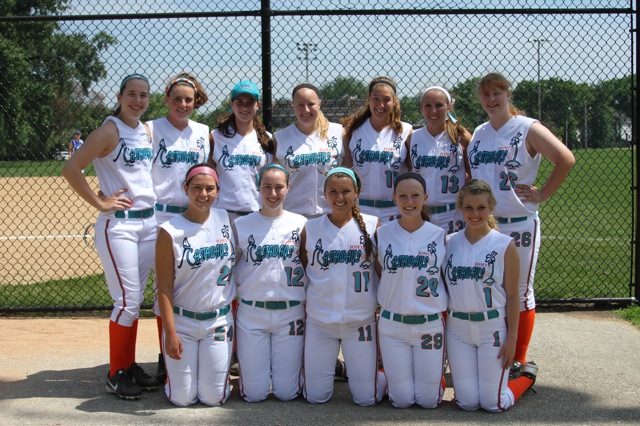 coached before on a team or who were pitching or hitting students of mine. (Some were both, too.)
The primary credential to be on the team (which led to the name) was having been underrated or under-appreciated on another team. Perhaps it was a school team where they were overlooked for varsity, or not given a chance to compete for their primary position. Perhaps it was a travel team that passed on them, or one that took them and then didn’t play them or constantly criticized them.
Whatever it was, these were essentially players that other coaches didn’t think much of but that I thought could play ball. We also looked hard at the kind of people they were. We wanted not just quality ballplayers but good teammates with good parents. We also made it clear that the goal of this team wasn’t college exposure. It was to give girls who just love playing softball an opportunity to play purely for the love of the game. )Truth is there were a couple of girls I knew who had all those other qualities but were still interested in pursuing college scholarships, so I suggested they play on a team that had that goal.)
In any case, we just finished up the season last Sunday. So how did the experiment go? Were we able to take these “castaways” from other teams and train them up to be competitive, or was it a nice idea that fell apart in the execution?
I’m glad to say it was actually a very successful season. We played a mix of sanctioned tournaments (A, B and open), and finished with a record of 21-14 across seven weekends. In our tournaments we earned one second place finish, two thirds and a consolation championship. Considering I would’ve been happy with any one of those results, to have achieved so much in a single year was outstanding.
Perhaps my favorite story came from one of our players, who knows some of the families in the host organization for one of the tournaments we played in. It was a USSSA A tournament where we took third, and came within a run of going to the championship game. Apparently we were quite the talk of the tournament. Everyone was asking “Who the (heck) are the Castaways, and where did they come from?” Of course, our Florida-like uniforms certainly helped keep the mystery alive.
More importantly, and I think anyone who has ever coached girls can appreciate this, we had no drama. None. There were no hurt feelings, no cliques, no catty remarks behind people’s backs. Our Castaways genuinely liked each, and embraced their differences and the quirks of their teammates. It was one of the happiest teams I’ve ever been around – at least until our last game was over, at which point there were many tears shed for the end of their careers, and the end of all of our time together.
The only regret our whole coaching staff had was that we started it at 18U instead of 14U. We couldn’t help but wonder what we might’ve been able to accomplish with them with a couple more years together. Often your better teams are those with at least a core of players who have been together for a while. Almost everyone on our team knew someone from having played with them before, but it was hardly a familiar group to start. To see them bond they way they did, and most likely make friends for life, was an amazing thing.
So there you have it. Proof that with the right group of players, the Castaways concept works. There are no plans for an IOMT Castaways in 2014. But I’m keeping the organization alive. It’s sort of like the Three Amigos. Whenever another group of players need a positive, supportive atmosphere where they can get an opportunity to show what they can really do, the Castaways will be there for them. And hey, who knows? Maybe a couple of the original Castaways will come back and coach.
Putting on the game face while coaching
As a general rule, I strive to keep myself out on the front end of the softball world. I’m constantly looking for new information and new ways of doing things.
There is one area, however, where I am pretty much “old school” – how I view opponents when we’re playing. Normally I’m a pretty friendly person. But when I’m coaching I tend to be rather, shall we say, focused and intense.
I am a competitor. I always have been. As the Billy Beane character says in the movie Moneyball, I hate losing more than I like winning. So when my team is playing, I’m not particularly interested in meeting new people and making new friends.
In fact, I can’t really understand those who are. I’ve seen plenty of coaches who like to come up and chat as though we’re just hanging out at a bar somewhere watching a game neither of us has a stake in. I’ll respond politely, usually. But I still don’t get it.
When we’re playing I’m not interested in being your friend or chatting about the weather. I’m interested in figuring out how to beat your team and not a whole lot else.
I dunno. Maybe it’s a character flaw. But at this point in my life, and my coaching career, I don’t see it changing.
So what about you coaches? Do you like chatting with the opponents? Or are you more like me and view them as an obstacle to be overcome and dispatched without prejudice?
The biggest mistake in coaching
Actually, this doesn’t just apply to softball coaching. It also applies to work, and family, and just about any other interaction. But it’s something to keep in mind:
The biggest mistake in coaching is insisting on proving you’re right in face of all evidence to the contrary.
Yet it seems to go on all the time. Coaches will stubbornly adhere to a certain strategy or way of playing even though it doesn’t work. Or they’ll set a lineup and stay with it even though it’s not producing runs – or wins.
One of my biggest pet peeves is coaches who make a decision at the beginning of the season (sometimes even before the season) about the abilities of their players, and never bother to notice which players have improved and which ones haven’t.
Whatever it is, they may think it makes them important, or awesome. But it only hurts the players and the team.
It’s good to have opinions and convictions. But not to the point where you do things just to prove you’re right. Instead, be sure to constantly evaluate what you’re doing, and don’t be afraid to make changes for the better.
Tips for calling pitches in fastpitch softball
I imagine that calling pitching in baseball is similar to doing it in fastpitch softball, but since I only have experience with the latter, and this is a softball blog, we’re going to focus there. You baseball folks can let me know if it’s the same in your world.
In any case, calling pitches in fastpitch softball is definitely an art. Some people seem to have a natural feel for it, while others tend to struggle making the right calls.
Having charts on hitters’ tendencies makes it somewhat easier, although even at that you never know. Maybe that hitter worked on her game in the off-season and doesn’t have the same weaknesses she had before.
Of course, if you’re a travel coach facing many different teams throughout the season the odds are you’re not going to have much information on most of the hitters you face. Which means you’re going to be doing a fair amount of guesswork.
No matter whether you have a lot or little information, here are a few tips to help make it easier. We can debate who makes these calls — the catcher or a coach — another day.
1. Mix it up
Mixing pitches is the cardinal rule of pitch calling. I don’t care how good you are or how well or hard the pitcher throw a particular pitch. If you give the hitters a steady diet of the same pitch, or location, or speed, sooner or later they’re going to figure it out and start sitting on it.
Think about hitters hitting off a pitching machine. You can crank it up to its max speed, which will seem overpowering at first. But eventually, if the machine is throwing the same speed to the same location the hitters will start hitting it.
A smart pitch caller will go up and down, in and out, and will certainly mix changeups or off-speed pitches in. You can walk up the ladder — starting low and working your way higher as you go. Or throw inside, inside and then outside or vice versa. You want the hitter worried about the entire strike zone, not just a portion of it, and about looking bad being ahead of an off-speed or change.
You’ll also want to mix in pitches the pitcher is struggling with, just to keep the hitters honest. For example, if the pitcher is having trouble with her changeup you still want to throw it now and then – if for no other reason than to make her other pitches look faster. But mostly, you just don’t want the hitters getting comfortable.
2. Avoid predictability
This is a corrollary to #1. When you’re mixing pitches you don’t want to fall into predictable patterns. One of the classics, of course, is throwing a changeup on an 0-2 count. You can do it now and then, but if you do it every time, a smart hitter will just concede the first two strike to get to the meatball. (A strategy my oldest daughter Stefanie was very good at, by the way.)
You can have a couple of pre-set patterns, but you don’t want to use them over and over. The more predictable your pitch calling is the easier it is for smart hitters (or their coaches) to zero in on a particular pitch on a particular count and send it toward South America.
3. Know your pitchers’ strengths
Every pitcher has pitches they throw well, and those they don’t. That’s something that can change from day to day, too.
It’s one of those funny things – a particular pitch might decide to hide on a particular day. But assuming all is well, it’s important to know what the pitcher’s best pitches are, and which the weaker ones are, so you can call the game to the pitcher’s strengths while using the weaknesses as filler or for contrast.
For example, if your pitcher has a great curve but a weak drop, calling the drop over and over is unlikely to yield the results you’re hoping for – unless the result you’re hoping for is a lot of hits and/or a frustrated pitcher.
Knowing your pitchers’ strengths is especially important deep in the count. You want to know what the pitcher can throw to get hitters out reliably. Sure, sometimes your pitchers’ strengths will be the same as the hitter’s strength. But more often than not you’re going to want to match strength to strength and let the one who wants it most win.
4. Don’t assume what you see is what you’ll get
You’ve probably seen the charts that tell you “if the hitter does this then throw this.” For example, if the hitter is standing close to the plate, throw a screwball or inside fastball.
Yes, that might work. But the hitter might also be standing in close to the plate because her strength is inside pitches. And maybe she has trouble with outside pitches, so standing in close turns them more into middle pitches.
One other thing a hitter might be doing is standing up there to bait the inside pitches so she can back off a bit and drive the heck out of the pitch because she hates outside pitches. So don’t assume the charts are right – pay close attention and make adjustment to whatever is in front of you.
5. Remember Einstein’s definition of insanity
Einstein’s definition of insanity is doing the same thing over and over and expecting different results. It doesn’t matter what else you make think or believe philosophically.
If you’re calling a particular pitch and it’s getting hit consistently, don’t be a fool. Call something else.
6. Work with your pitchers, not against them
Remember as a coach that your job first and foremost is to put your players in a position to succeed. A big part of that is building their confidence and setting your own ego aside.
You may want a particular pitch in a situation, but if your pitcher isn’t confident in that pitch it’s unlikely she’ll throw what you think she’ll throw and that you’ll be happy with the result. Personally, I’d rather see a pitcher shake off a pitch she can’t throw with absolute confidence than meekly go along and get hammered.
Confident players are successful players. Help your pitchers develop confidence in themselves and they’ll have more confidence in you.
Ok, what did I miss? What other tips do you have for calling pitches?
Look beyond the surface of fastpitch players
There is a tendency in all sports, not just fastpitch softball, to look for players who look like the best athletes. It makes sense on one level. You’d think the better the athlete the better the player will be.
But that isn’t always necessarily true, as evidenced by a post on Daniel Coyles’ The Talent Code blog. In it he takes a look back to the 2000 NFL Combine, and one player in particular. It was a quarterback who didn’t show too well in the tests they put players through.
He was fairly slow, running the 40 yard dash in about 5.2 seconds. (Understand that 4.8 is considered slow for an NFL player.) He didn’t have a bad arm, but it didn’t knock anyone out either. Still, one NFL team saw something in his character and thought he might just the right man for them.
The team was the New England Patriots, and the quarterback was Tom Brady. If you know anything about football, and probably even if you don’t, you know it was a pretty good selection.
You see, there’s a lot more to being a player than just athletic ability. Character plays a big part in an individual’s and a team’s success – especially in fastpitch softball, where there is so much adversity and failure. If you don’t have players of high character, they’re going to crumble pretty quickly under the pressure.
The IOMT Castaways
As at least some of the readers of this blog know, I am coaching an 18U team this year called the IOMT Castaways. IOMT stands for Island Of Misfit Toys. I recruited every single player on it, based not just on athletic ability but on character. 
They’re misfit toys because somewhere along the way some coach didn’t think very much of them, but I believe they can play. For the most part they’re not going to impress anyone with their time against a stopwatch, or the way they walk onto the field. But it doesn’t matter, because when the game is on they can flat out play!
The most important thing, at least so far, is how much they enjoy being together and playing together. Because of their individual histories there are no egos here, no one yelling at a teammate, none of the drama that often goes with the territory. Instead, they’re playing for the love of the game – as it should be.
It’s always tempting to go for that great athlete. But a lot of great athletes fail. In my book, and even at the professional level, character counts for more. Choose wisely and you can’t go wrong.






 Life in the Fastpitch Lane