Author Archives: Ken Krause
16U players looking for a home for 2011
Hi everyone. I don’t usually do this, but I happen to know of five 16U players who are looking for a team and wanted to put the word out any way I can. All played for me last year as 14U players, and I would take them again in a heartbeat if they didn’t age up to 16U.
In any case, if any 16U teams in the Northern or Northwest suburbs of Chicago, or even in southern Wisconsin, are looking for quality players with great attitudes, please let me know. You can email me at coachken@softballsuccess.com or use the Web call button on this site to call me.
By position, there are a right and left-handed pitcher/OF/1B, two 1B/OF and a catcher. All of these girls can hit, so you’d be helping out your team in more than one way. Thanks.
Technology doesn’t replace the human factor
Technology is a wonderful thing for tryouts. It certainly helps to be able to put numbers against certain things in performance, because it reduces the guesswork — especially when you’re trying to remember back after the fact.
Yet over-reliance on technology can work against you, too. As with many things in life, you have temper that technology with some common sense.
I saw this today when I was working at our program’s tryouts. When it became time to view the pitchers, out came the technology. In addition to my Jugs radar gun, another coach brought out the Rev-Fire, a device that measures ball spin in revolutions per second. The higher the number, the faster the spin and presumably the more the ball will move.
So there we were, standing behind (and a bit to the side) of the catcher as the pitchers were doing their thing. The coach with the Rev-Fire was dutifully calling out the numbers. It seemed like no one but me was really watching the pitches critically. At one point, a pitcher threw a screwball and the guy with the Rev-Fire whistled and said, “Wow, 21.3” or something in that range. I looked at him and said, “Doesn’t matter. The ball was spinning in the wrong direction.” Instead of a screwball spin, it was more of a curveball spin.
And that’s the issue. If all you do is run the technology and take down the numbers, you might think the pitch was impressive. Yet not only did it not move a bit, it wasn’t even spinning properly. It wasn’t physically possible for the ball to act like a screwball.
The Rev-Fire is probably a good device. But it doesn’t replace a coach using his/her eyes. No matter how fast the device says the ball is spinning, it doesn’t matter unless the pitch does what it’s supposed to do. Because the hitter could care less how fast the ball is spinning, or in what direction, if it comes in flat. She’s going to hit it a long way.
The same works in reverse, too. No matter how fast the bat measures on a device, if it doesn’t contact the ball it’ll just be a more impressive strikeout.
The measure of a good teammate
So how far would you (or your daughter) go to be a good and caring teammate? Not to mention a good friend? I found out something the other day that really struck me as an example of what being a teammate is all about.
We were in what turned out to be our last game at Northern Nationals. It was a 1-1 game at that point, so the head coach and I agreed we were going to stay with what was working. That meant three of our players were probably not going to get into that game unless something changed.
Along about the bottom of the fifth, our defense came in off the field. The second hitter due up was Kaitlin. When the first hitter went to bat, I was informed by someone else on the team that she had run to the bathroom, which was not far from the field. The first hitter went down quickly, and Kaitlin hadn’t returned yet. So I looked down the bench and called for a pinch hitter (Erin) to take her place. I felt bad about it, but we were under time pressure and needed to get a hitter up. The pinch hitter, by the way, was a girl who had broken her nose a couple of weeks before and was finally cleared to play for this tournament.
Kaitlin came back as Erin was walking to the plate. There was a question on whether we could put Kaitlin in after all, but the sub had already been reported so we decided to leave her there. Erin got her at bat and we re-entered Kaitlin.
A couple of days ago I was talking to Kaitlin’s father when he let me in on a little secret. Kaitlin didn’t have to go to the bathroom, he said. She chose to go there so Erin would get a chance to bat.
That impressed me — giving up her last at-bat in our final tournament so a friend could get into the game. Of course I wish she would’ve just come to one of the coaches and offered it rather than running off to the bathroom. Still, it demonstrated a lot of character to make that sacrifice.
So many kids today are self-focused. We have a very narcissitic society. But Kaitlin put the feelings and interests of someone else ahead of her own. She set an example that others can learn from, and showed what being a member of a team is really all about. My hat’s off to her!
It pays to know the rulebook
So there we were, at the ASA 14U Northern Nationals, engaged in a very tight game. We were in the top of the sixth with the score tied 1-1 and one out when our opponents managed to get runners on second and third. In such a tight game one run was very meaningful, so we decided to intentionally walk the next hitter (who had driven a ball into the gap her previous at bat) in order to load ’em up and create a force at home instead of a tag play. Pretty much baseball/softball 101.
On the first pitch of the intentional walk, the umpire throws his hands up, calls an illegal pitch and advances the two runners. That, of course, scored one of them, making the score now 2-1. Not exactly what we’d been hoping for in the exchange.
I started to go out to find out what was illegal, but then remembered I was not the head coach. So I went back into the dugout and told the head coach she would need to do it.
She went out, and came back to report the umpire said our catcher did not start in the catcher’s box when the pitch was thrown. I told her I would take it from here and went out to talk to the home plate umpire. It was what I suspected, by the way.
When I went to talk with him he repeated that the catcher did not start inside the catcher’s box. I said yes she did, and explained that the catcher’s box extends from the outside of one batter’s box to the outside of the other. It’s not like baseball, where the catcher must start behind the plate due to the size of the box there. I knew it from the rulebook, and also from one of the NFCA classes I took where they covered this topic and warned that many umpires don’t know this particular rule very well.
After a brief discussion the home plate umpire said, “Let me check with my partner.” He went out to the field ump and they conferred for a few minutes. Then he came back and said the ruling stands — illegal pitch. At that point I said I wanted the umpire in chief brought in. Surprisingly he agreed to it quickly. But instead of the UIC another Blue brought over a rulebook. The three of them looked at it for a few minutes, and then it sort of turned into My Cousin Vinnie. They knew what they had to do, all they had to do was say it out loud. The runners were returned to their previous bases and play resumed.
As I walked back to the dugout our parents cheered. Loudly. When I got back I said to the head coach, “That’s the last call we’ll get today.” We finished the intentional walk with the catcher behind the left-hand batter’s box and it was game on.
I would love to report that the strategy worked and we got out of the inning. But that’s not what happened. The next hitter managed to dink a ball in front of second base, just out of reach of a diving second baseman, and the run scored — legitimately this time. That broke open the game and we went on to lose, knocking us out of the tournament.
Bummer. But at least knowing the rules kept us from losing due to an umpire’s erroneous call. At the beginning of every season I make a point of reading the rulebook cover to cover. It definitely paid off this year.
Greetings from ASA Northern Nationals
Hello everyone! I don’t have a lot to say, but I figured I ought to check in anyway since I’m currently in Mankato, Minnesota for ASA Northern Nationals. I’m here with the Lake County Glory 14U team, so if you’re here too stop by and say hello.
I was actually surprised by the small number of teams in the tournament. There are only 14 teams at the 14U A level. Normally you expect 30 to 60 teams at a tournament like this. Not sure where everyone is.
Maybe it’s the economy. Maybe it’s the location, being so far North. Maybe it’s the large number of post-season tournaments these days that are drawing teams away that would normally come here. Whatever it is, the numbers seem to be down.
Oh well. It should make for a fun week and some good competition nonetheless. Wish us luck!
Things that make you proud as a coach
Tonight was one of those nights where I couldn’t have been prouder of the team I’m helping coach.
You see, I had invited a couple of my 12U students to come out and help our 14U team prepare for nationals by being baserunners for us. The 12Us have finished their season and were itching for a bit of softball action so it seemed like a mutually beneficial opportunity. The only question was how the older girls would react to a couple of younger players coming in.
That’s what made me so proud. From the moment I introduced them, our girls were extremely welcoming and went out of their way to make them feel good. A couple of times they gave the 12Us some cheers. Our girls also went out of their way to help the 12U players learn some baserunning tricks that will help them in the future.
Toward the end, we worked on rundowns. The 12U girls not only were runners but were given the opportunity to participate as fielders. They had a blast, and again our girls explained to them what they could do in order to execute them better.
It was really an awesome display. Later in the evening I received texts from the mothers of both girls thanking me for the opportunity for their daughters. They too were most impressed with the class and friendliness our girls showed. It made the night of the 12U — and their participation definitely helped us work on our defense. Everyone won.
To see the way our girls treated these 12U girls was a great moment. No matter what happens at nationals, I feel like a winner because I’m associated with so many great, classy players.
Illegal pitches at the World Cup
I haven’t had much chance to watch the World Cup of Softball on TV this weekend, but I know some folks who have. It’s been interesting to see and hear the discussion about illegal pitches, though. And to see a bit of it myself.
It started Thursday night when I received a text message from my friend Rich, who commented about Monica Abbott. He said she was stepping off the pitching rubber with her drive foot before pitching. That’s something I’ve certainly seen before, and that she has been called for. But apparently the umpires were told not to bother her about it. Then later today I got an email from another coach commenting on the same phenomenon.
Today I was watching Team USA versus the USA Futures and saw something else interesting. Jordan Taylor was pitching, and after a big windup, she was literally hopping all over the place. I saw her her hop up off the pitching rubber before she started moving forward, and hop again as she delivered the ball. Again, not a single call against her.
This is interesting, because earlier in the year an article on AnnArbor.com talked about how she had been called for illegal pitches during a collegiate tournament and had to relearn how to pitch. Guess it was only temporary.
I don’t know. It seems like the people who make the rules need to decide what’s allowable and what’s not, and stick to it. It’s hard to get young pitchers to focus on following the pitching rules when they see pitchers at a showcase tournament like this obviously not doing it.
I don’t really care which way they go, but they need to decide one way or the other. As I’ve said before, either change the pitching rules if you don’t want to enforce them, or start enforcing them — even on the game’s stars. Make that ESPECIALLY on the game’s stars. It really does matter.
Creating remarkable performances
Saw an excellent article the other day in Jeff Janssen’s Championship Coach’s Network newsletter and thought I’d pass it along. You can read it here.
The article is actually a book review written by Greg A. Shelley and Colleen Sager about the book The Encore Effect by Mark Sanborn. The book covers how to create remarkable performances. 
In the review, they highlight three areas Sanborn says are essential to becoming the type of performer who really stands out. Those elements are Commitment, Professionalism and Skills. Commitment and skills are pretty much self-explanatory. But professionalism takes a little explanation.
According to Sanborn, it’s being “other-minded,” i.e. putting the team and your teammates ahead of yourself. This is an area many young athletes struggle with. They are far more focused on their own personal performance than the performance of the team. Yet that mentality often holds them back from being, as the Army says, all they can be. Until they can move beyond themselves they may perform well. But they won’t be considered extraordinary, or a premier player.
This is a topic I’ve written about before as well. No matter how well you play, you’re not really an elite player until you can raise the level of play around you.
The end of the article includes an awesome quote from the late John Wooden, the former head basketball coach at UCLA. The quote is this: “Don’t measure yourself by what you have accomplished, but by what you should have accomplished with your ability.”
I love that concept. So many players are content to be good, or even very good, that they never make the effort to become great – or remarkable. That’s a shame, because it means they’ve wasted their potential. It’s like another favorite quote says — “Good is the enemy of great.”
I haven’t read the book yet, but it is going on my future reading list. If you want to find out what it takes to be remarkable, I suggest you pick it up too.
What happens when old men demonstrate slidebys
Just had to share this photo. One week ago today I was explaining to our 14U Glory team about not sliding or running into a tag, especially at home. Instead, I said, if the ball beats you there use a slideby. 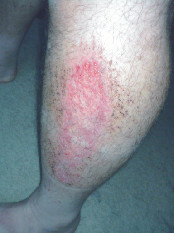
Knowing, however, that many people learn better by seeing than hearing, I positioned a catcher at home with the ball, strolled up the third base line, and then took a run at the plate. (I was wearing shorts at the time, incidentally.) As I approached the catcher I got out wide, beyond her reach, executed the slideby and touched the plate with one finger. Safe!
When I stood up to review what I’d just done, one of the girls pointed out that I was bleeding. I didn’t think much of it, but we took a break while I cleaned it off.
Turned out to be worse than I thought at first. In fact, the photo you see here is after a week of “healing.” It’s made for a great war story though, and it definitely demonstrated that I won’t ask my players to do anything I wouldn’t do.
Still, you’d think I’d know better. Old men, especially fat ones, and sliding are not a good combination. I have to think that the added weight didn’t do me much good as I tried to “glide” across the infield dirt.
In any case, while it looks bad I am fine. I’ve been wearing two 3″ x 4″ gauze pads over the area for the last week, changing them each morning before I head to work. It’s not as bad as it was, but I have a feeling I’ll be showing this particular scrape in some form for a few more weeks. Oh well, all for a good cause.
Game to make batting practice more interesting
Batting practice can get boring sometimes. Ok, a lot of the time, especially when you’re working on a specific skill. But the other day I came up with an idea to make it a bit more interesting.
I was working with a hitter on generating a sacrifice fly with a runner on third. The idea was she had to hit an outfield fly ball no matter where the ball was pitched. We did it for a while, then we got serious.
Every time she hit a fly ball as required, she received a plus one. Every time she produced a popup or a weak ground ball, she received a minus one. A line drive or hard grounder was a “push” — neither plus nor minus. I could’ve made them minuses, but since they’d probably accomplish the goal of scoring the runner I decided to make them neutral.
You can set the game to any number you want. I selected five to keep things moving, and so the game was on. The object was to get to plus five before the hitter reached minus five.
Another variation would be to name two teams, such as the hitter’s first name v. her last name. The first name gets the pluses and the last name gets the minuses.
It’s fun, and it definitely puts some pressure on to perform. Next time you’re working on a specific hitting skill, give this game a try.






 Life in the Fastpitch Lane