Author Archives: Ken Krause
It’s like being psychic
Earlier today I put up a post about coaching, and mentioned that being a good (or great) player doesn’t necessarily qualify you to be a coach. I was speaking in general terms at the time.
But tonight I heard what one of my students was told at a clinic that featured some NPF players, including one very big pitching superstar. You would think this woman would know what she was talking about since she’s had a lot of success.
When I asked her what this person said, the first thing my student mentioned was that the woman told her she should touch her hand to shoulder for her follow-through. Ugh! That is horrible advice that will likely lead to elbow trouble. You never want to force a follow-through. You want it to be loose and relaxed. Bill Hillhouse advocates finishing across the body. I’m not too picky as long as it’s loose and natural. Incidentally, this woman, who is still playing, has pretty much no follow-through herself. She definitely doesn’t touch her shoulder when she throws a pitch. But here she’s telling an impressionable young girl to do it.
She also told her to snap her wrist. Now that I know she does herself, but mostly because she has no follow-through. If she finished her pitches, as I’ve mentioned before, the wrist would snap on its own. Again, you’ll hear Bill Hillhouse saying the same thing, and he should know — he’s been there and done that for a long time.
The point is, don’t just take someone’s word for it. Even if they have a gold medal. Make sure whatever you’re told makes sense and you’ll have a longer, more successful career.
And your qualifications are…?
Imagine you are going into the hospital for a simple appendix operation when your doctor informs you that the person performing the surgery will be a youngster fresh out of medical school, with no actual experience but plenty of practice operating on cadavers. Oh, and there won’t be a more experienced doctor in the room, but they’ll be around if needed.
Or you’re being sued by someone for everything you have after a fender-bender accident and your law firm informs you that your case will be defended solely by a law student who’s never tried a real case before but did “really well” in college mock trials.
How would you feel? Would you be confident, or would you find a lack of experience to be worrisome?
Now think about what often passes for coaching in fastpitch. A recent college graduate who played college softball is hired and handed the reins of a team. Or a former college pitcher with no teaching experience is installed as the pitching coach, I guess under the assumption that if she did it she can teach it.
Well, gang, I’ve played musical instruments for more than 40 years, but I wouldn’t say it qualifies me to be the band director at the local school. Performing a skill and teaching it are two separate things. Many college pitchers are able to pitch, but they don’t necessarily know how they do it. And knowing the how and why is essential for teaching. Otherwise you may just be repeating the bad advice you received and very likely overcame in order to be succesful.
The same goes with hitting. Mike Epstein’s whole system is based on the idea of “Do we teach what we really see?” He contends that the answer is often no. Instead, we repeat what we’ve heard. Whether you agree with Epstein’s system is not important. But what is important is whether what a coach tells you to do is based on knowledge and experience, or simply something he/she has heard along the way.
Think of it this way. Suppose you’re a high school player who has taken hitting lessons for a few years from a qualified coach. You’ve had good success and improved each year. Now the new high school coach, fresh out of school from her playing days, comes in and tells you you’re doing it all wrong and should change to do it her way. What if you asked her this simple question: what are your qualifications for teaching hitting? What would she be able to say? That she played at Wherever College (a D3 school, by the way) for four years and hit .313 lifetime? Ok, that qualifies her to play high school softball. But does it really qualify her to teach hitting to others?
If I was hiring her to be my daughter’s private instructor I’d want to know how long she’d been coaching, what certifications she had or classes she’d taken that focused on hitting theory or how to teach, etc. If all she’d done was play fastpitch softball, with no coaching experience, I’d have to pass.
It is vitally important to the sport that we encourage players who have finished their careers to go into coaching. But it’s just as important, for their sake as well as the team’s, not to just assume that the ability to play equals the ability to coach. Instead, we need to mentor these young ladies, have them work with more experienced coaches, and let them grow into the position just as you would in any other business position. Otherwise we’re setting them and their players up for failure. And they won’t even realize it until they (or their players) quit in frustration.
Another cue for the backhand change
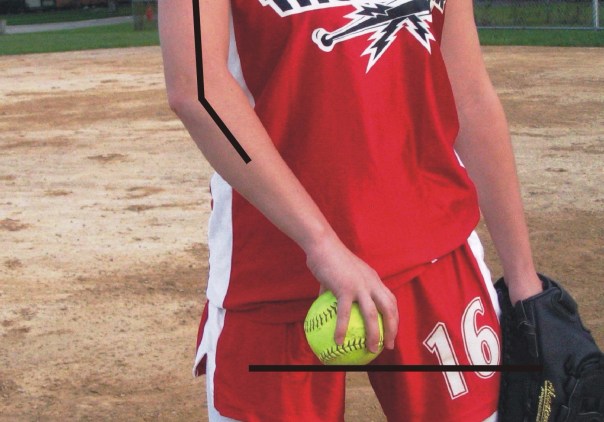
One of the keys to keeping the backhand change low and hump-free is maintaining a slight bend in the elbow as the hand comes through. In this position the ball comes through before the rest of the arm.
Ok, that sounds good in theory. But it can be tough to get the feel of how to get the arm properly bent. Here’s a new cue I’ve found that helps pitchers get in the right position. Have the pitcher bring her thumb across the spot where the hip bone and the thigh bone meet. In practice she can actually touch her hip area at that point. The arm will bend and she’ll be able to keep a flat release.
Pulling the head out
This is a companion piece to my previous post. The longer you hang around this game, the more you’ll learn all the “helpful” cliches. One of these is “keep your head in” or the negative version “you’re pulling your head out.” Generally speaking it’s true, but the statement ignores the root cause.
The head pulls out because the body stands straight up and the front shoulder pulls out. But no one ever tells hitters to keep their front shoulders in. If they keep their weight in and let the front shoulder get knocked out by the back shoulder on the swing, the head will stay in where it belongs. And the hitter will be able to see the ball just fine, because the eyes will be closer to the ball, instead of moving away from it.
Keeping the weight in
Had a chance to work with a couple of girls today on their hitting. It was two sisters, one of whom will be playing for me for the first time this summer. She played on my daughter’s HS team last season so I’ve been wanting to work with her anyway. Today serendipity prevailed — she was coming in as I was walking out of Grand Slam after teaching some pitching clinics. I watched her bat a round in the cage, then called her over.
I saw her doing what I see a lot of hitters do — swinging from the heels. She started from a good stance. But after that it was all hands. Her feet were locked in place as though Guido and the boys had cast them in concrete before throwing her in the river. This, in turn, caused a host of other problems. Her first move was also a problem — she’d drop her hands straight down, putting her in a weak position.
Being a natural busybody and serial coach, I called her over and asked if she’d like some help. She said yes, and so we went off to the side to get to work. I had her work on starting her hips rotating before moving her hands, and leading the hips before the upper body. We worked on keeping the hands tied to the back shoulder at the start of the swing, and keeping the bat on an angle instead of dropping it down parallel to the ground. Finally, we worked on trying to keep her weight/balance in toward the plate instead of winding up falling away from it.
It was just one impromptu “lesson” but it seemed to help. She started making more contact, and hitting through the ball better. Of course, now the key will be if she keeps it going. I hope she does, because it will help our offense in the summer as well as helping her individually.
Incidentally, her sister was doing many of the same things so I worked with her while I was there as well. Her sister seemed to get it as well. She’s playing travel ball for the first time this summer too, with our 14U team, so hopefully she’ll stick with it as well.
It’s amazing what you can do with a half hour and a willing student.
Getting the bunt down
Once again I was up at Grand Slam USA for the afternoon. I was there for pitching lessons, but in between I was wandering around aimlessly as I am wont to do.
In one of the cages was a girl working on bunting. She assume a good position, and looked ready to lay it down. But each time as the pitch came in, she dropped the barrel of her bat below the handle and stabbed at the ball. Almost without exception the pitch went foul, or at least as foul as a bunt can go in a batting cage. Often they also went up, creating a little pop-up.
Keeping the barrel of the bat above the hands is essential to getting the bunt to go toward the ground. It definitely makes it easier to hit the top of the ball, which is what you need to do to get the bunt down. Dropping the barrel tends to make you hit the bottom of the ball.
Here again I make the case for bunting with the hands together. The girl was using split hands, which as I’ve said before tends to make it easier for hitters to drop the barrel. I’ve observed that phenomenon time and time again.
Ironically, she did use hands together for one technique. She would show bunt, then pull back to swing away, hands still up the handle. This makes no sense to me either. If you’re going to show bunt you need to show it the same way you actually bunt. Otherwise you’re not fooling anyone. It was odd — show the bunt, then full pull back with the hands up the bat, then swing away. Seems to me like all you’re going to do from there is ground out and not very well. People sure teach some strange things.
The myth of the wrist
Emphasis on the wrist snap has been part of the process of coaching fastpitch pitchers since Eddie Feigner soiled his first diaper. Generally it is interpreted to mean that you have to have a strong, powerful wrist snap driven by the muscles in the wrist in order to throw hard.
But how true is that, really? Let’s try an experiment. Have someone grab your forearm with both hands so you can use the wrist muscles — and only the wrist muscles — to throw the ball. Now snap the wrist as hard as you can. No matter how strong your wrist is, and how many fireman rolls you do, the ball is not going to come out that hard, or go that far. It’s because the wrist muscles are relatively weak compared to the rest of the body. Because of this, on their own they don’t really add anything to the pitch, no matter what all those expensive pitching videos might tell you.
It’s not the strength of the wrist, but its flexibility, that is the key to its contribution. Have you ever snapped somebody with a towel? First of all, shame on you. But if you have, you know that if you get the end of the towel to flick fast enough, you can make your teammate, spouse, dog, etc. jump. There is no muscle in the end of the towel. It’s the speed at which it accelerates, and the fact that the previous section stopped moving in the same direction, that creates the snap.
Your wrist is like the end of the towel. As long as it moves quickly it will impart the speed. And the faster it moves over a short distance, the faster the ball will come out. It’s also the most flexible joint in your body, capable of moving 180 degrees back to front, and in a variety of directions. Try that with your knee! Wait, maybe you shouldn’t.
Still not convinced? Try another experiment. Stand with your elbow at your side and your forearm pointing straight up. Now snap your wrist down as fast as you can using the wrist muscles. Doesn’t work too well, does it? Now relax the wrist so the hand is just sort of hanging there, and then abruptly move your arm back and forth slightly. If I’ve described how to do it correctly you’ll see the wrist move much faster. (If I haven’t no telling what you’ll see!) A loose, flexible wrist can move much faster than a tight wrist can be muscled.
So does that mean the wrist can be weak and you’ll throw hard? No. It still has to have enough strength to accept all the power and stress being driven into it by the other, larger muscles in the body. A weak wrist won’t be able to transfer the power. But just as a car needs both a powerful engine and a strong transmission to go fast, so do your pitches. You should strengthen the wrist so it can do its job effectively.
The point, though, is that you don’t need to practice endless strong wrist snaps or concern yourself with muscling the wrist at the end of the pitch. Instead, make sure you’re getting good whip of the forearm (the forearm going quickly from behind the elbow to in front of it at the bottom of the circle) and keep that wrist loose. Done correctly your wrist will snap all on its own, and at the right time, to help you achieve your goals.
Another voice on playing the game right
So as it turns out I’m not the only one who’s been thinking about the whole issue of playing by the rules. Dave over at Girls Fastpitch Softball recently posted about one of the aspects I addressed earlier — batter interference. He reports the rule has been changed to try to eliminate the need for umpires to determine whether it was intentional or accidental. He has some great thoughts. Of course I think so because he thinks the same as me. Check it out!
Bunting hands together
I tried to get this topic going before but so far no one has posted. Seriously, if you have an opinion on anything by all means leave a comment! I may not agree but that’s ok. We’re all in this together, and we all get smarter when we’re forced to think through our positions on various topics. All I ask is that you be civil.
Anyway, I was up at Grand Slam the other day watching a couple of kids bunt in the batting cages and was reminded of one of the big reasons I prefer hands-together over hands-apart bunting. (The two are actually girls who play for me, but who have fallen under the evil influence of their HS coaches on this topic.  )
)
When you bunt split hands, there seems to be a strong tendency to drop the head of the bat, especially when going after a low pitch. It’s sort of like holding the proverbial 10-foot pole. If you try to do the same thing with a hands-together grip you have to work much harder to drop the bat head because of the way it feels around the wrists. I’m not saying it can’t be done because I’ve seen it. But when your hands are farther apart it’s much easier to let that bat head drop down.
Update on the light bulb
Just wanted to give everyone an update on the “light bulb” post. Sometimes as a coach you can effect a change one day, but then the next time you see the player they’ve fallen back on old habits.
I am happy to report that last night that was not the case. The girl I mentioned had a nice, relaxed throwing shoulder and looked very comfortable and smooth. Her dad said she worked on it hard during the week, and it showed.
Definitely good to see.






 Life in the Fastpitch Lane