Monthly Archives: February 2025
The Best Tryout Advice You’ll Ever Receive

Tryouts are beginning soon for high school fastpitch softball in many parts of the U.S., and with them comes all the anticipation, hopes, dreams, and yes, anxiety typically associated with trying to earn a spot on a team.
Plenty has been written about things you can do to improve your chances of making the team you want, such as hustling, going out of your way to talk to the coaches, taking chances by doing things like diving for balls and so on. Heck, I’ve written a few of them myself.
Today, though, I want to tell you about a secret most players don’t know that can help free them to show the coaches (or evaluators at an open selection event) what they can really do. If you’re a parent, guardian, or friend of a player, please be sure to pass this tip along to them.
Okay, are you ready? Here it is:
The coaches doing the evaluations want you to do well. In fact, they’re really hoping you do.
That’s right. They’re not standing there waiting for you to mess up or looking for things they can criticize to make you feel bad. Instead, they want you to look good.

How can that be, you ask? Why would they care one way or the other?
It’s simple: they have a need to fill or a problem to solve, and if you come out looking great they can fill the need or solve the problem without having to worry about it anymore. In other words it’s in their best interest for you to be awesome.
I actually had this epiphany while listening to the SmartLess podcast with Jason Bateman, Sean Hayes, and Will Arnett. It’s very entertaining as the three of them interview other celebrities and interesting people; it’s perfect for those long car rides to far-flung games and I highly recommend it.
They were talking about how nervous they would get as young actors auditioning for roles in movies or on TV shows. Then they started directing and producing, putting them on the other side of the audition table, and they realized their main thought there was “I hope this guy/gal is what we need for this role so I can move on to other things.”
It’s the same in fastpitch softball tryouts or evaluation events. The folks with the clipboards have X number of slots to fill.
They want to fill them with quality players as quickly as they can – players about whom everyone will say, “I see why they were selected.” So when you step onto the rubber or into the cage or on the field, they want you to be good.
They need you to be good. They are basically rooting for you to be good.
While I don’t coach teams anymore I can personally confirm from past experience that this approach is true. I never thought about it that way but yes, I hoped every girl I looked at would be awesome because it would make my job easier, especially when it came time to take the field in a game.
Now, I will say in many high school situations the term “tryouts” can be a misnomer. Often most of the team is already selected before the first day.
Still, there is usually a need somewhere, an open slot that needs to be filled for the team to be complete. The coach isn’t trying to eliminate those who can’t fill the spot; he or she is looking for the one person who can.

So when you step into the spotlight, don’t think or worry about the outcome. Focus on the process, which is going out there and showing the coach why you are the solution he/she is hoping to find today.
If you perceive the coach or evaluators as rooting FOR you instead of AGAINST you, you’ll stand a much better chance of setting any nervousness aside and performing to the best of your abilities. With the result of greatly increasing your chances of being selected.
Now go out there and show them what you can do! Good luck to all.
My good friend Jay Bolden and I have started a new podcast called “From the Coach’s Mouth” where we interview coaches from all areas and levels of fastpitch softball as well as others who may not be fastpitch people but have lots of interesting ideas to contribute.
You can find it here on Spotify, as well as on Apple Podcasts, Pandora, Stitcher, iHeart Radio, or wherever you get your podcasts. If you’re searching, be sure to put the name in quotes, i.e., “From the Coach’s Mouth” so it goes directly to it.
Give it a listen and let us know what you think. And be sure to hit the Like button and subscribe to Life in the Fastpitch Lane for more content like this.
Lead photo by Liza Summer on Pexels.com
Preparing for the Inevitble Storms

On this week’s episode of the From the Coach’s Mouth podcast, Jay Bolden and I spoke with Shawnee Harle, 2X Olympian with the Canadian Basketball National Team and now a Mental Toughness Coach with her own business called Winning Matters. While Shawnee had a lot of great insights into the mental game, there was one concept in particular that has been on my mind today: preparing for the storm.
Shawnee said that what most athletes and coaches miss is that there is always a storm coming – kind of like Florida during hurricane season. It’s not a question of if, but rather than of when.
Through experience, most people in Florida have learned that when a hurricane is on its way it’s best to put up the plywood over the windows, lock down anything that can be easily lifted (such as patio furniture), and lay in supplies such as food, water, toilet paper, and bandages so they’re ready for when the storm hits.

If it’s not that bad that’s ok – all they lost was a little time and a little storage space for supplies they didn’t need after all (but can use later). If it is bad, however, they have what they need to get through it until the storm passes and things get back to normal.
Unfortunately, many coaches and athletes like to pretend that the storm isn’t going to hit them. “I’ve put in the work,” they say, or “the negatives won’t hit me if I just stay positive.” But that’s a fool’s position.
According to Shawnee, the storm hits everyone sooner or later. Pitchers have a rough outing or two, or suddenly lose their best pitch for no apparent reason. Hitters go into slumps out of nowhere.
Catchers suddenly can’t throw baserunners out or start having pitches they’d normally catch glance off their gloves. Fielders start making fielding errors or sailing balls high instead of throwing to the base.
No one knows why the softball gods suddenly become angry and throw their wrath at a particular player. They just do, and it happens to everyone.
So knowing that, the question is what are you doing to prepare yourself (or your players)? Have you thought about how you’re going to deal with it and get back on track or are you going to allow yourself to get caught by surprise and then try to ride it out?
Now, some coaches will take the “Suck it up buttercup” approach. They see a problem and think if they tell players to “toughen up” or to “get your head in the game” they will solve the problem.

In reality, they will most likely make it worse.
The better approach is to heed the old saying “In times of peace, prepare for war” and start getting your mental game toolkit together before you need it. Just like smart Floridians gather up their supplies ahead of the hurricane rather than during the middle of it.
There are plenty of resources out there that can help you learn how to prepare for the coming storm. A mental toughness coach such as Shawnee is certainly a good one, especially if you’re playing on a bigger stage where the pressure is extreme.
But there are plenty of self-help options out there. The book Heads-Up Baseball: Playing the Game One Pitch at a Time is a great starting point in my opinion. It’s easy to follow, with great exercises that help you learn to control yourself and understand what else you can or cannot control.
There are many other books, videos, and training tools as well, all designed to address the storms that are inevitable in sports as well as in life.
The key, though, is not to wait until you’re facing the storm but to get out ahead of it. You wouldn’t suddenly try to learn how to hit or pitch or perform any other skill in the middle of a season.
You shouldn’t wait until you’re in the middle of a crisis to try to develop the skills you need to get out of one either.
If you polled 1,000 coaches and athletes and asked them how important the mental game is to success, I’d bet the overwhelming majority, like 90%+, would say “very important.” Ask that same 1,000 how much time they spend on it, though, and you’d probably get an answer of 5% of their time or less.
Face the facts: the storm is coming. It might not be today, or even tomorrow, but sooner or later it will hit. Start preparing for it now and you’ll find you’ll get through it faster and stronger.
A $500 Bat Won’t Fix a $5 Swing

Softball bat technology has certainly come a long way from the days when an $80 Louisville Slugger burgundy bottle bat was what every fastpitch hitter dreamed of owning. (Linda Lensch I’m looking at you.)
The materials and construction of today’s bats are designed to maximize distance and power, turning even so-so contact into a potential dinger. At least that’s the promise.
Yet while it’s true that the stiffness of advanced carbon fiber or other materials and “trampoline effect” of the specially engineered barrels do tend to yield better results (all else being equal), there’s one thing they can’t make up for: a poorly engineered swing. That’s something to keep in mind as you start to look at where to spend your money to try to create better results at the plate this season.
I know that $500 bat sure looks tempting in the online ads. These days bat manufacturers are doing a great job of making their bats not only powerful but beautiful.
Heck, a lot of them will let you customize the colors and graphics yourself, which is a wonderful option if you have an eye for that sort of thing and can be a disaster if all your taste is in your mouth, as an old boss of mine used to say. Still, as long as it’s beautiful to you it’s the stuff dreams are made of.
But while they may make your socks roll up and down when you look at the bat, all the pretty colors and cool graphics in the world won’t help when you take it up to the plate and are staring down a pitcher. At that point you’d better know how to swing it.

It comes come down to which you think will work better: a great swing with a cheap bat or a great bat with a terrible swing.
Sure, it’s possible with today’s technology that you can get a few great or at least decent hits with any ol’ swing. All you need to do is get the bat on the ball and the bat will do the rest, right?
That, however, is more of a “hope” or a “law of averages” strategy. Swing it enough times and you’re bound to hit something sometime – or at least you’d assume so.
But the reality is you’ll probably do a lot better making sure your swing itself is in order – that it is sequenced properly, you understand how time a pitcher, you are capable of making the fine adjustments to the swing once you get a better look at the pitch, etc. – before you go spending your limited budget on the shiny new bat.
Think of it like a guitar player. If you go to hear someone play who hasn’t been at it that long, he or she may have a $20,000 Martin acoustic guitar but it’s still going to sound like someone hacking away at an instrument they don’t really know.
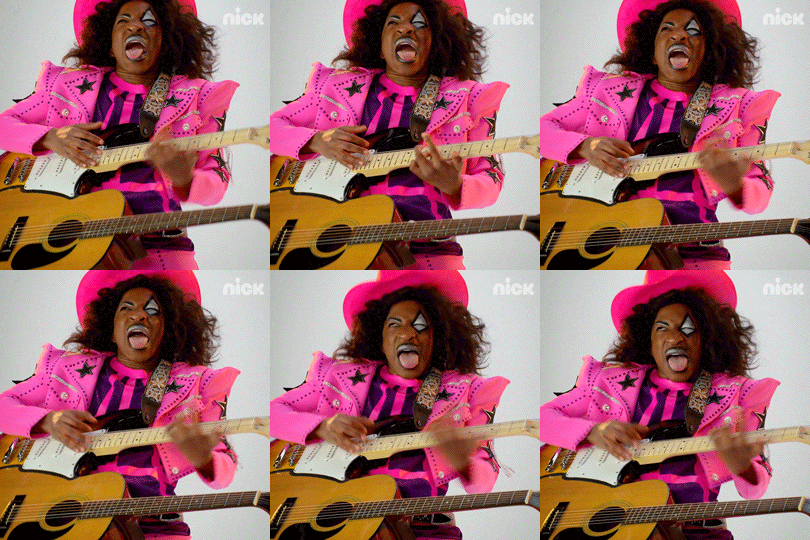
But if you go to hear a great guitarist, he or she will draw amazing, mesmerizing sounds out of a $200 special from Sweetwater. Because the tone and technique is in the hands of the player, not the instrument.
It’s the same with that $500 bat you’re coveting. The only way to get the results you want from that big ticket expenditure is to first make sure you know how to use it.
Rather than investing in that fancy new bat, first make sure you’re investing in yourself. Get some lessons from a qualified hitting instructor.
Put in time in the cages to work on what the instructor is telling you. Get comfortable with your swing mechanics and your approach at the plate.
See someone about your mental game if you find you’re great in the cage but struggle in games. In other words, get your house in order.
Then, when you’re sure you’re ready, have at it. Search the Internet or better yet go to a local store or facility where you can try out various bats to see which one feels and sounds best to you – there can be a huge difference even between bats with similar specs.
Then make your purchase knowing you not only have a $500 bat but a $1 million swing to go with it.
By the way, this thought also applies to pitchers and fielders too. Before you go spending money on new gloves or shoes or gimmicks, invest in yourself and what you’ll do with those things first.
You’ll probably like the results a whole lot better.
How Practice Helps Shorten the Trip to Softball Success

At the end of the first lesson with a new student I will often ask her if she knows where New York City and Los Angeles are on a map. I know that’s a gamble given how famously bad we Americans are at geography, but even if she doesn’t know she will usually have an idea of what the U.S. looks like and I can show her Los Angeles is way on the left and New York City is way on the right .
I will then ask her how many different ways there are to get from New York to Los Angeles. Most understand I mean modes of travel, although the ones who are just learning to drive may panic thinking I’m looking for turn-by-turn directions. I’m not that cruel.
Once she understands the question we’ll start listing them out: flying, driving, train, boat, bus, etc. I will also remind her you can walk, run, or bicycle as well.

The final question is, “Which way is the fastest?” Pretty much everyone says “flying,” although there’s an occasional outlier who has to be corrected. That’s when I swoop in with the point.
“If you practice at least two or three times a week between lessons, it’s like flying from New York to Los Angeles,” I tell her. “You’ll get to your destination quickly and refreshed, and be ready to go on and do better things than travel.
“But,” I will continue, “if you only pick up a bat or a ball or a glove when you have a lesson it’s like walking from New York to Los Angeles. You’ll still get to where you’re going, but it will take a lot more time and it will be a lot more painful and frustrating.”
In my mind, that may be the most important thing I teach these young ladies when they come to me. I think players and even parents often have an expectation that if they take lessons, especially from a coach who’s a “name,” it will automatically make them great.
Nothing is further from the truth, however. They may get a little bit better over time but it’s going to be a long time before they notice any substantial improvements.
But if they put in the work on their own that’s where they’re going to see real progress. Because that’s where the real magic happens.
Continuing the transportation theme, I tend to think of coaches as the GPS for the journey. They will give you information, even turn-by-turn directions, so to speak, that will guide players to their desired destination.
Nothing happens, however, until the player puts the “vehicle” (her body) in gear and starts driving toward the destination. Just like with the car, if she just sits there without doing something the directions will be the same day after day, week after week, month after month, etc. instead of moving onward.
A coach shouldn’t be watching his/her players work on last week’s assignment for the first time. The player should have already put in the work on it.
That doesn’t mean the player will necessarily have it mastered after a week or two. But there should be progress toward the goal so the coach is performing a process of continuous refinement – chipping away at the goal layer by layer the way a sculptor chips away at a piece of marble until it turns into a breathtaking work of art.
If the coach has to keep chipping away at the same level of skill, however, progress will be slow and the player is likely to get frustrated and stop long before she turns into the masterpiece she should be.
It can be difficult for players, especially the young ones, to understand the abstract concept of how quality practice leads to excellence. But everyone understand travel, because we all go somewhere every day.
If you have a player (or child) who doesn’t seem to see the need for practice, try the map analogy. It might just help get her moving in the right direction.
My good friend Jay Bolden and I have started a new podcast called “From the Coach’s Mouth” where we interview coaches from all areas and levels of fastpitch softball as well as others who may not be fastpitch people but have lots of interesting ideas to contribute.
You can find it here on Spotify, as well as on Apple Podcasts, Pandora, Stitcher, iHeart Radio, or wherever you get your podcasts. If you’re searching, be sure to put the name in quotes, i.e., “From the Coach’s Mouth” so it goes directly to it.
Give it a listen and let us know what you think. And be sure to hit the Like button and subscribe to Life in the Fastpitch Lane for more content like this.
US map graphic by User:Wapcaplet, edited by User:Ed g2s, User:Dbenbenn – File:Map_of_USA_with_state_names_2.svg, CC BY-SA 3.0, https://commons.wikimedia.org/w/index.php?curid=81990933






 Life in the Fastpitch Lane