Monthly Archives: January 2025
Debunking the “One Size Fits All” Myth

Take a look at fastpitch softball discussion groups on Facebook or other corners of the Internet for any length of time and you’ll find parents and coaches looking for the magical drill that will yield faster speeds with greater accuracy for pitchers, longer distances and higher batting averages for hitters, more sure-handedness for fielders, or some other tremendous improvement. You’ll also find plenty of responses.
Here’s the thing to know, however: there is no magical, one-size-fits-all drill that will accomplish those goals for everyone. They may work for a percentage of the player population, large or small, but there are no universal panaceas out there. Here’s why.
Each human being is unique, with his or her own ways of standing and moving. Two players may look similar, but they aren’t identical.
In fact, from my own set of experiences working with players generally and testing them more specifically for Motor Preferences®, even identical twins will have differences in the way their bodies work.

The reason, as David Genest at Motor Preferences Experts (MPE) will say, is that people aren’t machines. Or sci-fi replicants.
With machines, you can build every single one of them to perform the same way every time as long as you’re using the same parts and following the same blueprint. That means when you put them to work they will perform identically and interchangeably.

Not so much with human beings. While we all have arms, legs, torsos, bones, muscles, fascia, neuroreceptors, etc. – in other words all the same parts – the way those parts work individually and in concert with each other varies from human to human.
What that means is that the drill that is a breakthrough for one player could be a detriment, or even an injury risk, to another.
Take some of the drills for improving the leg drive of pitchers. A drill that emphasizes driving the hips could be great for someone classified as a terrestrial or “bottom mover.” They initiate movement from their hips, so enhancing that movement will likely yield some pretty good results.
Apply that same drill to an aerial or “top mover” – someone who initiates movement from her shoulders – and you could actually make her worse because you’re focusing your efforts on the wrong body segment at the expense of the preferred segment.
The same goes for hitters, fielders, and everyone else. If you use drills that place too much emphasis on one movement over another because you’ve seen them work for some famous player, without any consideration for how the individual in front of you moves, you can actually do more harm than good.
Both performance-wise and health-wise.
Does that mean you shouldn’t use any drills? Of course not. Drills are an important way of breaking down skills to help players improve.
But it does mean you should be careful about what you apply to whom.
Let’s look at team hitting practices. Unless all your players move the same way/have the same motor preference profiles, having one set of generic drills for everyone to perform is likely to be beneficial to some and detrimental or even harmful to others.
A better approach would be to create a set of drills for each group and have them work within their preferred profiles. That doesn’t mean you can’t have some crossover, for example hip drive drills for players who are more shoulder-oriented.
For best results, however, you’ll want them to spend 70-80% of their time doing drills that fit their preferred way of moving.
The same goes for conditioning and strength training. Terrestrial/bottom movers will benefit more by working on exercises that keep them closer to the ground, such as bear crawls, than by spending a lot of time on plyometric drills that require bounciness.

Aerials/top movers, on the other hand, will respond best to plyometric conditioning drills. That doesn’t mean either group should be exclusively one way or the other, especially since most people are not on the extreme end of either.
But for best results the bulk of their time should be spent working on the things that will help them take best advantage of their natural tendencies.
So how do you know which drills to assign to whom if you haven’t hand any specific training in this area? Glad you asked.
For that we can turn to science. When you assign drills initially, see who responds to what. Then keep what works and discard or modify what doesn’t.
You can even do that within profiles. When I’m working with a pitcher or hitter I will often ask them to try something different. After all, if you do what you always did you get what you always got.
After a few attempts, though, I will look at what the effect has been. Does the player seem to be moving/performing better or worse?
If it’s better we’ll keep working on it. If it’s worse (adjusted for the fact it’s new), we’ll move on to something else.
And sometimes I will suggest something I’m pretty sure will create an improvement but doesn’t work immediately for that player. In that instance I will tell her to stay within the general idea but find a way that works better than I originally described.
You’d be amazed at how well that can work, because she’s not only doing the right thing but doing it the right way for her.
Also, don’t forget to ask the athlete for her feelings about a drill or exercise or movement instruction too. Athletes can sometimes be a little too coachable and thus won’t tell you when something feels awkward or out of place to them. Instead, they’ll just keep pushing through.
But if you ask them for their feedback, and encourage them to be honest, you’ll often get a better idea of whether a new idea is worth pursuing further or something you should save for someone else.
The bottom line is the idea of a “one size fits all” drill that can be universally applied to every player is a myth. It’s magical thinking that simply doesn’t work in the real world.
You need to know your players, try different things with them, and only keep what works. If you look for similarities in what works with your players you can build a profile for each of them that will save you time in the future because you’ll have a better idea of what they will respond positively to.
The net result will be happier, healthier, and better-performing players. And that’s a fact.
My good friend Jay Bolden and I have started a new podcast called “From the Coach’s Mouth” where we interview coaches from all areas and levels of fastpitch softball as well as others who may not be fastpitch people but have lots of interesting ideas to contribute.
You can find it here on Spotify, as well as on Apple Podcasts, Pandora, Stitcher, iHeart Radio, or wherever you get your podcasts. If you’re searching, be sure to put the name in quotes, i.e., “From the Coach’s Mouth” so it goes directly to it.
Give it a listen and let us know what you think. And be sure to hit the Like button and subscribe to Life in the Fastpitch Lane for more content like this.
Elephant and mouse photo by Vindhya Chandrasekharan on Pexels.com

Energy Creation: The Rolling Snowballs Corollary

This seems like an apt analogy since as I write this much of the USA is still dealing with a fair amount of snow, including many places that rarely get any. Welcome to my world, although we actually haven’t gotten much all winter.
Anyway, the other day I was trying to explain the concept of acceleration to a young pitcher. We were talking about the need for her arm to pick up speed down the back side of the circle instead of staying at one speed if she wants to throw harder.
Then an idea hit me, thanks to a childhood misspent watching Saturday morning cartoons.
“Think about a snowball rolling down a hill,” I said. “At first, the snowball is small. But as it rolls down the hill, the snowball starts picking up more snow, getting bigger and bigger. Then, when the snowball reaches the bottom and stops, the snow explodes all over the place!
“That’s what needs to happen with your pitching arm,” I continued. “As you come down the back side you start moving your arm faster, which gathers more energy like the snowball gathers snow, until the ball explodes out of your hand at the end.”
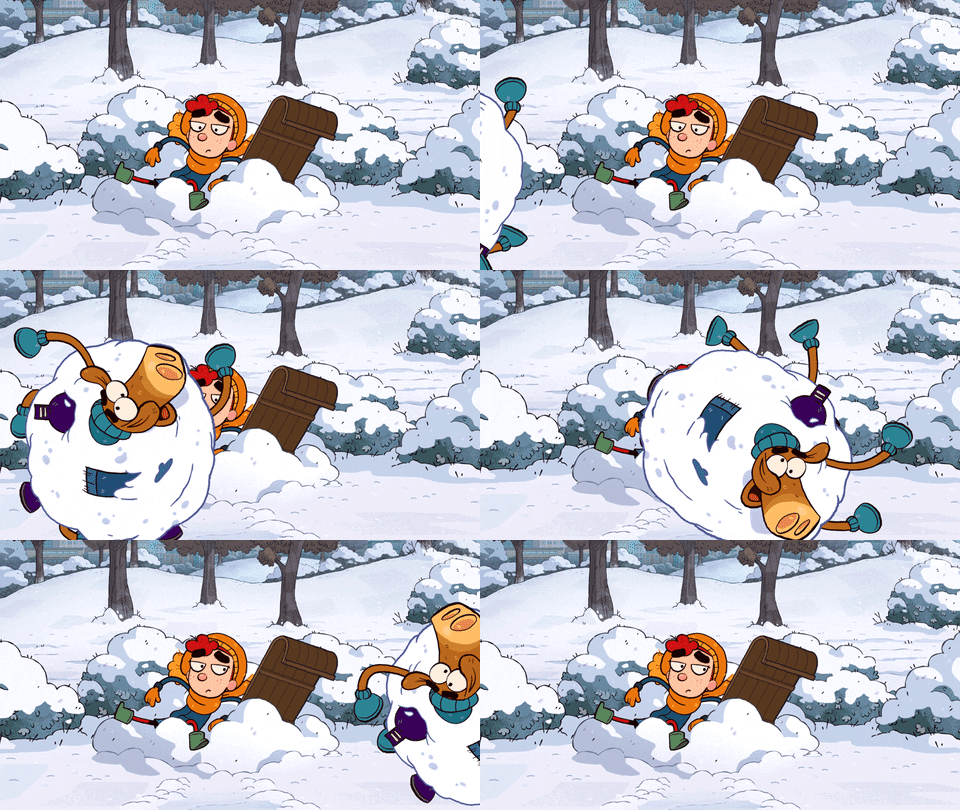
That made perfect sense to her. The more the snowball moves downhill the faster it goes and the more snow (energy) it picks up.
Ergo (love that word, rarely get to use it in a sentence), getting that arm to move faster down the back side of the circle is critical to maximizing speed. Logical, right?
But that doesn’t mean pitchers can always do it. Some will do it naturally. Others will do it once your bring it up. But some have to unlearn old movement patterns and replace them with new ones before they can execute it.
One of the best ways to help them learn that acceleration is by moving the pitcher in close to a net or tarp, having her stand with her feet and body at 45 degrees to the target, and then throwing with a full circle, emphasizing the speed on the back side of the circle. You can also do that with six or eight ounce plyo balls into a wall.
I also prefer they move their feet as they do it since body timing is also crucial to great execution.
The key here is feeling the arm moving as quickly as it can. But there’s another caveat.
To really make this work and get the acceleration, the arm has to be loose and the humerus (upper arm) has to be leading with the forearm trailing behind, i.e., throwing with whip. Moving the whole arm in one piece, as you do when you point the ball toward second base and push it down the circle, will not yield the same level of results. In fact, it could cause injuries.
Once the pitcher can execute this movement from in-close, start moving her further away and trying it again. Take your time with this process, because if you move her back too fast and she perceives the target is too far away she will start muscling it to make sure it gets there rather than letting it move naturally.
At each step, take a video and look to make sure there is at least somewhat of a bend or hook at the elbow instead of a straight arm. If not, move her back up or slow her down temporarily so she can get the proper mechanics.
Then speed it up and try again.
By the way, the energy snowball concept is not just for pitchers. This type of acceleration into release or contact is also critical for overhand throwing and hitting.
Or pretty much any other athletic skill requiring power.
Now, if you’re an adult with lots of real-world experience, all of this may seem obvious to you. You may even be wondering why I’m spending so much time on it.

But a young player, or even a young adult player, may not have the real-world understanding of basic physics or biomechanics to tie acceleration into energy production. For them, it’s helpful to put it in a context that they can easily comprehend based on what they have already seen.
Even if it comes from a Saturday morning cartoon.
If you have a player who’s struggling to understand the concept of acceleration into action, try talking about the rolling snowball. It just might break the ice with them.
My good friend Jay Bolden and I have started a new podcast called “From the Coach’s Mouth” where we interview coaches from all areas and levels of fastpitch softball as well as others who may not be fastpitch people but have lots of interesting ideas to contribute.
You can find it here on Spotify, as well as on Apple Podcasts, Pandora, Stitcher, iHeart Radio, or wherever you get your podcasts. If you’re searching, be sure to put the name in quotes, i.e., “From the Coach’s Mouth” so it goes directly to it.
Give it a listen and let us know what you think. And be sure to hit the Like button and subscribe to Life in the Fastpitch Lane for more content like this. Commercial over.
Snow roller photo by Perduejn, CC BY-SA 4.0 https://creativecommons.org/licenses/by-sa/4.0, via Wikimedia Commons
Be the River, Not the Rock

Here’s a simple question for you today: which is strong, the river or the rock that sits in the middle of it? The answer is it depends on your point of view.
Taken at a glance, a snapshot in time if you will, it appears the rock is stronger. After all, the rock stands steadfast, unmovable, while the river must divert around it.
But if you take a longer-term view, the answer is the river, because over time it will erode the rock until the rock is no longer an obstacle to its path.
I know, very Kung Fu of me (which is probably where I got the idea). You can hear the pan flutes even as you read this.

That doesn’t make it any less true, however. Which is a good lesson for playerstrying to learn or improve a challenging skill such as pitching or hitting, as well as for coaches trying to get the best out of their teams.
Players
Let’s start with players. They can take the rock approach to learning new skills or improving/revamping current ones for a variety of reasons, including:
- What they’re currently doing has worked for them before. For example, a 12 year old pitcher who is used to pushing or lobbing the ball toward the plate instead of using her whole body to throw. She threw more strikes than the other pitchers she knows and if that’s her only measurement of success why change? .
- They’re not comfortable doing something new. With minor exceptions, who is? It’s a lot easier to do what you’ve always done than to change it.
- When they try something new their performance goes down (in their mind). Such as a hitter who used to make weak contact but is now swinging and missing while trying to learn a new way to swing the bat.
- They just don’t want to change. Typically seen with players who are forced to take lessons by their parents or players who believe they are better than they actually are (big fish in a small pond).
The problem here, as they say, is if you do what you always did, you’ll get what you always got. But if others around you are improving their games, what you always got may not be good enough anymore and you’ll find yourself sinking down the batting order or the pitching rotation – or maybe even out of the starting lineup.
The important thing to remember when players make a change is that it doesn’t have to be permanent. Try something for a little while and see if it works. If it doesn’t, you can always try something else.
I do that a lot with my students. I have an idea, based on science and experience, of what will work, but I’m not omniscient. (That means all-knowing for those who don’t feel like looking it up.)
Try it and see how it feels. Sometimes you’ll hit farther or throw faster.
Sometimes it will throw you off your game completely. But you don’t know until you try it.
Remember, as the rock wears down the river changes its course. Be the river.
Coaches
Coaches, too, can benefit by taking the river approach instead of being the rock.
We see the rock approach a lot. Something new will come along and you’ll have a percentage of the coaching popular who will say “I’ve been doing it my way for 10/20/30 years and have had success. Why should I change?”
The answer, of course, is because new discoveries are being made all the time – data-based discoveries that can help players get better, shortcut the learning process, overcome deep-seated challenges that are built into the DNA, or otherwise improve.
It’s the same with game strategies. You may have followed the same playbook for X number of years, but what if there is information out there that could turn a few more of those losses into wins because you knew how to use it?
The best coaches I know are constantly scouring every source they can find to obtain new information in the hopes that it might help them. They are moving their knowledge forward like the river instead of standing in one place like the rock.
Imagine if you could discover just one little tip or trick or way of looking at things that would give you a significant advantage over your rivals. That’s the premise of the book and the movie Moneyball.
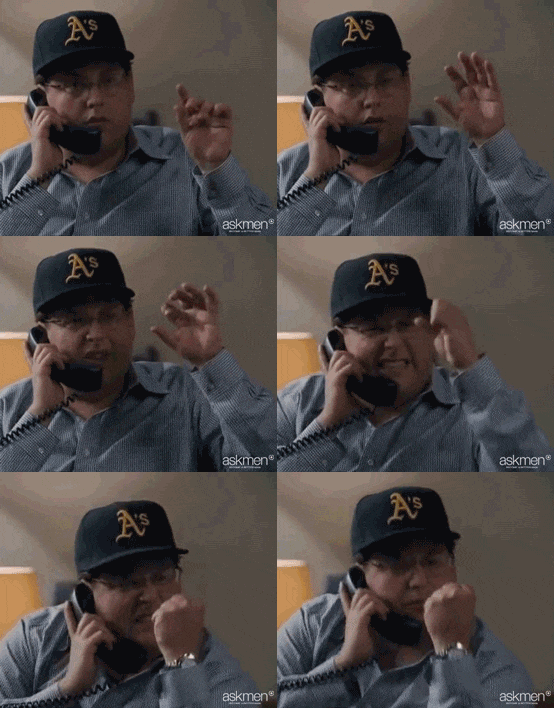
The Oakland Athletics used data to find players others didn’t value very highly to help them field a team that could win 100 games while fitting their very limited budget. It was a game-changer for them, and for the rest of Major League Baseball who followed that example.
Besides, learning new things is fun. Again, you may try something only to find it doesn’t work for you.
That’s ok. Now you know more than you did before.
But if you do discover some new strategy or approach that pays dividends you’ll be glad you gave it a try. Even if you had to change your world view a little.
It’s easy to be the rock, staying in one place while the world rushes past you. But eventually it will wear you down too. Be the river.
Check Out Our New Podcast
Speaking of learning new things, my good friend Jay Bolden and I have started a new podcast called “From the Coach’s Mouth” where we interview coaches from all areas and levels of fastpitch softball as well as others who may not be fastpitch people but have lots of interesting ideas to contribute.
Our first two episodes are in the books. In the first we spoke with pitching guru Rick Pauly of PaulyGirl Fastpitch, and in the second we heard from Coach Sheets (Jeremy Sheetinger), head coach of the Georgia Gwinnett College baseball program.
You can find it here on Spotify, as well as on Apple Podcasts, Pandora, Stitcher, iHeart Radio, or wherever you get your podcasts. If you’re searching, be sure to put the name in quotes, i.e., “From the Coach’s Mouth” so it goes directly to it.
Give it a listen and let us know what you think. And be sure to hit the Like button and subscribe to Life in the Fastpitch Lane for more content like this. Commercial over.
River photo by Matthew Montrone on Pexels.com
Compete Against Yourself First

The desire/urge to compete is pretty much baked into our DNA. Where originally it was a survival mechanism – those who were best at finding resources (or taking them from others) were the most likely to live – that drive lives on today in many forms, including the desire/urge to score more runs than an opponent.
It can be good thing, spurring us on to achieve more than we would have otherwise had we not had an example to compete against or a level of performance to aspire to. But it can also turn ugly when it moves from helping us establish goals to judging our self-worth by how we compare to others – either specific individuals or others in general.
The problem with these types of comparisons is they often don’t take into account the fact that the competition is often not occurring on a level playing field.
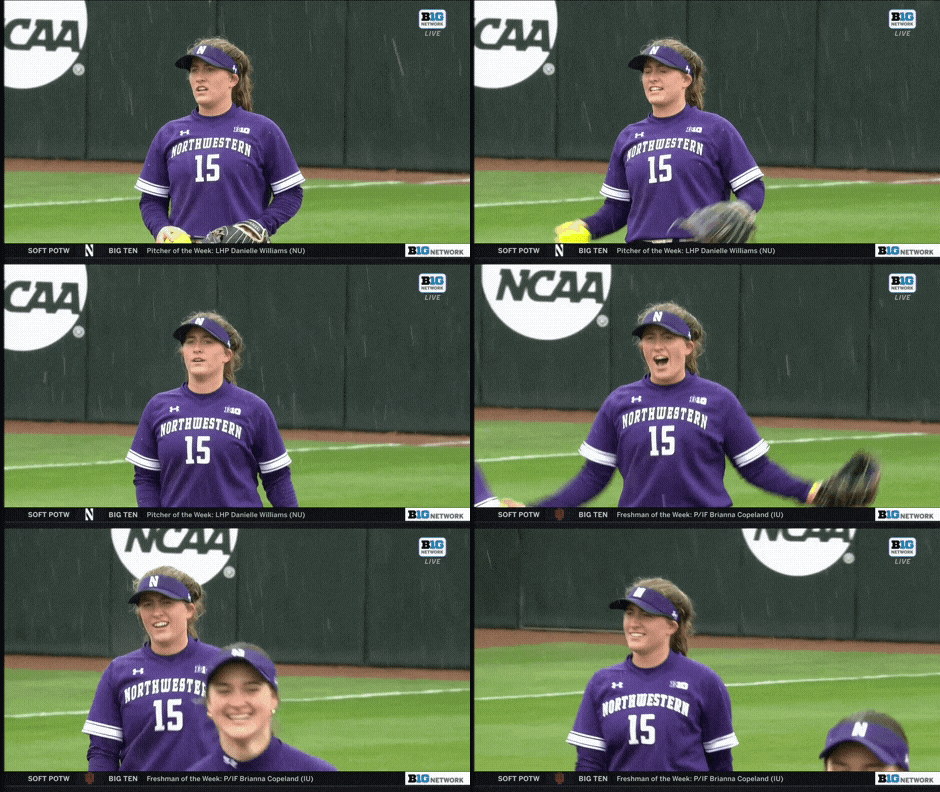
Take a couple of beginning pitchers for example. They both start learning at the same time, so it’s easy to think that they will progress at the same pace.
But maybe one is a little more naturally athletic or simply more coordinated than the other because physically they’re developing at different paces – each at her own pace, incidentally. The more athletic one is likely to jump out to an early lead, throwing harder, throwing more strikes, being ready for a second pitch, etc. before the other.
The one who falls a little behind may look at it and feel bad about herself. She can say, “I work just as hard and practice more, but I am not getting the same results. Therefore I must not be very good.”
That’s the wrong way to look at it, in my opinion. Rather than comparing herself to the other pitcher, the second girl should instead look inward to see if she is better than she was a week ago, a month ago, six months ago, etc. She might like what she sees a whole lot better.

Perhaps when the girl who’s feeling bad started out she was arcing the ball in, or having trouble making it to the plate. For an older girl, maybe she was throwing hard but it was anyone’s guess where it might go.
Now she is getting to the point where you could put her in a game when it matters. She may not be quite as spectacular as the other one (at this moment), but she is leaps and bounds better than she used to be.
And here’s the funny thing. Just because she’s behind right now doesn’t mean she will be forever.
Some kids are just naturally more coordinated than others at younger ages. Some kids have earlier exposure than others to quality coaching, which shortcuts the learning process. Some kids just take a little longer to grow or gain strength than others.
But when player two catches up, look out! She may just end up being the best of the bunch.
I recently heard a story about the legendary pitcher and Olympian Cat Osterman talking to a group of youth players at USA Softball’s High Performance Program (HPP) national player selection event. After watching the quality of the talent that was there, she told them that when she was their age there was no way she would have been invited to such an event, much less have been able to win a spot on the roster.
She didn’t become the Cat Osterman we know until a little later. She was tall and gangly and hadn’t quite figured out how to get those long arms and legs all moving together in a way that would dominate hitters.
Had she primarily been comparing herself to the other pitchers around her she might have become discouraged and given up. And the sport would have missed out on one of its all-time greats.
But instead, she just kept going, focusing on making herself better so she could get more opportunities to pitch. I’m sure at times she looked at who was ahead of her and thought, “If I can get better than her (or them) I’ll be pitching all the time.” She is a competitor, after all.
Yet she apparently never let the fact that she wasn’t as good right now discourage her from trying to become better. She kept plucking away at it, and eventually passed them all – to the point where she was good enough to compete and medal in the Olympics in 2004, 2008, and 2020. A pretty remarkable feat by any standards.
The bottom line is each of us has a path to walk, and we walk it at our own pace. You can’t control how good someone else is at any given point in time, but you can control your own progress toward your goals.
It’s ok to look ahead and say you want to beat this person or that person as a way of measuring progress toward those goals. But in the end remember the main person you’re competing against is yourself.
Keep trying to better yourself, little by little, day by day, step by step, without overly worrying that this person or that person is ahead of you right now. Keep walking the path and one day you’ll look back and be amazed at how far you’ve come.
Vlog: Absolutes v Core Principles in Fastpitch Pitching

Today we’re starting the new year with something a little different.
Recently Rick Pauly of Pauly Girl Fastpitch and the High Performance Pitching certification program and I got together for a video discussion about several topics related to fastpitch pitching. The driving topic behind it was the difference between absolutes and core principles in athletic movement generally, and how we view each relative to fastpitch pitching.
The discussion then branched out to a few other related topics, including the importance of posture, the effect of motor preferences when determining what’s optimal for performance, and the often-overlooked significance of deceleration as part of the overall kinetic chain.

So what are absolutes v core principles? We go into it more in detail in the video but briefly it’s the idea of whether there’s one “correct” way to do things – basically a hard line – or if there is a more of a range into which good pitching mechanics can fall.
In other words, do you want your pitchers doing certain things exactly the same way or does fastpitch pitching allow more room for deviation based on a number of factors? And even within that are there exceptions, i.e., pitchers who don’t necessarily do things the way they “should” but are successful anyway?
Which ultimately leads to when do you make corrections/changes and when do you just let them do what they do?
I think you’ll find it to be a pretty interesting discussion that covers a lot of ground. To check it out, follow this link to the Pauly Girl Fastpitch blog.

Happy new year to all! Or happy whatever holiday is close if you’re reading this sometime in the future.






 Life in the Fastpitch Lane