Blog Archives
The Best Make Time. The Rest Make Excuses.

As I’m sure you already know, we are at a very busy time of the year.
The school year is almost over, so teachers are diligently working to cram everything they were require to teach but haven’t so far into these last few weeks before the final bell rings for the summer. School, park district, and private organizations are preparing to put on their spring plays/musical recitals or concerts, dance recitals, science fairs, art fairs, and other events.
On top of which rec leagues are launching, travel teams are gearing up for the long summer, and many high schools and colleges are getting ready for their playoffs.
With so much going on it’s understandable that fastpitch softball players might say, “I just don’t have the time” when it comes to the extra work required to help them level up their play. And in many respects they’re right.

But here’s the reality: if leveling up is important to you, somehow you will make the time. If it’s really not, you’ll make excuses.
Take the photo of Madi shown here for example. She has one of the best built-in excuses for not practicing you could have: her left foot is in a boot due to a broken toe.

But instead of saying, “Oh well, if I can’t pitch full-out I can’t pitch” she kept every lesson and worked on what she WAS able to do to help herself get better.
Or how about this Maddy? She could barely walk in the door under her own power due to nerve damage in her leg from taking a couple of hard line drives to the same spot in her shin.

Did she let that stop her? No! We pulled up a stool and she worked on what she could so that when she was able to walk normally again she’d be better than she was before the injuries.
Those are a couple of extreme examples for sure. And their issue was injury, not time-based, so maybe you don’t think it’s quite the same.
The mindset is the same, however, i.e., I’m not going to let anything stop me from getting better.
If your issue is not enough time, then perhaps it’s time to put on your thinking cap and get creative.

One way to do that is to look for short opportunities instead of thinking practice has to be a half hour or an hour. For example, if you have a lot of homework, research shows that taking breaks of 5 to 60 minutes helps keep your mind fresh so you learn better.
Instead of hopping on social media (which doesn’t give your mind the proper break anyway) why not take some practice swings or throw a rolled up pair of socks into a mirror for 10 minutes? The physical activity will help rejuvenate your brain while also helping you improve your softball skills. Three breaks like that and you’ve put in 30 minutes without even thinking about it (pun intended).
Or let’s say your high school team’s practice doesn’t allot enough (or any) time for you to practice a specific skill. When practice is over, hang out a little longer while you’re still warmed up and in softball mode to do a few reps of whatever you need to work on.
What if you’re in the school play? I did those when I was young and I know how much standing around time there is during rehearsals, especially if you’re not the lead.
Go find a corner somewhere and go through whatever mechanics you need to work on, or your band work or other exercises. In most cases you don’t need much more than about a 10′ x 10′ area, or a convenient hallway.
You can even get a little practice time in when you’re standing in line for the school cafeteria or the grocery store with your parents. If you’re a pitcher, work on getting faster, looser pronation at the finish. If you’re a hitter, work on using your hips more effectively.
There are lots of fairly subtle things you can do to make use of the fact that you’re not doing anything else. Sure, people might stare at your funny. But those stares will turn into looks of admiration when you’re out-performing your opponents on the softball field.
The key is to think about practice not in the traditional large block of time way but in smaller bites that you can execute whenever you have a few minutes, or need a few minutes to yourself. Know specifically what you need to work on most, and then make the time to work on it.
All those little on-the-fly practice sessions will quickly add up to the types of big improvements that will help you achieve your goals.
Don’t talk yourself out of greatness. Remember that the best make time and the rest make excuses. Choose which group you want to be a part of.
Thoughts for Those at the End of Your Travel Ball Career

We are now at the point of softball travel ball where the season is winding down and teams are playing their final tournaments. It looked like such a long summer ahead back in May, yet here you are with just a few games left to play.
For many players, their thoughts have already turned to tryouts for next year. In fact, many of you have either already gone through the process or are in the midst of it.
But there’s one special group of players who aren’t thinking about next season: those who are playing their final season of travel ball. Those are the ones I want to address today.
It’s sure been a long journey for most of you. Maybe you started when you were 8 years old without a clue as to which field was right and which was left.
Maybe you started when you were 10. You played a couple of seasons of rec ball and then someone said, “Hey, you should try playing at a higher level,” or your friends were doing it so you thought you would too.
Or maybe you were kind of late to the travel ball party, starting around high school age. You had a lot of catching up to do but the effort was worth it
Whatever road you took to get here, you all ended up in the same place – the final games of your travel career.
If you’re not playing in college next year this is most likely the last time you’re going to play fastpitch softball at a truly competitive level. Sure you might join a club team if you go to college, or a slowpitch team that plays on a weeknight.
But it won’t be the same. The intensity of practice and the level of commitment required will be far less, and the overall atmosphere will be more laidback.

And even if you are continuing to play in college it will be a whole different world. No more spending 12+ hours at the ballpark with your team as you play five games in a day.
College teams play one game per day for the most part. About the only time they play more is if there was a rainout or a rainout is expected the next day. Then they will play two.
Unless you’re in the Women’s College World Series playoffs there won’t be dozens of other teams around either, sitting on the sidelines under canopies listening to music on earbuds or trying to catch a little nap. Just you and your opponent who come to the ballpark, play, and then leave.
It really is the end of an era for you, which is why it’s important to take a few moments as your travel ball career winds down to appreciate this very special time in your life and appreciate the journey.
As you go through these last few games, don’t just treat them like another day in a long series of days. Take a little time to appreciate the whole experience:
- When you’re warming up for your first game of the day, stop and sniff the air. Our sense of smell has the strongest connection to our memory. Even a faint hint of a familiar scent can trigger powerful emotions. So take a deep sniff and notice the fragrance of freshly mowed grass, a sweet breeze on a hot summer afternoon, maybe the hint of rain in the air, the charcoal coming from the grill at the concession stand, or even the leather in your glove. Someday, when you’re much older and making your way through the world, these sweet fragrances will take you back instantly to a time when your biggest care in the world was hitting your spots or not getting suckered in by a changeup.
- Take a moment to appreciate a freshly dragged and lined field. See the beauty of the chalk as it outlines the field of play, the world you’re about to inhabit for the next couple of hours. Enjoy the contrast it makes with the playing surface. (This also applies to turf, just in a different way.) You’ve been here a million times, sure, but have you ever really noticed it? The (hopefully) smooth surface and straight lines give promise to endless possibilities, It’s the perfect metaphor for what your life is about to become. See it and think of all the fields in all the places you’ve played, because soon the field won’t be yours to play on anymore.
- Enjoy the camaraderie of your teammates and being part of something larger than yourself one last time. When you first started you were probably among friends you already knew. Now, perhaps, you’re among friends you’ve made along the way, essentially by necessity as you all came together for a common goal. You will probably not remain close with most of them, but at some level you will always have a bond that time and circumstance cannot break. Years from now if you run into them you will talk about all the good times you had, and you may even be transported back in time for a few moments to when you were young and playing softball well seemed like the most important thing in the world to you.
Life rarely gives us a heads up as to when this will be your last time to do something you love. Parents never realize it’s the last time they will pick up their child. School friends rarely know it will be the last time they all meet at the playground.
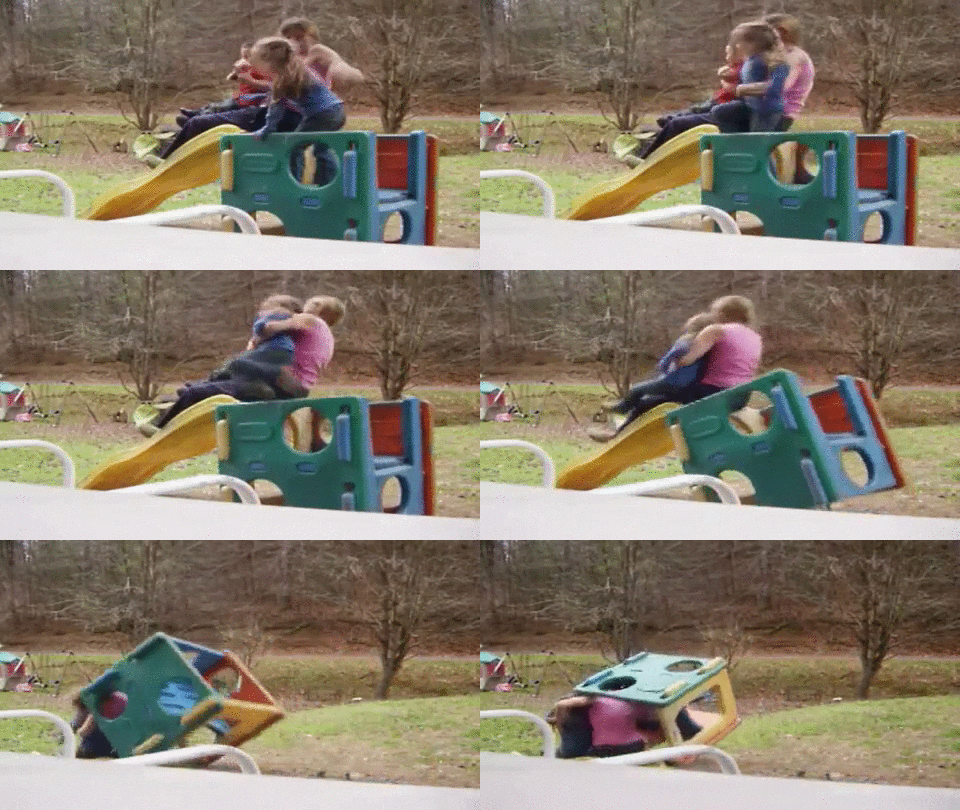
This one, however, does have an expiration date. Take a little time to appreciate the entire travel ball experience one more time.
And when the final out of your final game comes and the cheers die down, win or lose, take a little extra time to soak it all in for as long as you can. Such days as these will rarely come again.
Travel Ball’s Long-Term Effect on the Future of Pitching

I have made it clear in the past that I am not a fan of time limits on fastpitch softball games. Maybe I’m just old but I believe the game is meant to be played over a minimum of seven innings, no matter how long that takes.
Time limits, however, are a fact of life in travel ball. Whether you believe it’s tournament directors/organizations being greedy by trying to squeeze 10 lbs. of play into a 5 lb. set of fields or well-meaning tournament directors/organizations trying to ensure that games run on time out of respect for the teams who spend all day at the ballpark, time limits don’t appear to be going anywhere any time soon.
With that in mind, I have a few observations on how these time limits are affecting the game today, and how they will affect it in the future. Whether you agree or disagree, let me know in the comments below.
Observation #1: Pitchers find it more difficult to last seven innings when required. I am seeing that a lot in high school ball right now.
Pitchers who are used to games lasting 75 or 85 minutes are able to perform at a high level for five innings or so. But come inning #6, they start having a lot more trouble.
Now, I know some will say that’s because they’ve gone around the batting order a couple of times and the hitters have seen them. But I don’t think that’s the sole reason.
I believe that mentally they are used to the games being done by that point, and the thought that they have to keep going requires some adjustment. For some, it can even get tough at the end of the fifth as they realize they still need to have something in the tank for another two innings.
Does that mean they can’t adjust? Of course not. But it may take them a while before they learn to pace themselves properly for a seven-inning game.
Observation #2: Teams can no longer ride one pitcher for the season. Back in the day, to be successful a travel team, high school team, or even a college team really needed only one Ace pitcher. She was expected to carry the load, pitching every inning (or nearly every inning at least) in every major tournament.
That is no longer the case. Now, it could be that the hitters have gotten a lot better, actually working at their craft in the off-season like pitchers always have.
Rule changes have also made it tougher to ride one pitcher. Pushing the pitching distance back and moving from white balls with white seams to yellow balls with red seams has brought more offense into the game. So has bat technology, which sometimes allows a ball struck with a half swing to carry over the fence.
But I also think the way travel teams and tournaments are structured has had an effect on pitchers’ ability to carry that type of load. All the stop/start of more games can place more stress on young arms, so teams are spreading the load more.
While I think that’s a good thing overall, it also means many young pitchers don’t learn HOW to carry the load. They know there’s always help available.
Greater availability of facilities and lessons also means there are more pitchers out there than ever before. Those pitchers aren’t going to stick around very long, however, if they don’t get innings, so that means coaches must ensure #2 and #3 receive enough circle time to stay with the team.
From a health and safety perspective that’s a good thing, in my opinion. But it does mean that fewer #1s are learning how to be that pitcher. They are becoming more inclined to thinking they did their job in game one, and now it’s time for someone else to step up.
Observation #3: We will likely see more specialization in the future. As a result of the previous changes, I think it’s likely fastpitch softball, especially at the collegiate level, will start to look more like baseball, with a bullpen full of specialists.
Right now, all pitchers are considered to be starters. That doesn’t mean they all get starts – that decision is still merit-based (or political, depending on who you talk to).
But pitchers in a college bullpen aren’t thought of as being middle relievers, or closers, or really anything other than an arm available to throw in a game.
I think that will change, especially with a generation of pitchers used to working within time limits. That girl who is lights-out for one inning but deteriorates rapidly after?
Instead of trying to force her to improve her endurance, make her a closer. She can just go in and rocket the ball for three or four hitters rather than giving the top of the lineup a chance to see the starter for a third or fourth time.
Your #3 or #4 starter? Maybe she’s better suited to be a middle reliever. Pair her up with a starter where she will be a contrast – like a dropball pitcher paired with a riseball pitcher – and let her come in when hitters start getting comfortable with the starter.
The more teams use their pitchers as a staff in specific roles rather than trying to fit everyone into the “starter” category, the more they can become strategic.
Would it be better to have one Ace you knew you could ride the whole way? Maybe. But thanks to the way pitchers are being developed these days I think that ship has sailed.
Rather than fighting it, it’s time for colleges to look at what they’re getting and figure out how best to use them. The good news for players is that this sort of change in thinking might open up some new opportunities that weren’t there before. Especially for those who fit that “closer” description.
Matching reality
The foundation of softball at the high school and collegiate levels is youth softball – primarily travel ball. Changes there will affect the way the game is played all the way up the food chain.
Rather than fighting it, or clinging to old ways, schools need to take a hard look at the way the game is being played at the younger levels and adjust their strategies accordingly. Those who do will likely have greater success in both the short- and long-term.
Are We Destroying Our Kids?

Injuries have always been a part of participating in youth sports. Jammed fingers, sprained ankles and knees, cuts requiring stitches, even broken bones were an accepted part of the risk of playing. Things happen, after all.
Lately, though, we are seeing a continuing rise of a different type of injury. This one doesn’t happen suddenly as the result of a particular play or miscue on the field. Instead, it develops slowly, insidiously over time, but its effects can be more far-reaching than a sprain, cut or break.
I’m speaking, of course, about overuse injuries.
According to a 2014 position paper from the American Medical Society for Sports Medicine, roughly 46 to 54% of all youth sports injuries are from overuse. Think about that.
There was no collision. There was no tripping over a base or taking a line drive to the face. There was no stepping in a hole in the outfield or catching a cleat while sliding. The injury occurred while participating normally in the sport.
And here’s the scary part. As I said, this report came out in 2014. In the six years since, the pressure to play year-round, practice more, participate in speed and agility training and do all the other things that go with travel ball in particular has only gotten worse.
You can see it in how one season ends and another begins, as we recently went through. Tryouts keep getting earlier and earlier, with the result that players often commit to a new/different team before their finished playing with their current teams.
It’s not that they’re being bad or disloyal. It’s that they have no choice, because if they wait until the end of the current season there won’t be anywhere left to go because all the teams have been chosen.
What is even crazier is that there literally was no break for many players from one season to the next. I know of many for whom their current season ended on a weekend and their first practice for the next season was the week immediately after. Sometimes they were playing their first game with the new team before their parents had a chance to wash their uniforms from the old team.
And it wasn’t just one practice a week. Teams are doing two or three in the fall, with expectations that players will also take lessons and practice on their own as well.
That is crazy. What is so all-fired important about starting up again right away?
Why can’t players have at least a couple of weeks off to rest, recuperate physically and mentally, and just do other things that don’t require a bat, ball or glove? Why is it absolutely essential to begin playing tournaments or even friendlies immediately and through the end of August?
I think what’s often not taken into consideration, especially at the younger ages, is that many of these players’ bodies are going through some tremendous changes. Not just the puberty stuff but also just growth in general.
A growth spurt could mean a reduction in density in their bones, making them more susceptible to injuries. An imbalance in strength from one side to the other can stress muscles in a way that wouldn’t be so pronounced if they weren’t being used in the same way so often.
Every article you read about preventing overuse injuries stresses two core strategies:
- Incorporating significant periods of rest into the training/playing plan
- Playing multiple sports in order to develop the body more completely and avoid repetitive stress on the same muscles
When I read those recommendations, however, I can’t help but wonder: have the authors met any crazy softball coaches and parents?
As I mentioned, I’ve seen 12U team schedules where they are set to practice three times a week – in the fall! And these aren’t PGF A-level teams, they’re just local teams primarily playing local tournaments.
Taking up that much time makes it difficult to play other sports. Sure, the softball coach may say it’s ok to miss practices during the week to do a school sport, but is it really?
Will that player be looked down on if she’s not there working alongside her teammates each week? Probably.
Will that player fall behind her teammates in terms of skill, which ultimately hurts her chances of being on the field outside of pool play? Possibly.
So if softball is important to her, she’s just going to have to forego what the good doctors are saying and just focus on softball, thereby increasing her risk of an overuse injury.
This is not just a softball issue, by the way. It’s pretty much every youth sport. I think the neverending cycle may be more of a softball issue, but the time factor that prevents participation in more than one sport at a competitive level is fairly universal.
In the meantime, a study published in the journal Pediatrics that pulled from five previous studies showed that athletes 18 and under who specialize in one sport are twice as likely to sustain an overuse injury than those who played multiple sports.
The alarm bells are sounding. It’s like a lightning detector going off at a field but the teams deciding to ignore it and keep playing anyway. Sooner or later, someone is going to get struck.
What can you do about it? It will be tough, but we have to try to change the culture.
Leaders in the softball world – such as those in the various organizations (including the NFCA) and well-respected college coaches – need to start speaking up about the importance of reducing practice schedules for most of the year and building more downtime in – especially at the end of the season. I think that will help.
Ultimately, though, youth sports parents and coaches need to take responsibility for their children/players and take steps to put an end to the madness. Here are a few suggestions:
- Build in a few weeks between the end of the summer season and beginning of the fall season for rest, recovery and family activities. There’s no reason for anyone to play before Labor Day.
- Cut back on the number of fall and winter practices. Once a week with the team should be sufficient. Instead, encourage players to practice more on their own so they can fit softball activities around other sports and activities.
- Reduce the number of summer games/tournaments. Trying to squeeze 100+ games into three months in the summer (two for high school players who play for their schools in the spring season) is insane bordering on child abuse. Take a weekend or two off, and play fewer games during the week.
- Plan practices so you’re working on different skills in the same week. This is especially important when it comes to throwing, which is where a lot of overuse injuries occur. Work on offense one day and defense another. Or do throwing one day and baserunning another. Or maybe even play a game that helps with conditioning while working a different muscle group.
It won’t be easy, but we can do this. All it takes is a few brave souls to get it going.
Overuse injuries are running rampant through all sports, including fastpitch softball. With a little thought and care, however, we can reverse that trend – and keep our kids healthier, happier while making them better players in the process.
Photo by Karolina Grabowska on Pexels.com
Tryouts – No Rest for the Weary

Photo by Pixabay on Pexels.com
As someone who has been around fastpitch softball at the travel level for more than 20 years, I can’t help but shake my head at how early tryouts are these days.
It’s hard to believe today but back when I first became involved, as the parent of a player in her first year of travel ball, travel ball tryouts were in the spring. You would play out the summer, the last regular tournament would be at the end of July, then the various “nationals” would happen the first 10 days or so of August (depending on how the calendar laid out).
I remember, because that first year we had to leave for a family vacation on Saturday after playing Friday. (My daughter and I wanted to stay through the end of the tournament but my wife put a big “no” on that idea.)
As time went on and I became a coach, tryouts kept moving up earlier. First we held them at the beginning of December. Then in September. And finally, the organization I was with started doing tryouts the week after nationals finished. We had to, because everyone else was doing them then and if we didn’t all our players would’ve been settled in somewhere else.
Still, I was shocked in mid-July as various students and their parents told me they were going to tryouts the following week. Many nationals hadn’t even occurred yet, but here they were already trying out for next year.
It’s gotten to be like a reality TV show – “Tryout Wars.” Every program is trying to get a leg up on the others in its area, and so schedules its tryouts a week earlier than everyone else to try to secure the best players before others can get to them.
Of course, if they want you they expect a decision (and a check) on the spot. That way you’re less likely to go somewhere else.
It just seems like madness to me. Pretty soon, you won’t be trying out for the coming year in August. The timeline will have pushed back so far that you’ll be trying out for two years from now.
The people that get hurt the most by all this are the families. They can’t fully enjoy the end of their season, and the nationals experience, because they’re too busy planning for (or worrying about) the next season. Instead, they hear the music of The Clash in their heads:
What’s the answer? I don’t have one. Even if all the national sanctioning bodies got together and declared “no tryouts allowed until September 1” I doubt anything would change. There’s no way to enforce it.
So instead, when teams should be focused on making a run for whatever year-end title they’re going for, or families would like to take a break from the hectic schedule of the summer, they instead find themselves thinking mostly about next year.
Oh, and there’s no advantage for the top teams in each age bracket either. Players can’t afford to wait, because if they don’t make those teams and haven’t committed elsewhere they may find themselves without a place to play the next year.
It’s a shame. It would be nice if families (and coaches for that matter) could get a week or two off before beginning the whole process again. They could all come into it fresh and energized instead of tired and burdened. But unless there’s a groundswell movement, it looks like the only advice is “suck it up, Buttercup.”
Oh, and fall ball starts in two weeks.






 Life in the Fastpitch Lane