Blog Archives
6 Ways to Take Advantage of the New Year

The holidays are over and the calendar has flipped back to January. I would say people are stressing over writing the wrong dates on their checks but who writes checks anymore?
Except the little old lady in front of you in line at the grocery store when you just want to buy a loaf of bread or a half gallon of milk and get on your way?
While in reality New Year’s Day is just an arbitrary date (as evidenced by the many different calendars, each with their own first day of the year), the idea of a new year does provide an extra incentive to think about doing things a little differently going forward.
So with that in mind, here are a few ideas of how you can shake things up a bit and make this your best softball year ever.
1. Get New Batting Gloves
I actually see this one a lot. Hitters go to put on their batting gloves and half their fingers are sticking out, or the palm looks like a surface map of the moon. Or the stench is so bad it hits from 15 feet away.

Batting gloves aren’t that expensive, at least relative to most equipment in fastpitch softball, yet they can save you from a lot of blisters and other issues during long practice sessions. Sure, your daughter should have asked for them for the holidays but she didn’t, because the only time anyone thinks about batting gloves is when they go to put them on.
Don’t be cheap. Pony up a few bucks and replace them. If your daughter is superstitious, tell her she can keep the old gloves in her bag, or her back pocket. Preferably in a sealable plastic bag.
2. Clean Out Bat and “Go” Bags
Over the course of a season, bat bags quickly become a dumping ground for old water and sports drink bottles, half-eaten fruit rollups, used bandages, team handouts, the occasional extra shirt or shorts, miscellaneous plastic wrappers and other detritus of the sport. Not to mention field dirt and those little rubber pieces from turf fields.
With games at a minimum right now, this is a good time to completely empty out the ol’ bat bag, throw or put away everything that doesn’t need to or shouldn’t be in there, and give the inside of the bag a thorough scrubbing to boot. Maybe at a car wash.
The same goes for parents’ gameday “go” bags and coolers. There’s a pretty good chance you have a few science experiments running in there at the moment.
Clean them out before the season starts to crank back up in earnest. Not only will it be healthier (and smell better). It might even make everything a whole lot lighter.
3. Do Some Research about Doing Research
There is a metric crap ton of information about how to pitch, hit, throw, run the bases, warm up, and perform a variety of other fastpitch softball-related skills on the Internet and in social media. Some of it is great, but quite frankly a lot of it is useless at best and garbage at worst.
How do you tell the difference?
Well, rather than just jumping on to the first thing you come across in a search (or while scrolling), do some research about who is putting out the information, such as:
- What is their background?
- How long have they been teaching?
- Do they seem open to new information or are they stuck in their ways?
- How do their students do overall? Not just their one or two best students but across the spectrum?
- Does what you’re reading/watching make sense to you? (You’d be surprised how many videos, especially on apps such as Instagram, actually seem counter-productive when you think about them, even if you don’t have any expertise.)
- Does what the source is espousing match up to what you see the best players in the world doing?
Taking the time to check the source and evaluate what he/she is saying can save you from taking a long, frustrating trip down the road to nowhere.
4. Challenge Your Current Beliefs
It’s very easy to fall into a rut, or assume that you already know everything (or at least enough) about a topic. Taking that attitude can prevent you from discovering a whole other world of knowledge that can make you even better.
Every now and then it’s important to look at information that challenges what you already believe. Especially when it comes to mechanics and general approaches to the game.
You may end up right back where you started, Which is ok – it’s confirmation you’re already on the right track.
But you may also discover techniques or approaches you’ve taken for granted, or that you learned when you were a player, are not quite as beneficial as you thought they were. You can then decide whether to continue blindly following what you’ve always done or make a change that will help you going forward.
Either way, you’ll have made an informed choice.
5. If You’re Taking Lessons, Attend a Non-Affiliated Clinic or Camp
Taking private lessons is a wonderful thing. Obviously I highly recommend them as the best way to make progress toward improvement.
But after a while even the best-designed lessons can get a little dull. They also usually have a limited perspective, even if you’re in a group lesson with 2-4 other players.
Going to a clinic or camp with a different instructor(s) can help in a few ways. Not the least of which is a different instructor may see something your current instructor doesn’t because of familiarity. After a while, we all tend to see what we’re used to seeing.
It also gives you a chance to see how you compare to others. That’s especially important for those who are really driven to be the best.
Sometimes in the drive to get to the next achievement we forget how far we’ve already come. A large group setting can show that while you’re still working on things, you’re actually ahead of the curve overall.

It can also show if you’re behind the curve, which may be an inspiration to those who maybe have trouble getting themselves up for practice sessions. Nothing like seeing where others are to get a player to say “I’d better get after this.”
Many of these clinics and camps are just one day, so it’s not a huge time commitment. But they can be enlightening.
Just be sure to do your research again before just signing up for any old camp or clinic. Make sure the instructors are going to be teaching solid mechanics and approaches or you could end up going backward instead of forward.
6. Do Some Non-Softball Stuff
These days all competitive sports seem to take up a LOT of your time. While you no doubt love it, and wouldn’t trade it for anything in the world, there IS more to life than softball.
This is the time of year to find out what the rest of life is all about. Read a book. Go to a museum or a concert or a dance performance. Watch a completely different sporting event, either live or on TV. Go bowling or ice skating or to a trampoline park (just be careful not to get hurt).
Doing something just for the fun of it will clear your head, reset your spirit, and help you get ready for the long grind ahead.
Make It a Good Year
None of what’s listed here is likely to cost you very much. But the return on investment will be huge.
There’s a reason the windshield is much larger than the rear view mirror. This time of year provides a great opportunity to leave the past behind, symbolically as well as literally, and focus on the road ahead.
Doing these little things will help you do just that.
New Year’s photo by Karolina Grabowska on Pexels.com
Getting Your Money’s Worth Out of Softball Private Instruction

If there’s one thing I think nearly everyone in the softball world can agree on these days it’s that softball private instruction isn’t cheap. Especially in areas where you have to be indoors for at least part of the year.
The facility costs alone can get quite expensive. Then add in the cost for the instructor and it’s definitely not for the faint of heart – or wallet.
A dedicated family can easily spend hundreds or even thousands of dollars by the time it’s all added up, particularly if the instruction goes on for a few years.
That’s why it often shocks me how little effort so many parents seem to put into the decision. If they were buying a new lawn mower, or a refrigerator, or a set of tires for their car they’d probably do tons of research.
They’d look for professional reviews, they’d look for user ratings, they’d compare specs, and maybe even go to a store and look the item over.
That’s why items in this price range (and above) are called “considered purchases.” You don’t just buy them on a whim. You put some thought into the decision because it’s going to put a dent into your wallet and you’re probably going to have to live with whatever you choose for a while.
The cost of softball private instruction can easily surpass all of those items. You’re just doing it on a per-lesson “payment plan.” Yet based on what I’ve seen so many people accept, it seems they go into that expensive purchase that can have so much impact on their daughter’s softball career blind.
Here in the digital age, with a world of knowledge just a few clicks away at most, there’s simply no reason to get anything less than a full return on your softball investment. Here are some ways to make sure you do.
Do your homework on what is good
This is probably the easiest and yet most-ignored piece of advice. I think many parents start out by looking for an instructor who is close to them. To me, that’s putting the cart before the horse.
Before you go looking for instructors, do some homework on what you want your daughter’s instructor to teach. Put in some time to learn what is currently considered the state of the art for hitting, pitching, catching, throwing, fielding, etc.
See what well-known, high-level instructors and coaches are saying. Many of them generously share their knowledge on YouTube, or on sites such as the Discuss Fastpitch Forum. (FULL DISCLOSURE: I am also the administrator at the Discuss Fastpitch Forum, but it is a free resource with open discussions, not a selling site.)
There are plenty of quality paid sites as well, and some with a mixture of free and paid information such as Cindy Bristow’s Softball Excellence, and (hopefully soon) Fastpitch Foundations for pitching.
Once you start getting your feet wet into it, the other thing you can do is look at what high-level players do and see how that lines up with what you’re reading/watching in the instructional materials. You’d be amazed at how many people, even the players themselves, don’t actually understand how high-level players execute their skills.
Check them out on YouTube and other sites, and watch as many high-level games on TV as you can. You’ll start to see the similarities.
Many myths abound, so it’s important to gain as much understanding as you can before you go into it. That way, when you’re evaluating instructors you’ll have a better chance of selecting one who is teaching the techniques actually being used by high-level players.
Watch other local players
Once you have a decent understanding of the instruction you’re looking for, it’s time to start investigating your options. A good way to do that is to observe players, either in games or a practice session, who look to have the techniques you want your daughter to acquire. Then ask them (or their parents) who their instructor is.
Be careful, however, not to confuse “good” with “well-trained.” A gifted athlete – one loaded with lots of fast-twitch muscles and/or exceptional hand/eye coordination, for example – can be successful with no training or even poor training.
(In the latter case, they usually end up not doing anything they instructor says because their body just figures out what do. But they still think they’re doing what they’ve been told.)
That, incidentally, is why looking at an instructor’s record of developing high-level players (think: college) isn’t always an accurate indicator of his/her quality. It’s tough to know how many of them would have succeeded without that coach – or did succeed in spite of him/her. It takes a lot more than “the right instructor” to reach that level.
What you’re looking for instead are players who execute the skills properly, as you understand them from your research. If they don’t appear to be the greatest natural athletes so much the better, because then you know their success is due to their training and dedication.
Last summer I had a perfect case study of how this works. I received a call out of the blue from a father whose daughter is a catcher. They live about an hour’s drive away (with traffic), so it wasn’t a decision he was entering into lightly.
But he said he’d seen a really outstanding catcher in one of their tournament games and he asked where she learned her skills. The parents referred him to me, and I’ve been working with his daughter ever since.
I’m sure he passes a whole host of instructors to get to me, but it doesn’t matter. Because he knows his daughter is being trained in a way that matches his expectations.
Have a conversation
Once you think you’re on the right track, have a conversation with any potential instructors. Get a feel for their knowledge level and what they teach.
One thing you want to determine is whether they take a “cookie cutter” approach, using the same drills and progressions for everyone, or whether they customize the instruction to the student.
It will take some players longer to grasp certain concepts or movements. A good instructor will keep them working to become at least competent at those skills before moving them on to the next one.
Others will grasp the concepts or movements right away. In those cases there is no sense in lingering on them because the stock lesson plan says “on lesson 7 we do this.” Move on.
Do what you can to determine how much the instructor customizes the instruction. Again, a good instructor will teach the same things to all of his/her students. But he/she will do it differently for each.
That conversation is also the time to ask questions. If you know you don’t want your daughter learning certain techniques, such as “hello elbow” for pitching or “squish the bug” for hitting, ask the instructor about it. An informed parent is a smart parent.
Also, don’t be afraid to ask for the “why” behind what the instructor teaches. If there isn’t a “why,” I suggest you politely excuse yourself and move on to the next instructor. Everything should have a purpose.
Do a chemistry test
So you think you’ve found an instructor who has the knowledge and experience to train your daughter properly. The last test is to see what the chemistry is like between the instructor and your daughter.
We all have different personalities and ways of learning. And sometimes people just rub us the wrong way for no apparent reason. That’s life.
If there is a chemistry mismatch, lessons are going to be a drudge for both the instructor and student. You and your daughter will presumably be spending a lot of time working with this instructor, so you want to be sure they are working together as a team.
Also, you know your daughter better than the instructor ever will. You should be able to read her body language and enthusiasm level. A good coach will inspire her to do her best and help her feel good about the learning process.
If that’s not what you’re seeing in a conversation between the instructor and your daughter, or a sample lesson, you may want to continue your search.
Monitor success
Once you’ve made a selection, you’re not done. Keep monitoring to see how things are going.
Is your daughter getting better? Is her technique moving toward what you saw on TV from those high-level players? Is she gaining confidence in herself and her abilities?
The change is unlikely to be instant. It’s more likely to be incremental, with some frustrations and setbacks along the way. But over time you should be seeing speed and accuracy increases in pitcher, better blocking from catchers, stronger and more frequent hits from hitters, etc.
And perhaps someday some random parent will come up to you at a game or tournament and say, “Your daughter is really good. Do you mind telling me who her instructor is?”
Ultimately, however, the best ROI is the smile on your daughter’s face when she is successful and feeling good about herself. That’s when you’ll know it’s all been worthwhile.
Product Review: Softball Bound app makes the college search easier

Unless you are one of those incredibly talented players who has famous softball coaches going out of their way to plan their weekends around watching your 12U/14U games, you’re probably going to have to devote a considerable amount of time researching potential opportunities and looking up the contact information for the coaches at schools you’re interested in.
Now a new app called Softball Bound, which is available for the iOS and Android platforms, has made that part of the process a whole lot easier. Rather than having to spend hours looking up each school individually, and then clicking through to gather information about it and the softball program, Softball Bound puts all that information right at your fingertips. In fact, according to the counters on its website, it provides info on 996 NCAA and 196 NAIA 4-year institutions.
Finding the right schools
The interface is simplicity itself. The default view takes you to an address book-like listing of colleges, starting with the As of course.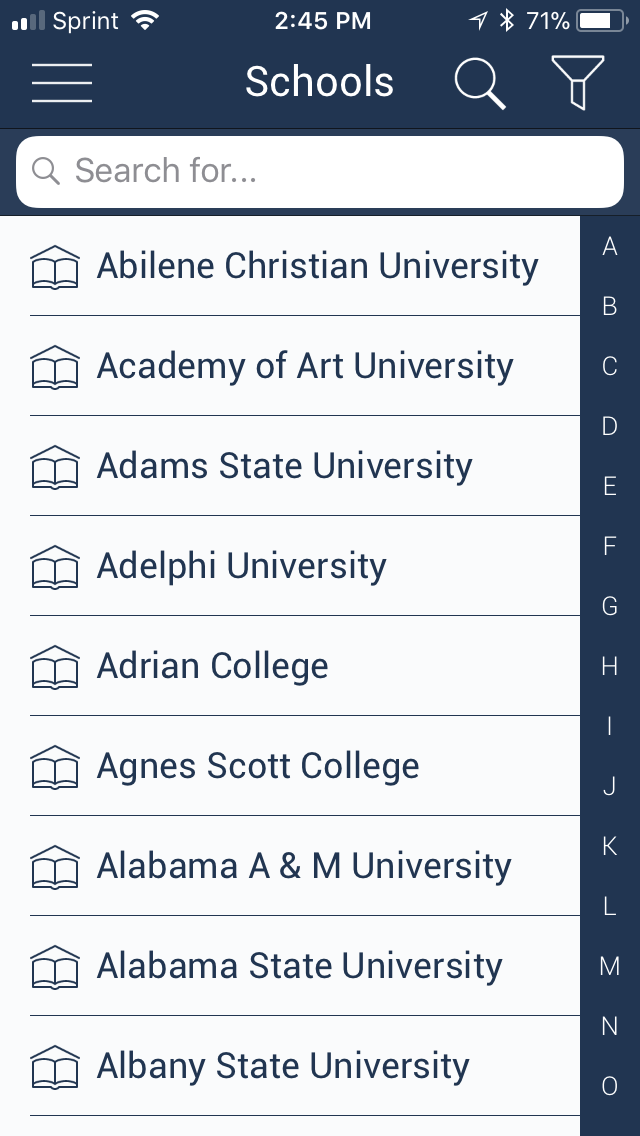
Down the right hand side is the entire alphabet, so you can click on a letter, based on the first letter in its name, and be taken right to all the schools that begin with that letter. So if you want to look up Baylor, you click on B and scroll down. For University of Whoever you click on U, which is probably more intuitive in the long run.
That’s not your only option, however. A little filter icon in the upper right hand corner lets you narrow down your choices by Division (NCAA 1,2, and 3, plus NAIA 1 and 2), Conference, State, or any combination of all three. If you have your heart set on  playing NCAA Division 1 in Tennessee, you can find all the schools that meet those criteria.
If you know exactly the school you want to look up, there’s also a search function. (You can only look up colleges, not coaches or conferences; use the filters for that.) The search function is intuitive, so as you type in your choice it starts showing suggestions.
Core information
Once you’re into a specific school there is a tremendous amount of information. The topic section offers the school’s name, address, and general website. The second section provides the name of the coach (usually the head coach, but sometimes an assistant who is involved in recruiting), along with the coach’s email address and phone number.
These are active links, so clicking on the email address or phone number will start an email or make a call, respectively. You will want to handle that with care. On the other hand, think of how impressed a college coach will be if 10 minutes after a game is over you send a messaging thanking him/her for stopping by to see you.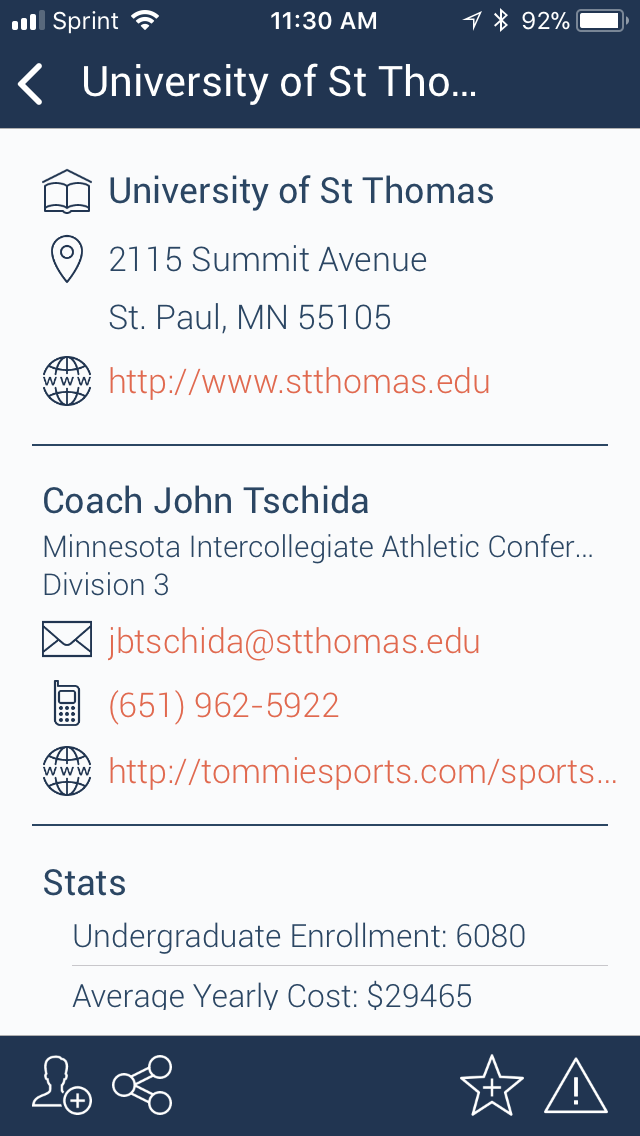
There is also a link to the softball team’s website so you can easily learn more about the program or do your homework before you contact the coach. Never hurts to start an email or a call by congratulating a coach on a recent win, conference championship, or personal milestone.
Deeper details about the institution
Where Softball Bound really shines, however, is the additional information it gathers. The bottom section offers a wealth of statistics about the school, such as undergrad enrollment, the average yearly cost, graduation rate, and average salary after graduation. It also helps you determine whether you have the academics to qualify by offering the average SAT and ACT scores for students at that institution.
Be aware you have to scroll down to see all of the information. The basic school and coach information stay on the screen permanently, but you can scroll through the bottom section to get the rest.
The only negative I found was that I couldn’t read some of the information on my iPhone. If the line is too long it just disappears. Hopefully the developers will be fixing that, because knowing how much money the average salary after graduation or the freshman return rates could be very valuable in helping you narrow your choices.
Carrying relationships forward
Once you’ve made your selections, you can “favorite” them. They then appear on a short list so you don’t have to go through the entire search process each time. As you refine your list further you can remove schools with a click of button as well.
As you build the relationship with different college coaches you can also ask Softball Bound to add them to your regular contact list so you can call or email the coach without having to go into the app. That’s also a very handy feature.
One of the other advantages of the Softball Bound app is they are constantly updating the contact and other information, which means you don’t have to worry about working from an outdated list.
On the website, they also offer the option of purchasing their list for $250. Not sure why you’d want to do that, especially since college coaches frown greatly upon mass mailings. It’s much easier to just purchase the app for a few dollars – especially because if you buy the list it’s up to you to maintain it. Sounds like a lot of unnecessary work to me.
A wealth of helpful, additional information
Speaking of the Softball Bound website, they have more than just product information there. They also have a list of camps you may want to attend, as well as information about the academic side and how to get ready for college. Plenty of links to info on testing (SAT and ACT), creating a skills video, eligibility and so forth. It’s all freely available to anyone and worth checking out.
If you’re actively pursuing playing fastpitch softball in college, or even thinking you might want to, this app is definitely worth it. Especially at $3.99 in both the Apple App Store and Google Play. It can save you a lot of time and effort, and give you a tremendous advantage in your recruiting efforts.






 Life in the Fastpitch Lane