Blog Archives
When Old Ways Become My Way or the Highway

I recently received a rather exasperating note from the mother of one of my catching students. She told me her daughter’s team coach is now insisting that their catchers rip off their hockey-style masks when going after foul balls and making other types of plays.
Neither her daughter or the other catcher is happy about it. They’ve both been taught (one by me, one by someone else) to leave the mask on.
But they are both concerned that if they don’t follow what the coach says they won’t get playing time. In my mind if they both band together and refuse what’s the coach going to do – pull in an outfielder to catch? But let’s table that discussion for now.
The coach’s admonition was, “You play for me and not your catching coaches,” thereby asserting the right of kings in making decisions regardless of the facts or the best information available. In other words, it’s the old coaching philosophy of “my way or the highway.”
From what I am told, this entire controversy cropped up when the other catcher missed a pop-up. The coach drew the conclusion the miss was caused by a lack of visibility within the mask without any real evidence to support it.
The reality is of the many things that could have caused the catcher to miss that pop-up, a lack of visibility caused by the mask is one of the least likely. That’s because the hockey-style masks are designed specifically to provide full visibility throughout the catcher’s field of vision.
Back when I was a catcher, in the days when dinosaurs roamed the earth, we used flat masks that were held in place by elastic straps on the back of your head. They provided good visibility straight ahead, i.e., in the direction the pitch would come from, but restricted your peripheral vision, making it difficult to locate pop-ups or see a ball coming in from the side on a tag play at the plate.
Additionally, those masks were easy to pull off and toss out of the way, so it made sense to remove them for anything that wasn’t a pitched ball coming from straight in front of you.
Today’s masks are large hunks of plastic designed to protect the catcher’s entire head. They are form-fitting and difficult to remove quickly. In fact, trying to remove the mask when doing something like chasing after a foul ball can become a huge and painful distraction if it gets caught on your nose or ears or forehead.
Ripping the mask off can also cause problems if you’re wearing sunglasses or even worse prescription glasses in order to see. The glasses get pulled off and now you’re far worse off than you would have been had the helmet remained in place.
Then there’s the problem of getting rid of it. The old flat masks were lightweight and easy to toss; a full-on hockey-style mask is much bulkier, making it harder to toss and creating more of a tripping risk because of its size. Tough to catch a pop-up when you’re lying flat on your belly, no matter how well you can see it.
Finally, we come to what happens on a play at the plate. When a runner is sliding into home (or worse, crashing into the catcher as she goes to apply the tag even though the runner is supposed to avoid contact) the catcher will be much better protected with the helmet on than the helmet off.
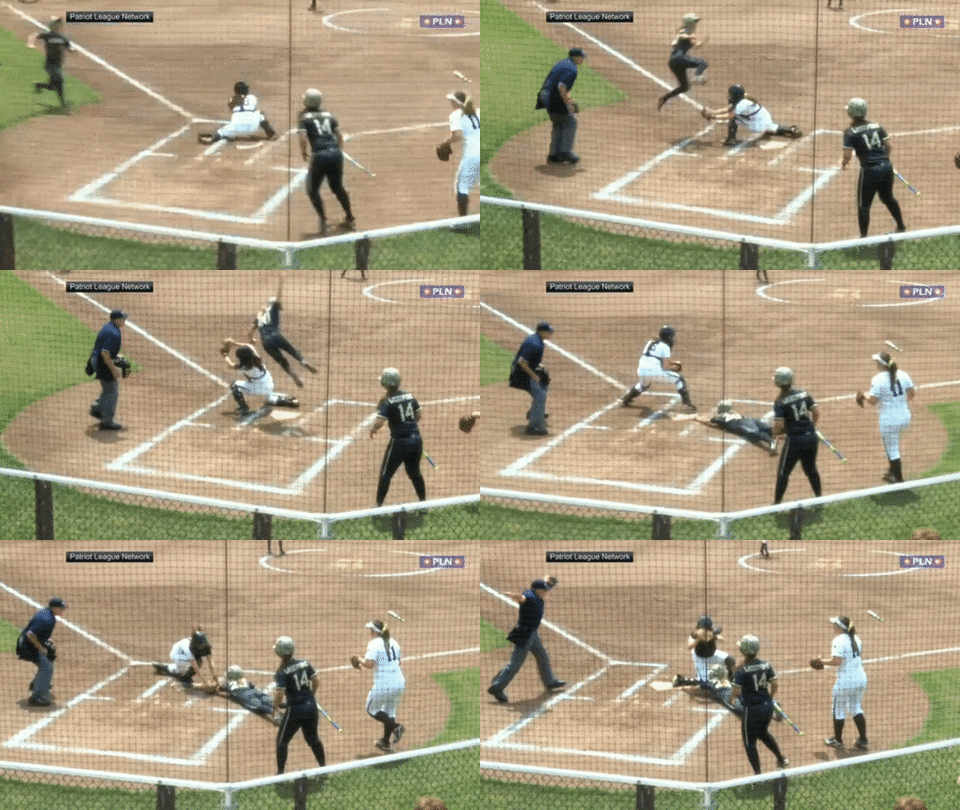
No cleats to the face, no banging your unprotected head on the ground if you’re knocked backwards.
By the way, this isn’t just me saying all this, although it is what I tell catchers. A quick Google or AI search will find pretty much all top-line catching instructors saying the same thing. Removing the catcher’s mask is both unnecessary and less safe.
So the only reason left to insist your catchers rip off their masks when making a play is because YOU ARE OPERATING OFF OF OLD AND OBSOLETE INFORMATION (saying it loud for the folks in the back), and you are letting your ego get in the way of doing what’s best for your players.
This is why it is so important for coaches to continue to seek out new information and learn. Not just about catcher’s masks but all aspects of the game.
The old ways may have worked, but there are a whole lot of smart people out there who have the time, tools, talent, and budget to research every aspect of the game more thoroughly. If new discoveries or information come along that can help your players do better why wouldn’t you want to take advantage of it?

I know some people hate to admit that they may have been wrong in what they were teaching, but they need to get over it. They need to understand it isn’t that they were wrong – it’s that they were using the best information they had at the time, and now they have new and better information.
As my buddy and podcast partner Jay Bolden says, as coaches we expect our players to be learning and improving all the time. Why shouldn’t we demand the same of ourselves?
The fact is we should be eager to learn more, because the smarter and more informed we are, the better chance we have of developing better players who will help us win more games. Sticking with something because that’s the way you’ve always done it is a very poor way to coach, and one that could hurt a player’s development – or even end up with her injured.
The catcher’s mask discussion is just a symptom of a larger issue. Before you insist on players doing something in cases where they’ve been taught something else, take the time to do a little research and see WHY it’s being taught differently.
You might just learn something that will help you not just now but in the future as well.
My good friend Jay Bolden and I have started a new podcast called “From the Coach’s Mouth” where we interview coaches from all areas and levels of fastpitch softball as well as others who may not be fastpitch people but have lots of interesting ideas to contribute.
You can find it here on Spotify, as well as on Apple Podcasts, Pandora, Stitcher, iHeart Radio, or wherever you get your podcasts. If you’re searching, be sure to put the name in quotes, i.e., “From the Coach’s Mouth” so it goes directly to it.
Give it a listen and let us know what you think. And be sure to hit the Like button and subscribe to Life in the Fastpitch Lane for more content like this.
Still Value in Learning to Think Like a Pitcher

These days, even at the younger levels, it seems like the goal is to turn softball players into robots. Nowhere is that illustrated more than the way pitch calling is often handled these days.
In many instances, perhaps even most, coaches are calling pitches from the bench. This occurs whether they actually know how to call a game or not. (Many do not.)
All that’s expected of pitchers and catchers is that they look at their ubiquitous arm bands, follow the rows and columns to the number called, and then throw whatever the answer key says. No thought required, and no shaking off the call.
That’s why I was heartened to receive an email from Tony Carlin, whose daughter Alyssa is a class of ’23 player currently pitching for her high school team.
She was pitching a game, he says, and breezed through the first four innings. Then, as I discussed in a previous post, she began to run into some trouble in the fifth inning.
The opposing team began to hit her, probably because they’d seen her a couple of times by now and was in a different situation than she usually faces in time limit-shortened games. I will let Tony tell the rest of the story:
“The 6th and 7th inning she told me she changed her strategy , and she did very well. She noticed that the batters started showing confidence, were making good contact, and were swinging at the 1st pitch, so she threw everything off the plate or below the knees and got them to chase , and chase badly.”
Brilliant! Alyssa saw that the other team’s hitters were trying to jump on her first pitch so she just threw junk at them – the kinds of pitches you normally reserve for an 0-2 or 1-2 count. In doing so she re-took control of the game and got the win.
What I like most is that she wasn’t just in the circle throwing – she was thinking.
Pitching to hitters is very much a cat-and-mouse game. When the hitters change what they’re doing, pitchers must adjust or they may end up getting clobbered.
But what do you do when the coach is calling the pitches and insisting you throw what he/she calls? Figure out how to change the equation while living within the parameters.
For example, if the call is for a dropball on the outside corner and you know the umpire is giving that and more, throw the ball off the plate. If hitters are being aggressive, throw it a little lower or further outside – anywhere it’s tougher to hit.
If hitters are routinely taking the first pitch, throw your first pitch fat on the plate, the way you would on a 3-0 count. If hitters are routinely laying off a pitch in a location and the umpire is calling it, talk to your coach about starting the hitter with that pitch.
After all, the goal is to get ahead of the hitter. What better way than to throw a pitch she doesn’t like to swing at? You never know – you may force the hitters to start swinging at pitches they don’t like and can’t hit well, either giving you a free strike or a weak contact that turns into an out.
The key thing is to pay attention to what is going on, and figure out for yourself where you can gain an advantage. It’s not only a lot more effective – it’s a lot more fun.
One other thing Tony told me is he was reminding Alyssa to pitch the full seven innings required for a traditional game by holding up seven fingers. He said the coach probably thought he was signaling pitches from the sidelines but he would never do that. He just wanted to be sure she didn’t fall into the time limit trap.
There is more to pitching than great mechanics – much more. True pitchers know how to take what hitters (and umpires) are giving them and use it to their advantage.
Pitchers should regularly walk through imaginary lineups, types of hitters, and situation to learn not just how to throw but what to throw when. It just might help you get out of a serious jam someday.
A quick rundown on why you should regularly practice rundowns
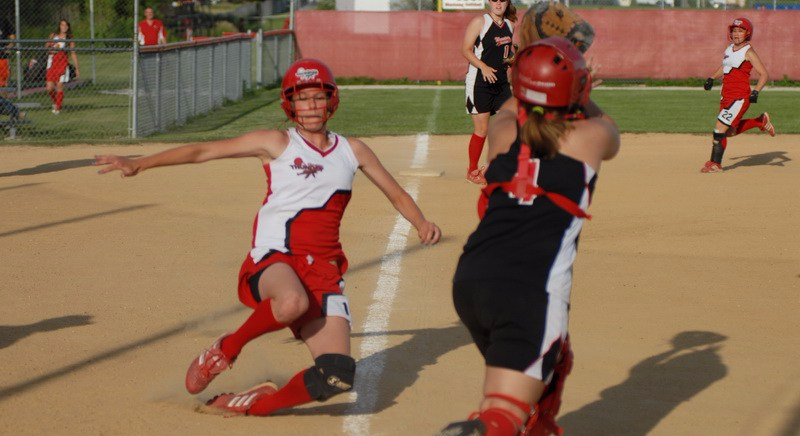
A few years ago, when I was still coaching teams, I heard through the grapevine that one of the parents was griping about how much we practiced rundowns. He was a “baseball guy,” and as such was of the belief that rundowns didn’t happen very often. He couldn’t figure out why we would spend so much time on them.
Forget about the fact that if he’s opened his eyes a little more he would’ve seen that in fastpitch softball, rundowns tend to happen a little more often. It’s a faster game than baseball, with shorter distances between bases (60 feet v 90 feet for those who don’t know) and a smaller field overall.
As a result, baserunning tends to be somewhat more aggressive, and runners (as well as coaches) are more likely to take chances. Especially if they’re not sure they’re going to have many opportunities to score.
But even if that wasn’t the case, there are a lot of other things your team can gain from practicing rundowns other than the specific skill of handling rundowns. Here are a few.
Precision
Rundowns occur over shorter distances overall, and they tend to squeeze in more as they go on. That means there isn’t a lot of room for error. Throwers learn to throw to a specific spot instead of a general direction, and receivers learn to focus intensely – especially when the throw may be coming from an odd angle because the thrower didn’t maintain a good line of sight.
Grace under pressure
This goes along with precision. Things happen quickly in a rundown, and they can go wrong very quickly. If you panic, you’re likely to pull the glove down early and miss a throw, or make a throw you don’t need to make, or hold the ball too long. Rundowns help players learn to handle pressure and stay focused on the task instead of the outcome. By the way, that goes for the person running too. Their job is to stay alive until the defense makes a mistake. Can’t do that if you’re in panic mode.
Communication and teamwork
The ideal rundown has zero throws: the ball gets ahead of the runner, and the fielder chases her down until she makes the tag. But that doesn’t happen too often, so fielders need to be able to communicate effectively to coordinate their efforts. I’m not a believer in the receiver calling “ball” and the thrower holding the ball until they hear that, but if one side isn’t doing their job the other side needs to be able to tell them. Or if the thrower is running with the runner between her and the receiver, blocking the line of site, one of them needs to tell the other to move over so she can see. Or think about a first-and-third situation, with a runner caught between first and second. The team needs to know how to communicate effectively if the runner on third starts heading for home, so the team can break off the rundown on the trail runner and get the lead runner. So much going on!
Conditioning and agility
Yeah, you could have your team line up on the baseline and run a bunch of sprints to build up their speed and recovery time. But why not have them practice rundowns instead? They can get the same level of conditioning – especially if you limit the number of runners who can sub in – and you don’t have to listen to all the complaining. Create a little competition with a prize at the end and they’ll practically kill themselves trying to win. They’ll also learn how to change directions quicker – a valuable skill in several aspects of the game.
It’s fun
When I was a kid, we used to call it “running bases.” Others call it “pickle,” and I’m sure there are other names. But the basic rundown was something we used to do for fun when there weren’t enough kids around or we didn’t have enough time to play a regular game. All you need is a couple of gloves, a ball, something to use for bases, and some space. Instead of treating it like a drill, treat it like a reward – something fun to do at the end of practice.
The beautiful thing is if your team gets really, really good at executing rundowns, they can generate more outs in the field. They’ll look for opportunities, and will be more confident in going after the lead runner in tag situations. On the offensive side, they’ll be more comfortable if they do wind up in one, helping you avoid some outs on the basepaths.
Don’t take rundowns for granted. Make them a regular part of your practice routine and watch the difference they make.
Now it’s your turn. How often do you practice rundowns? How good is your team at executing them? And if you played running bases/pickle as a kid, what did you call it?






 Life in the Fastpitch Lane