Blog Archives
When Scheduling, Leave Time for Practice

The other night as I was wrapping up from lessons I got into a conversation with my friend Dave Doerhoefer. In addition to being a private instructor, Dave is a long-time fastpitch softball coach with the Vernon Hills Stingers travel organization as well as Vernon Hills High School.
The question Dave asked was my feelings about the obsession many travel teams today seem to have with squeezing as many games as they possibly can into the brief summer season. It is not uncommon for travel teams – even those that only play a couple of months in the summer due to spring high school softball – to set a goal of playing 100+ games.
I’ve blogged about this before (actually back in 2012), and it only seems to have gotten worse. So much for me being an influencer.
Both Dave and I agree that teams that focus on playing a crazy amount of games are doing their players a disservice on several levels.
No time for practice
Probably the biggest issue is that if you’re scheduling 2-3 nights of games per week, plus playing tournaments every weekend, you’ve left little time for practice.
That’s a problem because games aren’t where you get better. That’s where you measure where your skills are currently. Practice is where you get better.
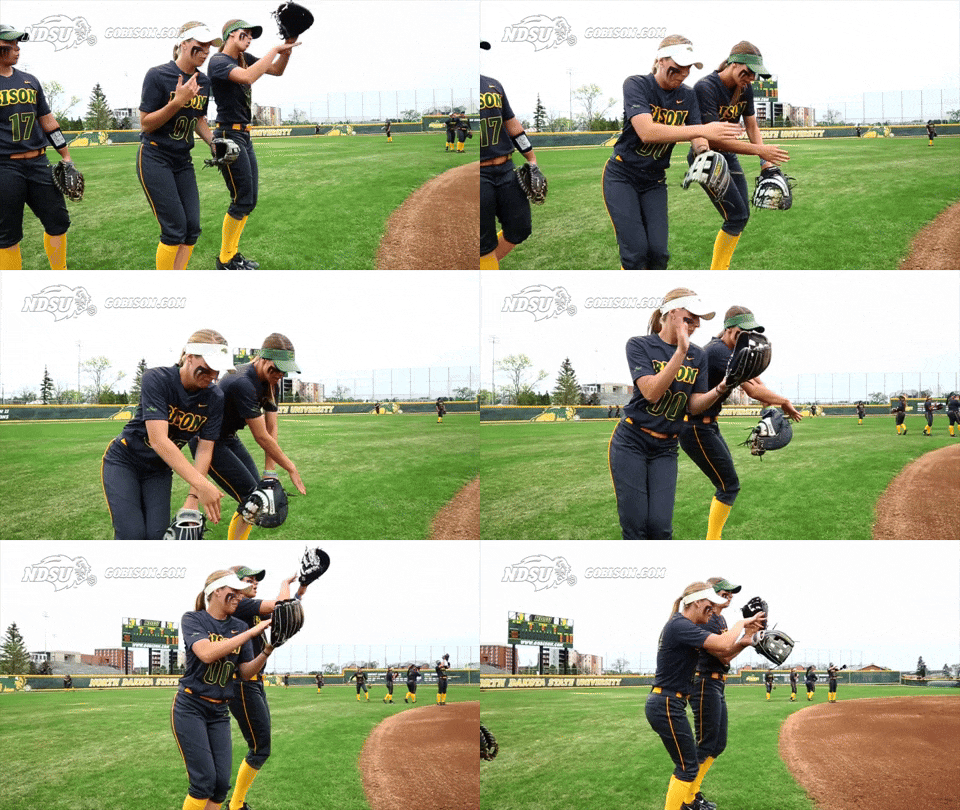
In practice you can field 100 ground balls or catch 100 fly balls, which allows you to really hone your skills. Especially if the coach is smart enough to make those balls just slightly outside your current level of competence and continues to raise the difficulty level as your skills improve.
In a game, you’re lucky if you get 7-10 touches on a batted ball. Most players will get far fewer, or perhaps not any, especially if you have dominant pitchers with good strikeout numbers playing in five inning games due to time limits.
Younger players playing in timed games, who are the ones that generally need the most repetitions, may only see three innings of play. It’s tough to get better when nothing happens.
Add the need to teach all the various situations and permutations a player needs to know to make the good, instant decisions required to play at a high or even decent level and the problem of not getting enough practice time grows exponentially.
Reducing the number of games to allow for more touches/repetitions and instruction time in practice will do more to grow a player’s skills and softball IQ than just throwing them out on the field and leaving it to random chance.
Keeping the excitement
When you play games practically every day what should be a happy diversion from normal life quickly turns into a job. And how happy are people with their jobs?
Research shows that while 65% of workers surveyed are happy with their jobs, only 20% are actually passionate about them. Translating that into teams, if you have a team of 12 players it means only 8 will actually be happy with the team, and just 3 will be passionate about it, if playing softball starts to feel like a job.
You never want playing to feel routine. You always want your players to be excited and ready to give their all – at least if you want to win.

Cutting back on the volume of games will help keep those you do play more special. It will also give the parents a little more time to keep those uniforms looking spiffy.
Reducing burnout
Burnout is a huge problem in today’s youth sports. In fact, research shows 40% to 50% of youth athletes report experiencing some level of burnout.
That doesn’t mean they stop playing necessarily. But they may not have the same level of enthusiasm for playing they once did, and that can lead them to dropping out of the sport entirely eventually.
We have to remember that while we may have big dreams and aspirations for these young athletes, they are still kids. A few may want to play all the time rather than pursuing other activities, but most need other stimuli to help them full enjoy their lives and reach their human (not just their softball) potential.
More general free time, or even more time spent in practices rather than game situations, can help them grow their social skills more effectively as well, which will also help prevent burnout.
Making time for multi-sport athletes
There is much talk about how college coaches love multi-sport athletes, and how being a multi-sport athlete is better for the youth athlete’s health. The cross-training of playing multiple sports can help prevent injuries, especially those caused by repetitive movements. It can also help prevent the burnout discussed above.
Yet it’s awfully tough to fit another sport into your schedule when your softball team is playing nearly every day as well as all weekend.
Of course, this isn’t just a fastpitch softball problem. EVERY sport seems to think they need their athletes playing an incredibly heavy schedule of games in order to compete, and they plan their years accordingly.
At some point nearly all athletes need to choose a sport to specialize in if they want to play at a higher level, i.e., college. But that doesn’t have to be prior to about 15 years old.
Younger teams that reduce their game schedules give their athletes the opportunity to pursue other sports, at least at some level, to help them fully develop their bodies and potentially reduce the chance of injury. In return, they get athletes who are better conditioned and mentally sharper, helping improve their performance on the softball field.
More is not always better
Yes, it’s easy to get caught up in the idea that more is better when it comes to scheduling games. But the reality is it’s not.
It’s time to bring some sanity back into the process. As you plan your 2024 game schedule, don’t get caught up in the “arms race” of which team in your area plays the most games.
Think strategically and prioritize quality of schedule (including the factors listed here) over raw quantity of games. I think you’ll find your results improve – and your athletes will have a better overall experience.
Scheduling photo by cottonbro studio on Pexels.com
The Downside of Being a Multi-Sport Athlete

There are many benefits to being a multi-sport athlete, as has been detailed here as well as in numerous articles and athlete-driven promos across the Internet. The cross-training, the different styles of coaching, the different atmospheres, etc. all contribute to making a well-rounded athlete who can compete more effectively.
The old-school types in particular love to talk about all the great things that come with participating in multiple sports, and how they did it and it made them better all the way around.

But there’s a very definite downside in today’s world, especially if you want to compete at a high level. The downside is the time commitment required and its effect on the athlete’s physical and mental state.
You see, back in the “good old days” of multi-sport athletes each sport had a season. You played volleyball or ran cross country or did whatever in the fall. When that season was over it closed out and the athlete moved on to basketball or swimming or whatever in the winter. Then came softball or track or another sport, which was separated from everything else.
Today, however, every sport seems to be 24 x 7 x 365. A typical day will see an athlete attend a game for a school sport in one season as well as a practice for another sport that is out of season. Throw in lessons, speed and agility sessions, weightlifting classes – not to mention school/homework and possibly work for the older players – and it’s amazing these players can stand upright much less participate in so many activities.
In the summer they don’t have school to contend with, but often they have two or even three full-blown teams in different sports running at once along with the other activities. No rest for the wicked, eh?
What it often means is athletes who are never 100% healthy or energized. Instead, they are doing the best they can each day, but not necessarily the best they’re capable of.
What’s the solution? The ideal situation would be setting up a system where the governing bodies of various sports get together to set priorities.
Each sport would have a full-on season where they take the bulk of the time, while the others step back to a very limited level. For example, in the summer softball would have priority, and sports like basketball and volleyball would hold no tournaments on the weekends and perhaps be limited to a single practice each week. In fall a different sport would have priority and summer sports would be limited in the same way.

Of course, that’s never going to happen. The sports culture here in America is too tied to winning for any sport to take a back seat to others, even if it’s for the benefit of the athletes themselves.
The next best alternative is for parents to keep an eye on their athletes and set the priorities for them. Even if it makes them unhappy.
They and their athletes should figure out which sport is their priority and make that the focus of their efforts. They should then, in my opinion, treat any other sports as fill-ins.
Rather than playing club/travel for every sport, play it for one and then do the others for school or at a rec level.
Club/travel coaches can also help out by voluntarily limiting practices to once a week when out of season, with liberal policies if their players have to miss due to a conflict with the main sport.
This plan may not solve everything, but it’s a start.
The level of commitment required these days is just insane in my opinion. It’s time to change the culture.
We need to make it possible for athletes to receive the benefits of being multi-sport athletes without the detrimental effects. It will be better for them, better for their parents, and ultimately better for their teams too.
Photo by Andrea Piacquadio on Pexels.com
Check the Big Picture Before You Hit the Panic Button

One of the most important characteristics that drives (or at least should drive) youth athletes is the desire to be better this week than they were last week.
That doesn’t mean leaps and bounds better, like suddenly jumping 5 mph in pitching or hitting the ball 50 feet farther as a hitter. But, as Bobby Simpson says, getting a little better every day.
So it can be pretty distressing when, say, a pitcher goes to a lesson or practice and her highest pitch speed that day is a couple miles an hour off of her personal record. The pitcher may get discouraged and question her self-worth, and her parents may panic thinking something is horribly wrong. And, of course, her coach will be doing everything he/she can think of to try to get the numbers back up.
Sometimes, however, the issue isn’t a mechanical flaw or a lack of effort. Sometimes that’s just all that player has to give that day.
This is especially true for multi-sport athletes. A fastpitch softball player who is also in-season for a high-impact, energy-draining sport such as basketball, volleyball, ice hockey, field hockey, swimming, tennis, etc. may find it difficult to maintain her highest level of performance when she leaves her other sport’s game or practice and goes to her softball event.
Think of it like a glass of water. The player starts out with a full glass.
During the other sport’s game or workout, the glass begins to empty. Depending on the intensity she may drain it completely.
When it’s over, she moves on to softball. Along the way the glass starts to fill again, but it may not quite make it back to the top before she has to go out and perform again. So she’s starting with a less-than-full glass.
In some cases, it may not have even filled halfway again. So to expect her to perform at her highest level will be unrealistic because the energy is simply unavailable.
And that’s just the physical side. There is also the mental component.
It can be tough to switch gears, especially after a game where there is competition and pressure. She comes down from that, then has to crank it back up for softball? It may not happen.
Of course, this isn’t just limited to mental drains due to sports. Other factors can be involved as well.
Students struggling with a course load, or a particularly difficult class, or facing a tough test or finals may find they can’t work up the fine level of focus required to do your best. Musicians preparing for a concert, recital or competition, actors looking at the premiere of a play, debate team members in deep preparation and so on all have distractions that could prevent them from performing at their best.
Finally, there are friend and family dramas and social media issues to consider. While they may seem small to you, to an adolescent or pre-teen the issues may seem overwhelming – or at least challenging enough to get in the way of top-level performance.
Now take two or three of those issues and combine them and it’s easy to see that while the player may be willing she just doesn’t have enough in the tank to perform her best.
With pretty much all sports and activities (not to mention life in general) being year-round, there are no easy solutions. Just saying “suck it up and rub some dirt on it” doesn’t do anything but add to the frustration (and anger).
Best we can do is understand that, just like at work, kids are going to have good days and bad days. Some days they’ll be all charged up no matter what is going on in their lives. And some days, well, they’re just going to have to give the best they have and call it a day.
The measurables may not be there, but it doesn’t mean they’re not getting value. If anything, they’re learning how to perform in the last Sunday game of a long tournament played in 95 degree heat and high humidity.
So if your daughter doesn’t seem to be performing at her highest level don’t be too quick to hit the panic button. Take a look at what else is going on her life.
It could just be a temporary bump in the road that will solve itself when she’s not so pressed with everything else.
Photo by Pixabay on Pexels.com
New Research Notches Another Strike Against Early Sport Specialization

The debate over whether young athletes should play multiple sports or focus on one to develop their skills – often framed around the best way to earn a college scholarship – has been going on for quite a while now.
Up until a few years ago it wasn’t much of a debate. Nearly all kids played multiple sports, and each sport had a season. These days, with nearly all club/travel sports becoming year-round commitments, it gets tougher and tougher to be a multi-sport athlete.
Some new research published in the November issue of the Journal of the American Academy of Orthopaedic Surgeons (JAAOS), a scientific, peer-reviewed publication, weighs in on the topic. Since reading the actual article would require you to purchase it, here’s a press release that provides a pretty good summary.
The article defines early sports specialization (ESS) as “the intensive training or competition in organized sport by prepubescent children (under the age of 12) for more than eight months per year, with a focus on a single sport to the exclusion of other sport and free play.” Does that sound like anyone you know?
The article goes on to point out that the “lack of diversified activity in youth leads to increased risk of injury and burnout.” No surprise there. Young bodies are still developing, and the constant repetition and wear-and-tear in the same ways can certainly take a toll.
As I like to explain, any sort of repetitive motion, done enough, can cause issues. Just look at carpal tunnel syndrome.
Clicking a mouse is hardly intense activity, yet 3-6% of adults in the U.S. acquire it at some point, often leading to surgery that costs thousands of dollars. Now imagine a much more robust series of activities repeated over and over on a body that hasn’t fully developed.
But what about the pursuit of excellence (and more specifically college scholarship opportunities)? The authors of the study state that ESS “may not be necessary for elite athletic achievement, but rather early diversification of sports leads to superior results.” They also say those who diversify show more enjoyment of sports in general, have a lower frequency of dropout, and have “fewer signs of chronic stress, higher levels of motivation and a gradual independence.”
I know I’ve seen the value of diversification in the athletes I’ve worked with over the years. For example, I love working with gymnasts, tumblers and cheerleaders. They have tremendous strength, especially in their core, as well as excellent body awareness that enables them to learn new athletic skills quickly. Skaters also tend to fall into this category.
Basketball, soccer, volleyball and lacrosse players are usually in great shape and very quick. No need to do a lot of conditioning or speed and agility work with them – someone else is already doing that heavy lifting for you. They tend to make excellent middle infielders and pitchers.
Those are just a few examples of how the skills and athleticism gained in other sports translate to fastpitch softball. Feel free to add more in the comments.
Of course, at some point athletes do have to start specializing to some degree if they’re going to pursue higher level play. By the time they reach high school age the time demands for club/travel players make maintaining a competitive level in one sport tough, much less two or three. Although it can still be done if the adults are adults about it and willing to accept that a multi-sport athlete may not make it to every practice and team activity.
By that age, players may also self-select out of multiple sports. They may recognize that they’re better at one than another and decided to focus on it, or may lose interest in some sports they liked in the past. Of course, a few will want to continue playing more than one, at which point they will likely have to choose which to do at a high level and which to do at more of a recreational level.
At the younger ages, however, participating in different sports should not only be allowed but encouraged. Parents and coaches should work together to build a schedule that’s best for the young athlete as well as the team – including total time off from everything now and then so the kid can be a kid.
Coaches can also take heart from the fact that many of the basic skills from other sports will transfer to softball, helping players become better than they would have been otherwise.
Now, if your child isn’t interested in other sports it doesn’t make sense to force him or her into them just for the sake of cross-training. But most kids aren’t that narrowly focused.
As a society we need to dial back our obsession with youth sports (and college scholarships for 10 year olds) and instead focus on helping our kids establish a solid foundation and love for athletics that will carry them through their lives. The evidence increasingly shows it’s best for them in both the short and long terms.
One sport or multiple sports?
First of all, thanks to Jan Pauly and Jennie Hughes Janda for sharing this story via Facebook. It’s definitely worth a read.
The story is on the nagging question of our times in youth sports – should young athletes play multiple sports if they want to be successful, or should they instead focus on one sport? The prevailing attitude (especially among coaches) these days seem to be specialization is not only better but necessary.
Yet when you look at what’s going on today, that may not be the right answer. First, you have the rise in injuries among youth athletes over the last few years. While there will always be some injuries in sports, many of them are now being attributed either to overuse or over-training.
Constantly doing the same thing over and over, especially in high-level competitive situations, places a lot of wear and tear on the body. The evidence suggests that the lack of variety is a major contributing factor to the injury situation. Athletes who play different sports use different muscles and muscle groups, and stress them in different ways, which seems to contribute to better overall development.
A second factor is what happens when you look at some of the top athletes of our time. The article mentions Wayne Gretzky, Michael Jordan, Tom Brady and several others. All top performers, and all multi-sport athletes through high school. Bo Jackson and Deion Sanders were multi-sport athletes in the pros, although they are exceptions.
Then there’s the crossover of skills between various sports. Things you learn in one can be applied in another. Look at mixed martial arts practitioners. They incorporate training from a wide variety of styles to help make themselves less predictable and therefore gain an edge. If this sort of synthesis works there, why wouldn’t it work in other sports?
The reality is we may be doing our young athletes a disservice by not giving them the opportunity to play multiple sports due to the crazy level of commitment now being demanded by all the individual sports or teams. Especially when you consider, as the NCAA ads say, most of those athletes will be going pro in something other than sports.
That’s not to say they have to abandon the sport entirely. But there’s no need to treat the off-season as though it’s mid-season. Youth athletes can work on their own, taking lessons and/or practicing skills when they can while participating in other activities. They don’t need to spend two hours a day, four days a week, in a team setting. And they (and their parents) should definitely set aside some time to shut down from the sport completely – for a month, six weeks or longer – to give their bodies time to heal, their brains time to refresh, and their spirits the burning desire that often flickers by the end of a long season.
Perhaps it’s time to start dialing back the expectations and give our youth players the opportunity to become well-rounded. It just might do more to up their games than expecting the high-level, 12-month commitment many are demanding now.






 Life in the Fastpitch Lane