Blog Archives
The Odds Are Stacked Against You in Fastpitch Hitting
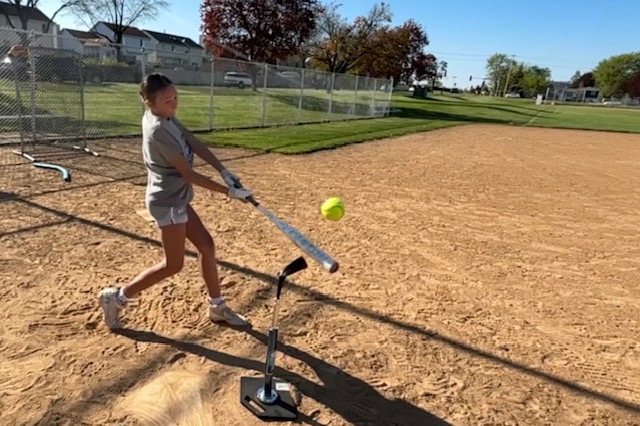
A few days ago I was doing a hitting lesson with one of my students, a young lady named Avery. We got to talking about why the success rate for hitting in fastpitch softball is generally so low.
That’s when she said something profound that her mom Abbey had told her that I hadn’t really thought about in that way: Hitting is 9 on 1.
I think most of us tend to think about the battle between the pitcher and the hitter, i.e., how the pitcher is trying to get the hitter to miss the ball or at least mis-hit if she does make contact so doesn’t go too far. But while the hitter is up at the plate standing alone, the pitcher has one other person in front of her and seven others behind her to help her get the out on that weak hit.
That’s a pretty unfair advantage, don’t you think? Picture a basketball game, or a soccer match, or hockey game, or pretty much any sport where scoring means getting the object at the center of the game into the other team’s goal.
You don’t have to be Mr. Vegas to figure out who is going to win that contest, no matter how skilled the player on the one side is.

Yet when the scoring opportunity comes up for a player in fastpitch softball (or slow pitch, or modified pitch, or baseball, etc.) she’s facing a whole phalanx of opponents whose only goal is to prevent her from achieving her goal. Seems pretty unfair, doesn’t it?
And that’s why the stats of a game, even if kept honestly (versus the person who scores every contact as a hit or anything close as an error, depending on whether his/her team is at bat or in the field), don’t always tell the whole story.
For example, a hitter can slam a screaming line drive directly at the face of the opposing shortstop, who throws her glove up in instinct to protect herself. If said screaming line drive goes into the glove and the shortstop’s palmar grasp reflex (yes that’s a real thing) causes her hand to contract around the ball, the hitter is out.
Never mind that she smoked the pitch that the pitcher mistakenly threw over the heart of the plate. One of the seven fielders happened to be in the way of the ball as it was on its way to being a double and turned that great contact into a drop of a few percentage points in her batting average.
Or what about the well-hit ball to the outfield that goes to the person the other team is trying to hide? She puts her glove up over head to make sure the ball doesn’t hit her, and instead it nestles softly in the web like a bird landing in its nest.

The hitter did nothing wrong, and the fielder, quite frankly, didn’t do anything intentionally right, but the fielder gets high fives while the hitter gets nothing except another ding against her batting average. And those are just the extreme examples.
During the course of the game most times there are seven fielders behind the pitcher, plus the pitcher herself, whose job it is to make sure the hitter doesn’t reach base. And then you have the catcher whose job it is to clean up anything around the plate. That’s a pretty stacked deck.
The only way the hitter can be absolutely assured of not being out after contact is to drive the pitch over the fence. And while the number of hitters doing so has increased dramatically over the last several years, those are still a low percentage of all contacts made.
So the next time you’re wondering why failing 7 out of 10 times at the plate makes someone an all-star, remember that the odds are stacked against the hitter from the beginning. And beating 9 on 1 odds is a pretty good reason to celebrate no matter how it happens.
A Volunteer’s Guide to Scoring on GameChanger

As an instructor who is mostly teaching lessons while my students are out playing, one of the greatest innovations in softball in the last 10 years is GameChanger.
(I say this despite the fact that I used to used iScore when I was coaching teams. Both are similar, but like VHS v Beta back in the VCR days, there is a clear winner in the battle for dominance among the masses.)
The beauty of GameChanger et. al. is that when you can’t be at the ballpark you can still keep up on what’s happening during the game. Or after.
(If am not teaching a lesson at the moment and my students are doing well I like to watch in real time. If they are struggling I am old school superstitious enough to believe I’m jinxing them and will check out the final box score later.)
Of course, as the short story The Monkey’s Paw (and the later Bruce Springsteen song) says, with every wish comes a curse.
In the case of GameChanger the curse is that the report you see doesn’t always tell the whole story. Or even an accurate one.
The challenge is that the person keeping score in GameChanger often is a volunteer, usually a parent, frequently a parent who missed the parent meeting and thus got stuck with the job instead of getting to do something simpler like line up hotels for away tournaments or convince the league’s governing board that softball girls deserve to have their fields lined and dragged for games, just like the boys’ baseball teams do.
So the GameChanger parents muddles through as best he/she can. And while the parent may get training on the technical aspects of how to enter information (and how to change it when they realize they screwed up the batting order or mixed up which field is left and which is right), they don’t get the opportunity to learn the nuances of how to score a game in a way that makes sense to someone who knows the game and wants to see what’s really going on.
Luckily, GameChanger parent, you have me! So without further ado, here are some of the nuances no one tells you when you agree to use up your online minutes to post the info on GameChanger.
Left Handed Hitter v Right Handed Hitter
Let’s start with this because it’s pretty basic and simple. For each player, it’s important to mark whether they hit left- or right-handed. Not that it affects the stats at all, but because it helps people who are watching remotely confirm that the Jennifer N they’re seeing is the one they want to watch. Not one of the three other Jennifer Ns on the team.
It’s also important for slappers, particularly newbie slappers who are just making the transition. And it helps give a more accurate picture of the game.
It’s just a simple button. If you have lefties on the team, give that button a click so they show up correctly.
Pop Out v Fly Ball v Line Drive
This one probably drives me battier (pun intended) than anything else because it just defies the laws of softball as well as logic.
If a ball goes out to an outfield, it is a fly ball, not a pop out. A pop out is contact that is caught in the infield area, either in fair or foul territory.
Saying “Mary T pops out to right fielder Sally J” when the ball has clearly traveled 180 feet is just wrong. The only time it would be correct is if Sally J is playing incredibly shallow in right field and the ball goes way up in the air and then comes down to her within spitting distance of the infield.
By the same token, a hitter cannot fly out to an infielder. She can hit a line drive out, or a pop out.
But even if she has to go backwards to catch the ball it’s not a fly ball. A fly ball has a trajectory that carries it well beyond where an infielder could catch it.
A line drive is basically a ball hit in a way gives it an upward trajectory but isn’t as high as a fly ball or pop up. This very basic drawing should help scorers distinguish between them.

Please, please, please, get this right. Otherwise it’s like nails on a chalkboard.
Hit v Error
This one should be pretty straightforward. But apparently it’s not so let me clarify.
If the batter hits the ball in fair territory and no one touches it, it’s a hit. Doesn’t matter how far it went or whether it was on the ground or in the air. It’s a hit.
If the batter hits the ball and a fielder touches it but doesn’t make the play, 99 times out of 100 it’s an error. The exception is a little leeway can be granted if touching the ball required extraordinary effort. Extraordinary effort being defined as “laid herself out to get there” not “stopped picking dandelions when the ball hit her in the shins.”
If the ball came to the fielder and she played hacky-sack with it as she tried to field it, or she fielded it cleanly but threw the ball toward South America instead of the base where an out could be obtained, it’s an error. Even if that fielder was your daughter.
While I have said in the past that I believe slappers should get credit for a hit if they bang the ball off a fielder’s shins and beat the throw, the reality is that’s not how it’s officially scored. It’s still reached on error. Deal with it.
The one area where judgment comes into play is if the ball could have been fielded for an out with an ordinary effort, i.e., it rolls through the hitter’s legs or drops next to an outfielder.
Even though it wasn’t touched, it should have resulted in an out had the fielder played it correctly so it’s considered an error.
This whole “outs v errors,” by the way, is why college coaches tend to take the stats players post on the Internet with a huge dollop of salt. Unless they know the scorer has a high level of skill, they can suspect that batting averages of .825 or ERAs of 0.25 on most teams owe more to scorer inexperience or manipulation than the player’s skills.
Slap v Bunt
People who are new to softball can be excused for not understanding this difference. But it’s an important distinction.
If the batter sticks the bat out with the intention of having the ball hit the bat and roll a few feet away, it’s a bunt. If the batter (especially a left handed batter who is running up on the pitch) takes a swing, or even a half swing, it’s considered a slap whether it comes off hard or soft.
Marking it correctly doesn’t affect the stats at all. But for the parents (or hitting coach) of a slapper who can’t be there it makes a huge deal in knowing that the player is using the skills she’s been training on.
Extra Base Hits and Which Fielder Is Named
Maybe this is just my personal preference but seeing “Jolene T hits ground ball double to shortstop Tina K” is another thing that makes no sense to me. How in the world do you hit a double to the shortstop?
The short answer is you don’t. You hit a hard ground ball that got through the infield and went toward an outfield position. That’s who it should be marked going to.
Getting It Right
Again, it’s great that apps such as GameChanger are available to allow interested parties to follow multiple games from afar. But as long as you’re putting in the effort to record the game, you might as well do it correctly.
Understand these differences and you’ll help everyone get a better idea of what’s really happening/what really happened, which makes following along more fun.






 Life in the Fastpitch Lane