Blog Archives
Making Sure You’re Prepared for the Storm

June 1 marked the beginning of the hurricane season on the Atlantic coast of the US according to the National Oceanic and Atmospheric Administration’s (NOAA) National Weather Service. So far so good, as there haven’t been any hurricanes yet, but you know they’re coming – even if you don’t know when.
I bring up this fact because of a conversation Jay Bolden and I had a few months back with Shawnee Harle, a mental toughness coach, on our From the Coach’s Mouth podcast. This link goes to that specific episode, although you’re always free to browse all the content we’ve created to date.
In that episode Shawnee made the statement that even when things are going well athletes must always “prepare for the storm, because the storm is always come.” What an awesome way to approach it, don’t you think? That’s why I thought today why not dig into that analogy a little further?
Think about what is (or at least should be) happening right now along the Gulf of Mexico and the entire Eastern seaboard. So far there hasn’t been much hurricane or even tropical storm activity.
Yet NOAA is predicting a 60% chance of an above-normal hurricane season. If that occurs it means tremendous risk to life, health, and property in the affected areas.
The people in those areas should know by now how bad things can get, so if they’re smart right now they are laying in supplies such as bottled water, non-perishable food (including pet food for those who have pets, or just prefer the taste themselves I suppose), cleaning supplies, toilet paper, batteries, flashlights, candles, and other essential goods that could be in short supply should a hurricane hit their area.
They should also be checking to ensure the bungees they use to tie down outdoor furniture are in good working order, that their plywood is ready to cover the windows, and that other precautions are available and accessible. There isn’t a storm right now to deal with, but they know a storms is inevitable and that they should be fully prepared for when it comes.

The same is true for athletes in general and fastpitch softball players in particular. Fastpitch softball is a game built on failure, designed to break your heart.
Or to paraphrase Billy Bob Thornton in the Bad News Bears remake, “(Softball’s) hard, guys. I mean, it really is. You can love it but, believe me, it don’t always love you back. It’s kind of like dating a German chick, you know?”
Even when things are going great, there’s always a monster lurking around the corner, waiting to take you down. You’re on a hot streak hitting and then suddenly, for no reason, you’re striking out, popping up, and grounding out on a regular basis.
You didn’t change anything in your swing or your approach. The game just decided you needed some humbling.
Or you’re a Gold Glove-level shortstop who one day misses a ground ball on a bad hop and the next thing you know you’re fumbling easy chances or throwing the ball into the parking lot instead of to first base. Things that were once routine are no more, and you end up with the “yips” to the point where you’re hoping the ball goes anywhere on the field except to you.
Or you’re a pitcher who suddenly can’t find the strike zone with her best pitches, and instead of dominating the dish you’re worried about walking or hitting batters. And the more you worry and try to fix it, the worse it gets.
When those or similar things happen – and they do to even the best players – that’s not the time to try to figure out what to do about it.
Instead, you want to prepare in advance for the storm, according to Shawnee. When things are going well, and you’re calm and thinking straight, THAT is the time to start preparing your plan for when things go South on you. Because sooner or later they will, and if you’re not ready you’ll see your mental lawn furniture flying by the window and you’ll be wishing you had some drinking water and at least a few granola bars to get you through the next few days.

Of course, most of us don’t do that. It’s like back pain.
We rarely do any of the stretches or exercises we should to prevent back pain. Instead, we don’t think about it until we suddenly can’t move, then desperately start looking for a chiropractor or massage therapist who can give us instant relief from our months or years of neglect.
By preparing ahead of time you will have a game plan available that you can execute when things start to go bad instead of waiting until you feel like you’re drowning.
For example, most mental game coaches will talk about how you need positive self-talk in a playing crisis so you can chase away the negatives. But it’s hard to come up with anything positive to say when you’re 0-for-the tournament and you’ve made three errors.
You’re far more likely to tell yourself that you stink and to worry incessantly that you’re going to be benched – to the point where it becomes a self-fulfilling prophecy.
But if you start writing down some positive thoughts when you’re on top of the world and tuck them away for when the storm hits, perhaps you’ll be able to push those negative thoughts out and get back on track faster.
Another idea is to create a highlight reel you can use to remind yourself of how good you really are. These days, game clips are all over the place, from parents, family friends, social media, GameChanger and other sources.
Rather than waiting until the storm is battering your psyche and then trying to find some good ones, capture a few and put them together as they happen. That way your highlight reel is just a click away and you can remember what it feels like to be on top of the game instead of under its heel.
You can put together a series of tension-relievers that will help you manage the moment too. Breathing exercises are good; rituals are good; visualization of success is good; techniques such as picking up a clump of infield dirt, squeezing all your fears, anxieties, and negative thoughts into it and then throwing them away is good.
There are lots of ways to gain control over the storm. If you’re not good at it yourself, seek out the help of someone like Shawnee who not only knows what to do but can be a calm, impartial guide who helps you face whatever demons you have and learn how to get rid of them before they take over you brain.
The key is to understand that no matter how good or great you are, the storm is coming – because it’s always coming. Just ask Simone Biles.
What you need to do is face that fact and, just like the people in the Gulf and on the Eastern Seaboard, make sure you’re prepared for that storm long before it hits.
It won’t keep the storm from hitting you. But it will sure help minimize the damage so you can get back to normal as quickly as you can again.
Hurricane photo by Pixabay on Pexels.com
Easing Young Arms Into the Season

On our From the Coach’s Mouth podcast yesterday, Jay Bolden (St. Xavier University, BeBold Fastpitch) and I discussed several topics related to the start of the high school and outdoor travel season. During that conversation Jay brought up a topic that I believe is critical to both the health of the athletes and the success of the team over the long haul: the importance of easing young arms into the season.
I get how challenging that can be, especially for high school (or college, for that matter) coaches. You get a couple of weeks with your athletes and then you have to start playing games.
In that couple of weeks, you have a mountain of things you feel you need to go over or get done to be prepared for the start off the season, and many of them involve overhand throwing. In the heat of those preparations it’s easy to lose track of just how much stress is being placed on those arms and shoulders – stress they are not ready for even with the best of arm care programs.
Let’s start with your athletes who are softball-only. During the offseason they have probably been practicing 1-3 times per week, which is very different than the six times per week a high school or college team will practice/play. Or a travel team will play in the summer.
Within that time they may or may not have done some arm care exercises as part of their warm-up and cool-down, but kids being kids they probably didn’t approach it with the same level of intensity they would in-season. Even if they did, though, there’s only so much an arm care program can do.

For example, one of my students is very diligent about her arm care program. But one weekend in the fall she went to a college camp where they spent three hours doing non-stop overhand throwing.
She came back with a sore shoulder that ended up requiring her to take some time off from overhand throwing and pitching while she did physical training to relieve the pain and repair the damage. Fortunately she was able to recover but it definitely set her back some.
Now imagine all the players who didn’t do that much arm care, or didn’t put in the effort to do it right when they did it. They’re not prepared to suddenly start throwing intensely in speed drills or distance drills day after day after day.
It won’t take long before they’re in some level of pain. Keep it up and by halfway through the season you may have a few athletes on the IR list and others who are gritting their teeth just trying to make it through the end of the season. Not exactly the formula for a long run to state.
Another complicating factor for many teams is the transition from indoor to outdoor practice. If you live in California, or Arizona, or Florida, or another area with warm temperatures during the winter it may not be a big deal.
But for those going from throwing in a cage or a small practice are to a full-size field it can be a huge risk factor. A little over-enthusiasm on the part of the coach can have even the best cared-for arms dragging in short order.
Then there are the athletes who come to softball after playing another overhead sport such as basketball or volleyball. Whether it was a school team or a club team, those other sports with their intense schedules have probably put a lot of stress on the shoulder joints.
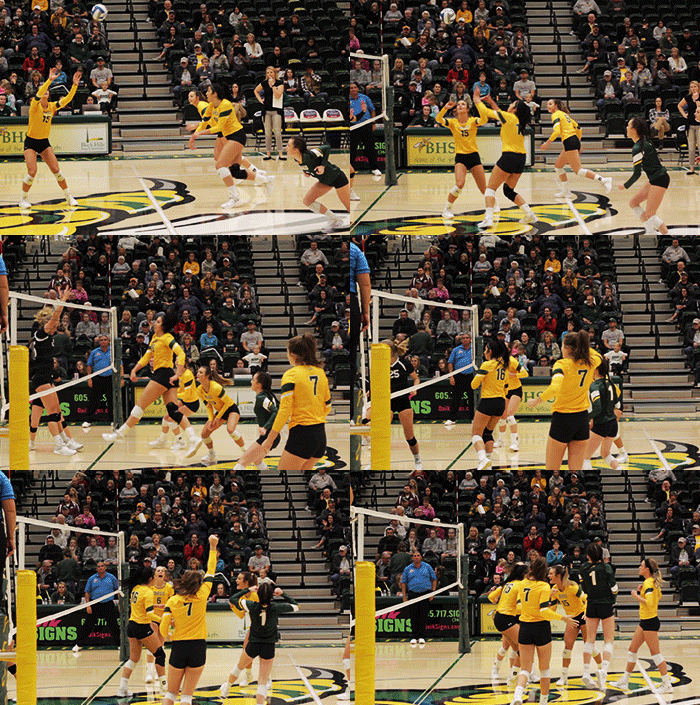
There is a high risk for labrum tears, bicep tendonitis, and other issues even before you start lengthy practices involving throwing. You could easily lose a couple of your best overall athletes before the season starts even if the softball-only players are doing ok.
So what can you do to avoid these issues while still getting your team ready to play? Jay had a great suggestion that he uses with his teams.
For starters, during fielding practice have buckets available near the fielders on some days, especially early in the pre-season. When you hit fly balls or ground balls, instead of having your players throw the ball back to the fungo hitter have them toss the ball in a bucket.
When the fielder’s bucket is full, have one of them run it back in to the hitter and take the empty bucket out. That way you get the fielding work done while reducing the strain on the arms and shoulders.
You can also spend time working on short tosses, the type you would do when one player is close to another and doesn’t need to make a full through. This part of the game is probably under-practiced by most teams, so it has the added benefit of shoring up a potential problem area while saving wear-and-tear.
It can also be fun if you work on a variety of throws. Jay mentioned hearing a coach at a clinic suggesting you can also work on crazy situations such as the glove scoop and toss or throwing behind your back.
Not all the time, obviously, but every now and then just to spice up practice a little. Think Savannah Bananas.
Dailies are another great way to get fielding practice in for infielders without stressing arms. You can get a lot of reps for straight-in, forehand, and backhand fielding in in a short amount of time – and with no stress to arms or shoulders. Although it can be a little tough on the knees.
Along the way, do your best to address throwing mechanics as well. If you’re not sure how to teach good mechanics ask a more experienced coach or check out programs such as Austin Wasserman’s High Level Throwing program to learn how to set up an organized, structed throwing program designed to ensure your athletes’ long-term arm health.
Finally, as with any other type of strenuous exercise program, be smart about what you’re doing. Start with low intensity activities and lower reps, then build your way up to more reps and longer throws.
A commonly quoted statistic is that 80% of all errors in baseball and softball are throwing errors. I couldn’t find a source to absolutely confirm it, but based on my experience it certainly sounds correct.
While some of those errors are no doubt just flat-out mistakes, I’d bet if you looked under the surface a fair percentage could be attributed to arms that are sore or just plain tired. Help your players go into the long season with healthy (or at least healthier) arms and you’ll be far more likely to make a deeper run into the postseason.
Be the River, Not the Rock

Here’s a simple question for you today: which is strong, the river or the rock that sits in the middle of it? The answer is it depends on your point of view.
Taken at a glance, a snapshot in time if you will, it appears the rock is stronger. After all, the rock stands steadfast, unmovable, while the river must divert around it.
But if you take a longer-term view, the answer is the river, because over time it will erode the rock until the rock is no longer an obstacle to its path.
I know, very Kung Fu of me (which is probably where I got the idea). You can hear the pan flutes even as you read this.

That doesn’t make it any less true, however. Which is a good lesson for playerstrying to learn or improve a challenging skill such as pitching or hitting, as well as for coaches trying to get the best out of their teams.
Players
Let’s start with players. They can take the rock approach to learning new skills or improving/revamping current ones for a variety of reasons, including:
- What they’re currently doing has worked for them before. For example, a 12 year old pitcher who is used to pushing or lobbing the ball toward the plate instead of using her whole body to throw. She threw more strikes than the other pitchers she knows and if that’s her only measurement of success why change? .
- They’re not comfortable doing something new. With minor exceptions, who is? It’s a lot easier to do what you’ve always done than to change it.
- When they try something new their performance goes down (in their mind). Such as a hitter who used to make weak contact but is now swinging and missing while trying to learn a new way to swing the bat.
- They just don’t want to change. Typically seen with players who are forced to take lessons by their parents or players who believe they are better than they actually are (big fish in a small pond).
The problem here, as they say, is if you do what you always did, you’ll get what you always got. But if others around you are improving their games, what you always got may not be good enough anymore and you’ll find yourself sinking down the batting order or the pitching rotation – or maybe even out of the starting lineup.
The important thing to remember when players make a change is that it doesn’t have to be permanent. Try something for a little while and see if it works. If it doesn’t, you can always try something else.
I do that a lot with my students. I have an idea, based on science and experience, of what will work, but I’m not omniscient. (That means all-knowing for those who don’t feel like looking it up.)
Try it and see how it feels. Sometimes you’ll hit farther or throw faster.
Sometimes it will throw you off your game completely. But you don’t know until you try it.
Remember, as the rock wears down the river changes its course. Be the river.
Coaches
Coaches, too, can benefit by taking the river approach instead of being the rock.
We see the rock approach a lot. Something new will come along and you’ll have a percentage of the coaching popular who will say “I’ve been doing it my way for 10/20/30 years and have had success. Why should I change?”
The answer, of course, is because new discoveries are being made all the time – data-based discoveries that can help players get better, shortcut the learning process, overcome deep-seated challenges that are built into the DNA, or otherwise improve.
It’s the same with game strategies. You may have followed the same playbook for X number of years, but what if there is information out there that could turn a few more of those losses into wins because you knew how to use it?
The best coaches I know are constantly scouring every source they can find to obtain new information in the hopes that it might help them. They are moving their knowledge forward like the river instead of standing in one place like the rock.
Imagine if you could discover just one little tip or trick or way of looking at things that would give you a significant advantage over your rivals. That’s the premise of the book and the movie Moneyball.

The Oakland Athletics used data to find players others didn’t value very highly to help them field a team that could win 100 games while fitting their very limited budget. It was a game-changer for them, and for the rest of Major League Baseball who followed that example.
Besides, learning new things is fun. Again, you may try something only to find it doesn’t work for you.
That’s ok. Now you know more than you did before.
But if you do discover some new strategy or approach that pays dividends you’ll be glad you gave it a try. Even if you had to change your world view a little.
It’s easy to be the rock, staying in one place while the world rushes past you. But eventually it will wear you down too. Be the river.
Check Out Our New Podcast
Speaking of learning new things, my good friend Jay Bolden and I have started a new podcast called “From the Coach’s Mouth” where we interview coaches from all areas and levels of fastpitch softball as well as others who may not be fastpitch people but have lots of interesting ideas to contribute.
Our first two episodes are in the books. In the first we spoke with pitching guru Rick Pauly of PaulyGirl Fastpitch, and in the second we heard from Coach Sheets (Jeremy Sheetinger), head coach of the Georgia Gwinnett College baseball program.
You can find it here on Spotify, as well as on Apple Podcasts, Pandora, Stitcher, iHeart Radio, or wherever you get your podcasts. If you’re searching, be sure to put the name in quotes, i.e., “From the Coach’s Mouth” so it goes directly to it.
Give it a listen and let us know what you think. And be sure to hit the Like button and subscribe to Life in the Fastpitch Lane for more content like this. Commercial over.
River photo by Matthew Montrone on Pexels.com






 Life in the Fastpitch Lane