Blog Archives
Easing Young Arms Into the Season

On our From the Coach’s Mouth podcast yesterday, Jay Bolden (St. Xavier University, BeBold Fastpitch) and I discussed several topics related to the start of the high school and outdoor travel season. During that conversation Jay brought up a topic that I believe is critical to both the health of the athletes and the success of the team over the long haul: the importance of easing young arms into the season.
I get how challenging that can be, especially for high school (or college, for that matter) coaches. You get a couple of weeks with your athletes and then you have to start playing games.
In that couple of weeks, you have a mountain of things you feel you need to go over or get done to be prepared for the start off the season, and many of them involve overhand throwing. In the heat of those preparations it’s easy to lose track of just how much stress is being placed on those arms and shoulders – stress they are not ready for even with the best of arm care programs.
Let’s start with your athletes who are softball-only. During the offseason they have probably been practicing 1-3 times per week, which is very different than the six times per week a high school or college team will practice/play. Or a travel team will play in the summer.
Within that time they may or may not have done some arm care exercises as part of their warm-up and cool-down, but kids being kids they probably didn’t approach it with the same level of intensity they would in-season. Even if they did, though, there’s only so much an arm care program can do.

For example, one of my students is very diligent about her arm care program. But one weekend in the fall she went to a college camp where they spent three hours doing non-stop overhand throwing.
She came back with a sore shoulder that ended up requiring her to take some time off from overhand throwing and pitching while she did physical training to relieve the pain and repair the damage. Fortunately she was able to recover but it definitely set her back some.
Now imagine all the players who didn’t do that much arm care, or didn’t put in the effort to do it right when they did it. They’re not prepared to suddenly start throwing intensely in speed drills or distance drills day after day after day.
It won’t take long before they’re in some level of pain. Keep it up and by halfway through the season you may have a few athletes on the IR list and others who are gritting their teeth just trying to make it through the end of the season. Not exactly the formula for a long run to state.
Another complicating factor for many teams is the transition from indoor to outdoor practice. If you live in California, or Arizona, or Florida, or another area with warm temperatures during the winter it may not be a big deal.
But for those going from throwing in a cage or a small practice are to a full-size field it can be a huge risk factor. A little over-enthusiasm on the part of the coach can have even the best cared-for arms dragging in short order.
Then there are the athletes who come to softball after playing another overhead sport such as basketball or volleyball. Whether it was a school team or a club team, those other sports with their intense schedules have probably put a lot of stress on the shoulder joints.
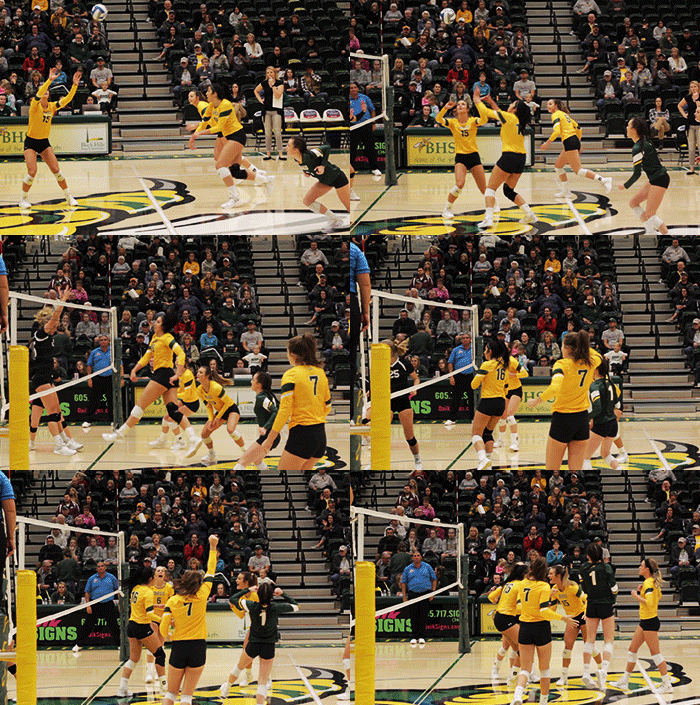
There is a high risk for labrum tears, bicep tendonitis, and other issues even before you start lengthy practices involving throwing. You could easily lose a couple of your best overall athletes before the season starts even if the softball-only players are doing ok.
So what can you do to avoid these issues while still getting your team ready to play? Jay had a great suggestion that he uses with his teams.
For starters, during fielding practice have buckets available near the fielders on some days, especially early in the pre-season. When you hit fly balls or ground balls, instead of having your players throw the ball back to the fungo hitter have them toss the ball in a bucket.
When the fielder’s bucket is full, have one of them run it back in to the hitter and take the empty bucket out. That way you get the fielding work done while reducing the strain on the arms and shoulders.
You can also spend time working on short tosses, the type you would do when one player is close to another and doesn’t need to make a full through. This part of the game is probably under-practiced by most teams, so it has the added benefit of shoring up a potential problem area while saving wear-and-tear.
It can also be fun if you work on a variety of throws. Jay mentioned hearing a coach at a clinic suggesting you can also work on crazy situations such as the glove scoop and toss or throwing behind your back.
Not all the time, obviously, but every now and then just to spice up practice a little. Think Savannah Bananas.
Dailies are another great way to get fielding practice in for infielders without stressing arms. You can get a lot of reps for straight-in, forehand, and backhand fielding in in a short amount of time – and with no stress to arms or shoulders. Although it can be a little tough on the knees.
Along the way, do your best to address throwing mechanics as well. If you’re not sure how to teach good mechanics ask a more experienced coach or check out programs such as Austin Wasserman’s High Level Throwing program to learn how to set up an organized, structed throwing program designed to ensure your athletes’ long-term arm health.
Finally, as with any other type of strenuous exercise program, be smart about what you’re doing. Start with low intensity activities and lower reps, then build your way up to more reps and longer throws.
A commonly quoted statistic is that 80% of all errors in baseball and softball are throwing errors. I couldn’t find a source to absolutely confirm it, but based on my experience it certainly sounds correct.
While some of those errors are no doubt just flat-out mistakes, I’d bet if you looked under the surface a fair percentage could be attributed to arms that are sore or just plain tired. Help your players go into the long season with healthy (or at least healthier) arms and you’ll be far more likely to make a deeper run into the postseason.






 Life in the Fastpitch Lane