Blog Archives
Why Your Player(s) Won’t Go Faster (Maybe)
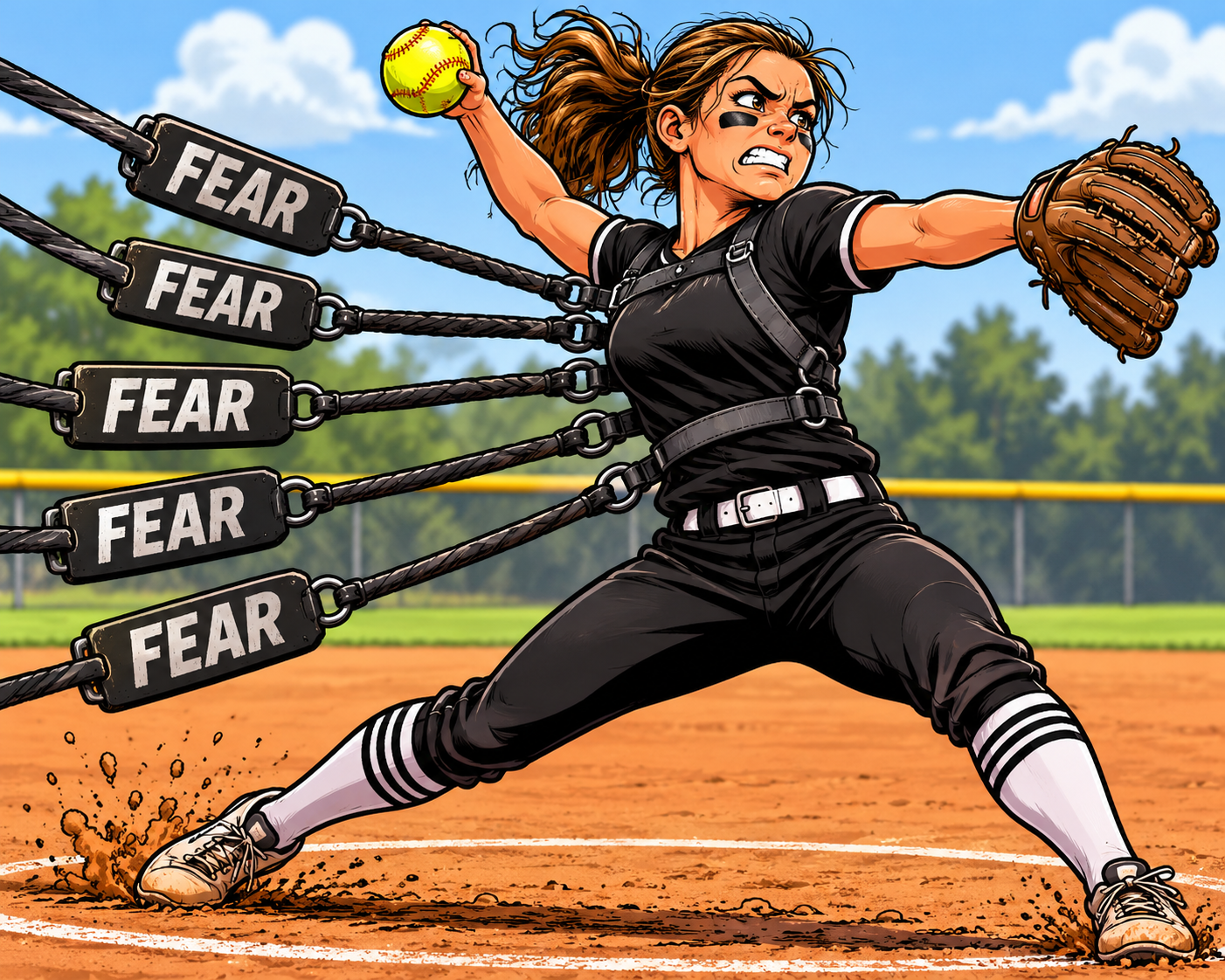
Watch high-level players on TV or online and one of the things you’ll notice is how quickly they move. There’s no hesitation when they start or landing /rotating softly when they finish – they go all-out with every rep.
Then you look at your player(s) and it’s a different story. Pitches feel like they’re easing to a stop instead of crashing into their front leg.
Hitters feel like they’re slowing their bats down rather than accelerating into contact. Fielders are clearly slowing their arms down to make a throw.
And no matter how much you scream at encourage them to go all-in, the next rep looks just like all the others.
There can be a couple of main reasons for this behavior: fear of failure, or fear of injury. Those fears can be either conscious or unconscious. Let’s take a look at each of them.
Fear of Failure
First we have to determine what failure is. For a pitcher, failure is often defined as walking a hitter.
Because what do they hear all the time from coaches, parents, teammates, and even random people on the sidelines? “Just throw strikes,” or “Don’t walk her” and the like if they get behind in the count.
Their brains hear those messages, at which point they tell the central nervous system (CNS) “Do whatever it takes to throw a strike.” Often that gets interpreted as slowing down and trying to force the ball over the plate.
Do that enough, and that becomes a habit that is difficult to break later.
The same goes for hitters or fielders. If hitters are ahead of the pitch when they swing, they’ll slow down the bat to try to at least make contact with the ball. If fielders get yelled at for making a throwing error, the next time they get a similar opportunity they’re not going to just cut loose and throw the ball; their CNS is going to tell the subconscious to slow down the arm so they can aim the ball (and avoid the pain and embarrassment of getting yelled at).

Those subliminal messages may solve the issue in the short term. But they’re not going to lead to those players becoming high-level performers.
Protection v Performance
This issue runs even deeper, going all the way back to when humans were living in caves and predators were all around.
Because our ancestors were so vulnerable, and because the goal of any species is survival of said species, our bodies and CNS are wired to prioritize protection over performance. In other words, any time we feel stressed, our bodies’ first order of business is to make sure we don’t fall down or get trapped in an obstacle or otherwise do something that will cause us to get eaten by a tiger.
On the softball diamond, that means pitchers won’t drive out hard if their CNS aren’t sure they can land and stabilize themselves successfully. They may try to do what you’re saying and drive hard, but if the ground feels unstable, or they’re afraid their knee will collapse, or they don’t think they can decelerate all that momentum in time, etc., they will subconsciously slow themselves down at least a little no matter how many times you yell at encourage them to keep on going all the way into foot plant.
Same with a hitter or fielder. If a hitter feels like she has too much momentum going into the swing, even if it’s on time and ready to clobber the ball, she’ll slow herself down to make sure she doesn’t screw herself into the ground and thus leave herself vulnerable to the aforementioned tiger.

A fielder approaching a ball who feels off-balance as she goes to field it will slow down to bring herself back into balance before attempting to field the ball. If that same fielder feels like the ground beneath her isn’t secure as she goes to make her throw, or that she’s in an awkward position as she goes into her throwing motion, she’s probably going to slow her arm (and possibly other body parts) down rather than taking a chance on missing the target and alerting the tiger in her head to her presence.
So,, What Can You Do About It?
Great, now we know the issues. The bigger question is what can you do about it?
First of all, understand that these behaviors are deeply ingrained, either through direct experience (the first group) or through our DNA (the getting eaten by a tiger scenario). As a result, it’s going to take time to change them, so be prepared to be patient.
In the first group, focus on the process rather than the outcomes, and then praise success in the process regardless of the outcomes. With the pitchers, tell them you want to see them landing strong, whipping their arms around the circle and through release quickly, and trying to go 100% on every rep.
Then tell them you don’t care where the ball goes, as long as it gets there fast. Get them out of their comfort zones and into the un-comfort zones.
But then, when the ball goes flying high or wide or into the dirt (or some combination of those results) don’t make a face, don’t huff and puff, don’t say, “I’m over here!” Just go get the ball and, if they gave it their all, tell them “That’s what I’m talking about.”
For hitters, tell them you don’t care if they miss the ball 100 times on front toss or live pitches, as long as they work on executing the swing you want them to execute. For fielders on throwing, tell them you don’t care if they throw the ball into the parking lot as long as they throw it hard.
In fact, tell them you’d PREFER it go in the parking lot instead of being a wimpy throw. And when they go to field, it’s ok if they bobble the ball, boot it, or miss it entirely as long as they execute the attempt with energy and enthusiasm.
In other words, change the goal or what you’re measuring them on to reflect the behavior you’re trying to drive.
As for the protection v performance challenge, the key here is to help them feel safe WHILE they are going full speed.
In many cases, you may have to get more involved in corrective exercise or other techniques to fix the underlying weaknesses before you can drive the performance you want. Take pitchers who are slowing down going into landing.
Hitting the brakes suddenly requires a fair amount of core strength as well as strength in the glutes. If they’re weak in either or both areas, their bodies are probably not going to allow them to crash into that front leg the way you want them to.
So you may need to get them working on building up that strength first so their bodies feel prepared to handle the load of 2-3 times their body weight getting stopped by their stride leg. If the ground is bad, you will have to either fix the ground or move to another area where they feel more secure so they can at least practice at the speed you want. In-game, where you can’t change the conditions or location, you’ll have to do what you can to help them through it.
If they’ve had a prior injury, say in the knee, you may need to look into alternative therapies such as the Square 1 System to help reset the CNS and convince it that it no longer needs to protect the knee. Our minds are funny things, and the CNS can think it needs to protect certain body parts even when they’re strong and healthy because at one time, maybe even in the distant past, they weren’t.
Addressing these underlying causes will get their bodies out of protection mode so they can focus on enhancing performance instead.
It’s very rare that players don’t want to do the best they can to become all they’re meant to be. But there’s more to it than just saying “go faster.”
Making sure that players feel safe in getting out of their comfort zones in practice, either physically, psychologically, or both, will give them the confidence to go all-in on every rep so they can deliver the results you’re looking for.