Blog Archives
Captain Picard’s Lesson on Winning, Losing, and Errors

Sorry to nerd out on this one, but there is a great Star Trek: The Next Generation episode called Peak Performance that puts some perspective into the challenges of competing in fastpitch softball. Even if you’re not a fan you might one to check this one out.

The part that’s interesting here is a side story involving Commander Data, the highly advanced android crew member. An outsider named Kolrami who is a grandmaster at a game called Strategema (sort of a holographic version of Space Invaders) comes on board and quickly irritates the crew with his arrogance.
A couple of crew members encourage Data to use his computer brain to take Kolrami down a peg by challenging him to a game of Strategema. At first reluctant, Data finally does it to defend the crew’s honor – and promptly gets his butt kicked by his flesh-and-blood opponent in about a minute.
Shocked, Data immediately surmises there must be something wrong with his programming and tries to take himself off duty until he figures out where the “problem” is. Captain Picard, who is captain of the ship, rather harshly tells him no he can’t do that, he needs Data, and that Data should quit sulking even though Data has no emotions and so presumably no capacity to sulk.
Then Picard tells Data something that every fastpitch softball coach, players, and parent needs to hear: It is possible to make no errors and still lose.
In our case I’m not talking only about the physical errors that get recorded in the scorebook. Playing error-free ball and losing happens all the time.
I’m talking more about the strategic decisions and approaches to the game that seem like they’re sound but still don’t produce the desired results (a win). Here’s an example.
There are runners and second and third with one out in the last inning of a one-run game. The defensive team opts to intentionally walk the next hitter to load the bases in order to create a force at home and potentially a game-ending double play at first if there’s time. They also pull their infield in to give them a better shot at that lead runner.
The next batter after that hits a duck snort single behind first base that takes a tough hop and rolls to the fence after landing fair and two runs end up scoring.
No errors were made, and the strategy was sound. But the result is still a loss.

Here’s another one from my own experience. Down one run with no outs in a game where they have been unable to hit the opponent’s pitcher, the offensive team finally gets a runner on first.
She’s a fast, smart, and aggressive baserunner, so putting the ball in play somehow could go a long way toward tying the game. The obvious solution would be a bunt to advance the runner to second, giving the offense two shots to bring her home from scoring position.
But the defense knows that and is playing for the bunt. So the offense opts for a slug bunt (show bunt, pull back, and hit the ball hard on the ground) combined with a steal of second. If the hitter can punch it through the infield the runner on first, who already has a head start, will likely end up on third and might even score, depending on how quickly the defense gets to the ball. Best case the batter will end up on second, as the potential winning run, worse case with good execution she’s on first.
Unfortunately, the batter does the one thing she can’t do in that situation – hit a weak popup to the second baseman. The batter is out and the runner who was on first gets doubled off.
Now, you can argue that the failed slug bunt was an error, but was it really? It was a failure of execution but not necessarily a mistake in the classic sense. It was just one of those cases where the hitter lost the battle to the pitcher.
The point is that sometimes, despite our best efforts and doing all we can to play the game correctly, things don’t work out the way we’d like. There are things that happen beyond our control that can influence the outcome of a play, an inning, or a game.
We can’t beat ourselves up over it or spend endless time second-guessing ourselves. We learn what we can from the experience and move on.
Sometimes we make different decisions the next time – and sometimes we don’t – and hope for a different outcome.
In case you’re wondering about Data, at the end of the episode he requests a rematch. This time he keeps the game going until Kolrami finally gives up in frustration.
When asked about it, Data explains that Kolrami entered the second game assuming both he and Data were trying to win and played accordingly. But Data’s strategy was to play not to lose, basically playing defense the whole time, until his opponent essentially forfeited the game, giving Data the victory.
Anyone who has played an international tie breaker can relate.
Not every decision you make on the field is going to work out the way you hoped, even if you’re making it for the right reasons. All you can do is learn from the experience and hope it works out better the next time.
Captain Picard photo by Stefan Kühn, CC BY-SA 3.0 https://creativecommons.org/licenses/by-sa/3.0, via Wikimedia Commons
Coaches: Remember What You Do Makes A Difference
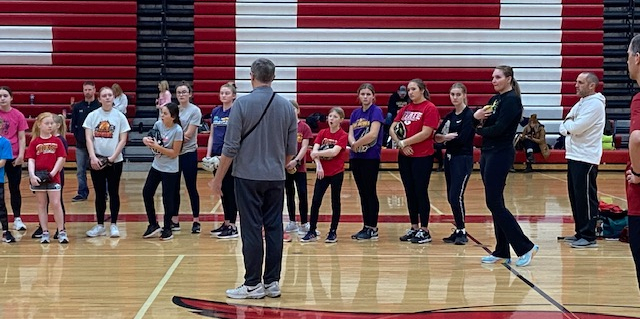
Coaching fastpitch softball can be a grueling grind. The seemingly never ending games, practices, organizational meetings, fundraising concerns, educational seminars, late night calls from concerned parents. etc. can all take their toll after awhile.
That’s why coaching burnout is such an issue and threat to everyone who is crazy enough to grab a clipboard (or tablet) and step onto a fastpitch softball diamond.
It’s easy to become overwhelmed by the sheer volume of work, not to mention the intensity of trying to help 12-15 players become the best versions of themselves as athletes and human beings. That’s a huge responsibility.
But underlying all of that is something else – something embodied in a great scene in the movie Star Trek Generations. (If you’re not familiar with it, this was the movie that handed off the film series from Star Trek the Original Series [TOS to you Trekkers out there] to Star Trek: The Next Generation [TNG]. I so rarely get to use the [square brackets] so what a treat for me.)

This scene takes place shortly after TNG’s Captain Picard runs into TOS’ Captain Kirk in a place called The Nexus, which is sort of a Field of Dreams for sci fi. In it, Captain Picard has been trying to convince Captain Kirk to come back to our reality and help him stop the bad guy who is killing billions of people in his attempt to get back into The Nexus.
At first Captain Kirk turns him down because he is perfectly content in The Nexus. No surprise there because it’s where your life can be whatever you want it to be.
But then Captain Kirk has a realization. (It takes a minute to get to the payoff in this clip but it’s worth it, trust me.)
If you didn’t bother to watch the clip, or weren’t able to, Captain Kirk’s realization is that while he was in Star Fleet he could make a difference in the world. Since he left, though, nothing he does really matters that much.
That’s what coaching enables you to do – make a difference in the lives of your players. And by extension their families.
None of us knows what goes on behind the scenes in the lives of others. So it’s easy to assume that everything is all hunky-dory with them, and that the face you see is indicative of what’s happening “under the hood.”
That may not be the case, however. I can’ remember who originally said it, but I once saw a statement that admonished coaches to remember that their practice might be the best part of their players’ day.
Maybe the player is struggling in school, or had a fight with her parents. Maybe she’s being bullied, or has had a close friend abandon her.
Maybe there is some food or housing insecurity in her family, or a favorite pet is on the brink of crossing the rainbow bridge. (Don’t click the link if you are in public and susceptible to emotional demonstrations.)

There could be hundreds of different things happening in your players’ lives. But when they get to your practice or game they have opportunity to set all of that aside and do something that makes them feel good about themselves and their lives, providing you’re doing it correctly.
The guidance you provide in helping your players overcome various softball hurdles is very likely to carry forward into the rest of their lives.
As a result, you can help a shy kid learn to make friends. You can help a kid who is always down on herself or feeling she isn’t good enough develop self-confidence.
You can help a kid who always follows the crowd (for better or worse) step up and learn to become a leader instead. Or at least learn to make better decisions rather than succumbing to peer pressure.
You can help a kid who has always been coddled and over-protected by her parents learn to manage adversity. You can help a kid with behavioral issues learn to work in a team setting.
You can help a naturally lazy kid develop a work ethic. You can help a kid who over-thinks everything learn to let go of her conscious thoughts (and fears) and trust her gut.
You can help a kid who feels like a failure learn what it’s like (and what it takes) to succeed. You can help a kid who feels unloved and unwanted at home to feel like she’s part of a family of sorts.
You might even prevent a kid from doing harm to herself or others. All while you are helping those kids learn to catch, throw, pitch, and/or hit a softball.
In other words, you can make a difference.
And you never know the ripple effect of making that difference either. Perhaps that kid you helped in some way goes on to cure cancer, or improve the environment, or become an elected official who enacts policies that make everyone’s life better.
Or even becomes a coach herself someday and pays what you did for her forward. Or maybe just grows into a great human being who has a family and/or contributes to society in some small but meaningful way.
All because you were there as her softball coach, making a bigger difference than you could have possibly realized.
Yes, coaching fastpitch softball, like any sport, can be a grind after a while. You definitely need to pay attention to your physical and emotional wellbeing if you’re going to help others. Just like how on a jet they tell you to put on your oxygen mask before you try to help others.
But when things get tough, keep in mind how empty your life would be if you weren’t coaching. Because as Captain Kirk says, while you’re in that chair you can still make a difference.
Make that difference for someone today.






 Life in the Fastpitch Lane