Video of the slug bunt
A few posts ago I put up a post about the slug bunt, also known as the fake bunt and slap. Afterwards, Stevepic at the Discuss Fastpitch Forum asked me to post a video of it.
It took a little while to get it, but here it is. It’s Kathleen, one of my players, executing it in the batting cage. Note that she keeps her shoulders forward (mostly) and uses top hand only to make contact.
Kathleen executes a good slug bunt/fake bunt and slap
You just never know
We live in a society that expects instant results. Often there is very little patience or willingness to hang in there while players find themselves.
I’ve certainly seen that with teaching pitching and hitting. Some kids (and/or their parents) will take a couple of lessons and expect that somehow, magically, the player will instantly become better. Well, it doesn’t work that way. Improvement comes in increments. Some learn faster than others, just like some learn math or a foreign language faster than others. But it’s not instant.
And sometimes it can take a long time. I have had pitching students who just couldn’t seem to get the feeling of attacking the pitch. They’d go through the motions, but without that intent to throw hard. Then one day, the lightbulb comes on and bang! They get a significant speed jump.
What is interesting to me in those cases is the parents who see it and DO have the patience to wait until their child comes out of the gate. It can’t be easy. You’re paying for lessons, and while there is some general improvement it’s not really the kind of results you’d hope for. But rather than giving up, they stick with it, and their patience is rewarded.
Now, if the kid really doesn’t want to be there it’s never going to happen. I’ve had a couple of those, but fortunately only a couple. In those cases I do try to tell the parents it’s not working. But if the player is enthused about the lessons, I’ll keep going as long as she wants to because I know what we’re doing will work when the time is right.
Quite frankly, as a coach I wish every kid could get things instantly. It would be easier on everyone. But that’s not the case. As the song (and the Bible verse on which it’s based) says, there is a time to every purpose under Heaven. Sometimes that time isn’t right away. But if what you’re doing is the right way to go about it, and you put in the effort, sooner or later it will take hold.
I am probably proudest of the students for whom it didn’t come easy — the ones who hung in there until the lightbulb came on. Because when it does, it’s a bigger deal than it was for the kids who were able to do it right away. I’m also confident that they have acquired a skill that will serve them well their entire lives — the skill of persistence.
It’s easy to think if it doesn’t happen right away that it never will. But you just never know. And remember — it doesn’t matter where you start the race. Only where you finish it.
Lesson cost (a bit of humor)
Don’t know what made me think of this tonight, but I was thinking about the sign you often see in auto repair shops that list the “rates” for fixing your car. Here’s my take on it:
Pitching Lessons Price List
- $40 per hour
- $50 per hour if you want to offer suggestions
- $60 per hour if you tried to teach her first
Well, I thought it was funny anyway.
Pitching + touching your shoulder = elbow pain
For a couple of years now I have been talking to pitchers and their parents about the dangers of forcing the hand to come up and touch the shoulder on the follow-through. I had heard from reliable sources (Cheri Kempf among others) how this movement put unnecessary stress on the ligaments of the elbow and could lead to elbow pain. Made sense to me, especially when I tried the movement myself.
Yet I have seen that move being taught by other pitching coaches. When I’ve done clinics and such I’ve had kids telling me “but my other pitching coach said I should do that.” Thankfully the other pitching coach didn’t tell them to jump off a bridge too.
I think the “logic” behind touching the shoulder is to try and get the pitcher not to stop her hand at her side, which is a good thing. But in touching your shoulder with your fingers after throwing you’re just trading one problem for another. And in this case, trading a performance problem for a health one.
All of that was pretty much theoretical, however, until this past week. I now have direct evidence of the dangers of “snapping up” and touching the shoulder instead of following through long and loose.
The first incident was with one of my top students. She had picked up a habit of pulling her hand straight up to snap the ball out — sort of like doing arm curls with a dumbbell. I’d told her to follow through long, but she couldn’t break the habit. Last week she came to her lesson with an elbow brace on. She’d developed a lot of pain in her elbow and hurt to pitch. After a long, slow warm-up she wanted to try pitching the full distance. I told her to work on following through long and loose instead of pulling her hand up. By the end of the lesson she was throwing full speed, harder than before, and pain-free. She was amazed that it could feel so good after hurting so much. But that’s the power of a proper finish.
Today I was talking to the father of another student who was comparing what I had taught his daughter to what her old coach had taught her. He said with his method (touching the shoulder) her elbow always hurt, sometimes to the point of tears. Since coming to me and learning to finish long and loose instead of touching her shoulder, she was pain-free.
Now, I know two is hardly a scientific sample. But two on top of other evidence I’ve heard is pretty clear. If you are a pitcher (or you have a daughter who is one) and you’re being told to touch your shoulder to finish the pitch, you are putting your health at risk. My advice would be to stop that immediately, and find another coach if necessary. There are a lot of good and proper ways to finish the follow-through. Stressing your elbow isn’t one of them.
Help for hitters who are dropping the back shoulder
In science, the proper way to conduct an experiment is to limit the number of variables to one. In other words, all else is the same except for one thing that changes. That way you know whether the one variable that changed was the cause of the success or failure of the experiment.
We had that opportunity earlier today. We were working with our 18U hitters, which is our usual routine on Sunday mornings. Today was a machine day. We had the Jugs Jr. cranked up to 100%, and as it turned out we were shooting balls from about 30 feet. We actually had planned on going from 35, but the plate was moved up in the cage and we just left it there.
In any case, most of the girls were doing fine, but a few were having some trouble. Mostly, they were swinging under the ball. So we told them to lower their front shoulders as they went to toe touch. This was a point we learned from Deb Hartwig at the National Sports Clinics. She showed how all top hitters have their front shoulders lower than the back at this point. It’s something you don’t hear about in even the latest hitting videos, but it seems essential to great hitting.
Lowering the front shoulder was the only change we made. Yet in every case the hitter went from missing completely to hitting the ball solidly. At this point it was more of a reminder than a real change — they all know they need to be in that position. But sometimes they forget, especially in the heat of high-speed BP.
If you have hitters struggling with swinging under the ball, or just with dropping their back shoulders to go into launch, have them work on lowering the front shoulder. It works!
A little trick for the backhand change
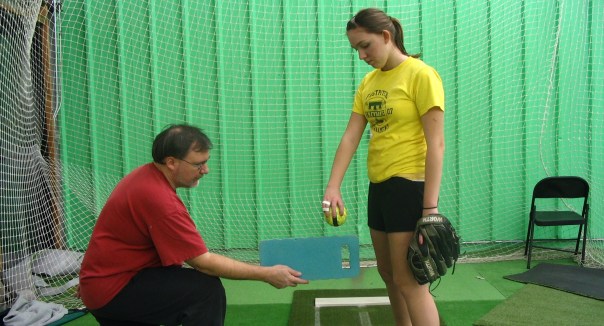
Previously I’ve talked about the importance of keeping a bit of a bend in the arm when you’re throwing the backhand change. That helps get rid of the dreaded “hump” in the pitch, where it starts to go out, then goes up a little — right into the hitter’s wheelhouse. Raising the arm slightly allows the pitcher to throw it out flat, which will keep it down.
Sometimes, however, pitchers think they’re bending the arm to pull the ball up but they’re actually not. Here’s a way to help them get the feel of it.
Take a lightweight object and hold it at the pitcher’s release point. I usually use a garden kneeling pad since it’s flexible. Hold it at the bottom of the normal circle. Then have the pitcher throw the change. If she’s dipping down instead of raise her arm, the ball will hit the object as she throws it. This will give her the feedback she needs to know where her hand should go.
Normally I tell the pitcher I’m going to hold it in the regular path of the ball. In truth, I actually hold it lower than that. They really have to work to hit it. But the idea of having it down there is usually enough to make them concerned and to bring the ball a little higher. Once it’s there, the arm is in a weak position — which means the pitcher can throw the ball as hard as she can without risking it being fast.
It’s a great trick, and works every time.
Love the breakthroughs
Tonight I was working with one of my students, a girl named Brigid. (Yes, that’s the correct spelling. I confirmed it with her a while back.)
Brigid had done some pitching a couple of years ago, but a wrist problem stopped her career. She decided to give it a try again this year, and a couple of changes we made earlier has made it possible for her to pitch without pain.
She has had one persistent problem, though: she keeps throwing inside. It’s a habit she’s had a tough time breaking. We were able to figure out that there are a couple of different causes, but one of the main ones has been her arm circle. She tends to let it wander behind her, so at release it has to go out to her right to avoid slamming into her hip.
We’ve tried a few things over the past weeks to try and fix it, but none have had much lasting success. Tonight, though, I think we had a breakthrough.
One of the main causes of her circle problems has been pulling the ball behind her on her backswing. That motion forces her arm out and away, which creates an off-center circle. So tonight we switched her to a barrel roll start. The barrel roll forces her to start with her arms in the center of her body and keep them there until the ball gets overhead. In other words, it completely eliminates one of the main causes.
It wasn’t perfect — she also has a tendency to pull her shoulders up and out at times — but it made a big dent in it. One of the biggest benefits was a rise in her confidence level. She was excited and smiling by the end of the lesson, and inspired to go forward.
Hopefully it will have a lasting effect. Stay tuned.
Choosing signals for pitches
I was having a discussion with a coach named Gail last night about the signals for her pitchers. There apparently were some inconsistencies on her team about the numbers assigned to various pitches. A couple of her pitchers come to me for lessons, and a couple go to someone else. The other pitching coach uses different numbers than Gail does for the pitches, and there were some questions about whether they should use different signals for the pitchers. This is actually more common than you might think, especially on younger teams.
In my mind, I don’t really care what numbers are assigned to various pitches by a team coach. Many of the team coaches of my students use a different numbering system than I do. That’s fine with me. I just need to know what system they use so when a student throws a pitch I know whether it did what it was supposed to do.
What I do believe is that whatever signals the team uses, they should use them for all pitchers. It’s just too confusing to have two or three sets of signals for different pitchers. A mistake will be inevitable, and since the softball gods can be cruel it will occur at the worst possible moment. If you or your catcher call for an outside pitch and the pitcher thinks it’s an inside one it’s probably going to end up at the screen.
How much do I believe this? Last the pitchers and catchers on the team I coach used a different numbering system than I use. There was confusion early in a practice game, so I told them to get together and figure it out. I believe it was the catchers who had the most input, since they call the pitches and needed to be confident in what they were calling.
Of course, that was a 16U team. If you’re not quite at that point, the head coach needs to make a decision and set the signals. That’s what Gail said she was going to do. You want everyone on board and pulling the same way. Having consistent pitch signals is one more way to do it.
Attitude may not be everything…
…but it sure is a lot. Last night I was teaching some pitching lessons at one of the local facilities. In the next couple of cages there were girls from an 18U travel team working on their hitting, with a couple of their coaches in attendance.
As my student was retrieving the ball her dad/catcher had thrown away on the return, I was distracted by something happening two cages over. A hitter was hitting off a machine that was being fed by the female coach. The coach noticed something in the girl’s swing — I didn’t get it all, but it sounded like she was over-coiling or doing something else that was causing her problems — and she pointed it out. The player’s response was “That’s how I swing.” And she said it with one of those “end of discussion” tones.
I have never understood that type of attitude. I don’t know what the player was doing or if the coach was right or wrong about it. But it sounded like the coach had some idea of what she was doing, and she was trying to help the player. But apparently the player (whom I do not remember being on the USA National Team or anything like that) wasn’t interested in any help. She was content right where she was.
What’s interesting is when you read stories about actual National Team players from any country, or MLB players, or most pro athletes in general, they’re some of the easiest players to work with. They’re always looking for an edge, and willing to try anything to get it. Many times they’re more open to new ideas, in fact, than youth players.
I know people who have worked with players at that level many times and they confirm that elite players tend to be very coachable. It’s probably what sets them apart from kids with equal talent but not equal accomplishment.
It’s a shame. I felt bad for the coach. She called over the other coach, a guy, to take a look and it sounded like there was more resistance. I didn’t really key in on it since 1) I had to focus on my lesson and 2) it wasn’t my business in any case. But that’s the kind of thing that can keep a player and a team from reaching its goals.
If you’re not willing to try new things or change what you’re doing, you’ll never be more than you are today. You don’t necessarily have to stick with it, but you should at least give it a try. You never know when some coach on a cold night January might be trying to hand you the keys to the kingdom.
Getting the slug bunt to work
One of the most fun short game techniques is the slug bunt, also known as the fake bunt and slap. You show bunt, getting the corners to come crashing in. You then pull back and slap the ball into play, past the corners crashing in and into one of the holes where one of the middle infielders used to be. Properly executed it can create all kinds of havoc, getting runners in motion and possibly scoring runs where they might not have been scored otherwise. It can also create some nice momentum that could result in a big inning.
Of course in order to get all of that you first have to be able to execute the skill. That can be more of a challenge than you might think. It seems easy as you describe it — show bunt, pull the bat back to your shoulder (without turning your body), then slap the ball when it comes in. Yet I’ve noticed that a lot of hitters seem to have trouble figuring out exactly how to do the actual slap.
I think it’s because there’s a difference between slapping like this and standard hitting. From what I’ve observed, hitters try to use the same technique for both. But there’s a critical difference in what the hands do. In a standard hit, when it’s time to launch the hands you pull the bottom hand, then drive the top hand through. But in a slap or slug bunt, it’s all top hand. Pulling the bottom hand first puts the hands too far out in front and doesn’t allow for a good, strong, quick slap.
Once the bat head is back to the shoulder, have your hitters launch the bat using the top hand only. It should snap forward smartly. The bottom hand just rides along to help balance the bat.
One other thing. Many hitters have a tendency to start too low, even on a regular bunt. On the slug bunt it’s death. You need to hit the ball down. It’s better to start out higher and chase the ball down if needed. The hitter will at least be headed in the right direct, and will be more likely to hit the top half of the ball.






