The reality of windmill pitching and over use injuries
Just saw this article today on the Softball Performance blog and thought it was important to pass along. In it he provides a synopsis of an article that appeared in a publication for professional trainers examining injuries in softball pitchers.
As you might expect, some of the high incidence of injury is due to poor mechanics. We’ve all seen those pitchers who are good at throwing hard despite having poor mechanics. Because they’re winning games and blowing away the competition, particularly at the younger ages, no one gives much thought to whether their mechanics are any good. Eventually, though, it catches up with them. I can personally think of a couple of kids who were phenoms at 10U and 12U, but unable to even throw a pitch by age 15.
Equally important, though, is the risk of overuse injuries in pitchers — even those with good mechanics. There is this prevailing myth that the windmill pitching motion is “safe” and “natural,” so there is little risk of injury. That’s simply not true and the article demonstrate it.
Any kind of repetitive motion, especially a violent one such as pitching, can lead to an overuse injury. Those can be tough to recover from, too. If you’re a coach and you’re throwing one girl more than three or four games in a weekend, or you’re a parent and allowing a coach to do it because “the team needs her to win,” you really need to read Marc’s post. Marc is an expert in softball-specific sports training with outstanding credentials, so when he says something is a potential issue you’d best listen.
Look at it this way: if a person get develop Carpal-Tunnel Syndrome sitting at a desk, what makes you think a softball pitcher can’t get it from pitching? I know which one I think is more strenuous.
Happy anniversary to me!
I was just looking up the statistics for the blog when I noticed that yesterday (December 7) was the three year anniversary of the Life in the Fastpitch Lane blog.
Wow! I can’t believe it. Has it really been three years since my first post? It must be true, though. GoDaddy would never lie to me!
In any case, thanks to all of you who stop by to read my random musings, and who comment on various posts. A blog is only an online diary without readers!
Coaching is a lot like doing improv
I have to admit I’m not real big on the whole comedy club improv thing. I tend to like my comedy a little more fully baked. Guess that’s the writer in me. Still, there is a parallel between improv and coaching.
One of the highlights of improv comedy shows is when the performers ask the audience to shout out a bunch of random stuff, or at least semi-random stuff, and then the performers act out the scene the audience has “put together.” It’s really living on the edge, because sometimes it works and sometimes it doesn’t. But it does require quick thinking and an open mind either way.
What made me think of this was working with a student last night on pitching. Although she is 15 and has pitched for a few years, this is the first time she’s ever had lessons. She had a few habits that we had to break her of, one of which was a balance issue. I’ve tried a few different things that have worked in the past and there has been some improvement, but the issue was still there. So like the comics doing improv, I had to come up with something else, which turned out to be the magic formula.
The cue I gave her — drive your back hip toward your front hip as you come forward — wasn’t substantially different than others I’d given her in the past. But this one worked, where the others didn’t, or only did to a limited extent.
With the balance issue addressed, this girl started throwing harder than she ever has before. She was able to put more of herself into her pitches with the confidence that they would go where they were supposed to (more or less). She walked out of there feeling pretty good last night.
That’s the beauty and the challenge of coaching. You always have to be prepared to come up with a new explanation, or a new drill, or a new approach right there on the spot. There’s no one-size-fits-all approach. What’s worked 100 times before is useless if it doesn’t work this time, for this player. You have to be able to figure out what the problem is, then find an explanation that makes sense to the player. It can be a bit nerve-wracking at time. But the reward is definitely worth it.
Juco looking for players
I’ve been meaning to put this one up for a few days, but it seems like every time I go on I forget about it.
In any case, I received the following note from a coach looking for a couple of players for the upcoming season. If you’re interested, be sure to contact her directly.
My name is Jody Long – Head Softball Coach at Northeast Mississippi Community. We are looking for a pitcher and a catcher to join our team in January 2010. We are a Div II JUCO with great scholarship money please contact us ASAP.
Jody Long
Head Softball Coach
Northeast Mississippi Community College
101 Cunningham Blvd
Booneville, MS 38829
(O) 662-720-7305
(fax) 662-720-7220
(Cell) 662-663-0340
Softball Hitting – Why Staying Loose is Important
When it comes down to hitting, every body wants to hit the ball hard and with power. Of course, the first natural reflex when we need to generate more strength and power is to “flex” our muscles to generate greater forces. It’s a normal reflex as more muscles are contracting = more forces being produced.
However, “flexing” your muscles before you hit is counter-productive. Flexed muscles are tensed muscles. Tensed muscles are slow muscles. Slow muscles = slow bat speed. Slow bat speed = reduced power.
What you need to do is stay loose until you are ready to fire. In other words, you stay “loosey-goosey” to use a term I heard Coach Murphy used before until you are ready to attack the ball. Anything you do before should be done while being relaxed. Watch the following video for more explanation about this important physiological principle.
Using the big muscles in pitching
One of the things I’ve always struggled with is finding the right way to tell pitchers how to use their bodies to throw the pitch. I’ve been describing the arm motion as pulling the elbow down or leading the elbow through the circle but that has had limited results. Some kids got it, but many others couldn’t quite seem to figure out how to do it at full speed.
A few weeks ago I was watching one of my students, a girl named Katie, during her lesson. I commented to her on how she looked like a young, much shorter Jennie Finch with the way she was using her arm. (Katie has very long arms, too, so the motion was a bit exaggerated. It also makes throwing some pitches a bit more challenging, but that’s a story for another day.)
As I observed her, I drew a mental picture of some of the videos I have or have seen of Finch pitch. That’s when it hit me — a way to describe the use of the arm and the shoulder complex that would make sure the big muscles in the shoulder become more engaged. When I watch her, Finch seems to do a better job of getting the big muscles in the back involved — probably the result of using the Finch Windmill all those years since it looks to me like those are the muscles it will work the most. When I watch in analysis mode I can almost feel the power she’s developing myself.
I tried it with Katie and got immediate results. I’ve tried it with pretty much all my students, and have seen universal results. They are able to throw harder/faster while remaining relaxed. So I thought I’d share the explanation I use now. 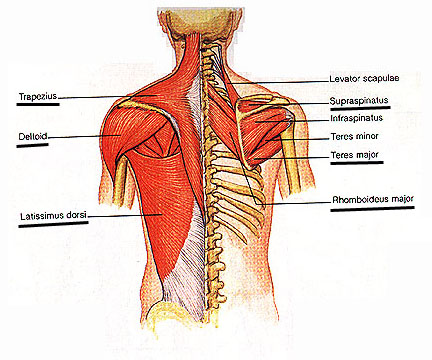
It really comes down to using or focusing on different muscle groups at different points of the pitch. I tell them when the arm is going up the front of the circle they’re using the pectoral muscles in their chest, and muscles at the top of the shoulder. (Technically that’s the supraspinatus muscle, but that’s a bit of over-explanation that causes the eyes to glaze.)
Then comes the critical part. As they start down the back side of the circle, it’s important to get the big muscles on the back side of the shoulder engaged — the deltoid, trapezius and latissimus dorsi. Sometimes I will name them, but mostly I’ll just indicate the area on the back side of the shoulder where the muscles are located. I’ve been telling them what they want to do is use those muscles to pull the upper part of the arm — from the shoulder to the elbow — down, and only that part of the arm. If they do that (as opposed to trying to pull the ball down), the elbow leads down the back side of the circle as if by magic. Finally, I tell them when the arm gets to a low point (ball is around 7:00 on a right handed pitcher, but I just show them the point) the muscles in the forearm get added on to finishing pulling the ball through to release.
Why I think this works is that most young pitchers, when they get the ball to the top of the circle, are thinking about pulling the ball to the release point. So, they engage their triceps and forearm muscles, and maybe their biceps to an extent, to do it. This motion allows them to shortcut the circle, stiffen up their arm, etc. But by separating the arm more with different sets of muscles they are able to stay loose and use a better path to bring the arm down, getting the three main pieces of the arm (upper arm, forearm, hand/wrist) to fire in sequence. It’s specific and easy to understand, which makes it easier to feel and execute.
While it may be out there, I’ve never seen the arm and shoulder action described this way before (at least that I can recall). It definitely works, though. When they do it, the pitchers can feel the added power, which puts a big smile on their faces. And ball speed definitely picks up.
Of course, this isn’t the only key to developing speed and power. That’s what makes pitching such a tough skill to learn. But it certainly helps, especially if you keep the wrist loose and ball pointed away instead of down on the back side of the circle. Give it a try and let me know how it works out for you.
Funny article on things parents do to screw up their kids
A friend of mine sent me a very funny article today titled 7 Things Good Parents Do (That Screw Up Kids for Life). Actually, I put it in the category of funny because it’s true.
In particular, pay attention to #5, because it directly applies to a topic I preach on often — what we’re teaching kids when we teach them to win at all costs. Here’s a quick excerpt:
“But let’s face it, you’re not sending your kid off to practice so he can have a good time and make friends. You want some goddamn trophies, so coaches are not above teaching kids how to cut corners, feign injuries and do whatever humiliating damage they can to their opponents, because hey, nothing else matters but winning, right?”
Unfortunately, many people do feel that way — they want the trophies, so whatever it takes to get them is fine by them. This article references an actual study that shows kids who play sports are more likely to cheat in other aspects of their life, such as school. So much for sports teaching positive life lessons.
There’s also a great section on the damaging effects of constantly heaping praise on them, to the point where they can’t handle legitimate criticism when it occurs. It definitely makes coaching much more challenging, because what is coaching if not saying what you’re doing now could be done better? There’s also that element of handing out trophies for participating, which totally negates the idea of having to work hard to earn your reward.
There’s a lot of truth in here, and the article even references legitimate outside studies to prove its points. Be warned, though. There is some profanity in it, so if that sort of thing bothers you approach with caution. I think there is a way to turn it off, but since it doesn’t bother me I didn’t check that part out thoroughly. Still, it’s worth checking out.
What Betty Crocker can teach you about hitting
There are all kinds of ways to explain things to hitters. Some people like to get really technical. I prefer to use analogies when I can.
Tonight was a case in point. I was trying to explain the timing of the load to a hitter. She was getting a late start, and consequently wasn’t getting to the ball on time. She was also rushing her swing a bit.
I wanted her to take her time through the load, and then be quick with the swing. So I explained it this way.
I asked if she had ever baked cookies. She said sometimes, when the mood strikes. I told her to think of the load being like making the dough. It doesn’t matter how quickly you make the dough. You can take your time doing that. But once you put them in the oven, there is a definite point you have to finish or they will burn.
Making the dough is the load. You can take your time. Once you get to the point where the front heel drops and the swing begins, though, there is a finite amount of time to complete the swing. That’s baking the cookies.
It may not be the standard canon for hitting. But it worked. She got the idea of the timing. And I got to think about Christmas cookies. It’s all good.
The “big dog” system of measurement for aggressiveness
Tonight I was working with a pitcher, and while what she was doing was technically fine it just wasn’t very aggressive. I tried to get her to attack the pitch more but she wasn’t quite getting what I meant. So I came up with a new way of explaining it that had the advantage of being both fun and effective.
The new method is what I’m calling the “Big dog system of measurement” for aggressiveness. Essentially, you take how aggressive the pitcher (or hitter for that matter) is being and compare it to a dog. You then try to move her up the scale.
For example, with Alyssa I told her she was currently at Labrador. I have a Lab, and they are loving, happy dogs. They can get aggressive when pushed or angered, but it’s generally short-lived. By nature they’re sweet. When I told her she was at Lab level she understood what I meant. I then asked her to step it up to German Shepherd. Shepherds also tend to be nice dogs, but they are more aggressive than Labs, which is why they’re used in police work. She went for it, and darned if her pitches didn’t pick up a bit and start smacking her dad’s glove harder.
At this point, here is what I have on the scale: Basset Hound (you’re practically comatose), Lab, German Shepherd, German Shorthair (I had a girlfriend who had one of those and it scared the heck out of me), Doberman Pinscher, Rottweiler and Pit Bull.
As you might guess, the dogs are ranked from least aggressive to most. Since it’s the “big dog” scale I didn’t include Jack Russell Terriers, Dachshunds (which can be very aggressive on your ankles) and other small breeds. The object, of course, is to make it up to Pit Bull. That’s a competitor!
I am looking for additional suggestions to help round out the scale. They have to be well-known breeds so the players can relate; they’ll have no idea if an exotic dog is aggressive or not. And for you dog lovers out there, please don’t bother defending a particular breed. I know the really aggressive dogs are usually that way as a result of their owners. But in this case I’m going with the popular perception to get the point across.
Again, the beauty of the big dog system is it provides context for what you’re asking. At least it did for the pitchers tonight. Anytime you can be more specific you’re going to be more effective too.
Camp Independence opens at YMCA Camp Duncan
Today was a very interesting and special day for me. I was privileged to attend the opening of Camp Independence at YMCA Camp Duncan — a youth campground located in Ingleside, Illinois. I was invited because I happen to give pitching lessons to the daughter of one of the driving forces behind the camp — Kim Kiser, Sr. Vice President of Camping for the YMCA.
When those of us in the softball world think of “camp,” we tend to think “opportunity to show my daughter’s softball skills so some college coach will pay for her education.” This was a camp of a different type. It is designed to help kids from seven to 18 who have spina bifida learn to live on their own instead of depending on their parents.
While I was there I heard an interesting story from Dr. Dave McClone, the founder of the camp and a doctor at Children’s Memorial Hospital in Chicago. He said that back in the 1950s and before, no one thought much about what to do with kids who had spina bifida because the mortality rate was 95%. In the last 50 years, that figure has reversed, and now 95% of the kids born with it survive into young adulthood and beyond. In fact, they’re not sure of the length of life for those patients because this is the first generation they can really track it on, but the expectation is they will live a regular life span.
That created a new issue, though. spina bifida can be pretty debilitating, and so it makes it difficult to live on one’s own. Things we take for granted — going to the bathroom, making dinner, doing laundry and other mundane tasks — have to be learned. With many of this generation’s spina bifida patients’ parents now aging, the kids have to start learning these skills so they can function on their own and contribute to their full potential in society.
That’s what Camp Independence is about. It will be taking in kids to live and work around the camp with the goal of teaching them, as the name implies, independence. It’s a very worthy endeavor that benefits not just the kids but all of us. From a selfish point of view (as was also pointed out), imagine these kids out there working and paying taxes instead of having tax funding diverted to them.
I know Kim comes on the blog now and then so hopefully she’ll see this and let us all know what we can do to help. The building that was dedicated today was just phase one. There are plans for a second building in phase two, and if I know Kim that’s not all.
You’ll pay $100, $150, $200 or more to have your daughter attend a camp or a clinic just to spend five minutes with an Olympic player or a top-level coach. Consider taking a little of that and applying it so a young person just like your daughter can learn to fix her own dinner. And regardless of which side of that divide you’re on, hug your kids tonight!