Category Archives: Pitching
Pitching + touching your shoulder = elbow pain
For a couple of years now I have been talking to pitchers and their parents about the dangers of forcing the hand to come up and touch the shoulder on the follow-through. I had heard from reliable sources (Cheri Kempf among others) how this movement put unnecessary stress on the ligaments of the elbow and could lead to elbow pain. Made sense to me, especially when I tried the movement myself.
Yet I have seen that move being taught by other pitching coaches. When I’ve done clinics and such I’ve had kids telling me “but my other pitching coach said I should do that.” Thankfully the other pitching coach didn’t tell them to jump off a bridge too.
I think the “logic” behind touching the shoulder is to try and get the pitcher not to stop her hand at her side, which is a good thing. But in touching your shoulder with your fingers after throwing you’re just trading one problem for another. And in this case, trading a performance problem for a health one.
All of that was pretty much theoretical, however, until this past week. I now have direct evidence of the dangers of “snapping up” and touching the shoulder instead of following through long and loose.
The first incident was with one of my top students. She had picked up a habit of pulling her hand straight up to snap the ball out — sort of like doing arm curls with a dumbbell. I’d told her to follow through long, but she couldn’t break the habit. Last week she came to her lesson with an elbow brace on. She’d developed a lot of pain in her elbow and hurt to pitch. After a long, slow warm-up she wanted to try pitching the full distance. I told her to work on following through long and loose instead of pulling her hand up. By the end of the lesson she was throwing full speed, harder than before, and pain-free. She was amazed that it could feel so good after hurting so much. But that’s the power of a proper finish.
Today I was talking to the father of another student who was comparing what I had taught his daughter to what her old coach had taught her. He said with his method (touching the shoulder) her elbow always hurt, sometimes to the point of tears. Since coming to me and learning to finish long and loose instead of touching her shoulder, she was pain-free.
Now, I know two is hardly a scientific sample. But two on top of other evidence I’ve heard is pretty clear. If you are a pitcher (or you have a daughter who is one) and you’re being told to touch your shoulder to finish the pitch, you are putting your health at risk. My advice would be to stop that immediately, and find another coach if necessary. There are a lot of good and proper ways to finish the follow-through. Stressing your elbow isn’t one of them.
A little trick for the backhand change
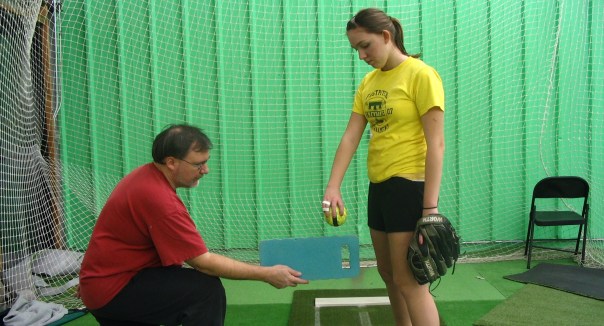
Previously I’ve talked about the importance of keeping a bit of a bend in the arm when you’re throwing the backhand change. That helps get rid of the dreaded “hump” in the pitch, where it starts to go out, then goes up a little — right into the hitter’s wheelhouse. Raising the arm slightly allows the pitcher to throw it out flat, which will keep it down.
Sometimes, however, pitchers think they’re bending the arm to pull the ball up but they’re actually not. Here’s a way to help them get the feel of it.
Take a lightweight object and hold it at the pitcher’s release point. I usually use a garden kneeling pad since it’s flexible. Hold it at the bottom of the normal circle. Then have the pitcher throw the change. If she’s dipping down instead of raise her arm, the ball will hit the object as she throws it. This will give her the feedback she needs to know where her hand should go.
Normally I tell the pitcher I’m going to hold it in the regular path of the ball. In truth, I actually hold it lower than that. They really have to work to hit it. But the idea of having it down there is usually enough to make them concerned and to bring the ball a little higher. Once it’s there, the arm is in a weak position — which means the pitcher can throw the ball as hard as she can without risking it being fast.
It’s a great trick, and works every time.
Love the breakthroughs
Tonight I was working with one of my students, a girl named Brigid. (Yes, that’s the correct spelling. I confirmed it with her a while back.)
Brigid had done some pitching a couple of years ago, but a wrist problem stopped her career. She decided to give it a try again this year, and a couple of changes we made earlier has made it possible for her to pitch without pain.
She has had one persistent problem, though: she keeps throwing inside. It’s a habit she’s had a tough time breaking. We were able to figure out that there are a couple of different causes, but one of the main ones has been her arm circle. She tends to let it wander behind her, so at release it has to go out to her right to avoid slamming into her hip.
We’ve tried a few things over the past weeks to try and fix it, but none have had much lasting success. Tonight, though, I think we had a breakthrough.
One of the main causes of her circle problems has been pulling the ball behind her on her backswing. That motion forces her arm out and away, which creates an off-center circle. So tonight we switched her to a barrel roll start. The barrel roll forces her to start with her arms in the center of her body and keep them there until the ball gets overhead. In other words, it completely eliminates one of the main causes.
It wasn’t perfect — she also has a tendency to pull her shoulders up and out at times — but it made a big dent in it. One of the biggest benefits was a rise in her confidence level. She was excited and smiling by the end of the lesson, and inspired to go forward.
Hopefully it will have a lasting effect. Stay tuned.
Choosing signals for pitches
I was having a discussion with a coach named Gail last night about the signals for her pitchers. There apparently were some inconsistencies on her team about the numbers assigned to various pitches. A couple of her pitchers come to me for lessons, and a couple go to someone else. The other pitching coach uses different numbers than Gail does for the pitches, and there were some questions about whether they should use different signals for the pitchers. This is actually more common than you might think, especially on younger teams.
In my mind, I don’t really care what numbers are assigned to various pitches by a team coach. Many of the team coaches of my students use a different numbering system than I do. That’s fine with me. I just need to know what system they use so when a student throws a pitch I know whether it did what it was supposed to do.
What I do believe is that whatever signals the team uses, they should use them for all pitchers. It’s just too confusing to have two or three sets of signals for different pitchers. A mistake will be inevitable, and since the softball gods can be cruel it will occur at the worst possible moment. If you or your catcher call for an outside pitch and the pitcher thinks it’s an inside one it’s probably going to end up at the screen.
How much do I believe this? Last the pitchers and catchers on the team I coach used a different numbering system than I use. There was confusion early in a practice game, so I told them to get together and figure it out. I believe it was the catchers who had the most input, since they call the pitches and needed to be confident in what they were calling.
Of course, that was a 16U team. If you’re not quite at that point, the head coach needs to make a decision and set the signals. That’s what Gail said she was going to do. You want everyone on board and pulling the same way. Having consistent pitch signals is one more way to do it.
There’s strong, then there’s…
Ok, I decided to borrow the Army’s slogan for this one. The full saying from them is there’s strong, then there’s Army strong. With a son who is on his way back to Afghanistan after a 15-day leave I guess the Army is on my mind. 
What made me think of this today was working with one of my students, a girl named Haley, tonight. With the holidays and all it’s been a couple of weeks since I’ve seen her. Haley was working hard when I got to the facility tonight, really putting a lot of effort in. Yet because she was trying so hard she was forming a bad habit. As she moved into release, she sort of did this arm curl move where she pulled her hand straight up instead of letting the forearm and hand whip past the elbow.
I told her I realized she was doing it because it felt strong, but it actually was limiting her speed. It was also putting her at risk of injury, most likely to the elbow but also possibly the shoulder the way she was tightening everything up.
We worked on getting the arm long again at release and after a little while she was back on track and moving on to other things. As she got it corrected she could feel how much easier it was to throw hard by staying loose. I told her she’d last a lot longer at a tournament that way too.
Fortunately, Haley is very coachable as well as being talented, so it was easy to get her to change. Not every kid is like that, however. They will want to stay with what feels strong instead of what actually is strong. But just because something takes a lot of effort doesn’t mean you’re using strength efficiently. Most players who are “in the zone” will tell you the activity feels almost effortless. That’s definitely true for pitching. They’ll use a lot of energy, but it will be easy energy. If it’s not, something is wrong.
Get quicker earlier
There is pretty much always more than one reason why pitches go wild in one direction or another. Some are obvious and easy to spot, others not so much.
Here’s one for pitches going high. Check to make sure that the pitcher is accelerating her arm circle at the right time. There can be a tendency sometimes for pitchers to wait too long to start accelerating their arm. Instead of speeding up from the top of the circle to the bottom, they wait until they hit the bottom of the circle, then start accelerating.
The phrase I like is get quicker earlier. In other words, start accelerating as soon as you pass the top. If you do that, and use a long, loose arm, you’ll feel the proper release point at the bottom of the circle, and have the proper timing. It’ll help you throw harder, too.
Interesting article on pitch speeds
Just saw this article referenced at DiscussFastpitch.com. The article is on a site focused on fastpitch pitching called PitchSoftball.com, and represents the observations of Gerald Warner, a pitching instructor from Colorado.
For those of you whose 14 year old daughters DON’T throw 65 mph with eight pitches (as the daughters of most people on eTeamz’s boards seem to do), don’t despair. According to the site, while the average pitch speed at a particular age varies by region, Coach Warner puts an average 14U pitch speed at 50. A 13 year old will pitch between 40 and 50, he says.
That’s pretty consistent with what I’ve seen too. There are always exceptions on both ends, but the speeds listed here are more the norms. Incidentally, an average HS pitcher is listed at 53-57 mph.
As people point out in the DiscussFastpitch post, keep in mind that speed is only one element of a successful pitcher. You need enough speed to be respectable, but you don’t have to be overpowering to be successful. Movement, location, and intelligence/pitch selection are also important – perhaps even moreso, especially at the upper levels.
Check out the article. It’s a quick read, but a good one.
It don’t mean a thing if it ain’t got that spin
You would think this would be self-evident but apparently it’s not, so I bring it up here.
There are two things that make a pitch move — the direction of the spin and the speed of the spin. You need to have both in order for the ball to do what it’s supposed to do.
Still, I am amazed at how many times I will watch a pitcher throw a “curve ball” or a “drop ball” or whatever and see that it’s not spinning in the right direction. The Magnus Effect dictates that air rushing around a spinning ball will go across the sides at different rates, creating a difference in air pressure. When the difference gets to be enough, the ball moves. 
So, as shown in the illustration here, if you want the ball to drop sharply, it has to be spinning 12 to 6. No other spin will create that same effect. For a right handed pitcher to throw a curve ball, the ball has to be spinning 3 to 9 (from the pitcher’s perspective), or darned close to that.
So when you’re working with a pitcher, that’s the first thing to check on a movement pitch — the direction of the spin. Because if you don’t have that, none of the rest of it matters. You can do all the other mechanics perfectly, but if you’re not releasing the ball in a way that imparts the proper spin you’re wasting your time.
Keep in mind that a drop ball is not a ball that angles downward. It is a ball that comes in fairly flat, or maybe with a slight downward angle, and then drops suddenly — the old “falling off a table” description. A curve ball has to be more than a pitch that moves from throwing hand side to glove side. It has to be traveling in one direction, then suddenly change directions. If it doesn’t, it’s not a true curve ball.
The speed of the spin is the other factor. Once you have the direction correct, you need to make sure it’s spinning fast enough to move. The faster the spin, the more the ball will move because the bigger the pressure differential will be on the ball. Balls that spin in the right direction, but tumble more than spin, won’t move. You don’t need a lot of forward speed on the pitch to get it to move either. Even a 40-45 mph pitch can move if it’s spinning fast enough.
Once you have the spin direction and spin speed, then it’s time to worry about locating the pitch. Up until that point you’re wasting your time. Focus on good spin and the rest will fall into place. And if you have a pitch that isn’t moving sharply, check the spin. You may have some work to do.
Lighting a spark
This is one of those stories that again reminds me why I like coaching so much. It’s for those little breakthrough moments that crop up now and then.
I was getting ready to start a pitching last night with a girl named Ashlee. Her catcher didn’t show up so I told her I would catch for her. We did some warm-ups and she started pitching.
Now, Ashlee has developed a habit of stepping forward (off the pitching rubber) as she goes to launch. We’ve been working on correcting it for a while now, but nothing we tried seemed to work. She takes a very aggressive stride and as part of it would tend to shift her weight forward early. Her foot would move, then she’d plant and launch. The problem went from small to severe in various stages. And it is a problem for two reasons: 1) it’s illegal and 2) she loses drive and therefore speed (even though she feels strong doing it).
I came up to work with her on it, saying it was a good night to do it since her catcher wasn’t there, and she agreed. As I stood there, a sudden idea hit me. All this time we’d been trying to get her pivot foot to stay in place instead of moving forward. Whatever we’d tried just didn’t process with her.
So this time, I suggested that she start with her pivot foot well forward, with just the heel barely touching the pitching rubber. She would then go to her negative move like that. But as she brought her hands down below her waist, and before she made her positive move, pull the foot backwards so the pivot foot would wind up in the spot most pitchers start from (ball of the foot touching the rubber). That seemed to do it, at least last night. It helped her gather her energy more effectively, and transfer her weight with better timing. We walked through it a few times so she could get the feel of it, then started trying to go more aggressively off of it — none of this with the ball. You could see the light bulb come on for her.
As we stood there, she looked at me and asked, “Did you just come up with that right now?” I paused for a moment to think if I’d heard it anywhere, but couldn’t come up with a source offhand so I said yes. She got a little smile on her face, raised her hand and said, “Give me a high five on that one.”
Ashlee is not the sort who does that lightly, so it was pretty rewarding to have her feel that way. After the lesson she said, “We had a breakthrough tonight.” Of course, only time will tell if it sticks, but I think it will. I asked her to practice just that movement during the week and she said she would. I believed her too, because she seemed to like it. It felt “right” to her where previous ideas we’d tried just didn’t.
So yes, fixing the problem (we hope) was satisfying. But more satisfying, to me, was the reaction. I think Ashlee felt good that I’d come up with something specifically for her, and something she could buy into. Her high five gesture wasn’t a huge one. But it was very sincere. If I can help one pitcher make one breakthrough on one night, it’s a pretty darned good night.
Another cue for the backhand change
I know it seems like I’m obsessed with the change this week. And perhaps I am. But it’s an important pitch and worth focusing on.
Sometimes a pitcher can have trouble getting her hand turned around in time to throw the backhand change. If that happens, try telling her to make sure she brings her thumb to her thigh as she brings the ball through the bottom of the circle. This cue is specific, and helps assure that her hand is coming knuckles first through the release zone.
Tonight was the first time I’ve used the cue, and it worked in the situation where it was needed. It may not work for everyone, but it’s certainly worth a try. The challenge for any coach is to find a way to communicate what the player needs to do in a way that makes sense to her. Thumb to the thigh is part of the rhyme often used for overhand throwing — thumb to the thigh, raise it to the sky, wave bye-bye. Now I know it works for pitching too!






 Life in the Fastpitch Lane