Category Archives: Pitching
Using the curve and screw effectively
One of the things I find fascinating when I read discussion boards is how many people — especially the old-time pitchers — seem to have a bias against the curve and the screw. Their basic premise is you should only be throwing pitches that move up or down, i.e. the rise and the drop, because they’re harder to hit than a ball that stays flat.
It makes me wonder what their expectations are or experience is with the curve and screw. I’ve found them both to be very effective pitches when thrown correctly and under the right circumstances.
First of all, the curve and screw don’t have to be flat pitches. A screw that goes up as well as in can be tough to hit (more on that later). The curve will tend to be flatter, but will still have some tendency to drop in most cases.
But the real advantage is in location. I think too often the people who don’t like the curve or screw tend to throw them or see them thrown for strikes. That’s not necessarily what you want to do.
I like a curve that starts out as a strike, out on the outer third of the plate. Then, a couple of feet before the plate it breaks off and is essentially a ball. The thing is, the hitter made her decision to swing before the ball broke, so she’s essentially swinging at a ball. If she does hit it, she likely won’t hit it very hard. But the odds are she will swing and miss, chasing a pitch that’s too far outside to hit. That’s a great 0-2 pitch. If she doesn’t go for that outside pitch, come back with a pitch on the outside corner that doesn’t break laterally. If she laid off once she’ll likely lay off again, only this time it is a strike.
If you can throw a back door curve on the other hand, you’re throwing a pitch that looks like it will plunk the hitter in the ribs. She backs off, and the ball goes across the plate for a strike. As long as the blue is watching the pitch the entire way you get an easy strike.
On the screw, there are a couple of strategies that make it effective. To simplify the description, we’ll assume a right-handed pitcher (RHP). Her pitch will break in toward a right-handed hitter and away from a lefty.
Assuming you can get actual break and not just angle, the screw can be very effective against a big hitter. It starts out looking all fat, around the middle of the plate, then breaks in on the hands. The bigger hitter who was planning on crushing the middle of the plate pitch has to pull in her hands and hit with alligator arms. If she does catch it in time, odds are you’re going to see a long foul ball down the left field line, which looks spectactular but is still a strike, same as a ball popped back into the screen.
With less talented hitters, a ball darting up and in toward their hands or face masks can be pretty intimidating. They back off, the ball stays on the plate, again you get an easy strike. One of the beauties here is that there usually aren’t many kids around who throw a good screw, so if you can the hitter has fewer reference points to use in recognizing it. If one happens to get away and plunk someone, so much the better. The others will think twice before digging in.
For lefties, the screw can be used the same as a curve for righties — a pitch that breaks off the plate. You can also have lefty slappers chasing what looks like a good pitch to slap — providing you can adjust the break point to the front of the batter’s box. Otherwise, the slapper will catch it before it breaks. Since slappers are taught to swing down, they may wind up getting the bat too low too early, swinging under the pitch because it’s not where they thought it would be. No need to throw it for a strike; it only has to look like it will be a strike when the hitter makes her decision, which is usually about halfway between the plate and the pitchers rubber.
The objective with pitching is to get hitters to swing at pitches that they thought would be good but turn out not to be. The curve and the screw can both qualify if you use them correctly.
More on the so-called natural softball pitching motion
Had this thought earlier today and just had to share.
Everyone talks about how the softball pitching motion is a “natural” motion. If that was true, parents wouldn’t pay thousands of dollars for their kids to learn how to pitch.
The reality of windmill pitching and over use injuries
Just saw this article today on the Softball Performance blog and thought it was important to pass along. In it he provides a synopsis of an article that appeared in a publication for professional trainers examining injuries in softball pitchers.
As you might expect, some of the high incidence of injury is due to poor mechanics. We’ve all seen those pitchers who are good at throwing hard despite having poor mechanics. Because they’re winning games and blowing away the competition, particularly at the younger ages, no one gives much thought to whether their mechanics are any good. Eventually, though, it catches up with them. I can personally think of a couple of kids who were phenoms at 10U and 12U, but unable to even throw a pitch by age 15.
Equally important, though, is the risk of overuse injuries in pitchers — even those with good mechanics. There is this prevailing myth that the windmill pitching motion is “safe” and “natural,” so there is little risk of injury. That’s simply not true and the article demonstrate it.
Any kind of repetitive motion, especially a violent one such as pitching, can lead to an overuse injury. Those can be tough to recover from, too. If you’re a coach and you’re throwing one girl more than three or four games in a weekend, or you’re a parent and allowing a coach to do it because “the team needs her to win,” you really need to read Marc’s post. Marc is an expert in softball-specific sports training with outstanding credentials, so when he says something is a potential issue you’d best listen.
Look at it this way: if a person get develop Carpal-Tunnel Syndrome sitting at a desk, what makes you think a softball pitcher can’t get it from pitching? I know which one I think is more strenuous.
Using the big muscles in pitching
One of the things I’ve always struggled with is finding the right way to tell pitchers how to use their bodies to throw the pitch. I’ve been describing the arm motion as pulling the elbow down or leading the elbow through the circle but that has had limited results. Some kids got it, but many others couldn’t quite seem to figure out how to do it at full speed.
A few weeks ago I was watching one of my students, a girl named Katie, during her lesson. I commented to her on how she looked like a young, much shorter Jennie Finch with the way she was using her arm. (Katie has very long arms, too, so the motion was a bit exaggerated. It also makes throwing some pitches a bit more challenging, but that’s a story for another day.)
As I observed her, I drew a mental picture of some of the videos I have or have seen of Finch pitch. That’s when it hit me — a way to describe the use of the arm and the shoulder complex that would make sure the big muscles in the shoulder become more engaged. When I watch her, Finch seems to do a better job of getting the big muscles in the back involved — probably the result of using the Finch Windmill all those years since it looks to me like those are the muscles it will work the most. When I watch in analysis mode I can almost feel the power she’s developing myself.
I tried it with Katie and got immediate results. I’ve tried it with pretty much all my students, and have seen universal results. They are able to throw harder/faster while remaining relaxed. So I thought I’d share the explanation I use now. 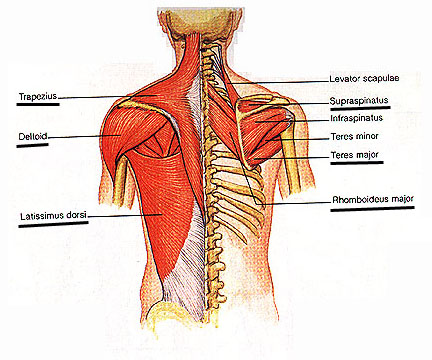
It really comes down to using or focusing on different muscle groups at different points of the pitch. I tell them when the arm is going up the front of the circle they’re using the pectoral muscles in their chest, and muscles at the top of the shoulder. (Technically that’s the supraspinatus muscle, but that’s a bit of over-explanation that causes the eyes to glaze.)
Then comes the critical part. As they start down the back side of the circle, it’s important to get the big muscles on the back side of the shoulder engaged — the deltoid, trapezius and latissimus dorsi. Sometimes I will name them, but mostly I’ll just indicate the area on the back side of the shoulder where the muscles are located. I’ve been telling them what they want to do is use those muscles to pull the upper part of the arm — from the shoulder to the elbow — down, and only that part of the arm. If they do that (as opposed to trying to pull the ball down), the elbow leads down the back side of the circle as if by magic. Finally, I tell them when the arm gets to a low point (ball is around 7:00 on a right handed pitcher, but I just show them the point) the muscles in the forearm get added on to finishing pulling the ball through to release.
Why I think this works is that most young pitchers, when they get the ball to the top of the circle, are thinking about pulling the ball to the release point. So, they engage their triceps and forearm muscles, and maybe their biceps to an extent, to do it. This motion allows them to shortcut the circle, stiffen up their arm, etc. But by separating the arm more with different sets of muscles they are able to stay loose and use a better path to bring the arm down, getting the three main pieces of the arm (upper arm, forearm, hand/wrist) to fire in sequence. It’s specific and easy to understand, which makes it easier to feel and execute.
While it may be out there, I’ve never seen the arm and shoulder action described this way before (at least that I can recall). It definitely works, though. When they do it, the pitchers can feel the added power, which puts a big smile on their faces. And ball speed definitely picks up.
Of course, this isn’t the only key to developing speed and power. That’s what makes pitching such a tough skill to learn. But it certainly helps, especially if you keep the wrist loose and ball pointed away instead of down on the back side of the circle. Give it a try and let me know how it works out for you.
The “big dog” system of measurement for aggressiveness
Tonight I was working with a pitcher, and while what she was doing was technically fine it just wasn’t very aggressive. I tried to get her to attack the pitch more but she wasn’t quite getting what I meant. So I came up with a new way of explaining it that had the advantage of being both fun and effective.
The new method is what I’m calling the “Big dog system of measurement” for aggressiveness. Essentially, you take how aggressive the pitcher (or hitter for that matter) is being and compare it to a dog. You then try to move her up the scale.
For example, with Alyssa I told her she was currently at Labrador. I have a Lab, and they are loving, happy dogs. They can get aggressive when pushed or angered, but it’s generally short-lived. By nature they’re sweet. When I told her she was at Lab level she understood what I meant. I then asked her to step it up to German Shepherd. Shepherds also tend to be nice dogs, but they are more aggressive than Labs, which is why they’re used in police work. She went for it, and darned if her pitches didn’t pick up a bit and start smacking her dad’s glove harder.
At this point, here is what I have on the scale: Basset Hound (you’re practically comatose), Lab, German Shepherd, German Shorthair (I had a girlfriend who had one of those and it scared the heck out of me), Doberman Pinscher, Rottweiler and Pit Bull.
As you might guess, the dogs are ranked from least aggressive to most. Since it’s the “big dog” scale I didn’t include Jack Russell Terriers, Dachshunds (which can be very aggressive on your ankles) and other small breeds. The object, of course, is to make it up to Pit Bull. That’s a competitor!
I am looking for additional suggestions to help round out the scale. They have to be well-known breeds so the players can relate; they’ll have no idea if an exotic dog is aggressive or not. And for you dog lovers out there, please don’t bother defending a particular breed. I know the really aggressive dogs are usually that way as a result of their owners. But in this case I’m going with the popular perception to get the point across.
Again, the beauty of the big dog system is it provides context for what you’re asking. At least it did for the pitchers tonight. Anytime you can be more specific you’re going to be more effective too.
A solution to walking off the pitching rubber
A common problem for pitchers, especially here in the Northern climes where a lot of time is spent practicing indoors, is developing a habit of “walking off” the pitching rubber. In other words, instead of loading, transferring the weight to the pivot foot and then pushing off, pitchers will start to let the pivot foot slide forward off the rubber then plant and push off. This is often found with pitchers who practice on a flat gym floor instead of on a pitching mat. Here’s an illustration of that problem to make it clearer (those reading this on the Discuss Fastpitch forum may need to go to my blog to see the video — http://fastpitchlane.softballsuccess.com):
Stepping off the pitching rubber
Ashlee, the girl depicted here, is one of those who had developed this issue. (EDIT: I actually don’t have the video for Ashlee anymore, so another student, Emma, kindly stepped in {no pun intended} to demonstrate the concept.) We tried a number of the standard solutions, such has applying light pressure to her foot as she started to pitch, putting a piece of paper under her toes and having her try to drag it forward, etc. All would work while we were doing the exercise. But as soon as we went back to regular pitching she was right back into walking off. She is very aggressive in her footwork which contributed to the problem. Ultimately it got to the point where the walk off was very obvious.
This movement is a problem for two reasons. One is that it’s illegal. It’s essentially a crow hop without the hop, and because of the way it happens it’s pretty easy for an umpire to call. Beyond that, though, by not loading properly she wasn’t developing the proper level of drive she needed to maximum speed and sharpen her movement pitches.
So, rather than continue to fight her body’s desire to introduce early movement into her footwork we decided to work with it. Essentially, what we did was have her start with the heel of her front foot just barely touching the pitching rubber. Then, as she goes into the loading phase she actually pulls her foot backward so the ball of the foot is against the pitching rubber. Here’s how that looks:
Pushing off from the pitching rubber
As you can see, she still “walks forward,” which feels comfortable to her. But now when she does it she is loading better and remaining legal.
As a side note, the “after” video is her natural motion now most of the time. We actually had to take several shots to get the “before” video because it is no longer her habit. Not to say she doesn’t backslide every now and then, but for the most part this is where she is now, without having to think about it. Let’s say it’s a work in progress, but progress is good.
So if you have a pitcher with this problem, give it a try. It may be just the trick to help her overcome the issues.
Where do coaches come up with this stuff?
I am often amazed by the things I hear from my students regarding what their team coaches tell them. Sometimes the statements are just jaw-droppingly stupid.
Last night was such a case. I was working on the changeup with one of my students. She threw a real nice one, about thigh-high and well-disguised. I complimented her on it, and she told me one of her team coaches told her that “a good changeup should hit the plate.” Huh? I was stunned.
Why in the world would you want to make your changeup hit the plate? If you are throwing it well, one of the good things that can happen is it causes the hitter to freeze. If that occurs and the pitch comes in for a strike, well, you get a strike. If it hits the plate, it’s a ball. Why in the world would you not want to get a free strike?
I can only think of a couple of reasons a coach might make that statement. One is he may never have seen a real changeup and thus doesn’t realize what it’s supposed to look like and what it can do. Even if a changeup gets hit, if it does its job and fools the hitter it’s usually for a weak ground ball or pop fly. Of course, if you’re just slowing your arm down and giving it away you might want it to hit the plate so it doesn’t hit the grass behind the fence.
Another reason would be if the pitchers are throwing it too high. Asking them to try to hit the plate might be a cue to help them bring it down. It’s mechanically unsound and unlikely to work, but at least it’s well-intentioned.
The third reason, of course, is that the coach is simply speaking of things which he knows not. As Mark Twain once said, “Better to keep your mouth shut and have people think you’re a fool than open it and prove it.” Apparently this coach didn’t watch Taryne Mowatt lead Arizona to a WCWS championship by throwing changeups for a strike. A change that hits the plate is what you would call a mistake.
For this pitcher, I gave her my standard instruction for dealing with this sort of thing: say “OK,” or “I’m trying,” then continue to throw it for a low strike. In other words, save this coach from himself. Maybe someday he’ll learn.
USSSA pitching distance moving to 43 feet
This morning I received an email from USSSA announcing that, effective immediately, the pitching distance for 15U and above is now 43 feet. The decision is a reaction to the National Federation, the high school sports ruling body, moving the pitching distance to 43 feet for varsity. I have a few thoughts about this move (as you might expect).
One is kudos to USSSA for sending an announcement out directly to coaches instead of making us hunt for it on their Web site — which is what ASA typically does. Nice to see an organization actually using more modern technology to disseminate their information.
The second is amusement that high school softball is essentially dictating what summer ball does. For all the talk everyone puts out about how high school ball is a joke, it’s not as important as summer ball, blah blah blah it seems that the summer folks actually do put a priority on high school ball. Actions speak louder than words, boys and girls.
I can also see where pitching coaches (including me) are going to have some dilemmas this off-season. The key one is what distance to use when working with your pitchers. If ASA, NSA, Pony, NAFA, AFA and whatever other sanctioning bodies out there don’t follow suit, it’s going to be tough to know how to practice. There are some adjustments that need to be made going from 40 feet to 43 feet, and some pitchers adjust better than others. It’s conceivable that a pitcher will pitch a tournament one weekend from 40, the next from 43, and so on. (Or maybe even from 46 feet like my pitchers did at one tournament where the umpire didn’t know how the field had been set and assumed that the far pitching rubber was the right one.)
Of course, that dilemma already exists for high school age kids. Should a freshman practice at 40 feet, which is likely to be the frosh/JV distance, or should she assume she’s going varsity and practice at 43 feet? The longer distance doesn’t become mandatory in high school until the 2010-2011 school year, but Illinois has already adopted it for varsity.
It’s all very confusing right now. I expect that eventually it will all be standardized, and the distance will be 43 feet from freshman/15U up for everyone. Then the 12U and 14U pitchers will get better and soon everyone will be there, except 10U pitchers who will move to 40 feet.
I say why not get it over with and just have all pitchers pitch from second base like Eddie Feigner used to? Then they won’t need to wear masks, and you’ll have fewer ground balls getting through the middle.
Nice problem to have
I am currently watching the championship game of the KFC World Cup series — USA v Australia. Eric Collins and Michele Smith were just talking about the decision to pitch Monica Abbott instead of Cat Osterman in this game.
Let’s face it. Don’t you wish you had that decision to make? I wonder if Jay Miller agonizes over it? I also wonder if he worries about the confidence of one or the other, or whether one of them will be upset if she doesn’t get the ball? Still, that’s a great problem to have. And he didn’t even think about Jennie Finch, apparently. She’s over at first base and unlikely to pitch. Imagine having Jennie Finch and not even thinking about pitching her.
Must be nice!
It’s official: High school pitching distance moving back to 43 feet
Just saw a notice in an NFCA newsletter. The National Federation, the governing body of high school softball, just voted to increase the pitching from 40′ to 43′ for varsity players beginning with the 2010-2011 season. For those not sure what that means, it takes effect the year after the one coming up. So if you’re a senior, no sweat. If you’re a junior it will kick in your senior year.
The rationale is to increase the amount of offense in the game. The feeling is the extra three feet will help batters hit the ball more, which will get the defense more involved (instead of watching pitchers rack up 15 strikeouts per game) and make the game more exciting for the fans.
All of that is probably true for the better teams. But I wonder what it will do to the lesser teams — the ones whose pitchers are already struggling. It might also be a problem for those pitchers who bounce between JV and varsity during the season. Any who rely on movement rather than speed may find it difficult to stay on top of their game.
What do you think? Is this move really necessary for the quality of the high school game, or is it more to benefit the elite pitchers — to get them ready for college ball? And will it make the lower teams more competitive by helping them generate more offense, or penalize those who don’t have big, strong pitchers who can throw 60+ mph?






 Life in the Fastpitch Lane