Category Archives: Hitting
12 Ways Fastpitch Softball Has Changed Over the Last 25 Years

It is always tempting to think that the way things are today is the way they have always been. After all, it can be difficult to imagine things being significantly different if you’ve never known anything else.
Well, I’m here to tell you that the game HAS changed significantly over the last (roughly) 25 years since I became involved with it. Sometimes for the better, sometimes for the worse, and sometimes somewhere in between, depending on your point of view.
So for those of you who enjoy a little history, or who wonder if things were better in the “good old days,” or would just like a little perspective on how we got to where we are today, here are X ways the game has changed over the last 25 or so years.
#1 – The Increase in Offense
If you look back at scorebooks, especially at the higher levels of play such as D1 college games, you would find a lot of games ended with a score of 1-0 or 2-1. You would probably also find that many of those games went into 8, 10, 12 or more innings to arrive at that finaly score.
There were a lot of reasons for that phenomenon, some of which we’re going to get into below. But regardless of the reasons, there typically wasn’t a whole lot of offense being produced back then.
Hits were a rarity – never mind the powerhouse slugfests we typically see today. Many of the “old school” types who played or coached in that era believe that’s when the game was at its best.
But the reality is unless you were a pitcher or a pitcher’s parents those games were kind of boring to watch, especially for the casual fan. So much so that on those rare occasions when ESPN would televise a game they would typically tape it, run it later, and edit out two or three innings where there were no hits or runs scored because they figured nothing happened so viewers weren’t missing anything.

That’s why many of the changes that follow were made – to make the game more accessible and interesting to the casual viewer so they could hike up ratings and capture those big TV dollars. Turns out that strategy was the right one because the 2024 Womens College World Series final games averaged 2 million viewers per game, and softball at all levels is more visible than ever on TV.
#2 – The Ball
This was one of the big changes made to try to increase offense.
The original ball for fastpitch softball was white with white seams. As a result, hitters would tend to see a screaming blur of white coming at them from a close distance, making it difficult to pick up on how the ball was spinning (which might give them a clue as to what it was going to do).
Today, of course, it is optic yellow with red seams. That makes it at least a little easier for hitters to pick up and follow to the plate overall, and gives them at least a shot at identifying the type of pitch being thrown so they can react accordingly.
That said, with all the bullet spin pitches being thrown these days picking up the seam direction is probably less important. Still, when facing pitchers who do have true spin on their balls it can help.
#3 – Pitching Distance
This was probably one of the biggest changes that helped the offense. Believe it or not, when I first became involved with the sport, the pitching distances were 35 feet up through 12U, and then 40 feet from 14U up.
That’s right – the college and international pitching distance was 40 feet!
Today, of course, only 11 and 12 year olds pitch from 40 feet. The extra three feet has helped older hitters gain a little more time to see the ball and execute their swings, resulting in more offense.
With so many more pitchers throwing at or near 70 mph, however, don’t be surprised if you start seeing a movement to push the pitching rubber back a little more in the near future.
#4 – More Offseason Training for Hitters
Today it’s almost a given that fastpitch softball players will go for hitting lessons pretty much year-round. That wasn’t always the case, though.
In fact, many players rarely picked up a bat when they weren’t in-season, or at least in the pre-season. Contrast that with pitchers training constantly in the offseason and you can see another reason why there was such an imbalance.
Today it’s pretty common to see players from 10 years old up either taking lessons or showing up to work on their swings in batting cages two or three times per week. They may not always have the greatest swings, but sheer repetition has helped them out-perform many of the players in the past.
#5 – The Proliferation of Facilities
The increase in the number of players who want to work out in the offseason has led to the growth of batting/pitching cage facilities throughout the U.S.
Back when my oldest daughter started playing you had to travel pretty far to find a space where you could pitch or hit in the offseason. And I live in a pretty high popular suburban area.
Today you can hardly swing a dead cat without hitting a high-quality facility that offers not only cage space but also a weight training area, speed and agility classes, and a host of other options to help youth players develop their games. Sure beats trying to sneak into the local high school so you can get a few reps in.
#6 – More Instruction
When my oldest daughter announced she wanted to start pitching I had no idea of what to do to help her. I felt lucky to come across a coach from another team who gave pitching lessons, and would drive an hour to take her to those lessons either at a field in the summer or in a middle school gym in the winter.
This was pre-Internet, by the way, so it’s not like I could have done a Google search to find someone. It was all pretty much word of mouth.

It’s not too hard to find an instructor today. They are in every local facility, and most can be found through social media or a quick search on “fastpitch pitching instruction near me.”
Now, that’s good and bad. Good because you can find them, but bad because it allows a lot of unqualified people to hang out a shingle and take your money while leading you down a rabbit hole.
Still, with a little due diligence you can find someone who can help your daughter develop faster than she would through the trial-and-error method on her own. Which is a good thing.
#7 – The Uniforms
Now we get to some of the fun stuff.
When my oldest daughter started playing, college teams and international teams wore shorts. So naturally all of the youth players wore or wanted to wear shorts too.
In fact, the travel program my daughter was in had pants and I had to fight on their behalf to get the standard changed to shorts.
Then college teams started going to pants, largely driven by Arizona who was a powerhouse at that time. And then everyone else went back to pants.
There is that saying that what goes around comes around, so I can’t help but wonder if one day shorts will make a comeback. I’m sure all the manufacturers who sold those calf-length sliding pads are hoping that’s the case.
The other significant change in uniforms is how many today’s players often have. Back in the day it was normal to have two, which meant if you had a three- or four-day tournament someone was going to be doing laundry at home or in the hotel.
Today, of course, teams can have four or five uniforms, plus maybe a specialty one for a cause, plus practice uniforms. The players of the past are likely pretty jealous of all the options today’s players have.
#8 – Time Limits
This may be hard for today’s players and parents to believe, but once upon a time EVERY game went a minimum of seven innings. Longer if there was a tie at the end of seven, because in fastpitch softball games could not end in a tie.
Nowadays it’s common in travel ball tournaments for there to be an 1:15 time limit. Sometimes that means no new inning, other times it’s that the game stops at 1:15 and if the inning isn’t over you revert back to the previous inning.
The addition of a time limit definitely makes it a different game. It’s critical for your team to start fast on offense and not make too many errors on defense early on, because you may not have the time to make up for any issues later.
It’s also a challenge for coaches who want to give all of their players ample playing time. One rough inning and those kids who started on the bench may not see the field. Or else the coach will have to put in subs in the middle of an inning, which usually doesn’t make anyone happy.
Time limits have also had a lot of other effects on the game. You can read more about my thoughts on this big topic here and here.
#9 – Offseason Training
For much of my early coaching career it was rare for teams in areas where there was a lot of cold and snow to do any practicing during the offseason. Dedicated facilities were rare, and local schools often didn’t like to rent out there gyms to outside programs so they’d charge an arm and a leg and then make it difficult to schedule times.
The program I was with was a rare exception. We worked out a deal with the local Park District to offer “open clinics” on Saturday mornings, which would give us an hour a week to work with our teams, plus any other players in the area who wanted to sign up. We’d actually draw a pretty good cross-section of dedicated players from various teams, essentially training our competitors.
Today it’s not uncommon for teams to practice two or three times a week in dedicated baseball/softball facilities, either their own or facilities they rent. It shows up in the way they play, which quite honestly is far better overall than many of the teams of yesteryear.
#10 – Winter Games
Readers in California, Florida, Arizona, and other southern states will have no idea what I’m talking about, but for those of us in cold weather states the addition of games and tournaments during the winter has been a huge change.
There are more domes and other large turf facilities than ever, which opens up the ability for teams to play two or three times a month if they choose. While I still believe there is more value to practice than games in terms of learning the sport, I will also admit that practicing all the time without any games to measure your progress can be boring.
Having the ability to mix games in with offseason practice has been a huge plus for today’s players.
#11 – The Technology
This has been a huge advance for today’s players over those in the past. Let’s start with bats.
Back in the day if you had a Louisville Burgundy bat (old timers, you know the one) you were highly privileged. Today most players wouldn’t use that for a practice bat.
Bat technology has advanced so much that now even a checked swing can result in a double if you hit a gap. One more reason scores now are more like 7-5 instead of 1-0.
But there is also technology like 4D Motion, Rapsodo, Blast, Pocket Radar and others than can deliver hard data instead of just having coaches eyeball a pitch or a swing and guess what’s going on. Not to mention high-speed video such as OnForm that lets you slow down the skill, mark it up, and really analyzed it to the Nth degree.
Finally, there is game scoring technology such as GameChanger that not only lets family and friends who can’t attend the game follow along (or see how their favorite players did afterwards) but also provide coaches with a lot of statistical data about how their teams are doing without all the hassle of transferring the information from a paper scorebook to a spreadsheet.
Of course, the data is only as good as the person who is keeping the book, but that was also true for a paper scorebook. The nice thing is it’s easier to pull it up when you want to get a feel for how your players are doing.
#12 – The Cost
Most of the changes we have talked about have been positive. This one might be more of a negative.
Back in the day, a typical team fee for a travel ball team was $400 – $800 dollars, either with or without uniform. Those fees would cover not only tournament and practice field fees but also team equipment such as bats, helmets, and catcher’s gear.
(Yes Virginia, in the old days teams would actually supply a few bats and helmets for shared team use. We’ve come along way since then.)
These days travel ball fees can run into the thousands of dollars. It’s not unusual for families whose daughters are playing on high-level teams to pay $10,000 a year or more, not counting travel fees which are additional.
Sure, we can talk about inflation and the numbers not quite being the same. But I guarantee even if you account for those differences the cost has gone up significantly.
The price of progress, I suppose. But it does mean young ladies who once might have been interested in playing fastpitch softball have now been priced out of the market, unfortunately.
Ok, those are some of the changes I have seen. What have I missed? What have you seen change within your time in the sport, whether that’s two years or 20 years? Leave your thoughts in the comments section below.
Re-Thinking the Traditional Batting Order

One of the most important responsibilities a team coach has is putting together a batting order that will produce runs. Yet all too often these same coaches become so bound to a particular way of thinking that they don’t take advantage of opportunities that might be available to them if they’re willing to think a little bit outside the box.
Let’s start with what is the norm for most teams. The traditional batting order usually looks something like this:
- Leadoff – Fastest girl who can put the ball in play reliably; often a slapper if one is available; tends to hit mostly singles; often called a “table setter”
- Two hitter – Primary job is to move the leadoff along when she gets on base, either by hitting a single, bunting, or hitting behind the runner; mostly puts the ball in play on the ground
- Three hitter – Best all-around hitter on the team; can hit for power, hit for average, doesn’t strike out much; her job is to bring the table setters in
- Cleanup – Your most powerful hitter, the girl who is a threat to go yard any time she steps up to the plate; not too worried about average so it’s ok if she strikes out a lot as long as she hits those deep balls
- Five hitter – Second-best all-around hitter on the team; she’d be the three hitter if three wasn’t there; maybe has a little lower average or slugging percentage than three but still a huge threat at the plate
- Six hitter – She’s ok and you hope to get her on base but you also know it’s not as likely; mostly a singles hitter, might be good at drawing walks
- Seven hitter – Great defensive player
- Eight hitter – Shows flashes of being good but not strong enough to make the top five; probably there to drive in six and/or seven in case either one is fortunate enough to get on base
- Nine hitter – Second base candidate for leadoff; while she thinks you put her there because you think she’s bad, you’re actually hoping she gets on base so the top of the lineup can drive her in; generally fast, could be a developing slapper; OR, your worst hitter who you’re trying to limit in how many times she comes to the plate
That’s a lineup that has worked for many teams for decades, and certainly a valid approach. But it’s not the only one.
One of the determining factors should be your personnel, i.e., your players and how they hit. A smart coach will look at who he/she has available and will try to take the best advantage of them regardless of what the “experts” say.
And in doing so, he/she may just catch the more traditional-thinking coaches off guard as they call pitches based on their assumptions. Here are a couple of examples.
More power at the top
Instead of opening with a couple of table setters, try taking a traditional five hitter and batting her at leadoff. She hits for average so will likely get on base, and since she also hits for power she could lead off the game with a double or triple.
That way you already have a runner in scoring position after one batter and have three outs to bring her in. Statistically you’re more likely to score in that situation than if you get a runner on first and sacrifice her to second. You also deflate the opposing team (and especially their pitcher) psychologically by opening with a big hit.
Then put your traditional three hitter in the two spot. A second big hit in a row scores the first one and probably leaves this hitter in scoring position as well.
Worst case you have two runners on base with no outs, with one or both already in scoring position. Then put your cleanup hitter in the three slot.
If she goes yard you have three runs before you have any outs, and even if she just hits a deep fly ball that’s caught you score one and probably advance the other runner to second or third where you still have two outs to bring her in. Worst case she strikes out but you still have two more outs to score at least one run.
From there, you can bunch your traditional one, two, and nine hitters to see if you can scratch a couple more runs together. You might want to put two in the four spot so that the traditional four, if she gets on base, isn’t in the way of your speedsters.
With this lineup you maximize the number of at-bats your best hitters get while minimizing the at-bats of your weakest hitters. It does create a potential hitter desert at the bottom of the lineup so you have to hope the top does its job so you’re not depending on the bottom to win a close game.
But hey, no risk, no reward.
Focus on speed
What if you don’t have any (or at least not many) big hitters? In that case you might want to bunch your fastest players (who can hit) at the top and try to create havoc and errors with aggressive baserunning.
Your leadoff hitter would be the same as a traditional lineup. But then bring the traditional nine up to the two slot, and follow her with another speedster in the three slot.
With three girls who can get on base with a slight bobble you are putting a lot of pressure on the defense to perform. And as we’ve all seen, errors often happen in bunches.
Force one bad throw that results in an extra base or two, then keep applying the pressure, and you may get another, or a fielding error as the fielder tries to rush her play on the ball. You could easily end up with a run or two without the ball leaving the infield.
You could also end up with demoralized opponents, especially if the opposing coach has to stop the game to yell at his/her players about making plays.

After those first three, put in whoever is closest to a traditional three (great power, great average) to see if you can clear whoever is left off the bases. You can then start again with speed, or if you have a traditional cleanup hitter put her in there before going back to the speed game.
The 5-4 lineup
There is probably a better name for this one but this is what I call it.
Basically what you’re doing is structuring the lineup so the first five hitters follow the tradition lineup. But then then next four act like a second top of the lineup.
In other words, your six hitter would probably be your traditional nine – the girl who would be leadoff if you didn’t have your one hitter. The seven hitter will be a traditional six – decent hitter but not good enough to crack the top five.
The eight hitter would be the same, a budding traditional three or five. Then the nine spot would be that great defensive player. You’re basically willing to take the out, or maybe that’s a good spot for the designated player to add one more decent bat to the lineup.
The turtle parade
This one is definitely driven by your personnel. And as you can probably guess by the name, while your team can hit pretty well it’s not exactly blessed with speed.

In this case I’d say take your fastest player who can get on base regularly and put her in the leadoff spot. She may not be all that fast, but compared to the others she’s a rabbit so give her the opportunity to run.
From there, if everyone is about 4 seconds or more down to first, base your lineup on batting averages – highest in the two spot, second highest in the three spot, etc. Figure you’re going to mostly be running station-to-station, so give the most reliable hitters the most at-bats.
Just be sure not to put the slowest turtle in the nine spot, because if she gets on base your only girl with any speed at all is going to be stuck behind her.
Be creative
Those are just a few options. A lot of what you can or should do will depend on who you have on your team and how consistent they are.
One other thing to keep in mind is how they handle things psychologically. I can tell you from personal experience I was a good three or five hitter, but for whatever reason struggled at four.
I’ve also coached girls who could hit .750 from the seven spot, but put them at one or two and they folded like a cheap card table. When weighing your options be sure to account for those factors.
With a little creativity, however, and a willingness to buck the norms (even when the parents don’t get it) you can find a lineup that helps you produce more runs and win more ballgames. And look like an offensive guru in the process.

Little Things That Make a Big Difference
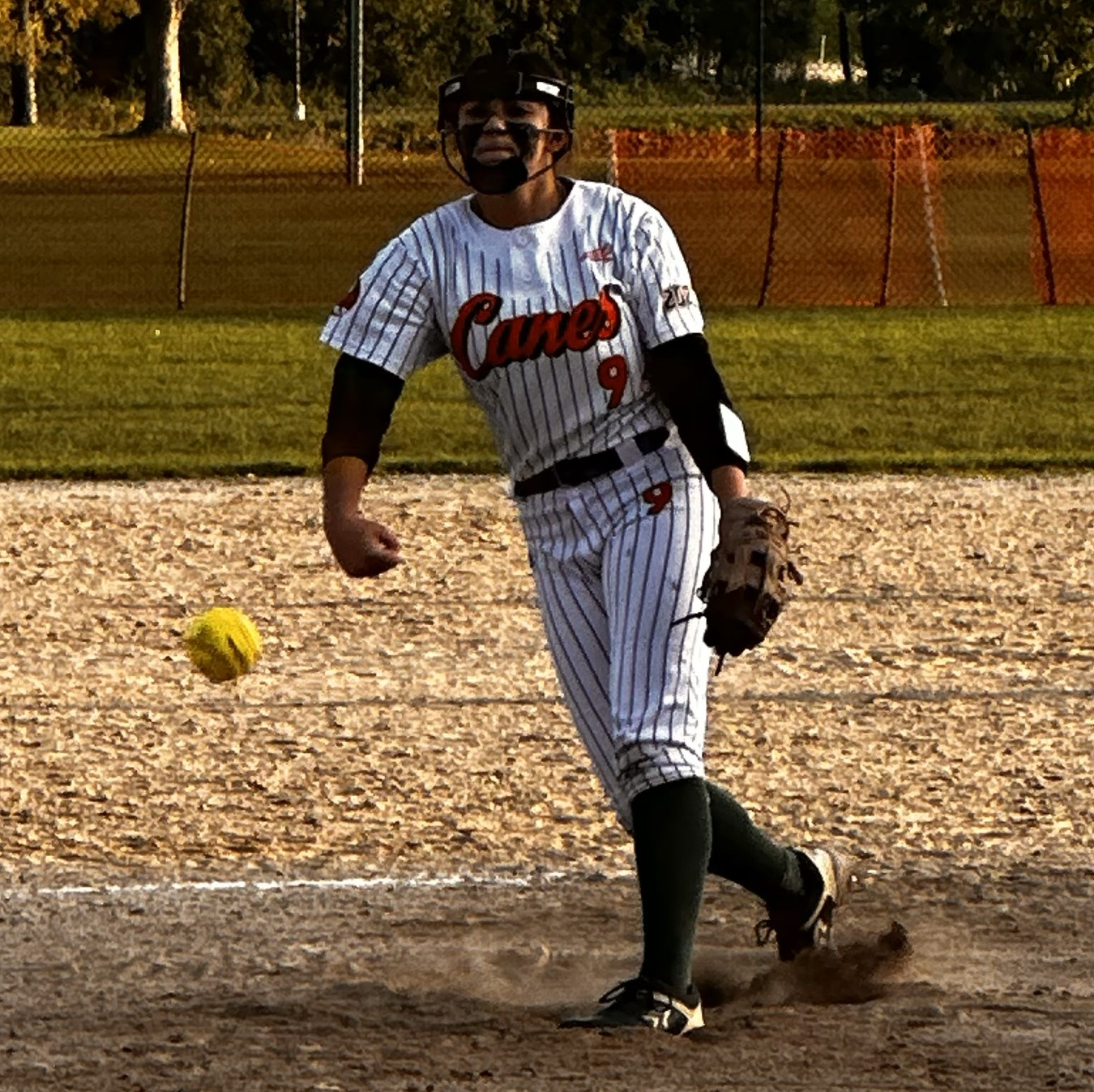
It seems like softball coaches, players, and especially parents are always in search of the “silver bullet” – that one technique or piece of knowledge or magic adjustment that will take an average (or below-average) player and turn her into a superstar.
That desire is actually what keeps a lot of what I would call charlatans – people who claim to have a “secret sauce” when really what they have is a knack for hyping otherwise very ordinary solutions – in business. It’s also what drives some of the incredibly crazy drills or controversial posts you see on social media.
Well, that and a need to constantly feed things into the social media machine so they can keep getting those clicks.
In my experience there is no single silver bullet or secret sauce drill that can turn an average player into a superstar overnight. There is no “next big thing” either.
But there are a lot of little things that can make a huge difference in your game if you learn to execute them properly. Here’s a little collection of some of them.
Pitching a rise ball
The rise ball is often the toughest pitch to learn. That’s because getting true backspin on a 12 inch softball (versus the typical bullet spin) requires the pitcher to do some things that work against the body’s natural tendencies.
One of the biggest has to do with what the hand and forearm do at release.
The natural movement for the hand and forearm as they pass the back leg is to pronate, i.e., turn inward. If you hold your arm up and let it just drop behind you, you’ll see that inward turn when you get to the bottom of the circle.
Try it for yourself, right now. Go ahead, I’ll wait.
When you’re throwing a rise ball, however, you have to keep the hand and forearm in supination, i.e., pointed outward, as you go into release if you want to be able to cut under the ball and achieve backspin. Otherwise you’re throwing a drop ball.
What often happens, however, is that in trying to keep the forearm and hand pointed out, the pitcher will cup her hand under the ball so the palm is pointed toward the sky or ceiling. That may work to impart backspin when doing drills from a short distance away, but it will also create a “big dot” spin instead of a more efficient and active “small dot” spin when thrown full-out.
So, to throw a true backspin rise the pitcher needs to learn to keep the palm of her hand pointed mostly out to the side, with just a slight cupping of the fingers. In other words, throw with more of a fastball-type orientation (fingers down) going into release, then angle the hand back up slightly so the fingertips are under the ball instead of to the side.
Do that and you have a much better chance of getting 6 to 12 backspin. (For those unfamiliar with that term, think of an analog clock, with the spin direction moving from the bottom at 6:00 to the top at 12:00.)

Another key is to freeze the fingers at release rather than trying to twist the ball out like a doorknob.
Again, twisting or “twizzling” the ball (as Rick Pauly calls it) will work when you’re self-spinning or throwing at a short distance. But once you try to put any energy into the ball, your hand’s natural tendency to pronate or turn in (remember that from a few minutes ago?) will cause you to turn the palm forward and create bullet spin.
Now, if you can throw the ball 70 mph or more, I suppose it doesn’t matter how your rise ball is spinning so you can get away with that. But if you’re not, forget the twizzling and make sure your hand simply cuts under the ball like a 9 iron hitting a golf ball onto the green and you’ll have a lot more success with it.
Bend in slightly to the curve ball
The curve ball tends to have the opposite problem. Here, you want your hand to be palm-up (if you’re throwing a cut-under curve) so the spin axis is on top of the ball.
The problem is many pitchers will tend to extend their spines a little as they go to throw the curve, which will naturally make the hand tend to sag down, turning the palm more out and away rather than up.
To avoid that issue, try bending in slightly over your bellybutton (on the sagittal plan for those who love the technical terms). That slight bowing in makes it easier to maintain a palm-up orientation, placing the spin axis on the top of the ball and creating a better chance for the fast, tight spin that enables a late break.
Get hitting power from your hips, not your arms
Look, I get it. You hold your bat in your hands, which are at the ends of your arms. So logically you would think to hit the ball harder you should use your arms more if you want to swing the bat harder.
And yes, that will work if you’re on a tee, where the ball isn’t moving. But if you’re not 7 years old, it won’t work so well when the ball is moving.
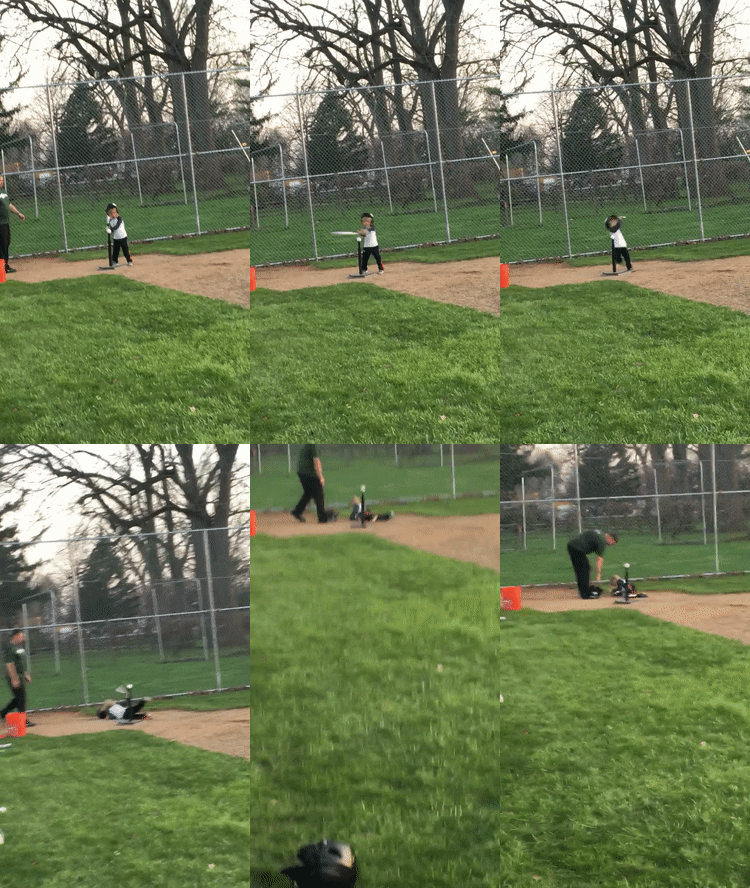
The reason is when you use the arms to create power, you give up control of the bat. You’re just yanking it wildly and hoping something good would happen.
The better approach is to use your hips (and core) to generate energy through body rotation. More energy, in fact, than you can create with your arms.
Then use the arms to easily direct that energy toward the ball. Approaching it this way will give you the adjustability you need to take the bat to where the ball is going instead of where it was when you first started the swing.
Generating power from the hips first also gives you more time to see the ball before you have to commit the bat, further allowing you to fine-tune the path of the bat to where the ball will be when it gets close to the plate.
Remember, the difference between a great contact and a weak one, or no contact for that matter, can be measured in centimeters (fractions of an inch for those who don’t remember the metric system from school). The ability to make fine adjustments during the swing is often the difference between a great hit and a poor one. Or none at all.
Shoulder tilt creates bat angle
While we’re talking hitting, another small adjustment has to do with the angle of the shoulders at contact.
We’ve all heard the instruction to “swing level” at some point or another. Many of you may have even said it, or say it now.
But if by swing level you mean having the bat parallel to the ground you’re just asking for a season filled with pop-ups and ground balls.
If you look at great hitters at the point of contact, you’ll see that 99 times out of 100 they have an angle on the bat that slopes down from the handle to the barrel. If you look a little further, you’ll see that the angle of the bat usually matches the angle of the shoulders.
So…if you want to get a great bat angle to hit rising line drives and other powerful hits, you don’t really need to manipulate the bat. You just need to let the back shoulder tilt downwards toward the ball. This preferably happens about halfway through the turn rather than dropping the shoulder first and then turning.
Think of the back shoulder as an aiming device. Once you see where the ball is headed, take the back shoulder in that direction and swing on a plane that matches the shoulder angle.
Before you can say “Bob’s your uncle” (always wanted to use that one) you’re crushing the ball deep – without having to do any crazy manipulations.
A better way to put on your glove or mitt
Given the power of the Internet to spread information I’m surprised that this little trick isn’t more well-known.
When most people put on a softball glove or mitt, they tend to put it on as they do a regular glove, i.e., one finger in each slot. I mean, it makes sense, right?
But that’s now how the pros do it. The problem with the one finger, one slot approach is that you ring and little fingers are your two weakest fingers. Far weaker than the index and middle fingers.
So when you go to catch the ball, your weakest (little) finger is trying to close at least half, if not more, of the glove by itself while the strongest part of your hand is closing the other half. You don’t have to be an anatomy expert to figure out why that can contribute to a lot more dropped or mis-handled balls.
Here’s a trick that can solve that issue: Take your ring and little finger, hold them together, and then slide them into the loop in the last finger stall. Then move each of the other fingers over one toward that end, leaving the area for the first finger open.
Now your two weakest fingers have combined to create one stronger finger, better balancing the closing power between the thumb and other side of your hand. You middle finger also gives somewhat of an assist to the other two.

And bonus, you no longer have to leave your index finger out of the glove to keep it from hurting when the ball hits the palm of the glove because it’s not in that spot anymore!
It’s going to feel awkward at first, especially because your hand won’t go into the glove quite as deeply. But try it for a month. You’ll never go back to the old way.
Little things mean a lot
None of these little tips are earth-shaking or revolutionary. But each of them can make a significant difference in your performance.
If you’re struggling with any of these issues, give these tips a try. It’s amazing the difference a slight adjustment can make.
For Better Hitting You First Have to Set the Table

The other day I was trying to explain a concept in hitting that is pretty important – the need to get your body and bat into the proper position before actually taking a swing.
I asked the girl if she played chess – an obvious analogy about getting all the pieces in place. No she didn’t, she told me.
I asked about checkers, which is not quite as complex but still requires some strategic planning. That was a negatory as well.
So finally, with Thanksgiving just a couple of weeks away as I write this, I came up with what I think is an explanation any young person can relate to.
Basically, it’s that before you can enjoy the great Thanksgiving feast you first have to set the table. I guess you don’t absolutely have to, but if you don’t you’re pretty much looking at a messy Viking dinner.

For the civilized world, though, you want to be sure the plates, silverware, napkins, condiments, etc. are all on the table before you bring out the food. That way when everyone sits down you’re ready to gobble up the gobbler (or whatever is being served).
The same goes for hitting. When the ball is pitched you don’t want to just start flailing the bat at it.
Instead, you need to start moving body parts into place – setting the table as it were.
For example, you’ll want to load in plenty of time to set a nice rhythm. If you’re using a stride you’ll want to stride; if you’re doing a no-stride you’ll want to start shifting the weight/center of gravity forward.
You’ll also want to start gathering visual information about where the pitch is going, how fast it’s going to get there, and if you’re more advanced what type of spin it has.
All of this happens before what would be considered a swing by the rules, which is when the bat starts moving toward the ball.
If you take the opportunity to put all of these pieces in place, you stand a pretty good chance of being able to feast on the pitch when it comes.
If you don’t, and you just start bringing the bat when the pitch is released, the odds are you’re going to look like a turkey.
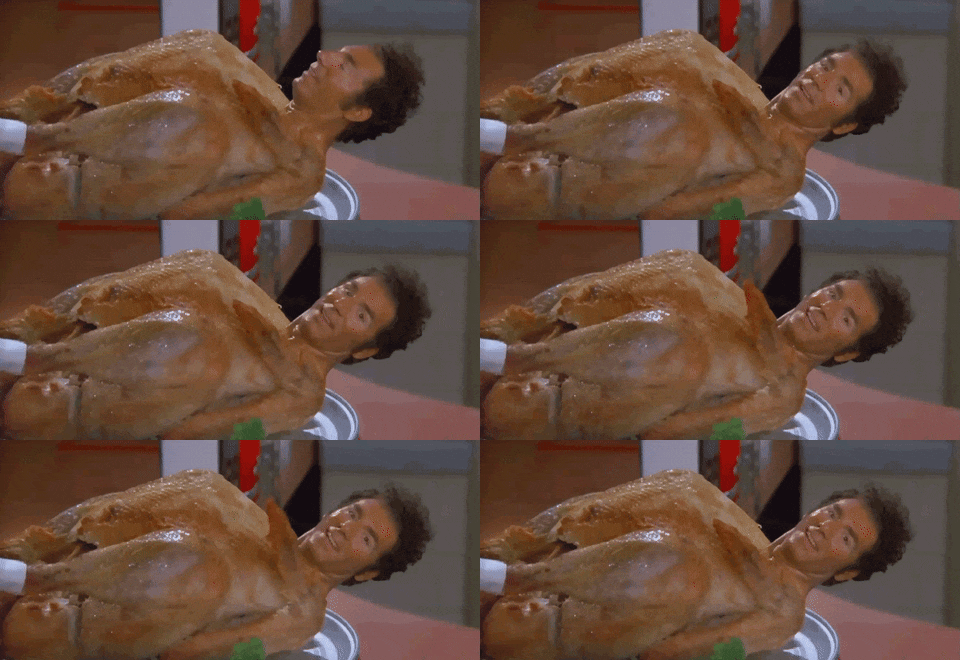
The key is you have to know what moves to make before bringing the bat – that is, which movements are table setting and which are the actual swing.
Using a stride-based swing as an example, everything that happens before the front heel drops and the hips start to fire is table setting. You haven’t committed to anything yet.
Once the hips start moving forward in a hips-shoulders-bat sequence, you’re now into the swing. You can still pull off if you recognize that the pitch isn’t going to be a good one to hit, but you are definitely going after it with the intention of hitting it hard somewhere.
If you have a player or son/daughter who is having trouble understanding the difference between the preparation phase and the execution phase of the swing, try this analogy on him/her. (It applies to all forms of hitting.)
With a little practice his/her hitting line will start to look like a cornucopia of excellence.
Proper Form? The Shadow Knows!

You’ve no doubt heard that different people learn best in different ways. The four basic learning styles are visual (watching the skill performed), audible (listening to instruction about the skill), kinesthetic (learning by doing), and reading/writing (using written words to understand).
Fastpitch softball instruction typically uses audible (coach explains) or visual (coach demonstrates, or at least tries to) learning, then expects that to translate into kinesthetic as the player tries to emulate the instruction. The idea is to get the “feel” of the movements so they can be carried forward later.
While this is important, some players have difficulty moving from visual/audio to kinesthetic learning. They are trying, but they can’t quite get the feel of it and thus go right back to old habits.

A great example is a pitcher trying to learn to keep an elbow bend down the back side of the circle to allow her arm to whip at the end. She may be trying to bend it, but as she goes into the back side her elbow straightens out and the arm becomes stiff, which means no whip.
One solution is to video the player so she can see what she is doing. Sometimes it helps, but often she has trouble translating what she sees into what she does.
A better approach is to use a mirror so she can see what she’s doing AS she tries to feel it. The combination of the two is very powerful, and often helps shortcut the learning curve.

But what if you are outside and don’t have access to a mirror? Not to worry – there is another solution: her shadow!
If you place the pitcher with her back to the sun, her body will cast a shadow. She can then watch that shadow as she moves to see if she is maintaining elbow bend or coming out of it over the top.
This quick, crude video demonstrates how that works:
Note how rather than reaching back with the hand I pulled the upper arm or elbow down, maintaining bend that leads into release. By watching the shadow while moving her arm, your pitcher can begin to feel where her arm needs to be as she practices.
She can continue to observe as she builds up speed, first without a ball and then throwing a ball into a net or screen. Over time she will feel it more and more until she no longer needs the visual cue – at which point you can really turn her loose.
This is just one example of how you can use a player’s shadow to enhance learning. For example, if she tends to drop her hands or flatten out her back too early while hitting, her shadow will show it, enabling her to make that adjustment.
If she is pulling her hand straight back while throwing instead of retracting her elbow with her scap and then letting her hand rotate behind her, that will be easy to spot in a shadow too.
Next time you’re outdoors on a sunny day and a player struggles to get the feel of a skill, give this idea a try. It’s quick, easy, and free – and the shadow always knows!
Don’t Just Put In the Time – Put In the Effort

One of the most common questions coaches get at the end of a lesson or practice session is, “How long and how often should my daughter practice?”
While it’s a legitimate concern – parents want to their daughters get the full benefit and they get a better return on their investment – I tend to think they’re asking the wrong question. Here’s the reason: practicing is not actual time-based; it’s quality-based.
Take two players who are at the same skill level and have been assigned the same drill(s) as “homework:”
- One diligently does the homework, being mindful of her movements and attempting to execute the skill the way she has been taught. She does this for 20 minutes three times before she has her next lesson.
- The other goes out to practice for a half hour three days a week between lessons. But she doesn’t like doing drills because it’s “boring,” so she instead just decides to pitch from full distance or take full swings or field ground balls hit by a partner etc. the whole time.
Which one do you think will show improvement in the aspect that needs the most help as well as in the overall skill?
Player two put in more time – an extra half hour to be exact. If time were the only factor that counted she should do better at the next lesson.
But I will tell you from experience, and bet you dollars to donuts, that player two will be the one who is most likely ready to advance further at the next lesson. She may not have put in as much time, but she put in more effort to solve her biggest issues – the one that is most limiting her.

So if she’s a pitcher who was straightening out her arm on the back side of the circle, she is now far more likely to have a nice elbow bend or “hook” as her arm gets ready to throw the ball. If she is a hitter who was dropping her hands straight to her waist before swinging, she’s far more likely to be keeping them up and turning the bat over to get the ball.
That’s because she mindfully worked at changing what she was doing. She is serious about improving so she put in the effort to make those changes.
Player two, on the other hand, actually put herself further away from her goals by practicing as she did, because all she did was reinforce the poor mechanics she should be trying to move away from.
Yes, she put in the time and could mark it down on a practice sheet, but she didn’t put in the effort. Without the effort to improve, the time is pretty much meaningless.
She would have ended up in exactly the same place at best if she hadn’t practiced at all. And she may have ended up further behind because now those extra reps with the wrong techniques will make it that much more difficult to get her to the right path.
If your daughter is going to spend her valuable time on practicing her softball skills, or anything else for that matter, make sure it’s on something that will help her advance her abilities forward.
Have her make the effort to concentrate specifically on the areas that need improvement rather than spending all her time making full pitches, full swings, etc. and you’ll see faster progress that leads to greater softball success.
P.S. For any parents of my students who may think I’m talking about their daughter, don’t worry. I’m not. It’s a big club. But do keep it in mind as you work with your daughter anyway!
Throw It Like You Know It

So, you’re a fastpitch pitcher and you’ve added a new pitch to your arsenal. You’ve worked weeks, or months, to learn the nuances and perfect it to the point where you throw it pretty reliably in practice.
But then, when you go to trot it out in a game, it turns into a hot mess.
If it’s a drop ball it rolls in like you’re playing bocce ball. Changeups go sailing high and wide, riseballs go over the backstop, and curveballs end up forcing your catcher to lay out after them like a wide receiver catching a pass from the third-string quarterback.
So what happened?
There’s a pretty good chance the problem isn’t from the neck-down; it’s from the neck-up. Because instead of just relaxing and throwing the pitch you practiced, you got nervous that it wasn’t going to work and started tying yourself in knots trying to make sure it did.

How did that work out for you?
That’s why, when you go to introduce a new pitch to your gametime routine, you need to clear your mind of thoughts about it being your first time, you hope it works, it was really bad last time, etc. and just throw it like you know it.
There’s a pretty good chance if you’ve been pitching for a while you don’t think much about throwing your fastball – or whatever your base pitch is. You’ve done it thousands of times by now, and you already know you can do it.
Doesn’t mean it will be perfect every time – no one’s is, not even the high-level pitchers you admire. But you’re not worried because you know if this one doesn’t work quite right the next one will.
Well, it’s the same with a new pitch. Let’s take a changeup.
You told your coach you’ve been working on it and want to throw it this game. You’ve gotten the speed and location to be right in practice but have little to no experience with in games.
When the call comes in, however, your muscles tense, your mouth gets dry, and you start to breathe a little harder and more rapidly.
There’s really no reason for that reaction, however. First of all, hopefully your coach is smart enough to call it in a situation where the outcome doesn’t matter, such as no one on base and you’re ahead in the count 0-2 or 1-2.
At that point, what’s the worst that can happen? You throw a ball and it’s now 1-2 or 2-2. You’ve thrown balls before with the fastball, so why should this particular one be treated any differently?
Oh, but you’re worried you’re going to embarrass yourself by rolling it in or sailing it over your catcher’s head. So what’s the difference here?
The count is still 1-2 or 2-2, just as it would be if you had barely missed the strike zone. No runners advanced, no one walked, a shadow didn’t fall upon the earth, seas didn’t begin to boil, the ground didn’t rupture. no one died. It’s just a ball.

Only now you’ve thrown one in a game, you know a little more what it feels like, and you’ve just taken another step forward in your pitching career. Someday, when throwing a changeup is as natural to you as breathing, you’ll probably laugh about it.
So given all that, why worry about it at all?
The better approach is to pretend like you’ve been throwing this new pitch for years and just chuck it in there – i.e., throw it like you know it. With a more positive approach like that you’re far more likely to have success, and avoid all the negative outcomes you were worried about originally.
By the way, this concept isn’t just for pitchers. Hitters should apply their new hitting mechanics rather than relying on their old ways.
Slappers, particularly converted righties, should go after their slaps as if they’ve been doing it for years. Fielders should try that new sidearm tilted toss as though it’s been part of their routine all along. And so on.
If you take the “throw it like you know it” approach you’ll find you build your confidence quickly and your game will improve exponentially. You’ll also find you’re having a lot more fun in the process.
Navigating the Maze of Fastpitch Skills Development

People often talk about the “path to greatness” when it comes to fastpitch softball skills development. But when you think about it, it’s not really a path – it’s more of a maze.
Everyone starts out in the same place – at the entrance. Everyone knows the end goal is excellence.
But it’s really not a straight-line journey, i.e., you hire a coach, join a team, or try to try to train your daughter yourself. Instead, the journey can be full of twists, turns, blind alleys, and dead ends.
Go the wrong way and you’re going to spend a lot of your time backtracking or trying to get your bearings again. Get in deep enough and you may never find your way back to a lane that will take you to your goal.

Take pitching for example. There are those who believe it doesn’t really matter what you teach to budding pitchers; they say eventually those pitchers will find their way to the mechanics that will lead to success.
I can tell you wholeheartedly that that is not true. Yes, some can overcome learning “hello elbow” (HE) when they start out, replacing them with more body-friendly internal rotation (IR) mechanics as they mature. They are usually exceptional athletes.
But that is not the case with everyone. I’ve acquired many pitching students who were taught turn the ball back toward second and push it down the back side of the circle who struggled to unlearn that early, sub-optimal teaching.
It can take them months just to learn how to keep the ball facing forward at the top of the circle (and just past it) so they can set themselves up to whip the ball through release. It’s not that they’re bad pitchers or poor athletes.
It’s just that the habit has been so ingrained into them that it’s difficult to break. They essentially got deep into the maze and then have to find their way back to nearly the beginning to get on the right track.
Hitters can have this too. They’re taught to “squish the bug” or “throw their hands/knob of the bat” at the ball or over-use their arms, or some other outdated concept.
Or maybe they’re just allowed to swing the bat however they want because they are big enough and strong enough at the younger ages that the techniques they use really aren’t important.

However they get there, they follow that path thinking they’re on their way, only to discover after their habits become ingrained that it’s been a series of blind alleys once again leading to a dead end. The other players have matched (or surpassed) them in size and strength, and suddenly what made them look like studs when they were young has them seeing more bench time today.
Just like in an actual maze, it’s important to start out in the right direction early. So how do you know which way to go when you’re just starting out so you ensure you don’t waste a whole lot of time and money that you will never recover?
Fortunately, unlike an actual maze there are plenty of signs and guideposts that will help you find the most expedient path to your goal. Some of those include:
- Watch high speed video of what actual high-level players do, then match that up to what potential coaches are teaching. If they’re not closely aligned you probably don’t want to go that way.
- Research the topics that interest you on the Internet. Yes, the Internet has as much bad information (or more) than good, but if you’re really interested in doing what’s right it shouldn’t take you too long to separate the gold from the garbage.
- Ask other parents, especially those whose daughters stand out, about their journey and what their daughter is being taught now They can help you avoid the pitfalls they themselves fell into.
- Try what’s being taught yourself to see if it makes sense. Many people actually seem to miss out on this simple test. See what it feels like to move your body the way it’s being described. Be aware of what you feel and whether it feels natural or forced. The goal is for it to feel natural and easy, because it means you’re working with your body instead of against it.
- Once you’ve gathered the data, think through it carefully to see what makes sense. Don’t just accept what Famous Player A says, because Famous Player A may not have a clue as to what she does on the field. She was probably one of those who found her way to good mechanics DESPITE what she was taught. Yet when it comes to teaching herself, she just goes back to what she was told when she was young because that’s all she consciously knows.
Starting down the wrong path in the beginning, or taking a bad detour along the way isn’t unrecoverable. But it definitely makes achieving one’s playing goals a lot more difficult because there’s going to be a lot of backtracking (and angst) before you can move forward again.
Take the time to determine which path will lead you through the maze of softball skills development more efficiently and you’ll find the entire journey to be a lot more enjoyable.
Maze photo by Tom Fisk on Pexels.com
Keep Hitting Toned and Tight Instead of Flabby

A few weeks back I had a hitting student who was having a little trouble getting her bat to the ball most effectively despite her best efforts. She wasn’t hitting badly, but I knew she had more in her.
So, I told her she needed to keep her swing toned and tight instead of letting it go flabby. While that may sound like a rather vague instruction she knew instantly what I meant, made the adjustment, and started hitting bombs.

I have since used it with several other students and it always produces the desired results. It’s a language the kids can understand. But what does it really mean?
Basically, it refers to being efficient. A flabby swing is one where there is a lot of extraneous movement either at certain points or throughout the swing.
One example of flabbiness in a swing is over-loading the body overall or even just the hands. Pushing back over the back leg, or lifting the hands way up and/or back before bringing them forward is inefficient.
Casting the hands out away from the body as you start to turn is another example. That movement will make the swing take too long to execute, and disconnecting the hands from the shoulders prematurely will cause a lot of the potential energy to leak out before it can be turned into kinetic energy at impact.
In a toned and tight swing, the body load will go into the back leg instead of over it. I refer to that as “bouncing off” the back leg.
That will be a quick, easy movement designed to break inertia instead of trying to make it a power generator. The power generation comes with the turn.
If the hands pull too far back up and/or back, you’ve created a longer path to the ball that will make it harder to be on-time. You’ve also made it more likely that you will try to generate too much of the power from the shoulders instead of letting the lower body drive the swing.
In a toned and tight swing, the hands will stay close to the back shoulder (I call it “in the bubble”) until the lower body has turned about 45 degrees. By that point you will have a better idea of where the ball will be when it enters the hitting zone AND you will have a shorter path to get there.

A toned and tight swing will also let the lower body/core provide the bulk of the power while the upper body rides that wave for most of the swing. That’s important, because when you try to generate too much power from the upper body you end up giving up control of the bat.
A lower body/core-driven swing makes it far easier to direct the bat where you want it to go. Why? Because you haven’t generated early momentum with the bat that is going to carry it to a particular area before you’re sure of what area you need to take the bat to.
Instead, you can use the largest muscles in the body, which incidentally can do little to nothing to influence where the bat goes, to create power, while letting the parts that are closest to the bat guide its path more fluidly – and directly.
The result is a more effortless swing that efficiently delivers power more precisely to where it needs to go, creating more and better hits that will help the hitter raise her batting average (BA), on-base percentage (OBP), slugging percentage (SLG), and on base plus slugging percentage(OPS).
Can you say all that without the toned and tight v flabby descriptor? Sure. I certainly have.
But all the technical talk may not resonate as well. If, however, you tell her what you want and then add the idea of making the swing toned and tight it seems to get through better. At least in my experience.
So if you have a hitter who is struggling a little to get her swing more efficient, give this one a try. It just might work for you too.
Photo by Scott Webb on Pexels.com
5 Reasons Lefties Should Be Trying to Hit to Right
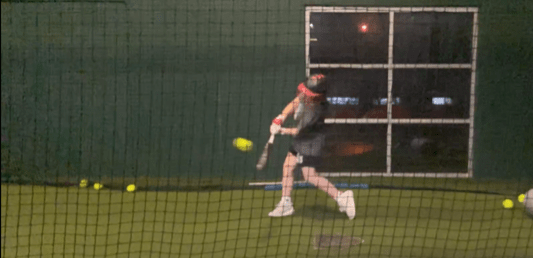
The other day I was working with a left-handed hitter and noticed two things.
The first was that her sister, who went out to shag balls after her own lesson, set herself up in left field. The second was that the sister was correct – everything was going out that way.
I told the girl who was hitting that she was late, needed to get her front foot down earlier to be on time, especially on inside pitches, and all the usual advice for someone who is behind the ball. But then it occurred to me – she might have been going that way on purpose.
So I did the most sensible thing I could – I asked her about it. “Did someone tell you to hit to left all the time?” I asked.
“Yes,” she replied. “My old team coach.”
This is the second time I’ve heard that from a lefty. The first actually got that advice from a supposed hitting coach.
Forcing lefties to try to hit to left on every pitch makes no sense to me. Sure, if the pitch is outside you should go with it. That’s hitting 101.
But on a middle-in pitch? No way! Here are five reasons why that’s just plain old bad advice.
Giving Up Power
This is the most obvious reason. The power alley for any hitter is to their pull side.
You get the most body and bat velocity on an inside pitch when you pull it. Laying back on an inside pitch to try to hit it to left is taking the bat out of the hitter’s hands, which you don’t want to do – especially in today’s power-driven game.

Encouraging the hitter to barrel up on the ball and hit to her pull side will result in bigger, better, more productive contacts. And a much higher slugging (SLG) and on base plus slugging (OPS) percentage, leading to more runs scored and opportunities taken advantage of.
Creating a Longer Throw from the Corner
If a left-handed hitter pulls the ball deep down the first base line and has any speed at all there’s a pretty good chance she will end up with a triple. It’s a long throw from that corner to third base, and will likely actually involve two long throws – one from the corner to the second base relay, and another from the relay to third.
A hit to the left field corner, however, will more likely result in a double. It’s a much shorter throw and one that doesn’t (or at least shouldn’t except for the younger levels) involve a relay. One less throw means one less chance for something to go wrong for the defense.
I don’t know about you, but I’d much rather have my runner on third than on second. As this chart from 6-4-3 Charts shows, your odds of scoring go up considerably regardless of the number of outs when your baserunner is on third:

You probably didn’t need a chart to show you that – it’s pretty easy to figure out on your own – but it always helps to have evidence.
Hitting Behind the Runner
Coaches spend a lot of time talking screaming at their right-handed hitters about the need to learn how to hit behind the runner at first. Then why shouldn’t lefties be encouraged to do it as well?
It ought to come natural to a lefty. Now, part of the reason for hitting behind the runner is to take advantage of a second baseman covering second on a steal, which is less common in softball and probably doesn’t happen with a lefty at the plate.
But what about advancing a speedy runner from first to third? Again, longer throw from right.
A well-hit ball to right, even one that doesn’t find a gap, gives that speedy runner a chance to get from first to third with one hit. A well-hit ball to left that doesn’t find a gap will probably still require the runner to hold up at second because the ball is in front of her.
So if you’re teaching your lefties to go to left all the time you’re leaving more potential scoring opportunities on the table. In a tight game, the ability to go to right instead of left could mean the difference between a W and an L.
Taking Advantage of a (Potentially) Weaker Fielder
This isn’t always the case. There are plenty of great right fielders, especially on higher-level teams.
But for many teams, right field is where they try to hide the player who may have a great bat but a so-so ability to track a fly ball or field a ground ball cleanly.

Why hit to the defense’s strength when you can hit to its weakness instead? At worst, if right field is a great fielder you’re probably at a break-even point.
If she’s not, however, you can take advantage of the softball maxim that the ball will always find the fielder a team is trying to hide.
Reducing Their Chances of Being Recruited
Most of today’s college coaches want/expect their hitters to be able to hit for power. Not just in the traditional cleanup or 3-4-5 spots but all the way through the lineup.
A lefty who only hits to left looks like a weak hitter. (And is, in fact, a weak hitter.)
Unless that lefty is also a can’t-miss shortstop, college coaches are going to tend to pass on position players who don’t look like they can get around on a pitch. That’s just reality.
Teach your lefties to pull the ball when it’s appropriate and they stand a much better chance of grabbing a college coach’s attention. And keeping it until signing day.
Don’t. Just Don’t
Teaching lefties to hit to left as their default is bad for them and bad for the team. It also doesn’t make much logical sense.
Encourage them to pull the ball to right when it’s pitched middle-in and you -and they – will have much greater success.






 Life in the Fastpitch Lane