Author Archives: Ken Krause
Softball hitting tip – adjusting to speed
As most people know, the game isn’t called fastpitch softball for nothing. Speed kills in our game, especially pitching speed. Faster pitching makes it tougher for hitters to hit.
But not impossible. One of the big keys is getting the front foot down on time. If you do that, the rest gets easier. But getting the front foot down on time varies depending on the pitcher’s speed.
There’s actually a math formula that explains it. I’m no math whiz, believe me, but it makes sense even to me:
time = distance/velocity
In other words, the amount of time you have to swing the bat is a function of how far away the pitcher is divided by the speed of the pitch.
We know that in a tournament or league, the distance is constant. Whether it’s 35, 40 or 43 feet, that will always be the same within that event. But as the speed of the pitch goes up, the amount of time goes down.
For example, let’s say the pitcher is throwing 52 mph from 43 feet. We need to convert mph to feet per second, so we multiply the number by 1.46. (The actual multiplier is a bit longer than that, but 1.46 makes it simpler.) What we wind up with is the ball moving 75.92 feet per second. We’ll assume a constant speed, even though we know the ball actually slows a bit as it travels. We also will assume she has a six foot stride, so will actually deliver the ball from 37 feet away. That means our equation is 37/75.92 = 0.487 seconds reaction time.
Now let’s assume everything else is the same, but she’s throwing 58 mph. That makes our equation 37/84.68 = 0.436 seconds. That a difference of about 5/100ths of a second. Doesn’t seem like much — it’s less than the blink of an eye. Yet in those 5/100ths of a second, if you’re timed for the slower speed the ball will go from the optimum location to hit it to deeper in the zone, likely handcuffing the hitter.
This is what your hitters have to realize. They absolutely must adjust their timing to the pitch speed or they will be late getting the bat through the zone. Not horribly late, necessarily, but just enough to turn a good hit into a weak one.
It also works in reverse, by the way. If you’re timed for a 58 mph pitch and the pitcher is throwing 52 mph, you’ll be too early and will either miss entirely or “pool cue” the ball, resulting in a weak hit.
Again, the adjustment is when the front foot lands. Get it down on time, or even a little early, and you will be better off than being late.
Softball practice game
Tonight for our last practice before our next fastpitch softball tournament we decided to do something a little different. After warmups and throwing we played a game that worked on both defense and hand-eye coordination for hitters. It also exposed the girls to a skill most of them rarely practice.
We divided the team up into four groups of three players each. Nine went onto the field, and the other three were up to bat. But instead of live pitching — which pitchers often have trouble doing with their own team — we had the girls fungo the ball instead. (For those who don’t know the term, fungoing is throwing the ball up and hitting it yourself.)
The overall objective was to introduce some unpredictability into the game for the defense. Although the girls struggled with fungoing at first, as they got the hang of it they started looking for holes and placing the ball. That made it tougher on the defense, challenging them, because unlike coaches hitting balls they really didn’t know where it was going to go.
If the hitters got on base they continued as baserunners. That automatically set up situations for the defense to handle, and put pressure on them to perform. About the only thing we couldn’t work on were steals since the hitter controlled the ball. We kept score, and three outs brought in the next team of three.
Why not go with live pitching? We’ve done that before. But it takes longer and less action occurs. In addition, it’s tougher to move the ball around the field. Fungoing keeps the game moving, creating more situations for the defense to handle and more opportunities for the offense.
If you’re looking for a way to spice up practice, get some quality work in, and introduce some competition give the fungo game a try.
Now it’s your turn. How do you get some competition going in practice?
Fastpitch coaching: The yelling and screaming school
There is this belief in the fastpitch softball world, and youth sports in general, that coaches have to yell and scream to get the best out of their teams. It’s partially a function of the Hollywood mythology of sports — all those movies with the “tough but ultimately kind” coach who takes a ragtag group of players and wins a championship — and partially our obession with pro sports.
The reason I bring this up is the team I’m currently coaching has not gotten out of the gate quite as quickly as we had hoped, although we are showing improvement each day, and I suspect at least a couple of parents who buy into the mythology think it’s because I’m too soft, especially during games.
They think that because when a player makes an error or a mistake I don’t come screaming off the bench, or yank that player in the middle of an inning in favor of a replacement. I may bark a little (which can be difficult to hear at large, open complex), but I don’t go into the usual histrionics some may be used to. I also suspect a couple of players who come from that environment may be wondering about it as well.
With that in mind, I had a chat with the girls yesterday about playing big, overcoming fear of failure, that sort of thing. And then I addressed the yelling and screaming part.
I told them I am not that way as a conscious decision. I told them I used to be that guy, and they really don’t want to play for that guy. I had my assistant coach Hillary, who played for me from the ages of nine through 18, confirm it. And boy did she.
I used to get pretty angry at poor play. I don’t think I was ever totally over the top, but I would be a lot more vocal during games, yelling stuff out and holding people, um, accountable right then and there. I kicked over a few buckets of balls in my day, and threw some other stuff around.
But what I came to realize over the years through a combination of coaching education and my assistant coach Rich was that it was really counter-productive. Yes, we want to hold players accountable, and it’s ok to be tough. But there’s a way of doing it, and a time and place to do it. That is usually at practice.
One other thing I learned was the value of saving the post-game evaluation for a different day. I was known for some lengthy post-game speeches/analysis, especially when things didn’t go right. I doubt much was heard, but it made me feel better. Along the way, though, I realized it was best to keep it to a minimum because sometimes things don’t look as bad after 24 hours as they do right after the game.
So these days I’m actually pretty calm during games, at least on the outside. My insides still do churn when we drop a popup, throw away a ball on an easy play, or watch an obvious third strike go by. But that’s where it stays. Goosefraba for you Adam Sandler fans.
The easy way when you get mad is to let it all hang out. It’s definitely tougher to keep your cool. But in the long run they’re still just kids playing a game. Staying in control gives them the opportunity to learn from their mistakes rather than simply ducking and covering all the time.
Not to say I never get after them. I can still be tough when needed. But now it’s a decision that that’s what’s required to get them on track rather than an emotional reaction to negative stimuli. It makes a world of difference.
Softball pitching – when movement fools the umpire
Had a kind of frustrating day today at our fastpitch softball tournament. Actually the first two games went well. But in the third game we ran into a bit of a problem pitching/umpire-wise. I’m curious to hear if others have had the same issue.
Our pitcher, who is also one of my students, was really moving the ball tonight. I couldn’t see it from the dugout, but I got that report from my catcher and some of the parents behind the plate. They said she was really on.
Yet she struggled, because the umpire we had apparently couldn’t deal with left-right movement in particular. She throws a curve ball and screwball that actually break, a drop that can actually drop. But despite crossing the plate, they were being called balls. It got so bad she had little choice but to throw fatties, and started getting hit. Her catcher was frustrated too — so much so she asked me to call the pitches because she couldn’t figure out what the umpire wanted.
Of course, from the dugout all I knew was balls and hits. I eventually had to take her out and put in another pitcher. It wasn’t until after the game that I learned how well she had actually pitched.
She was frustrated too. But I guess it’s a compliment, really. She was moving the ball so well she was fooling the umpire. Not saying there’s a direct comparison, but I wonder if Cat Osterman ever had the same problem when she was 14?
Love playing NSA fastpitch
The fastpitch softball team I coach is in the midst of an NSA tournament. It’s our only one with NSA this season. That’s unfortunate from a coaching standpoint because I love their playtime rules.
Specifically I love the two EPs you get to use. It’s sort of like the “bat everyone/free substitution” rules some tournaments use in pool play, but you can actually do it all the time.
Of course, how much you like it probably depends on how well your team hits. Mine has been hitting pretty well overall so it’s working well for us.
Players sign up for summer ball to play. When you can only bat/ play nine, a few are on the bench waiting to get in. With NSA rules you can keep more kids active and give more of them an opportunity to play. You can also rest players without risk if you get ahead, because if something happens you can always put your starters back in.
The other thing it helps with is the injury risk. With a straight nine, if you use up all your subs and then a player on the field gets hurt, you’re screwed (unless it was a sub). You have no one left to take their place. With the EP, you have a couple of moves left so you can use everyone without being penalized.
So if I love it so much why aren’t we doing more NSA tournaments? It has to do with the World Series — their equivalent of Nationals. The one we would’ve played in is down in Georgia, and I just didn’t feel like traipsing all the way down there. Sorry Georgians — I’m sure you’ll do a great job and your fields are lovely — but the thought of driving all the way down there from Illinois was a bit overwhelming. Maybe next year!
Congratulations to Mary Chamberlain
Sibling rivalry can be an interesting think. A few weeks ago I wrote about Chrissy Chamberlain setting the RBI record at the University of Dubuque. She was also named the team’s most valuable pitcher in a season where she originally wasn’t expected to pitch at all.
Well, not to be outdone I found out her sister Mary (who is also a student of mine) was recently named to both the all-conference and all-academic teams for the Fox Valley Conference in Illinois. She was also named her team’s most valuable player for the second year in a row.
With all those honors you would expect to find Mary to be some 6’2″ stud just dripping with athleticism. In truth, though, Mary is closer to 5’2″ or 5’3″. To look at her just standing around you wouldn’t think “this is the team’s MVP.” She doesn’t have that build. But what Mary has going for her is an exceptional work ethic and as much mental toughness as you will ever find. (She’s obviously smart, too.)
Mary doesn’t have overpowering speed, but she can make a ball move all over the place. More importantly, she knows how to set up a hitter to keep her from getting comfortable. That ability has served her well over the past few years, and will continue to next year playing for Blackburn College.
So congratulations, Mary. She’s yet one more great example of how being successful isn’t just about talent. It’s about desire and love of the game. A strong will can lead you to great heights.
Predictable in pitching equals fail
Did a little catching up over the weekend with some of my high school-age students who have wrapped up their high school seasons. They were looking for a little tune-up before going into the summer travel ball season.
One theme that seemed fairly universal was that A) their high school coaches wanted to control pitch calling and  they had no idea how to call pitches. A big frustration was the lack of change-ups being called. These girls have excellent change-ups, very effective, and throw hard enough to make a change-up worthwhile.
One in particular went even further. She told me her high school coach would only call pitches to one location — low and out. He was obsessed with throwing the ball there, and would yell at her if the ball rose above mid-thigh. And this for a pitcher who is naturally inclined to throw riseballs.
The frustrating part for her was that while low and out is a good location, eventually their opponents would figure it out and start pounding the ball. Then she’d get yelled at for letting them hit the ball.
The key to effective pitching is keeping hitters off-balance. That means avoiding falling into patterns or being predictable. Throwing the same pitch to the same location is being very predictable.
Pitch calling isn’t rocket science. Mix it up — speeds, location and movement. Keep the hitters guessing and you’ll be far more successful.
Another story with a happy ending
Yesterday I heard from another former player who achieved some post-season honors. Her name is Lindsay Meverden, and she’s a sophomore at Lakes Community High School. She told me that she was named a North Suburban Conference all-conference honorable mention. 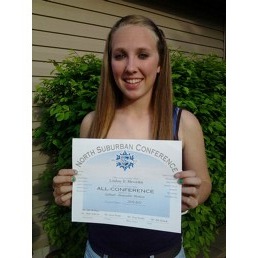
What’s cool about this (to me) is she then asked me what that meant. So many players these days are focused on their personal accolades and achievements instead of team goals. It’s nice to see one who is simply playing her heart out for the love of the game.
There’s also another bit of inspiration here. At the beginning of the season Lindsay was pretty much a bench player — a backup catcher in her first year on varsity. She was struggling a bit at the plate too. But we got together and worked on getting her hitting back on track. I told her if she could hit that the coaches would find a place on the field for her.
Sure enough, she started hitting, and then she started playing more. She was eventually installed at first base, learned the position (she hadn’t played there since 10U ball) and now has received some post season honors.
Once again it points out that it doesn’t matter where you start the race, only where you finish it. Work hard, persevere and good things will happen.
Congratulations, Lindsay. You’ve earned it.
An exercise in communications
One of the challenges many teams face is getting players to communicate on the field. I saw it happen in a high school game yesterday. A throw came from right field to the second baseman, and she had no clue where to go with the ball. She turned toward third to make a throw, saw it wasn’t there, and then tried to throw to second from an off-balance position. Needless to say it didn’t work out too well, and a run scored and the runner on second advanced.
That’s not unusual. I’ve seen it happen on teams I’ve coached too. So today at practice we did a little experiment that I got from John Tschida at the University of St. Thomas. We sent the girls out into positions with one instruction: absolutely no talking. We then had a couple of coaches act as baserunner while I hit balls into the field.
The girls didn’t like it at all. It was very difficult to know where to make the play and there was a lot of confusion. After about 10 minutes we called them together and talked about it, then sent them back on the field while removing the “no talking” restriction.
It really made the point. We had a lot more talk — not all of it correct, but most of it — and they started making more plays successfully.
If a lack of communication is an issue you face, give this one a try. It probably won’t be a problem for long.
Congratulations to Stephanie Youngman, all conference
Got some more good news today. One of my former players, Stephanie Youngman, was named to the all conference team for her play at College of Lake County, our local junior college.
The cool thing about this is Steph is one of those players whose high school coach never seemed to think much of her. She was overlooked her first couple of years, then made varsity as a junior. But she always seemed to struggle to perform, and to get playing time. That lasted throughout her varsity career. In her final game as a senior, at Regionals, the coach suddenly decided to sit her out in favor of a freshman. Not exactly the time to be experimenting.
For us, Steph always played well. After starting slow her first couple of years she found her rhythm hitting, and ultimately became one of our leading hitters. She was also an excellent fielder, particularly in the outfield. She could play extra shallow to cut off the Texas Leaguers because she was so good at going back on a ball.
I share her story for two reasons. One, obviously, is that I am happy for her that she finally has received the recognition she so richly deserves. The other is an inspiration to other players. This is the time of year when many players seem to be feeling a lack of love from their high school coaches. (Their feelings about their travel coaches come later.)
So I want to show that no matter what, it’s only one person’s opinion. Keep playing and perhaps someday you too will be all conference in college.






 Life in the Fastpitch Lane