Author Archives: Ken Krause
Oh Who Am I Kidding?

I was going to write a new post, but let’s face it. Nobody has the time to read it, especially with Christmas basically falling over the holiday.
So Merry Christmas, Happy Holidays, whatever you celebrate I hope it’s a great time for you.
As my gift from me to you, here’s a song I wrote and recorded in my home studio. Enjoy!
Keep Dancing Until It Rains

There is a proverb (or an anecdote, or a story, I’m not sure which) about a Native American medicine man who was particularly renowned for his ability to overcome droughts by performing a rain dance.
One day he decides to retire and so takes on an apprentice to whom he can teach all his secrets. He shows the younger man a whole variety of treatments and such, but of course the younger man is particularly interested in learning the skill for which the medicine man is most famous.
Finally, the younger man just flat-out asks him, “Teacher, what is your secret for being so successful in performing the rain dance?” The medicine man gives him a sideways look, then says, “It’s simple: you have to keep dancing until it rains.”

This is the aspect many young softball players (and their parents) miss when it comes to improving their games. All too often they are looking for that quick fix – do a one-day clinic, take a handful of lessons, stay after practice for an hour one day, etc. and then they’ll be great.
It would be nice, and for an ultra-gifted athlete that may be all they need. But for the overwhelming majority improvement isn’t going to come that fast.
Instead it will happen in small, often unnoticeable increments that add up over time. If the player (and her parents) are willing to keep chipping away at it, they will see the results. Mostly because they kept working until the results showed up.
Take a story I heard the other day. The father of a couple of my students who is also a head coach was telling me about another girl I work with on his team.
When I first got her she struggled with hitting. A lot of strikeouts, and when she did hit the ball it was usually an easy ground ball or pop-up in the infield.
We worked at it and she got better, but it wasn’t exactly a straight line. If she was away from lessons for a few weeks due to being a multi-sport athlete who had other commitments we’d see a lot of backsliding and often have to start all over again.
When that happened I could see the sadness in her face. She was frustrated with the results, and probably frustrated with me that I was telling her she had to go backwards and re-learn how to hit.
Honestly, I thought I was going to lose her at least a couple of times. But she kept dancing.
Fast forward to the other night. The coach told me this girl was raking the ball in practice. I wasn’t surprised because she’d been doing that lately in our lessons too.

The key difference, though, was that although she had taken a few weeks off again, when she came back we were no longer going back over the basics. She had locked them in so all I was left to do was make little tweaks here and there to help her elevate her hitting to a level above where she’d been in the past.
If you looked at her swing now you’d probably think, “Wow, what a natural.” She is smooth and powerful (despite still having what I would call a slight build) and she is bringing the bat with authority. And she’s able to hit the ball hard in multiple zones, not just when it’s thrown down the middle.
None of that would be happening now if she had just given up when things got discouraging, i.e., when the swing mechanics reverted to her old ways. Instead, she kept working at it not just until she could do it right but until she couldn’t do it wrong. And boy is she having fun at the plate now.
Of course, not all roads lead to success. If you’re a parent, coach, or parent/coach you still have to do your due diligence to see if what your daughter is being taught lines up with what you see the majority of high-level players doing – whether that’s hitting, pitching, throwing, or some other skill.
If, however, you are sure of the mechanics or techniques, then keep working at them. Persistence pays off, and eventually it will rain.
Otherwise you may find yourself like the person who invented 6UP, wishing you would have hung in there just a little bit longer.
Rain photo by Aleksandar Pasaric on Pexels.com
The Real Point of Playing Fastpitch Softball

Having a competitive spirit is pretty much a requirement for playing fastpitch softball (or any sport for that matter). As long as someone is keeping score, human nature says you want your team’s score to be better than that of your opponent’s.
Yet if the score and who wins and who is the best becomes the entire point of playing, that mindset will obscure a much more important value that can be gained, in my opinion. Namely, the value of the overall experience.
This thought came to me when I saw an Internet meme with a quote from author Kurt Vonnegut. You can read the full quote here, but I will try to summarize it quickly.
Vonnegut tells a story about being on an archeological dig when he was 15. At one point the head archeologist asked him if he played sports, and he replied no, but told the man he did several other activities. When the archeologist said “Wow, that’s amazing,” Vonnegut told him he wasn’t good at any of them.
That’s when the archeologist dispensed this wisdom: Being good isn’t the point of doing things. It’s gaining the skills and experiences that make you an interesting person (no matter how you do them) that is the real benefit.
I mean wow, right? What a way to think about it.
In our “winning is the most important thing” and “if you’re not the best you’re nothing” culture imagine doing something just because you enjoy it.

Instead of playing for the trophy or chasing the college scholarship imagine that you play for the sheer joy of the experience.
I think that’s what is often missing in today’s game. Too many players are losing the joy in fastpitch softball because they’re so obsessed with reaching a goal someone else has told them they need to be striving for or securing an achievement that really isn’t a priority for them.
One of the biggest examples, of course, is playing in college. Players (and their parents) get so caught up in playing on the “right” teams or the “right” tournaments/showcases (those that will give them exposure to college coaches) that they forget why they picked up a glove and ball in the first place.
Players (and their parents) get so caught up in comparing themselves to others they know personally, or placing as high as they can in some arbitrary rankings, that they end up spending so much time trying to “be the best” that they lose out on other experiences life and the sport has to offer. And if after all of that they still don’t measure up to their wishes or expectations, what once started out as a way to go out and have a little fun in the sunshine as part of a group becomes a source of angst or even despair.
So, does that mean it’s ok for everyone but the most talented or most driven to give up trying to be better? Of course not.
I believe every player should strive to be the best they can be, overall and every time they step on the field. But the key part of that phrase is the “best THEY can be.”
Maybe you’re not going to be compared too favorably to the best players on your team or in your area. Maybe you’re never going to make a super high level team that travels all over the country.
But you can still work to better than you were yesterday.
If you’re a pitcher, maybe you’ll never come close to throwing 70 mph. But if you’re throwing 48 mph today, try to throw 49 mph tomorrow. If you walked 10 hitters today, try to walk only 9 tomorrow.
If you’re a hitter who struck out in every at bat today, work so that you put the ball in play once tomorrow. And so forth.
Others still may not think of you as being a great player, or maybe even a really good one. But you will have learned how to overcome obstacles and build skillsets where you previously didn’t have any.
And that’s going to far more important to your future success than your specific prowess in pitching, hitting, throwing, or fielding a yellow ball. It will also make you a more interesting person.
Try not to get caught up in all the hype and BS that seems to be so much a part of sports and life in general these days.
You don’t have to be great at something to enjoy it. Or to gain value from it.
Just grab your glove and get out on the field. A whole world full of experiences is waiting for you.
The Power of Using Video When You Practice

One of the tools I use the most when I give lessons is my iPhone. If I see a player making some sort of awkward or inefficient movement, out comes the ol’ phone and I immediately shoot a video I can show that player (and often her parent, guardian, team coach, etc.).
Now, I can stand there and tell the player what she’s doing without using video, but often it seems like they either think I’m exaggerating the movement they’re making or I am making it up entirely. I said that because it has little impact on what they’re doing, and they frequently will go right back to doing it.
But when they see the video, they suddenly know I was not exaggerating for comic effect but if anything was dialed back a bit on it. Seeing is believing, and believing enables them to start making the correction. Things usually get better from there.
That’s great during lessons. But what about the other 90% of the time, when the player is practicing on her own or with a teammate, parent, guardian, team coach, etc.?
There is a solution that will help shortcut the time-to-improvement. It involves a little practice secret that I’m now going to share with you.
The Revelation
These days pretty much everyone’s personal phone has the ability to shoot video. And those video capabilities can be used for more than a Snapchat or a Tik Tok dance video.
Why not set up the phone to the video setting, hit the “Record” button, then take a video of whatever skill she is trying to master? Then she can play it back, watch herself, and see if she is leading with her hips (if she is a hitter), getting some elbow bend over the back side of the circle (if she is a pitcher), or making whatever movement she is supposed to be making at whatever point she’s working on.
I know, genius, right?
Sure, when I shoot video I use the OnForm app so I can easily slow it down, scrub it back and forth, draw on it, measure angles, or do whatever else I need to do. It’s really cool to be able to do that, as I describe here.
But you don’t absolutely need all of that, especially if your coach has told what to look for/work on specifically. The basic video any smart device shoots is enough to give you eyes to see what’s happening and whether the movements that player is making are the movements that player SHOULD be making.
I know on an iPhone you can even scrub it back and forth by tapping on the video and then using one finger to move the little frames at the bottom back and forth. I imagine Android and other operating systems offer the same capabilities.
Different Learning Styles
So what makes video so valuable?
Science has documented that different people learn in different ways. Some of us learn better from reading directions. (Most of those people tend not to be male, as most males tend to jump in first and then only read directions when they get in trouble – usually halfway through the project.)
Some learn better from hearing things explained, the way it would typically happen in a lesson or team practice. “Suzy, you have to get your butt down on the ball.”
Some learn best by actually performing the skill we are attempting to perform. Although in my experience a lot of young players actually have trouble feeling whether they are doing something correctly while they are in the middle of it.
But the vast majority of us (65%) are visual learners. If we see it, we can understand what we’re supposed to do, or what we’re not doing now, better.
Yet when it comes to actual practice sessions, players and coaches rely almost entirely on the two weakest preferences for learning – auditory/listening to instructions (30%) or kinesthetic/doing it and feeling it (5%). Doesn’t make much sense, does it?
By incorporating video into the learning process players can learn faster by using the method most prefer. And even if they are in the other 35%, augmenting auditory and/or kinesthetic instruction with video is neutral at worst and a plus beyond that.
Video Power in Your Pocket
The beauty of all this is that it doesn’t require a lot of work. Today’s teen or preteen carries more video power in her pocket or purse than was available when Debbie Doom (yes, that was her real name, and what a great name it was) was dominating hitters, Lisa Fernandez and Sheila Cornell-Douty were winning gold medals in the Olympics, and Linda Lensch was becoming a USA Softball Hall of Famer.
All you have to do is take that device out of wherever it is, prop it against a nearby bench, bat bag, or rock, and hit “record!” Then you have instant feedback on where you are and whether what you’re practicing is making the player better – or worse.
She can even do it by herself. And if the coach says it’s ok, she can even send it to the coach’s phone or other device to receive additional feedback to make sure she stays on track.
That’s sure a lot faster and easier than the early 2000s, when I started coaching. Back then it was a production.
I had to bring a laptop and separate video camera, set up the camera on a tripod, connect the video feed to the laptop and then whatever video tool I was using, and then manipulate it all to run it back. I had to plan it all ahead too, and hope an errant throw didn’t knock out the camera or laptop.
Now it’s just pull out the phone, open the app, shoot, and review.
Opportunity Knocks
The opportunity here is tremendous, and the cost is nil if you already have a phone or tablet. So why wouldn’t you take advantage of it?
By incorporating video into their practice sessions players can learn more effectively – and reach their goals faster.
Seems like a no-brainer to me.
Phone photo by Wendy Wei on Pexels.com
Body Language and Finding the Diamond Within the Coal

Today’s topic was suggested by a longtime friend and reader who is also a highly successful travel and high school fastpitch softball coach as well as a private instructor.
His name is Darrell, but he is mostly known to members of the Discuss Fastpitch Forum by his screen name of Cannonball. He is well known for offering great advice and counsel on a whole variety of subjects in the softball world.
The topic he suggested was about not being too quick to judge a player by her body language, or give up on her too quickly, because there may be more going on beneath the surface than we might realize. (As a corollary to that idea, players need to be careful about the story their body language is telling about them, especially when college coaches are around. But that’s a topic for another day.)
Cannonball then went on to tell me about a player who crossed his path whose every posture, gesture, and facial expression gave off an “I don’t like this, I don’t want to be here” vibe. It’s tough to work with players who seem like they don’t want to put in the effort to get better, so he was ready to write her off like everyone else.
But he was asked to work with her on hitting so he decided to dig a little deeper and find out what her story was before making any final decisions.
It turns out that she was A) playing for everyone else and their expectations instead of herself and B) constantly being compared to other players who were maybe a little more advanced at the time instead of being allowed to grow at her own pace.
This is definitely a common story, especially at the younger ages. Young people grow and mature and get control of their bodies at different times and in different ways. The girl who is scrawny and awkward at 10, or short and pudgy at 12, just might turn out to be an excellent athlete once she gets better control of her limbs and/or the puberty wand hits her.

There is even a blurb going around the book of many of faces that addresses this, and how the kid who is behind at 10 years old just may turn out to be the best of the bunch when she is 14 or 16. Anyone who’s been around kids for any length of time has seen that happen time and time again.
Yet all too often coaches whose obsession is winning or parents who desperately want their kid to be a star are quick to dismiss or even denigrate those kids when they fail to measure up to the coach’s or parents’ expectations. When that happens, something that should bring joy and be a relief from the challenges of everyday life instead becomes yet another burden.
And, since most youngsters aren’t too good at hiding their emotions, those negative feelings often show up in body language, facial expressions, and “attitude” that makes it look like those kids don’t want to be there or don’t care. In many cases it’s a defense mechanism to protect that child against any further expectations so their self-image or feelings aren’t hurt any further.
Then, after a while, that mask they’re wearing becomes their actual attitude or approach. At which point the downward spiral continues.
That’s why you don’t want to be too quick to judge poor body language or an apparent bad/sad attitude before taking a look under the hood to see what’s underlying it.
In some cases, it may be that the player really isn’t interested in softball and would rather be spending her time doing something else. If that is the case, a good coach will help her figure out what she really wants to do (and how to tell her parents) then do his/her best to make the remaining softball experience as pleasant as it can be for all.
But if there is a spark there waiting to be lit, instead of just relegating the player to the bench or shining her on entirely a good coach will dig below the surface to see what’s really going on and help turn that spark into a four-alarm blaze.

That’s what Cannonball did for the girl he thought didn’t want to be there. He says:
It seems that she was playing for everyone else and not herself. It seems that she could never be good enough. It seems that she was constantly compared to other players and did not measure up. I had to address that first. She had to be told to play for herself and if she enjoyed the game and her efforts, the rest was just noise she needed to avoid.
She was doing ok on her TB team and as we progressed and she understood the reasons why she was playing, she took off. She went from 7th in the lineup to 3rd. She became a hard charger this summer.
Heck, we were getting ready for a hitting session and it started sprinkling as she did her pre-lesson routine. I told her we might have to cancel since it was going to begin raining harder. She said that she had nationals and wanted one more lesson. We/she hit in the pouring rain.
Wow, what a turnaround, and what a story! All because a caring coach pushed past the surface to find out more about the player and why she didn’t seem too enthused about playing ball.
Yes, it can be difficult. It’s definitely much easier to take your best players and put them on the field while leaving out the others. Especially if your main goal is to win no matter what.
But think about the impact Cannonball made on this young lady.
Maybe she’ll go on to play in college, or maybe she won’t. But also maybe his believing in her, and helping her to believe in herself, will lead to her doing more in her life in some other aspect and contributing something great to society than she might have otherwise.
Oh, and while we have been focused on the younger ages, this also goes for older players. Perhaps you’re a 16U or 18U or high school coach with a player who came to softball late.
Maybe she doesn’t quite measure up to some of your other players yet. Maybe she’s a little intimidated by the others because she sees the difference in skill levels.
But if she’s working hard, why not find a way to encourage her and give her an opportunity to test her skills? The confidence boost you give her might just lead to her surprising you on the field – and making a difference in her life off of it.
It’s easy to dismiss a player whose body language makes it look like she doesn’t want to be there. But don’t fall into the trap of assuming.
Before you write her off as a lost cause, find out what’s happening below the surface. You may find there’s a diamond under there waiting to be brought out.
Diamond photo Wikimedia Commons contributors, “File:Natural white diamond.jpg,” Wikimedia Commons, https://commons.wikimedia.org/w/index.php?title=File:Natural_white_diamond.jpg&oldid=610400260 (accessed November 18, 2023).
For Better Hitting You First Have to Set the Table

The other day I was trying to explain a concept in hitting that is pretty important – the need to get your body and bat into the proper position before actually taking a swing.
I asked the girl if she played chess – an obvious analogy about getting all the pieces in place. No she didn’t, she told me.
I asked about checkers, which is not quite as complex but still requires some strategic planning. That was a negatory as well.
So finally, with Thanksgiving just a couple of weeks away as I write this, I came up with what I think is an explanation any young person can relate to.
Basically, it’s that before you can enjoy the great Thanksgiving feast you first have to set the table. I guess you don’t absolutely have to, but if you don’t you’re pretty much looking at a messy Viking dinner.

For the civilized world, though, you want to be sure the plates, silverware, napkins, condiments, etc. are all on the table before you bring out the food. That way when everyone sits down you’re ready to gobble up the gobbler (or whatever is being served).
The same goes for hitting. When the ball is pitched you don’t want to just start flailing the bat at it.
Instead, you need to start moving body parts into place – setting the table as it were.
For example, you’ll want to load in plenty of time to set a nice rhythm. If you’re using a stride you’ll want to stride; if you’re doing a no-stride you’ll want to start shifting the weight/center of gravity forward.
You’ll also want to start gathering visual information about where the pitch is going, how fast it’s going to get there, and if you’re more advanced what type of spin it has.
All of this happens before what would be considered a swing by the rules, which is when the bat starts moving toward the ball.
If you take the opportunity to put all of these pieces in place, you stand a pretty good chance of being able to feast on the pitch when it comes.
If you don’t, and you just start bringing the bat when the pitch is released, the odds are you’re going to look like a turkey.
The key is you have to know what moves to make before bringing the bat – that is, which movements are table setting and which are the actual swing.
Using a stride-based swing as an example, everything that happens before the front heel drops and the hips start to fire is table setting. You haven’t committed to anything yet.
Once the hips start moving forward in a hips-shoulders-bat sequence, you’re now into the swing. You can still pull off if you recognize that the pitch isn’t going to be a good one to hit, but you are definitely going after it with the intention of hitting it hard somewhere.
If you have a player or son/daughter who is having trouble understanding the difference between the preparation phase and the execution phase of the swing, try this analogy on him/her. (It applies to all forms of hitting.)
With a little practice his/her hitting line will start to look like a cornucopia of excellence.
Offseason Games: The Perfect Time to Try New Skills

Fall ball 2023 is now behind us for most teams, or will be after this weekend.
For many that will mean a welcome break from organized team activities (OTAs), at least until after the first of the year. For the rest, it will probably mean more of a maintenance schedule (e.g., once a week instead of three times) to give everyone (including coaches) a chance to unwind and refresh themselves for 2024.
Of course, that doesn’t mean that the game schedule will come to a complete halt until the summer, or until high school ball kicks in for those who play in the spring. These days, the proliferation of domes and other large structures in the northern climes means teams still have an opportunity to get some games in once or twice a month. (Southern states just carry on as usual.)
So for those who will be playing throughout the cold, dark months of winter, I have a suggestion on how to get more benefit from these essentially meaningless games. Are you ready for it? Here it is:
Try something new.
Brilliant in its simplicity, isn’t it?
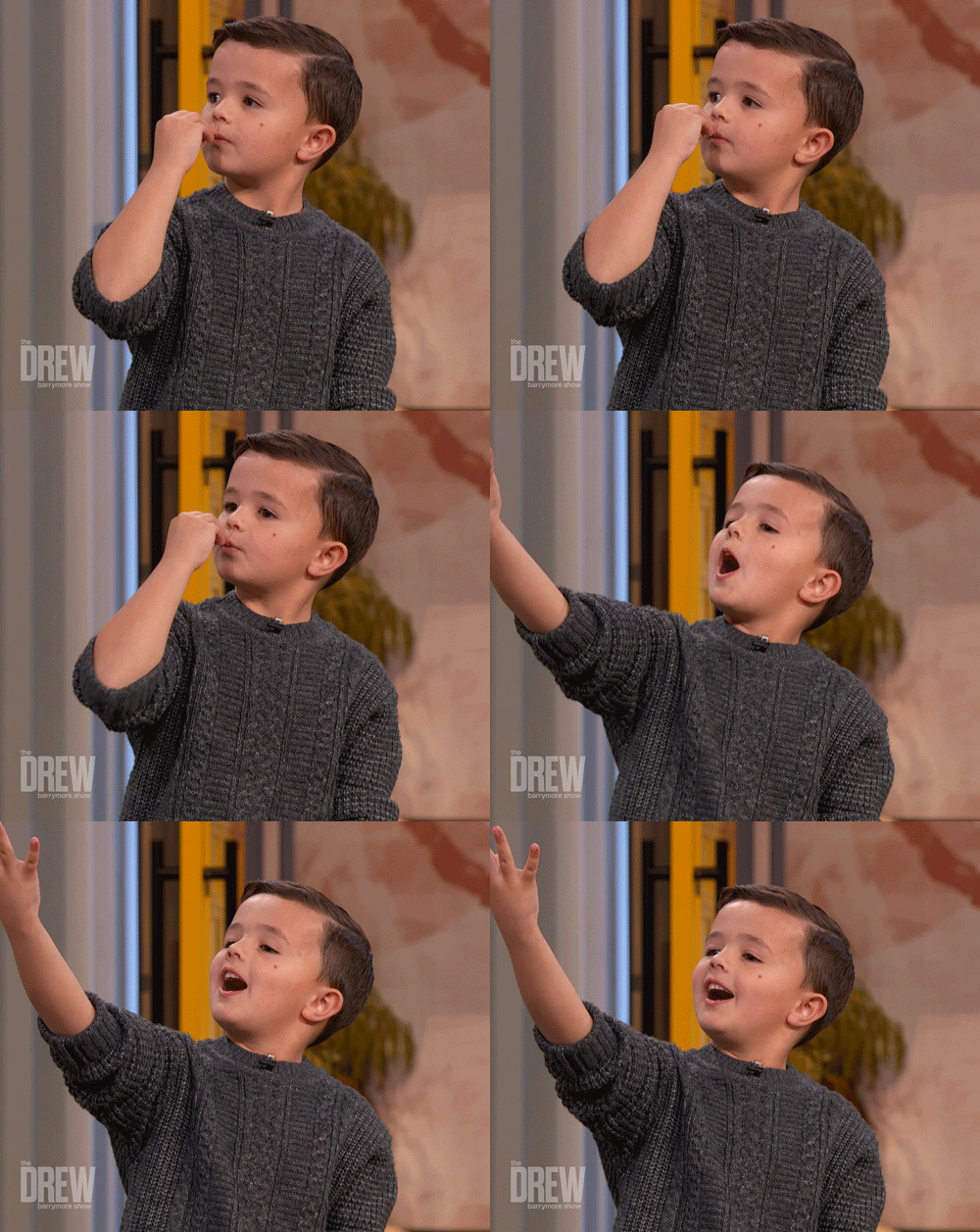
Wait, you don’t understand what I mean?
During the offseason many players work on new developing new skills. For example, a naturally left-handed hitter may learn how to slap in addition to swinging for power. Or a right-handed hitter may get turned around to the left side to take advantage of her speed.
A pitcher may learn a new pitch. An infielder may learn how to throw sidearm from a crouch on a bang-bang play.
A catcher may learn how to throw from her knees. A coach may attend a coaching clinic, such as the ones offered by the National Fastpitch Coaches Association, and learn a new offensive strategy or defensive sets.
But then when they actually play in an offseason game, the slap, the new pitch, the new throwing motion, the new strategies, etc., get stuck in the back pocket in favor of what the player or coach is most comfortable with.
That’s a missed opportunity in my mind. What better time to experiment with something that could be very valuable next summer than when you’re basically just playing for fun or to break up the boredom of practice?
Back when I was coaching teams, that was actually fall ball. You’d basically scrape a few double headers or round robins together on a Sunday, or maybe if you were lucky you’d find a local tournament or two that would give you a chance to play beyond the summer.
Today, fall ball is basically equivalent in importance to the summer. If you’re of recruiting age it may even be more important due to all the college showcase events around the country.
No one wants to risk looking bad in that atmosphere. So even if they’re learning new things they’re reluctant to trot them out on a stage where they could embarrass themselves mightily.
Winter/offseason ball doesn’t have that same level of risk. It’s perhaps the last bastion of “who cares about the outcome?” left in our sport.
So again, what better time to put on the big girl (or big boy in the case of coaches) pants and try something you’ve been working on but haven’t executed in a game yet?

Sure, it could be disastrous. A slapper could end up striking out every at-bat, including in a situation that causes her team to lose.
A pitcher could try out her new riseball and watch as it sails into the upper reaches of the net, scoring not just the runner on third but the runner on second as well. A coach could try a suicide squeeze only to watch in agony as the bunt is missed and the runner is hung out to dry.
Again I say unto you, so the heck what?
Yes, it would be temporarily sad. But it would also break the seal on using those skills or strategies in a game situation.
It would become a learning experience as well, helping the player or coach do better with them the next time. Do it a few times over the course of the offseason and the player or coach just might have the experience – and confidence – to execute them effectively and subsequently become better than they were before.
Remember, if you do what you always did you get what you always got. You’re spending considerable time, and perhaps money, to learn new things. Those new things don’t do you any good if they never get out of your back pocket.
Take full advantage of games without real pressure or consequences to try out new things and get more comfortable with them. If you’re a coach, find out what your players are learning and make them give it a try.
Because that little pebble you toss now may have a significant, positive ripple effect for you next year.
Greatness Comes With A Cost

A whole bunch of years ago there was a series on cable called Camelot. It was yet another retelling of the King Arthur legend, although with a grittier feel to it.
Of course one of the key characters was Merlin, the King’s magician/adviser. Normally he is portrayed as someone who can wave his hands or wand or whatever and easily conjure up whatever is needed at the time.
But in Camelot it didn’t happen quite so simply. On the rare occasions when Merlin needed to summon up some magic, it took all his concentration and an extreme effort, which would often see him bleeding from his eye before he finished.
When asked about it, he would painfully reply, “Magic has a cost.”
The same is true for learning how to play fastpitch softball. (You knew there had to be a point to this story somewhere.)
If you want to be great at it, or even really, really good, you don’t simply walk out onto the field and start playing. There is a cost to achieving greatness – a price to be paid in exchange for the glory you seek.
Often that price is paid in time. You may stay need to stay after practice when everyone else is going home to get some extra reps in or solve a particular issue.
It likely will also involve working on your own, even when you don’t feel like it, to improve a skill that’s deficient or take one that’s good to the next level. (Often the second one is tougher to get going on than the first, because it’s easy to convince yourself you’re already good enough.)

The price may come in terms of missed opportunities for other things. While your friends are all going to a concert or an amusement park or a birthday party or some other fun event, you’re going to a college camp or a tournament or maybe even staying behind because your team has practice.
The price could be financial. If your family doesn’t have a lot of disposable income you may need to pass on that new phone or skip getting a new outfit so you can pay for team fees or a new bat or a college camp – anything that’s outside of the core fees.
Or it could mean you’re not able to get a job to make some “fun” money of your own because your practice and game schedule doesn’t allow it.
The price could be pain from a particularly tough speed and agility class or perhaps the result of an injury – especially if you’re attempting to play through it. Or it could be the feeling of being tired all the time.
College players experience that a lot. Between early morning lifting, classes, practice (team or on their own depending on the time of year), study tables, and making up for lost time in the classroom due to games they can pretty much be in a fog much of the year.

The cost can manifest itself in many ways. But there is always a cost if you have that burning desire to stand out on the field and do all you can to help your team win.
This isn’t just for players, by the way. There is also a cost is you want to be a better coach.
You will find yourself putting in far more time than just the couple of hours at the field a few days a week or even the 12-hour days of a tournament. There’s practice planning, coordinating schedules, managing budgets, talking to parents and players, and a whole host of other tasks to be performed while still trying to stay employed at your day job.
If you want to be great you also have to allow for continuing education. You’ll need to take online courses or attend in-person clinics such as those offered by the National Fastpitch Coaches Association as well as local events.
You’ll invest an inordinate amount of your own money on books and videos as well as training devices – even if it seems they will solve one problem for one player.
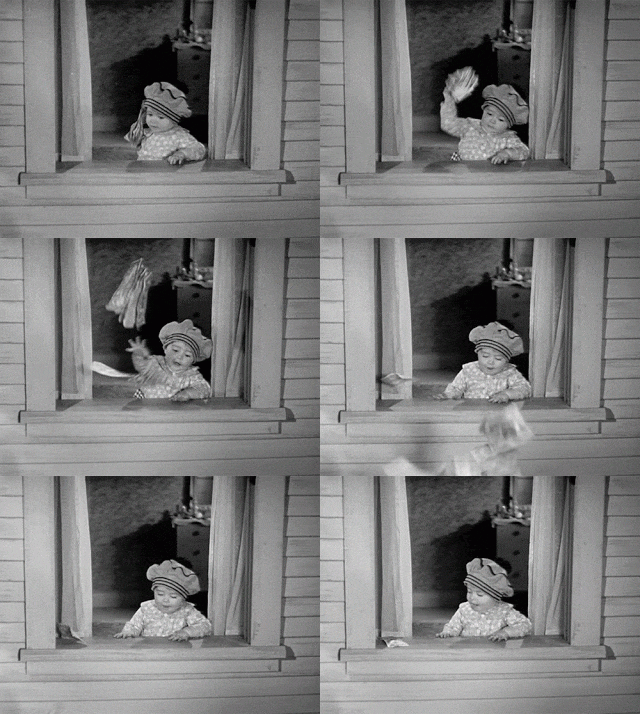
And, of course, at some point you will miss a family birthday, or a school reunion, or a work outing, or something else because, well, games. At which point the cost will also include the internal stress it puts on your personal relationships because “you’re always at some field somewhere” instead of where others think you should be.
So is achieving your goals on the field worth the cost? Only you can answer that.
The key, though, is to understand that there will be a cost if you want to aspire to greatness – or even “really, really goodness.”
Your willingness to pay it is where the true magic happens.
Magician photo by cottonbro studio on Pexels.com
Coaches: Remember What You Do Makes A Difference
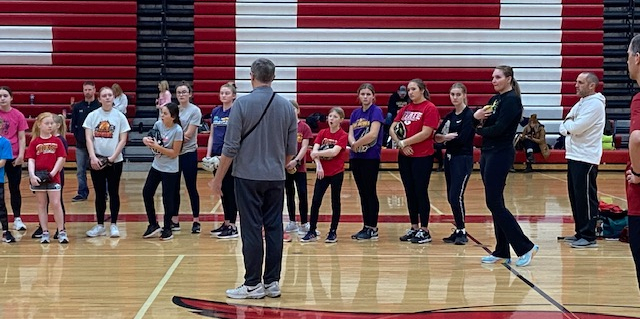
Coaching fastpitch softball can be a grueling grind. The seemingly never ending games, practices, organizational meetings, fundraising concerns, educational seminars, late night calls from concerned parents. etc. can all take their toll after awhile.
That’s why coaching burnout is such an issue and threat to everyone who is crazy enough to grab a clipboard (or tablet) and step onto a fastpitch softball diamond.
It’s easy to become overwhelmed by the sheer volume of work, not to mention the intensity of trying to help 12-15 players become the best versions of themselves as athletes and human beings. That’s a huge responsibility.
But underlying all of that is something else – something embodied in a great scene in the movie Star Trek Generations. (If you’re not familiar with it, this was the movie that handed off the film series from Star Trek the Original Series [TOS to you Trekkers out there] to Star Trek: The Next Generation [TNG]. I so rarely get to use the [square brackets] so what a treat for me.)

This scene takes place shortly after TNG’s Captain Picard runs into TOS’ Captain Kirk in a place called The Nexus, which is sort of a Field of Dreams for sci fi. In it, Captain Picard has been trying to convince Captain Kirk to come back to our reality and help him stop the bad guy who is killing billions of people in his attempt to get back into The Nexus.
At first Captain Kirk turns him down because he is perfectly content in The Nexus. No surprise there because it’s where your life can be whatever you want it to be.
But then Captain Kirk has a realization. (It takes a minute to get to the payoff in this clip but it’s worth it, trust me.)
If you didn’t bother to watch the clip, or weren’t able to, Captain Kirk’s realization is that while he was in Star Fleet he could make a difference in the world. Since he left, though, nothing he does really matters that much.
That’s what coaching enables you to do – make a difference in the lives of your players. And by extension their families.
None of us knows what goes on behind the scenes in the lives of others. So it’s easy to assume that everything is all hunky-dory with them, and that the face you see is indicative of what’s happening “under the hood.”
That may not be the case, however. I can’ remember who originally said it, but I once saw a statement that admonished coaches to remember that their practice might be the best part of their players’ day.
Maybe the player is struggling in school, or had a fight with her parents. Maybe she’s being bullied, or has had a close friend abandon her.
Maybe there is some food or housing insecurity in her family, or a favorite pet is on the brink of crossing the rainbow bridge. (Don’t click the link if you are in public and susceptible to emotional demonstrations.)

There could be hundreds of different things happening in your players’ lives. But when they get to your practice or game they have opportunity to set all of that aside and do something that makes them feel good about themselves and their lives, providing you’re doing it correctly.
The guidance you provide in helping your players overcome various softball hurdles is very likely to carry forward into the rest of their lives.
As a result, you can help a shy kid learn to make friends. You can help a kid who is always down on herself or feeling she isn’t good enough develop self-confidence.
You can help a kid who always follows the crowd (for better or worse) step up and learn to become a leader instead. Or at least learn to make better decisions rather than succumbing to peer pressure.
You can help a kid who has always been coddled and over-protected by her parents learn to manage adversity. You can help a kid with behavioral issues learn to work in a team setting.
You can help a naturally lazy kid develop a work ethic. You can help a kid who over-thinks everything learn to let go of her conscious thoughts (and fears) and trust her gut.
You can help a kid who feels like a failure learn what it’s like (and what it takes) to succeed. You can help a kid who feels unloved and unwanted at home to feel like she’s part of a family of sorts.
You might even prevent a kid from doing harm to herself or others. All while you are helping those kids learn to catch, throw, pitch, and/or hit a softball.
In other words, you can make a difference.
And you never know the ripple effect of making that difference either. Perhaps that kid you helped in some way goes on to cure cancer, or improve the environment, or become an elected official who enacts policies that make everyone’s life better.
Or even becomes a coach herself someday and pays what you did for her forward. Or maybe just grows into a great human being who has a family and/or contributes to society in some small but meaningful way.
All because you were there as her softball coach, making a bigger difference than you could have possibly realized.
Yes, coaching fastpitch softball, like any sport, can be a grind after a while. You definitely need to pay attention to your physical and emotional wellbeing if you’re going to help others. Just like how on a jet they tell you to put on your oxygen mask before you try to help others.
But when things get tough, keep in mind how empty your life would be if you weren’t coaching. Because as Captain Kirk says, while you’re in that chair you can still make a difference.
Make that difference for someone today.
Fastpitch Softball Returning to 2028 Olympics

The fastpitch softball world got some great news this week, as our sport will once again be included in the Olympic Games for 2028. I’m sure it comes as no surprise since the games will be held in Los Angeles and the U.S. is essentially home territory for softball.
Still, nothing is ever a given, so I’m glad to see our sport (as people like to say) will be part of the world’s biggest sports showcase. Hopefully we’ll be able to avoid another worldwide pandemic just prior to the Olympics so there can actually be fans in the stands to see the competition and cheer their teams on.
Of course, with every wish comes a curse. In this case, if past patterns hold, it means beginning this year USA Softball will divert nearly all of its attention to putting a team together to compete at the 2028 games and providing all the logistical support that requires.
The result is the youth levels (with the possible exception of the most elite players) as well as the men’s game (yes, for those of you who don’t know there actually still is men’s fastpitch softball too) will receive scant if any attention for the next five years.
Hope I’m wrong. But I wouldn’t bet against it if I were you.
In any case, as we look forward to watching softball return to the Olympics in 2028, here are a few things I’d like to see.
A new crop of players
Let’s be honest: as exciting as it was to see softball in the 2020 Olympics, it also kind of resembled an Old Timer’s game. Many of the marquee players on the top teams had actually participated the last time softball was in the Olympics.

No disrespect to those long-time players. They were and are tremendous athletes, inspirations, and ambassadors for our sport. I salute them all.
But there are many exciting young players who now deserve an opportunity to wear their countries’ jerseys and fulfill their dreams of competing in the most visible softball games in the world. I look forward to getting to know them throughout the games.
Softball actually be part of the Olympics
While technically softball was part of the 2020 games, the reality is the gold medal had already been awarded by the time all the other participants marched in the parade and lit the torch. It was kind of a slap in the face to our sport, in my opinion.
It was like saying, “Ok you can play, but you have to be done before the REAL Olympics begin.”
This time around I hope to see the games integrated into the two or so weeks that the rest of the events occur. Doing so will maximize the audience by bringing in more casual viewers (most people who watched softball in 2020 were us, the die-hard fanatics) and provide a little more validation of our sport’s place on the world stage.
Announcers who actually understand the sport and its nuances
Much as we love to see fastpitch softball on TV in any capacity, a lack of quality in the announcers covering the game can definitely take away from the enjoyment of the broadcast. At least for those of us who live and breathe the sport.
I’m sure it doesn’t bother the casual observer when, say, a high pitch with bullet spin is called a “riseball” when in fact it is just a high fastball. Or that same bullet spin ends up on the outside corner and it’s called a curve even though it didn’t break even an inch off its normal path.
But those of us who love the sport really would like to see a more accurate appraisal of what is going on.
To that point, I personally would like to see a little more honest analysis of what’s happening on the field instead of the boosterism that normally occurs.
If a knowledgeable expert in the booth thinks a team’s strategy is bad, say so! If an error is made because a player lost focus or made a poor decision, call it out.

That’s what the most popular announcers in all sports do. John Madden never hesitated to call out a boneheaded play (or play call) when he was doing NFL games. Bob Uecker made a career out of telling the (mostly) unvarnished truth during games.
That doesn’t mean announcers need to be hyper critical. But they don’t have to have the Pollyannaish approach we typically hear either.
If announcers call ’em like the see ’em, and make sure to do their homework so they really know what they’re talking about, I think it will be a better, more credible experience for everyone.
The USA change its offensive philosophy
Obviously this one is specific to my favorite team, and the host team, but the offensive approach in the 2020 games was a disaster. Mostly because it seemed to be stuck in the ’80s or ’90s.
It appeared to me that the starting lineup in 2020 was selected for its defensive prowess, as if the people making the selections were expecting a lot of 1-0 or 2-1 games.
Those days are gone. Better equipment, better skills training, better strength and conditioning, rules changes, and more have made today’s game one where you need to put at least a half dozen runs on the board if you plan to win.
That means no more automatically trying to sac bunt a runner to second when the first batter gets on base. IIRC, the U.S.A. team wasted its best hitter by having her bat in the two position and then automatically bunt when the leadoff hitter got on base.
When she finally got a chance to swing the bat she was putting up extra base hits consistently. Imagine if she had done that with a runner on first and no outs!
Having bats in the lineup also gives you a chance to come back if you fall behind. Playing the short game when you’re down three runs in the fifth inning just punches your ticket out faster.
The selection committee needs to invite players who can flat-out hit, and choose a coaching staff that understands how to let them do what they do best instead of trying to fit them into an outdated model.
A little spectacle
Fastpitch softball is a very fan-friendly sport. Much more so than watching athletes run around a track or chuck heavy objects (not that there’s anything wrong with that).
Let’s treat it that way. One of the things that keeps softball out of the Olympics is that some on the Olympic Committee feel it isn’t universal enough, i.e., viewers in non-softball countries won’t tune in to see it.
Give it a little extra pizzazz in the presentation, with some knowledgeable explanation of what’s happening and an eye toward showing non-softball countries how much fun it is to play, and maybe, just maybe, we won’t have to wait another eight or more years to see softball in the Olympics again.
Olympic rings image by Vusi vilanculos, CC BY-SA 4.0 https://creativecommons.org/licenses/by-sa/4.0, via Wikimedia Commons






 Life in the Fastpitch Lane
