Monthly Archives: January 2026
Why Fastpitch Softball Pitching Is So Danged Difficult

You hear it all the time from coaches, parents, and others sitting safely on the sidelines at fastpitch softball games: Just throw strikes! As if that idea hadn’t occurred to the poor pitcher while she’s sweating out a delightful inning of walks and hit by pitches.
Ah, if only it were that easy. I mean, it doesn’t look that difficult from the outside.
You step or jump or ninja leap your way forward, swing your arm over your head, bring it down, and let go of the ball. What could be more basic than that?
Plenty, to be honest. Because pitching in fastpitch is like a fine Swiss watch.
On the surface, you see the hands going around a disk. But underneath, there’s a complex set of gears creating individual movements that all have to be perfectly in synch to keep the correct time.
Let one little piece of a gear wear down, or get knocked askew, or take on a spec of dirt that slows it down by a microsecond, and suddenly the whole operation is no longer functioning properly.

Think I’m exaggerating? Take a good look at any video or sensor-based analysis of the pitching motion.
You have to be concerned about how the legs work in relation to the arms at launch. You have to look at where the body goes when it drives out – is it relatively straight or going off line?
When the arms go back on a backswing or forward on the first phase of the pitch are they working together and moving toward the plate in an efficient manner or are the wandering all over the place, creating timing and balance issues?
What’s happening with the muscles underneath? Are they loose and flexible the way they need to be in order to move quickly, or are they stiff and locked out?
What’s happening in the shoulder as the arm goes over the top? How is the upper arm positioned relative to the shoulder and the lower arm?
Where is the upper arm positioned when the front foot lands? What is the hand doing at this point?
As the pitcher goes into delivery are her shoulders stable and locked into position or are they swinging around like one of those carnival rides? Does she have good, upright posture, or is she collapsing like a cheap folding chair?

There’s more to consider but you get the idea. Lots of moving parts that all have to work properly, and in synch, in order to “just throw strikes.”
Now add in the idea that this sport is called FASTpitch. So it’s not enough to get the movements correct.
You have to do it while putting every ounce of energy you have into every pitch. All in the space of a couple of seconds start to finish, with a lot of the critical movements occurring in a matter of milliseconds before the pitcher has to move on to the next one.
Anything in that process gets slightly off and suddenly the ball is heading into the dirt, or into the backstop, or into the side of the hitter. And when that happens, the pitcher has to know how to make a micro-adjustment here or there to get everything back on track in an effort to make sure it doesn’t happen again on the next pitch.
What usually happens, especially with younger or beginning pitchers, is that they over-correct instead of understanding they should just relax, trust their training, and allow the gears to get back in line. That’s why one pitch goes into the dirt and the next one hits the field number sign at the top of the backstop.
When you see that issue occurring, the worst thing you can yell is “just throw strikes.” That’s what she’s trying to do.
But a gear has slipped and she’s probably not sure which one or how to fix it. Telling her to “just throw strikes” will only encourage her to try to force the ball over the plate, abandoning all mechanics.
That would be like trying to fix your watch by hitting it with a hammer. You might get lucky, and get it running again, but the odds are you’re just going to ruin the watch.
A better approach is to call time if you can and go out and talk to her. Remind her to trust the work she’s put in and let her body do what it does best, focusing on the process instead of the outcome.
In other words, let her get all her gears back in order. And if that still doesn’t work, tell her it’s just not her day and you’re going to give someone else a try now, and you’ll come back to her another game.
If you’re a non-coaching parent and can’t go out for that circle visit, just be encouraging and supportive. I know it’s difficult to watch your daughter struggle – I’ve been there – but she’ll be able to handle the adversity a lot better if she knows you’ve got her back instead of thinking you are judging or criticizing her in the moment.
If she’s not able to correct things on her own, the time for those corrections is in her next practice session, not under pressure in the middle of a game. Trying to do it in-game will likely only make it worse.
Yes, pitchers like Tegan Kavan, Nijaree Canady, Sam Landry, Emma Lemley, and so many others you see on TV or at live games often make fastpitch pitching look easy.. But it’s anything but – even for them.
Understanding just how complex the individual movements are, and how intricate the timing of each movement is in relationship to all the others, should help you cut your pitcher(s) a little slack when things aren’t going quite the way you or she wants. It ain’t easy.
But like that fine Swiss watch, it’s a thing of beauty when you get it all working the way it should.
Pitching Coach Bill Hillhouse Extraordinaire Could Use Your Help

Yesterday Jay Bolden and I had the privilege of talking with pitching coach Bill Hillhouse for an upcoming From the Coach’s Mouth podcast. If you’re not familiar with him, Bill was the youngest pitcher ever to play for the Team USA Men’s National Team when he joined it in 1993, and was an outstanding player who competed all over the world, winning wherever he went.
(If you’re interested in learning more about his softball resume, I’ve included more facts below.)
Bill then started giving lessons, mostly to female players, as his playing career was winding down. He saw the terrible hello elbow mechanics that were being taught widely at the time and became a very vocal advocate for learning to pitch the way the body moves naturally and the way all the top-level pitchers actually threw – what we today call internal rotation, although he’s not a fan of that description either for various reasons.
He named his business the House of Pitching, and he put out a series of DVDs to help spread his teachings more broadly than he could one-on-one. My guess is thousands of pitchers benefitted from the work he did in explaining everything from basic to advanced pitching mechanics in his lessons, clinics, and DVDs.
It was a business that again took him all over the world and afforded him a comfortable although not lavish living. He was also a columnist for Softball Magazine at the same time I was, which is where we met and became friends.

Then in July of 2025 Bill got the news no one wants to hear: he was diagnosed with stage 4 pancreatic cancer. In typical Bill fashion he didn’t make a big deal about it, not wanting to burden others with his issues, but as we all know getting sick here in the good ol’ USA isn’t cheap.
Suddenly, not only did he have all these medicals bills but he was also cut off from his only source of income – giving lessons.
Which brings me to the point of today’s post. After all the years of helping others (including many who were indirectly assisted by his influence on other pitching coaches like me), Bill could use a little help himself.
His girlfriend set up a GoFundMe page to help him with his expenses while he does his best to battle this disease. He knows it’s not a winnable fight – there is no “cure” for pancreatic cancer – but as a competitor he’s not just sitting around waiting for the inevitable.

In fact, he told us he’s been giving lessons again on a limited basis, and while it’s bringing in some revenue it’s less than he needs to live a normal life. So here’s my ask today.
I know times are tough right now, but if you can please go to https://www.gofundme.com/f/help-bill-hillhouse-through-his-cancer-battle and leave a donation. Even $5 or $10 will help, especially if a lot of people choose to do it.
So maybe instead of your morning Starbuck’s or those McDonald’s Diet Cokes you enjoy, take one day and dedicate that money to Bill. The big corporations won’t miss it, but it will sure make a difference to a guy who has made a difference to so many of us in the fastpitch softball world – including many who don’t even know it.
Thanks for considering it. And keep an eye out for our conversation with Bill coming up in a couple of weeks over at the From the Coach’s Mouth podcast. It was a lot of fun and I’m sure you will enjoy it.
Bill Hillhouse Mini-Bio
Bill Hillhouse was a star pitcher in international men’s softball, playing all over the world including eight seasons competing in New Zealand. He was not only a two-time member of the USA Men’s National Team but was the youngest pitcher ever to play for that team when he joined it in 1993. Among his accomplishments are being named the Pan American Games M-V-P, winning the Men’s Major National Championship three times, earning a gold medal at the U-S Olympic Festival, and being inducted into the USA Softball of Pennsylvania Hall of Fame in 2022.
Bill’s coaching career is equally stellar. After stints as a pitching coach consultant for division 1 Drexel University and the University of Georgia, in 2018 he joined the staff at Providence College in Rhode Island. A strong advocate of men’s fastpitch, he also served the sport as a commissioner for the International Softball Congress from 1997 to 2013.
He is probably best known, however, as a private coach. Operating under the House of Pitching moniker, Bill gave individual lessons and conducted group clinics all over the US and the world. While he coached many high-level softball pitchers to successful college careers, including 2025 WCWS winner Tegan Kavan, he never really publicized his association with any of them. As he told Jay and me, “Their accomplishments were theirs, not mine, the result of a lot of hard work and dedication. I teach everyone the same things but get varying results, so the difference is really in them.”
The Hero’s Journey Always Includes Trials and Tribulations

The so-called hero’s journey is one of the most fundamental tropes in storytelling. In fact, if you line them up in a chart the stories are all pretty similar.
One of the key points, whether you’re talking about Ulysses or Hercules from ancient mythology or more contemporary heroes such as Frodo Baggins, Dorothy Gale (from The Wizard of Oz), Anna and Elsa, or Luke Skywalker, the path the hero must walk is never smooth or easy. It’s filled with trials and tribulations, setbacks and betrayals, dark moments of doubt, and other challenges before the hero ultimately (and often barely) triumphs.
So it’s amazing to me how people think their or their daughter’s softball journey should be filled with nothing but sunshine and unicorns, one success after another without any setbacks or suffering whatsoever. Sorry, it doesn’t work that way.

Even those who turn out to be the highest-level players often tell stories about how they were the fourth or fifth pitcher on their travel team for years, or how they could barely crack the lineup in pool play or their first couple of years of high school ball before they became the player we all came to know. In fact, in real life as in fiction, it’s the trials and tribulations they go through that make them capable of being heroes when the moment arises.
Rather than fearing or avoiding adversity, it’s important to embrace it. It’s a lot easier to weather the next storm (and there’s always a next storm) when you’ve already gotten through the last one.
Besides, if there weren’t challenges and obstacles to overcome that softball journey would be pretty danged boring. There is no triumph with challenge.
In other words, if Frodo could just take a casual stroll into Mordor without all those evil forces pursuing him and putting his life at risk, it wouldn’t be much of a story. It certainly wouldn’t be one that has become beloved and retold many times since it was first released in 1954.

The same with Ulysses and Hercules, which are many centuries older. If they just did what they needed to do without the trials and tribulations no one would be interested in either of them.
It’s the obstacles that make us who we are. For many (me included, by the way), it’s the people who told us we couldn’t do something or weren’t good enough that kept us working harder to prove them wrong.
It’s the times we failed to reach a goal we really wanted that caused us to double down on our efforts and keep working until we got there.
They say that each of us are the heroes of our own stories. Or at least we should be.
If that’s true, remember that your hero’s journey won’t be nearly as interesting or powerful if it’s all sunshine and puppy dogs. While I’m not advising that you seek out problems, I will say they’re going to find you whether you want them or not.
The key is not to be afraid of them or let them take over your life. Even in the biggest slump or lowest points of your life or softball career, remember that you have the ability to overcome whatever difficulties come your way.
Also remember that heroes rarely do it alone. Anna and Elsa had Kristoff and Olaf. Frodo had the Fellowship of the Ring. Dorothy had the Scarecrow, Tin Man, and Cowardly Lion, Luke had Han and Leia, among others.
Let those around you help you through the tough times and keep your spirits up when you feel like giving up. And in the end, remember when you do triumph over all that adversity, the success will be that much sweeter.
Today’s problems will pass. No one can say exactly when, but they will pass.
When they do, you’ll come back stronger than eve, ready to complete your own hero’s journey, whatever that may be. And you’ll have a great story to go with it.
Photo by Alex Kinkate on Pexels.com
Product Review: Portolite Signature Spiked Practice Mat
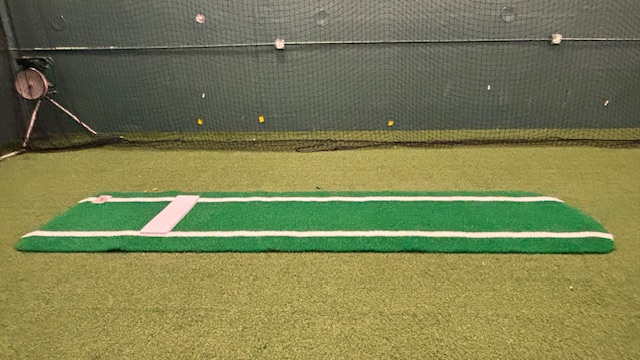
Having a good-quality practice mat for indoor pitching practice is an essential to me. It helps cut down on “gym stepping” (taking a step forward with the pivot foot before launch) and gives some good feedback about the direction the pitcher is going and distance the she is covering in the drive phase of the pitch.
For years I have used a mat designed for use on turf. It was good for two of the facilities I work at, both of which have very low-pile, carpet-like turf. But at the third, which has turf that is a little more grass-like, I found that the mat would slide forward and turn toward the throwing hand-side after two or three pitches for all but the smallest girls. Which meant that I would have to stop the lesson and readjust the mat pretty frequently.
The solution I came up with was to turn the mat backwards so the pitcher could use the pitching rubber to push off of but would then land on the regular turf. It solved the problem of the turning mat, but made it kind of pointless to have an 8 foot long mat since most of the mat would be in the opposite direction to which she was going.
Finally, I decided to do what we all do in these frustrating situations – search the Internet for a solution. I finally found one I thought would work: the Portolite Signature Spiked Practice Mat. I have used and liked Portolite products before, so it definitely caught my interest.
But the cost was a little high, which caused me to hesitate before pulling the trigger (more on that later). Finally, I saw a Black Friday sale and decided to roll the dice.

I’m glad I did, because it is definitely up to the task of staying in place on higher turf, even with the biggest/strongest/heaviest pitchers. No more turning, no more sliding forward, no more resetting the mat every few pitches.
You just lay it down wherever you want it and it stays there for hours or even days without having to touch it. Here’s a little more in-depth look.
(NOTE: There are no promotional considerations for this review. I purchased the mat as a consumer and am not being paid to write this review. Just thought you should know.)
Basic construction
The mat definitely features high-quality construction. The turf side is thick and built to hold up to heavy use, and the back side appears to be made of heavy-duty rubber. The two are attached seamlessly and look like they will hold up for years without splitting apart.
(For contrast, the turf and backing on my Jennie Finch mats began separating at the front edge shortly after I got them, and I occasionally have to glue them back together to reduce the chances of them coming apart completely or having a pitcher trip over them.)
The pitching rubber isn’t just glued to the mat – it is bolted on with four bolt and nut combinations that are incorporated somehow into the rubber then stick out of the bottom.
I don’t think that pitching rubber is going anywhere. This construction also means (according to the manufacturer) that you can replace the pitching rubber at a later date if it gets too worn or damaged.
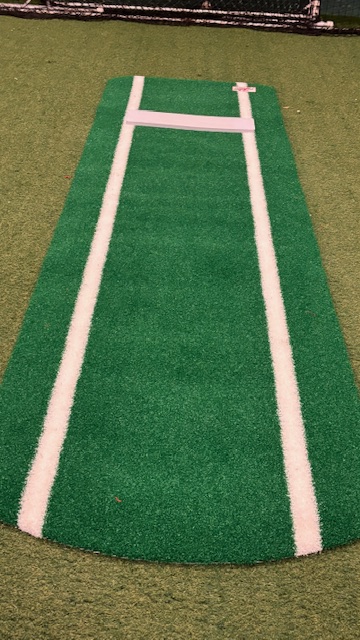
The overall length of the mat is 3 feet wide by 11 feet long, with 8 feet from the rubber to the end of the mat. That should be sufficient for most pitchers, while also leaving a generous 3 feet on the back side so both feet can start on the mat, even with a deep drop back.
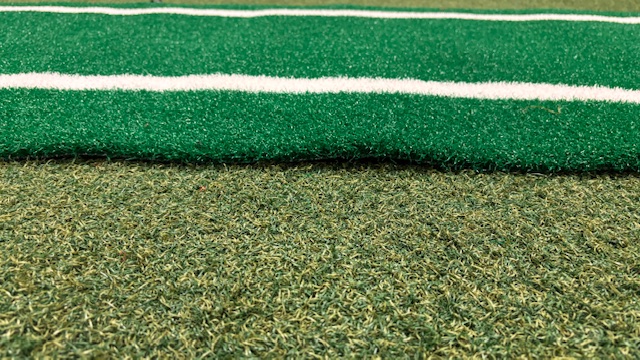
The lines appear to be deeply sublimated or otherwise embedded into the turf so I don’t think you I have to worry about them wearing away any time soon. I wish there was a center line instead of (or in addition to) the two lines extending down either side from the pitching rubber, since I think that makes a good reference for pitchers.
But it’s not a deal-breaker, and I suppose I’ll get used to it. You can also order the mat with no lines if you prefer.
The turf comes in three colors – green, red, and clay – so you can choose the one that suits you best. I’ve always had and liked green mats so that’s what I went with. It’s a bright green right now, but we’ll see how it holds up after hundreds of shoes have slid across it.
I can’t speak to the durability yet since I’ve only been using it a few weeks. But it looks like it ought to hold up for years.
One other thing that takes a little getting used to is that it feels a little spongier than the other mats when you walk or land on it. That’s probably good for young backs and knees versus landing on hard concrete with just a thin piece of carpet over it.
The Spiked Side
Here’s where the real magic happens, at least for me. As I said, the whole reason I purchased the mat was to try to solve the problem of the mat slipping on the turf. It has definitely done that.
The key is the 1,200 little spikes on the bottom side. They are molded as a part of the heavy-duty rubber backing, creating a plethora of individual grip points.
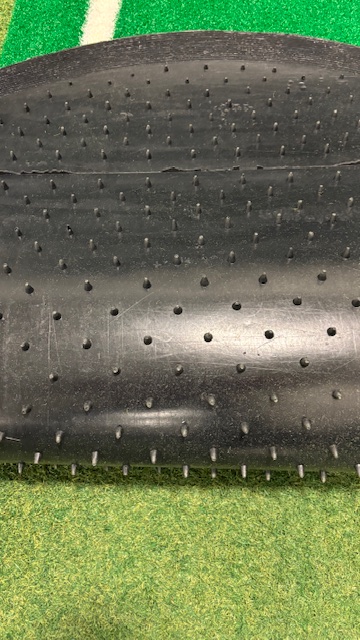
As pitching people know, the goal is to land into the front foot like an airplane rather than on top of it like a helicopter. That momentum is what can cause the mat to twist or slide forward.
With the Portolite mat, though, all those little spikes distribute the landing load throughout the mat so it stays in place easily. I have yet to have to make any adjustments, other than to change the distance for different age pitchers.
But once it’s down, it’s down until you pick it up and move it. So yes, total success for the goal I had.
And in case you were wondering, while it does leave a pattern of little indentations when you first pull it up to move it or put it away, those indentations go away quickly, leaving the base turf looking like it did before you laid the mat down. That’s important if you’re in a shared space like I am.
Heavy weight
Another reason I think it stays in place so well is that the mat itself is heavy – probably due to the molded rubber backing. It weighs 30 lbs., which is roughly 50% more than my other mats that clock in at 23 lbs.
That’s great for functional use, but it can be a challenge if you have to carry the mat for any distance. I’m a pretty big guy so I can handle it, but it’s definitely something to consider if you are on the smaller side or not particularly strong. It will give you a workout.

I wish it came with a little carrying pouch like other brands do, which I think would make it easier to transport. Then again, because of the construction the Portolite mat doesn’t roll up as tight without great effort so maybe it would be difficult to get one in an appropriate size.
Either way, right now I have to roll it up and grab it by either end to move it around the facility, It’s the one time when I miss the other mat.
The cost
Earlier on I mentioned that it’s not cheap. The current price on the Portolite website (as of January, 2026) is $999 USD.
When I first saw that I decided to roll the dice and see if there might be a Black Friday sale since it was getting close to the holidays. My gamble was rewarded, and I was able to purchase it for $799.. Add in the tax and shipping and it was $935 out the door – still expensive but every little bit helps.
Assuming it lasts for several years (as it appears it will), it’s not so bad. For example, at 5 years of use that $935 works out to $187 per year. Add in the savings on chiropractors for not having to constantly bend over to reset the mat and it’s a pretty good bargain.
More options
Portolite has some other mat options in addition to the one I purchased, including a shorter throw-down mat for $299 and their Pro Spiked Game Mat for $1,899. The short mat would be great, I suppose, if you don’t need the full length for your pitcher to land on (or you don’t want to carry a 40 lb. mat around).
The game mat is similar to the practice mat but I believe the turf is even heavier duty, it includes 1,700 spikes (versus 1,200 for the practice mat), and it weighs 60 lbs. Clearly it is made to hold up to heavy use and abuse, even on outdoor surfaces.
I know of at least one program that is planning to purchase a couple to use on dirt to try to eliminate the dreaded “pitcher’s trough” that happens after multiple games in a day.
The bottom line
When I was first looking at this mat I was concerned because it was a lot of money to pay for something that I wasn’t 100% sure would solve the issue. But I am happy to report that it did solve the sliding/turning problem, and my pitchers like using it.
So if you’re having similar issues, know that you can purchase this pitching mat with confidence. Time will tell how well it holds up (maybe I’ll share a report on that sometime in the future) but I can definitely recommend it as a solution for the immediate need.






 Life in the Fastpitch Lane