Monthly Archives: October 2024
Captain Picard’s Lesson on Winning, Losing, and Errors

Sorry to nerd out on this one, but there is a great Star Trek: The Next Generation episode called Peak Performance that puts some perspective into the challenges of competing in fastpitch softball. Even if you’re not a fan you might one to check this one out.

The part that’s interesting here is a side story involving Commander Data, the highly advanced android crew member. An outsider named Kolrami who is a grandmaster at a game called Strategema (sort of a holographic version of Space Invaders) comes on board and quickly irritates the crew with his arrogance.
A couple of crew members encourage Data to use his computer brain to take Kolrami down a peg by challenging him to a game of Strategema. At first reluctant, Data finally does it to defend the crew’s honor – and promptly gets his butt kicked by his flesh-and-blood opponent in about a minute.
Shocked, Data immediately surmises there must be something wrong with his programming and tries to take himself off duty until he figures out where the “problem” is. Captain Picard, who is captain of the ship, rather harshly tells him no he can’t do that, he needs Data, and that Data should quit sulking even though Data has no emotions and so presumably no capacity to sulk.
Then Picard tells Data something that every fastpitch softball coach, players, and parent needs to hear: It is possible to make no errors and still lose.
In our case I’m not talking only about the physical errors that get recorded in the scorebook. Playing error-free ball and losing happens all the time.
I’m talking more about the strategic decisions and approaches to the game that seem like they’re sound but still don’t produce the desired results (a win). Here’s an example.
There are runners and second and third with one out in the last inning of a one-run game. The defensive team opts to intentionally walk the next hitter to load the bases in order to create a force at home and potentially a game-ending double play at first if there’s time. They also pull their infield in to give them a better shot at that lead runner.
The next batter after that hits a duck snort single behind first base that takes a tough hop and rolls to the fence after landing fair and two runs end up scoring.
No errors were made, and the strategy was sound. But the result is still a loss.

Here’s another one from my own experience. Down one run with no outs in a game where they have been unable to hit the opponent’s pitcher, the offensive team finally gets a runner on first.
She’s a fast, smart, and aggressive baserunner, so putting the ball in play somehow could go a long way toward tying the game. The obvious solution would be a bunt to advance the runner to second, giving the offense two shots to bring her home from scoring position.
But the defense knows that and is playing for the bunt. So the offense opts for a slug bunt (show bunt, pull back, and hit the ball hard on the ground) combined with a steal of second. If the hitter can punch it through the infield the runner on first, who already has a head start, will likely end up on third and might even score, depending on how quickly the defense gets to the ball. Best case the batter will end up on second, as the potential winning run, worse case with good execution she’s on first.
Unfortunately, the batter does the one thing she can’t do in that situation – hit a weak popup to the second baseman. The batter is out and the runner who was on first gets doubled off.
Now, you can argue that the failed slug bunt was an error, but was it really? It was a failure of execution but not necessarily a mistake in the classic sense. It was just one of those cases where the hitter lost the battle to the pitcher.
The point is that sometimes, despite our best efforts and doing all we can to play the game correctly, things don’t work out the way we’d like. There are things that happen beyond our control that can influence the outcome of a play, an inning, or a game.
We can’t beat ourselves up over it or spend endless time second-guessing ourselves. We learn what we can from the experience and move on.
Sometimes we make different decisions the next time – and sometimes we don’t – and hope for a different outcome.
In case you’re wondering about Data, at the end of the episode he requests a rematch. This time he keeps the game going until Kolrami finally gives up in frustration.
When asked about it, Data explains that Kolrami entered the second game assuming both he and Data were trying to win and played accordingly. But Data’s strategy was to play not to lose, basically playing defense the whole time, until his opponent essentially forfeited the game, giving Data the victory.
Anyone who has played an international tie breaker can relate.
Not every decision you make on the field is going to work out the way you hoped, even if you’re making it for the right reasons. All you can do is learn from the experience and hope it works out better the next time.
Captain Picard photo by Stefan Kühn, CC BY-SA 3.0 https://creativecommons.org/licenses/by-sa/3.0, via Wikimedia Commons
How “Garbage Time” Can Become Your Treasure

There is an old saying that states “One person’s trash is another person’s treasure.” (Actually it says “one man’s” but I have updated it for the modern era. You’re welcome.)
This concept definitely applies to softball, especially if you are one of those players who is struggling to get playing time at a particular position so you can prove what you can do. It all revolves around what football fans call “garbage time.”
The term “garbage time” typically refers to a point in the fourth quarter where one time is so far ahead the other team has no chance to catch up, but there are still several minutes left to play. That’s usually where you will see the second string quarterback (as well as other bench players) take the field to run out the clock while keeping the starters from suffering a stupid injury.

The softball equivalent would be a game where one team is clearly over-matched, down by several runs, and there is a time limit. It’s clear the team that’s down isn’t going to be able to overcome the deficit in time but they have to keep playing anyway.
Here’s how you can turn this unfortunate situation into an opportunity.
Let’s say you’re the third or fourth pitcher on your team. You started the fall season kind of rough but have been working hard over the offseason and have improved your pitching considerably over the last few months.
Now that it’s summer you’re eager to prove what you can do, but your coach still thinks of you as you were back in the fall and is reluctant to put you in to pitch.
So suggest to your coach that you will take all the “garbage time” innings you can get. (Although you may not want to refer to them as “garbage time.”)
Frame in the context of helping the team: The team still has to play, but why waste one of the “good” pitchers on meaningless innings? Wouldn’t it be better to save them for a game where you have a better chance of winning?
That logic should make sense to most coaches – at least the ones who are honest with themselves. Worst case you go out there and give up a bunch of runs and the game ends early due to the run-ahead rule.
Embarrassing, sure, but does it really matter if you lose by 7 runs or 10 runs? And if you do get run ruled your team gets a little extra time to rest, relax, and reset before having to play their next game.
But you’re not actually planning to give up any runs. In fact, your plan is to show the coach that you’re ready to pitch by holding your own against a team that was beating up on your #1 or #2 pitcher.
Do that a couple of times and your coach may start to look at you differently. Perhaps he/she will let you start or relieve in a pool play or “friendly” game where the outcome isn’t already decided.
Do well there and he/she may start giving you more opportunities, and eventually turn to you as a regular member of the staff instead of the pitcher of last resort.
All because you volunteered to eat up the innings no one else really wanted.
While this strategy probably works best for pitchers, it can be applied to other positions as well. After all, field players need a break from time to time too, especially if they’re already nursing injuries or you’ve been playing a lot of games either in one day or on back-to-back days.
And who knows? Maybe your eagerness and positive attitude can spur the team to keep fighting and do better even when it feels like all hope is lost.
In the right conditions it just takes one spark to light a major fire. You could be that spark.
It’s said that luck doesn’t just happen; we make our own luck. Volunteering for “garbage time” is a way to make your own luck – and turn what looks like trash into your own personal treasure.
Gold bars photo by Pixabay on Pexels.com
Why You Shouldn’t Let Today’s Setbacks Define You

Not sure who needs to hear this story today but I have no doubt there are some who do – and others who may in the future. So I thought I’d share it, courtesy of my friend Tim Boivin who first shared it with me.
Hopefully the link works and you can read the full story. But just in case I will summarize it here.
Today we all know Mike Trout as an 11-time Major League Baseball All-Star and a standout hitter and outfielder ow playing for the Los Angeles Angels. Even those who don’t follow baseball closely have probably heard the name.
He’s definitely one of the top current players in the game and will likely make the Hall of Fame in either his first or one of his first years of eligibility. His career stats include a batting average of .299, on base percentage of .410, slugging percentage of .510 and on base + slugging (OPS) at a hefty .991.
Back in 2008, however, Trout was invited along with 99 other players to try out for the USA Baseball National team. You would think someone with his skill and athletic ability, demonstrated over years at the highest level of the game, would be a lock for something like that.
But he wasn’t. He was kind of an unknown going in and didn’t have the hype some of the other players did.
So when the powers that be assembled the final 18-player roster, Mike Trout’s name wasn’t on it.
I’m sure it hurt, to come that close and not make it. But he didn’t let it deter him.
Instead, Mike Trout continued to work on his game and play his heart out, and he eventually rose to outshine all those players who were selected instead of him.
You see, that’s the thing. It really doesn’t matter where you start the race, only where you finish it.

I mean, the world is full of stories like this – Michael Jordan not making his high school varsity basketball team as a sophomore, The Beatles being turned down by every major record label in Britain, and so forth.
So maybe you tried out for a team and didn’t make it. Or maybe you’re on a team but not getting many opportunities to show what you can do.
It’s easy to get discouraged and give up in that type of situation. But instead of hanging your head and letting others define you, keep working at it.
You may only have so much natural ability or athleticism but you can have a boundless supply of desire, determination, and positive attitude if you want it. Use those qualities to lift yourself up and someone will recognize it.
At some point, you will get an opportunity to show what you can do somewhere. When that happens, make sure you’re prepared to take advantage of that opportunity.
Give it all you’ve got and good things will happen.
And always remember sometimes the things we desire most may not be the things that are best for us in the long run. But as they say in Harold and Kumar Go to White Castle, the universe tends to work out the way it should.

So if you’re facing disappointment today, shed a few tears or overturn a few tables or deal with it however you deal with it. Then get back to work.
And someday you may find someone writing an inspirational story about you.
There’s No Good Reason to Squeeze the Strike Zone
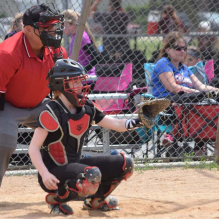
Before I start I want to say that this is not your typical rant about how umpires are terrible and shouldn’t be allowed to walk free with the rest of us. To the contrary, I have tremendous respect for umpires because I know it’s a tough and often thankless job, and that nearly all umpires do the best they can to keep each game fair for all involved.
That said, one thing I’ve never understood is why some umpires seem to have a strike zone that is roughly the size and shape of a child’s shoebox. Who do they think it’s benefiting?
According to the USA Softball Rulebook (which is the book all other sanctions are based on) the strike zone runs “from the batter’s arm pits to the top of the knees.” Further, it is “that space over any part of home plate, when a batter assumes a natural batting stance adjacent to home plate.” (Rule 1, Definitions. I looked it up so you don’t have to.)
That’s a pretty big area, really. Note that it doesn’t say the entire ball must be over the plate when it crosses, just that the ball must cross some part of the plate.
So that’s about 18-19 inches wide if you just catch the corners. The vertical area will vary by the height of the batter and her natural stance, but it’s still a lot larger than the 4 inches to either side of the beltline that some seem to demand.
If that’s the case, what reason could there be for shrinking it any smaller than that? Who does it benefit?
Let’s look at all the possibilities.
The Pitcher
That’s a big negatory. You could try to make an argument that the pitcher must learn to spot her pitches better when the strike zone is small.
But the effect that happens in 99.999% of the cases is it forces the pitchers to throw meatballs all game long because that tight little zone sits over the heart of the plate. Pitchers should be learning to pitch the corners – preferably no more than half a ball on – and nip at the very top and bottom of the strike zone.
When she’s forced to throw it down the pipe or have it be called a ball all you’re doing is discouraging a pitcher from growing her craft and creating unnecessary frustration that might discourage her from continuing in the position.

There is already a shortage of pitchers at the older ages. Squeezing the strike zone, especially on younger pitchers who are just beginning to find their way at the position, encourages their abandoning the position.
The Hitter
Sure, you would think forcing pitchers to throw meatballs would be a great thing for hitters. Who wouldn’t love a steady diet of easy-to-hit pitches?
But in many cases it has the opposite effect. Coaches who are more interested in winning a game today than in developing their players will often tell their hitters to keep the bat on their shoulders and wait for the walk instead of swinging.
At least until they get two strikes. Yes, they get lots of extra baserunners that way and might even get some extra runs on walks or wild pitches. But the HITTERS DON’T LEARN TO HIT.
They learn to stand there. At some point they’re going to have to swing the bat, but if they’re not getting reps because umpires are squeezing the zone they’ won’t develop the skills or the mechanics under pressure to execute a successful swing.
Once they’re playing in a game where a more realistic strike zone is being called they’ll be toast.

The Fans/Parents
Nope. Of course, the pitcher’s parents will be apoplectic watching a game with a shoebox-sized strike zone.
A little less if it’s being called the same way on both sides, but still angry that little Maizey is getting screwed over by the person in blue.
But even the hitters’ parents aren’t going to care for it much because it’s BORING. No one wants to watch a walkfest. No one.
The Coaches
Truthfully some coaches will be happy about it. Those are the ones for whom winning is the only important thing.
They’re the ones who are sending their kids to the plate looking for walks.
But any coach who is truly in it for the kids will want their kids to have the opportunity to learn all aspects of the game. That means pitchers learning to give their all instead of trying to hit one tiny spot, hitters swinging at pitches when they’re hittable, balls being put in play so fielders can make plays and learn how to react to different situations, and baserunners can learn how to run the bases.
The Umpires
Finally we get to the folks causing all the commotion. Why any umpire would squeeze the strike zone when it is counter to their own self-interest is beyond me.
Umpires should want to keep the game moving. If it is an untimed game, the more strikes they call the faster the game will go and the sooner they can get off the field and onto whatever they want to do after the game.
But even in a timed gameall they’re going to do is make coaches and parents angry. The last thing they need to do is encourage any more of that.
Not to mention that not calling the strike zone by the rules hurts the players as well as the game. Normally, well-meaning people volunteer to become umpires because they want to serve the game and those who play it.
Whether it’s due to a power trip or just not caring about calling a good and fair game, squeezing the strike zone goes against everything they are supposed to be doing.
At the end of the day there is simply no reason to shrink the strike zone into a belt-high, middle of the plate box. Call it properly and everyone will benefit.






 Life in the Fastpitch Lane