Blog Archives
Where Have All the Pitchers Gone? 2025 Edition

Two years ago almost to the day I wrote the post below. Sad to say things don’t seem to have gotten any better so I thought it would be worthwhile to re-post it.
I still believe one of the biggest problems is coaches who are so averse to losing that they won’t give their less experienced pitchers the opportunity to develop. Instead, they go with their Aces all the time, even when they don’t need to. For example, in weekday “friendlies” or pool play games, especially when seeding is going to be determined by a blind draw anyway.
Pitchers who don’t get the opportunity to pitch get discouraged and stop doing it. In the meantime, pitchers who are over-pitched develop over-use injuries and then often become unavailable to pitch when they get older.
It all ends up in a perfect storm of not enough pitchers to go around by the time teams get to 15U/16U. Or sometimes even second year 14U.
Teams need pitchers right now like crops need rain. Let’s try to do better at the early ages and give budding pitchers an opportunity to grow.
Because you never know. Today’s gawky, uncoordinated 11 year old may just turn out to be tomorrow’s stud – if she’s given the incentive to stick with it.
Yes, I know, it sounds like a folk song but it’s a legitimate question. Especially now that we are hot and heavy into the softball tryout season.
If you’re following softball-oriented Facebook groups or forums such as Discuss Fastpitch you’re probably seeing this plea a lot, particularly in the older age groups: Impossibly great team looking for one more bracket pitcher to complete our outstanding roster.
With all the 8-10 year olds jumping into the pitching pool you would think there would be a cornucopia of pitching at every level. It’s not unusual to see box scores on GameChanger that show four or five pitchers each getting an inning of work on a regular basis. And it’s been that way for long before GameChanger existed.
So what happened to all those pitchers?

Well, somewhere along the way they stopped pitching. Or maybe even playing the game entirely.
Sure, some probably found that they just didn’t care for the pressure of being in the circle. And some probably found that they didn’t like all the extra work that goes with being a pitcher. All legit, and to each her own.
But I can’t help but think that the rapid shrinking of the pitching pool might in many cases also be driven by team coaches and parents who are more focused on winning 10U or 12U games or trophies than they are on ensuring their players develop properly.
Take the coach who has 5 pitchers on his/her roster but gives 90% of the innings to the #1 pitcher. Yes, it’s nice to win games and tournaments, but if you’re only really giving one pitcher an opportunity to pitch regularly the others won’t develop.
Then they won’t develop, they’ll fall farther behind, get discouraged by their lack of progress as well as their lack of opportunity, and eventually stop pitching. So now four more are out of the pitcher pool for the future.
Oh, and in the meantime the #1 develops an overuse injury and may end up not pitching either.
Then there are the coaches who set impossible standards for their young, developing pitchers. They tell them in order to pitch they need to “hit their spots” 80% of the time.
Not because it’s necessary – really the only “spots” that are important at the 10U level are ball and strike – but because they heard on TV or read an article that said that’s what college pitchers do. Or because they want to use the vague “hit your spots” as an excuse not to pitch a girl who isn’t going to walk in and dominate every game.
So again, she doesn’t get circle time, falls behind, and eventually gives it up because what’s the point of taking lessons and practicing if you never get to pitch, even in “friendlies” or pool play?
Pitching coaches who say they’re teaching 10 or 12 year olds to throw seven pitches aren’t much help either.

Most 10U and 12U pitchers have enough to do mastering a fastball and and a changeup. Having them work on five other pitches – especially with some of the crazy mechanics I’ve seen them try to use – is a recipe for disaster.
Those pitchers never master their fundamentals. So when the hitters get better all those so-called different pitches turn out to be bullet spin fastballs to different locations that are fairly easy to hit. And then they’re out of the pitching pool because they’re getting hammered all the time.
And the list goes on. If we really want to have more pitchers available at 16U and 18U, parents and coaches have to do more to encourage greater success for more pitchers at the younger levels.
Keep them pitching, keep them developing, and give them opportunities to learn their craft – even when they’re bad at it. Then maybe there won’t be so many teams begging for pitchers or fighting over the same ones at the older levels.
My good friend Jay Bolden and I have started a new podcast called “From the Coach’s Mouth” where we interview coaches from all areas and levels of fastpitch softball as well as others who may not be fastpitch people but have lots of interesting ideas to contribute.
You can find it here on Spotify, as well as on Apple Podcasts, Pandora, Stitcher, iHeart Radio, or wherever you get your podcasts. If you’re searching, be sure to put the name in quotes, i.e., “From the Coach’s Mouth” so it goes directly to it.
Give it a listen and let us know what you think. And be sure to hit the Like button and subscribe to Life in the Fastpitch Lane for more content like this.
Lead photo by Pixabay on Pexels.com
Developing Fastpitch Pitchers: The Speed v Accuracy Debate

One of the age-old questions when developing fastpitch pitchers is whether coaches should prioritize speed or accuracy.
Of course the real answer is they should focus on mechanics and everything else comes from that. In other words, focus on the process and the outcomes will take care of themselves.
Still, you do need some way of measuring whether the mechanics you’re working on are helping your pitcher get better or not. The two most common are speed and accuracy.
So we again come to that question: which of those should be the priority? In my opinion, the priority for young pitchers should be speed. Here’s why.
Let’s say you choose to prioritize accuracy. Understandable, especially if you are a team coach.
You want pitchers who can get the ball over the plate and get hitters swinging. After all, you can’t defend a walk and all that, and no one likes a walkfest.

The problem is, if you sacrifice speed for accuracy your pitcher will develop a way of pitching that is totally focused on that outcome. That will get her by up until about the age of 12, especially if you’re not playing high-level ball.
But at some point she will need to gain some speed or she won’t be pitching anymore. While it may have been good enough to “just get the ball over the plate” when she was younger and the opponents didn’t hit very well, those hitters have been developing too.
And they can now crush those slow meatballs all the way toward South America.
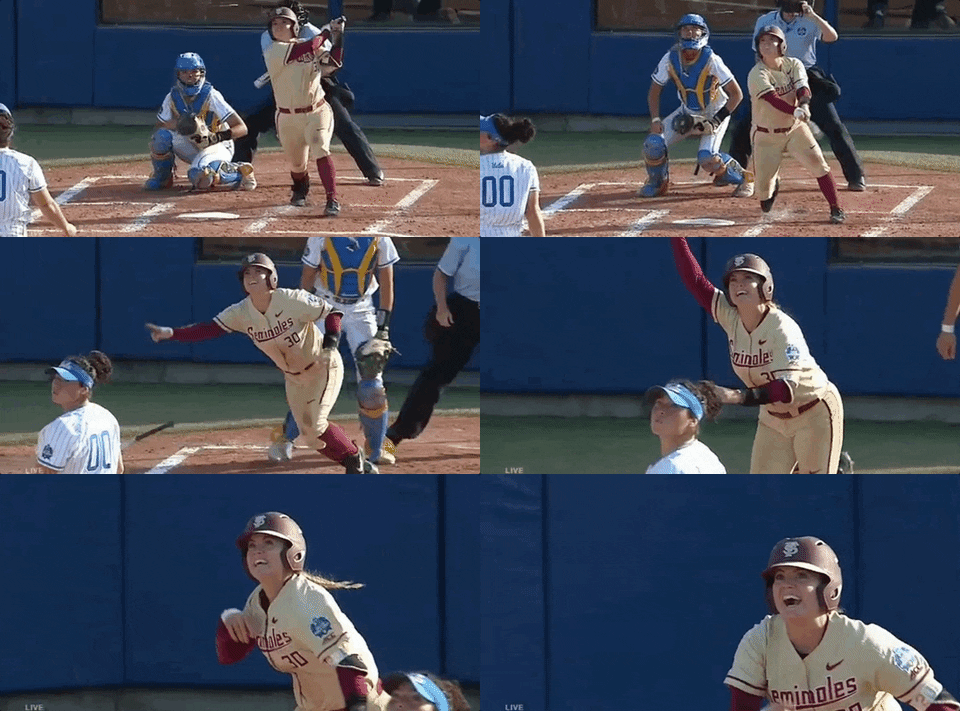
So she’s going to have to gain some speed. The problem is, that’s going to throw off her whole way of pitching because she’s going to need to use her body differently than she’s been doing it, which means her accuracy will go down anyway. And now she’s neither fast nor accurate.
Let’s look at it from the other side. If you focus on speed first, your pitcher may have some trouble throwing strikes at first.
Young people don’t always have total command of their bodies, and some have less than others. Which means you could have arms and legs (as well as pitches) going everywhere when they try to use their full energy But…
The more they work at it at full or near-full energy level, the better they’ll be able to feel their body moving in space. Pitches that were way wide, or going to the top of the backstop, or rolling in the dirt, start getting closer to being strikes.
The zone keeps narrowing until finally the pitcher can throw reliably. Only instead of throwing meatballs she’s bringing heat.
And as she gets older, the mechanics she developed to build that speed continue to be refined, giving her better and better control without having to go back to the drawing board and re-learn how to pitch.
In the end, it comes down to what your goals for that pitcher are. If all the team coach cares about is not giving up walks to ensure a better shot at wins in the short term, it might make sense to go for accuracy.
Your pitcher will definitely get more opportunity to pitch right now.
If, however, you’re looking to develop your pitcher in a way that delivers long-term success, put the priority on speed and let accuracy come later. Because by the time a pitcher is 13, she needs a minimum level of speed to even be considered for most teams, much less given the ball when it counts.
You show up to a tryout with speed and no one cares how many batters you walked or hit when you were younger. They may even be willing to take a chance on you if you look a little wild.
But show up throwing in the mid-40s or less and you’re probably not going to be pitching much no matter how accurate you are. Because by that time accuracy will be considered table stakes, not a point of differentiation.
Where Have All the Pitchers Gone?
Yes, I know, it sounds like a folk song but it’s a legitimate question. Especially now that we are hot and heavy into the softball tryout season.
If you’re following softball-oriented Facebook groups or forums such as Discuss Fastpitch you’re probably seeing this plea a lot, particularly in the older age groups: Impossibly great team looking for one more bracket pitcher to complete our outstanding roster.
With all the 8-10 year olds jumping into the pitching pool you would think there would be a cornucopia of pitching at every level. It’s not unusual to see box scores on GameChanger that show four or five pitchers each getting an inning of work on a regular basis. And it’s been that way for long before GameChanger existed.
So what happened to all those pitchers?
Well, somewhere along the way they stopped pitching. Or maybe even playing the game entirely.
Sure, some probably found that they just didn’t care for the pressure of being in the circle. And some probably found that they didn’t like all the extra work that goes with being a pitcher. All legit, and to each her own.
But I can’t help but think that the rapid shrinking of the pitching pool might in many cases also be driven by team coaches and parents who are more focused on winning 10U or 12U games or trophies than they are on ensuring their players develop properly.
Take the coach who has 5 pitchers on his/her roster but gives 90% of the innings to the #1 pitcher. Yes, it’s nice to win games and tournaments, but if you’re only really giving one pitcher an opportunity to pitch regularly the others won’t develop.
Then they won’t develop, they’ll fall farther behind, get discouraged by their lack of progress as well as their lack of opportunity, and eventually stop pitching. So now four more are out of the pitcher pool for the future.
Oh, and in the meantime the #1 develops an overuse injury and may end up not pitching either.
Then there are the coaches who set impossible standards for their young, developing pitchers. They tell them in order to pitch they need to “hit their spots” 80% of the time.
Not because it’s necessary – really the only “spots” that are important at the 10U level are ball and strike – but because they heard on TV or read an article that said that’s what college pitchers do. Or because they want to use the vague “hit your spots” as an excuse not to pitch a girl who isn’t going to walk in and dominate every game.
So again, she doesn’t get circle time, falls behind, and eventually gives it up because what’s the point of taking lessons and practicing if you never get to pitch, even in “friendlies” or pool play?
Pitching coaches who say they’re teaching 10 or 12 year olds to throw seven pitches aren’t much help either.
Most 10U and 12U pitchers have enough to do mastering a fastball and and a changeup. Having them work on five other pitches – especially with some of the crazy mechanics I’ve seen them try to use – is a recipe for disaster.
Those pitchers never master their fundamentals. So when the hitters get better all those so-called different pitches turn out to be bullet spin fastballs to different locations that are fairly easy to hit. And then they’re out of the pitching pool because they’re getting hammered all the time.
And the list goes on. If we really want to have more pitchers available at 16U and 18U, parents and coaches have to do more to encourage greater success for more pitchers at the younger levels.
Keep them pitching, keep them developing, and give them opportunities to learn their craft – even when they’re bad at it. Then maybe there won’t be so many teams begging for pitchers or fighting over the same ones at the older levels.
For the Love of Gaia, Please Stop Teaching Screwballs to 10 Year Olds

There is a phenomenon I’ve noticed lately in my area and seemingly is happening across the country as I speak with other pitching instructors.
When I start lessons with a new pitcher I will ask her what pitches she throws. For pitchers under the age of 14 my expectation is fastball, change, and maybe a drop ball.
These days, however, I have been shocked at how many, even the 10 year olds, will include a “screwball” in their list of pitches. Especially when I then watch them pitch and they struggle to throw their basic fastball with any velocity or semblance of accuracy.
Who in the world thinks teaching a screwball to a 10 year old (or a 12 or 13 year old for that matter) is a good idea? Particularly the screwball that requires the pitcher to contort her arm and wrist outward in a twisting motion that includes the “hitchhiker” finish?

There is simply no good reason to be doing that. For one thing, most kids at that age have rather weak proprioception (body awareness of self movement), which means they often struggle to lock in a single movement pattern.
So, since the way you throw a screwball is in direct opposition to the way you throw a fastball (especially with internal rotation mechanics but it’s even true of hello elbow pitchers) why would you introduce a way of throwing that will interfere with development of core mechanics? Pitchers who are trying to learn both will be splitting their time between two opposing movements, pretty much ensuring they will master neither.
Then coaches and parents wonder why the poor kid can’t throw two strikes in a row in a game.
Just as important is the health and safety aspect of twisting your forearm and elbow against the way they’re designed to work. As my friend and fellow pitching coach Keeley Byrnes of Key Fundamentals points out, “Boys at that age are cautioned against throwing curve balls with a twisting action because of the stress it places on their elbow joints. Why would you encourage a softball pitcher to do the same thing?”
Keeley also points out that most 10 year olds don’t hit very well anyway, so developing a screwball at that age is unnecessary. You can get many hitters out by throwing a fastball over the plate with decent velocity (which means it’s not arcing in).
Tony Riello, a pitching coach, trainer, and licensed doctor of chiropractic, is also concerned about the effect throwing the twisty screwball can have on other body parts. He says, “To be that spread out left to then force the arm and shoulder right seems not healthy for either the back or the shoulder,” he says.
Then there’s the fact that in 99% of the cases a screwball isn’t really a screwball. It’s just a fastball that runs in on a hitter.
Why do I say that? Because if you look at the spin on 99% of so-called screwballs, especially among 10 year olds but even at the collegiate level, they don’t have the type of spin that would make them break. They have “bullet” spin, i.e., their axis of spin is facing the same direction as the direction of travel.
For a screwball to actually be a screwball the axis of spin would need to be on top of the ball, with spin direction going toward the throwing hand side. Just as a curve spins away from the throwing hand side.
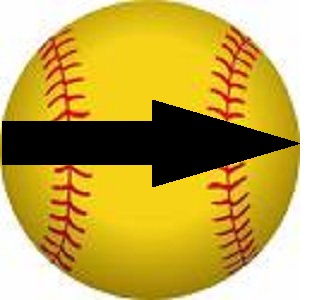
So if you’re throwing a pitch that isn’t going to break anyway, why not just learn to throw an inside fastball instead? If you want it to run in a little more, stride out more to the glove side then let it run itself back in.
But again, you’re now giving that young pitcher who’s just trying to learn to throw the ball over the plate two different mechanics (stride straight, stride out) to use, which means she’s probably going to be half as effective on either one.
Oh, and that hitchhiker move that’s supposedly the “key” to the screwball and places all the stress on the elbow? It happens well after the ball is out of the pitcher’s hand, so it has no impact on the spin of the pitch whatsoever. Zero. None. Nada.

Finally, and perhaps most important, once a young pitcher can throw with decent velocity and locate her pitches (or at least throw 70% strikes) there are simply better pitches for her to learn first.
After the basic fastball, in my opinion (and in the opinion of most quality pitching coaches), the second pitch that should be learned is a changeup that can be thrown with the same arm and body speed as the fastball but resulting in a 10-15 mph speed differential. Throwing both the fastball and change at the right speeds for 70% strikes should be enough to keep the typical 10- or 12-year old pitcher busy for a while.
Next you would want to add a drop ball. The mechanics of a properly taught drop ball are very similar to the fastball. In fact, I like to say they are fraternal twins.
Making a ball drop at the right spot, especially given so many young hitters’ desire to stand up as they swing, will get you a lot more outs, either as strikeouts or groundouts. A good drop ball will still translate into more groundouts as you get older too – just ask Cat Osterman.
From there it’s a little less certain. You can go either rise ball or curve ball. I usually make the decision based on the pitcher’s tendencies.
A well-thrown rise ball is still an extremely effective pitch, even though it doesn’t actually break up. And a well-thrown curve will actually break either off the plate (traditional curve) or back onto it (backdoor curve). Either way it moves – unlike the screwball which mostly travels on the same line.
I would save the screwball for last – unless you happen to play in an area where slappers are predominant in the lineup. Which in the era of $500 bats and quality, year-round hitting instruction is about as scarce as screwballs that actually change direction.
There are simply better pitches to learn. And if you do work on a screwball, there are better ways to learn it than trying to twist your wrist and forearm off in a contorted move that should be outlawed by the Geneva Convention.
The bottom line is that, for the love of Gaia, there is no good reason to be teaching a screwball to a 10 year old – or any pitcher who hasn’t mastered her fastball and changeup first. Let’s make sure we’re giving our young pitchers the actual tools they need to succeed – and avoid those that can lead to injury and perhaps a career cut short.
Wanted: A Better Strategy for Developing Young Pitchers

The other day I was talking with Rick Pauly of Pauly Girl Fastpitch about the challenges of developing young fastpitch pitchers – especially those in the the 8-10 year old range.
Rick said it’s something that has been on his mind for a while, but really came home after completing another of his successful pitching clinics, this time in Fairmont, Minnesota.
The Beginner session included several very young pitchers who worked very hard at the drills and techniques being taught. But clearly they were going to take a while before they were ready to go out and dominate.
The problem is most of them, even the rec league players, often don’t have “a while” before they have to be game ready. It can easily take several months to a year or more for young players to throw strikes on a regular basis.
Most have limited proprioception (body awareness), which means that they can’t feel where various body parts are in space. They may be trying to mimic the movements they’ve been taught or the instructions they’re receiving, but can’t quite feel whether they are successful or not in that moment.
Don’t even get me started on attention span for most of them.
If they continue to work at it they will eventually get it and no doubt become very good at their craft. They’ll be the pitchers who are mowing down the competition left and right, whether it’s racking up tons of Ks or regularly getting out of innings after throwing only 10 or 12 pitches.
The problem is that future competence is not what their youth teams need right now. They need pitchers who can get the ball over the plate.
So what happens? The most valuable pitchers on those young teams are the ones who can throw strikes, no matter how they throw them.
As a result, those girls tend to get the bulk of the innings while those who are taking lessons and practicing all the time get very little circle time. Which means some who might be quite good one day get discouraged and quit pitching while parents who are taking time out of their schedules and paying for lessons begin to wonder whether that investment is worth it.
Look, I get it. While pitching to a large extent may be an individual effort, it’s still performed in the context of a team sport. It’s no fun for everyone if pitchers on both sides are throwing walkfests, and the other eight players on the field (not to mention the team that’s batting) don’t learn much if none of the hitters have an opportunity to hit the ball.
You want there to be some sort of activity on the field that resembles actual softball.
But at the same time, the future of the game isn’t with the lobbers. It’s with those few who are trying to learn how to pitch the right way.
There has to be some sort of solution. I’m sure some of you are thinking “We let the pitchers pitch until they load the bases, then a coach steps in after three balls to pitch.”
That’s ok in theory, but the reality is the coach who’s pitching isn’t helping the hitters much at all. They’re probably not throwing with a realistic motion, and since most want to win the game (because nothing is more important in the world than a $30 plastic trophy) they’re more throwing where the hitter is swinging than teaching hitters to take the bat to wherever the ball is.
It just seems there has to be a better way. I don’t know what it is, but maybe we can all put on our collective thinking caps and figure out how we can enable young pitchers to develop while still making the game fun for everyone else.
One idea is to put restrictions on when pitchers can be pulled. Give them a chance to find their way in a game rather than getting yanked after two or three walks.
Perhaps the pitcher is required to pitch to the full lineup, or half of it until she can be taken out. That might remove some of the pressure she may feel and give her a chance to find her groove, even if momentarily.
Or perhaps we formally loosen up the strike zone to the tops of the shoulders to the tops of the ankles. (I don’t think widening it will help because, well, short bats and short arms.) A bigger zone will also give hitters encouragement to swing more rather than just waiting for the walk, or for the coach to come in and pitch targeted meatballs.
Another idea is to cut the number of outs a team is given at the plate if their opponents are using pitchers who are seeing a recognized pitching coach. In other words, if I am pitching a girl who is taking lessons but struggling, we only have to get two outs to flip the inning. That one might be a little tough to enforce but if the goal is to develop pitchers for the long term hopefully it won’t be abused.
Those are just a few thoughts on our part. Not saying they’re the right way, or the best way, but they might provide a solution.
How about you? Especially those of you who are closer to that age level.
What ideas do you have to encourage young pitchers to keep learning to pitch the right way while not penalizing everyone else on the field? I know we have smart readers here, so leave your comments below and let’s start developing that next generation of pitchers to realize their full potential.
My fastpitch learning by osmosis theory
I have always been a big believer in the ability of kids, at least certain kids, to learn the nuances of softball through osmosis. I certainly saw it with my own daughters, who were eight years apart.
When my older daughter Stefanie was playing, we dragged all the other kids out to her games. We had to – she was the oldest, and we couldn’t leave the others at home.
When Stefanie was playing 14U, my youngest child Kim was 6. I was coaching, so I mostly remember seeing her heading off to a playground or just sitting in the grass. We never talked to her much about what was going on.
But somewhere along the way it must’ve stuck in her brain, because by the time she started playing she had a pretty high level of innate knowledge about what to do when. For example, I never had to teach Kim about going after the lead runner on comebacker to the pitcher. She just knew.
I am convinced that’s because she saw so many games. Even if she wasn’t constantly thinking about what was going on, she picked up a lot of it by osmosis. I think that’s the benefit the younger sister (or brother) gets.
I bring this up because of something that happened last night that just tickled me. I have been working with a 12U pitcher named Jenna for a little over a year now. (I refuse to say anyone is 11, 13, 15 or any other odd number of U. Old school.)
Anyway, I started with Jenna when she was 10U, and she’s made the transition to 12U pretty easily. It’s fun to see how far she’s come in a short period of time, and how she can take command of a game.
This summer, her dad Gary decided it would be a good time to get his younger daughter Sammie started. She was 8 when we started, playing rec league, but I know Gary has aspirations for her future. 🙂 She turned 9 not long ago.
At first she had all the challenges 8/9 year olds typically have. Like being so literal about her form that she looked all stiff and robotic.
But she’s determined, and has been working hard. The last couple of lessons the light bulb has started coming on and she’s been throwing more relaxed. Her strikes are going up, and she’s definitely throwing hard. So last night I thought it might be a good time to get her started on the basics of a changeup.
When I said that, Gary told me, “Sammie’s already gotten started on it.” Apparently she’d been watching Jenna and thought it looked pretty cool, so she decided to start working on it on her own.
I asked her to show me, and darned if she didn’t do a nice job! The pitch was really high, but it was straight, and more importantly it was the right speed without slowing her arm down. She did a couple more and it was the same thing.
Honestly, I was impressed. I asked Gary if he had been working with her and he said no. Sammie had just picked it up by watching Jenna.
I think what knocked me out was that she was maintaining her arm speed. Normally, when a new pitcher is trying a change on her own she’ll slow down to make the ball go slower. (Which, by the way, is the opposite of what you really want to do.) Not Sammie, though. She just cranked it right out there and let the design of the mechanics do the job.
Of course, it helps that she has a great example to model herself after. Jenna throws a killer change that is quite effective in games. But still. Sammie just sort of figured it out by watching.
We did some quick work and got Sammie throwing it for a strike at least part of the time. But it sure was nice to start from a solid foundation!
So there you go. Learning the game, or even parts of it, doesn’t always require a formal setting. Sometimes, if you’re fortunate, it just happens. Gotta love osmosis.
Farewell to Ernie Parker
Last week the softball world lost one of its greats – pitching coach Ernie Parker. While he hasn’t been tremendously visible the last few years – which means younger readers may not recognize the name – he was extremely influential in the careers of a lot of pitchers and coaches. Including this one.
Back in the pre-Internet days it was difficult to find quality information on anything softball-related. Which is likely one of the reasons there was such a disparity between teams in Southern California and everywhere else in the country. Ernie’s video series was one of the first to explain the techniques for “California-style” pitching, i.e., explosive speed with dynamic ball movement.
Most of us non-Californians, especially those of us in the Midwest, hadn’t seen anything like it and had no idea how it was done. But through his videos (at that time on VHS) Ernie gave the rest of us some valuable clues on what the techniques should look like and ideas on how to teach them.
Not to say he necessarily got everything right. In those early videos he talked about the importance of “slamming the door,” or bringing the hips around, to finish the pitch. I spoke to him by phone a couple of years ago about that and he said he had long since changed his stance on that, like any good pitching coach would. He also focused a lot on developing the purposeful wrist snap. That aside, though, there was enough great information to help those of us who knew nothing begin to learn.
For me, Ernie was particularly influential in learning to teach the backhand changeup and the curve. His video was the first place I saw a well-disguised changeup, and I still use several of the tips he provided. For the curve, his video was where I learned to use a Frisbee to get a pitcher started. Again, that is something I still do today.
Despite his stature and accomplishments, Ernie always had time for anyone who contacted him, and he would always give you a straight answer. I remember emailing him years ago, lamenting about the lack of effort from a couple of students with good potential and commenting on how nice it must be to be Ernie Parker and have all your students work hard. He responded that he wished it were true, but he had the same issues as everyone else. Some students worked hard and did well, others put in little effort – I supposed counting on his name to make them great.
I have to admit it made me feel a little better about my own efforts, and helped me to understand there’s only so much a coach can do. The player has to want it.
Ernie had a passion for the game, and for helping players become the best versions of themselves they could be. He will be missed by those of us who knew him and/or learned from him. Thanks and farewell, Ernie.
Helping young softball pitchers build consistency
Last night I was working with an 11U beginning pitcher named Alex. She’s a great kid, always smiling, always giving 100 percent. You can see a real love of the game in her, and a love of the opportunity her parents are giving her to learn how to pitch.
Being young, though, she has been struggling a bit to find the consistency that leads to control. Kids develop fine motor skills at different times, and it seems that Alex hasn’t quite gotten there yet. As a result, she was throwing balls all over the place.
Now, I am a believer that control is a result, not a goal. If you do the right things mechanically the ball will go where it’s supposed to go. But sometimes pitchers need a little help to push them toward that consistency.
You don’t want them to aim the ball, or do whatever it takes to get it to the catcher. That often leads to poor mechanics and slow pitches, which defeats the purpose of learning to pitch. But you do want them to start honing in on where they need to be. That’s when I got an idea.
I happened to have a Jugs Quick Snap pitching screen set up for hitting lessons that were happening after Alex’s pitching lesson. It’s the type with the hole in it. I use it so I can put the screen close to the hitter without giving my wife the opportunity to cash in the insurance policy she has on me – especially when I’m working with older hitters. That hole seemed like the perfect way to help Alex start working her way toward control.
So, I dragged it over and set it up a couple of feet in front of her and had her pitch through the hole. It’s large enough that it provides some leeway for the pitcher, yet small enough to make it something they have to work at. She struggled with it at first, but after a few minutes was able to get the ball through the hole (and toward her dad, who was catching) pretty regularly.
We then moved the screen to a distance of about 10 feet in front of her. She struggled again, but even when she didn’t get the ball through the hole she was getting a lot closer to that area than she had been.
What I liked about using the screen over having her pitch at close distance to the backstop (which we have also done) is it gave her context. It was regular pitching, but with a goal right in front of her.
As I write this it occurs to me we could even make a game of it – scoring points for getting the ball through the hole (with a full, 100 percent motion) and earning prizes depending on the score. Or maybe a prize for each time through, just to keep it fun. Hmmm, I’ll have to keep that in mind if we do it again.
I realize everyone doesn’t happen to have a Jugs protective screen handy. But if you do have access to one (or a similar screen) and are working with a pitcher who doesn’t quite seem to be able to lock in her mechanics, give it a try. Just be sure to let us know how it works for you.
As for Alex, it seemed to help. She’s still not quite there yet – it’s not a miracle cure by any means – but I have a feeling her brain will process it and she’ll be in a lot better shape the next time I see her.






 Life in the Fastpitch Lane