Blog Archives
The Way You’re Training Your Players Could Be Hurting Their Performance – And Health

We’ve all been there. We have a player who turns out to be great, or we watch what great players do, and we study them intensely to figure out what they’re doing so we can replicate it with all our other players.
But then when we try to apply what we’ve learned we find it works really well for some, pretty well for others, and little or not at all for the rest. Some even see their performance level go down or even get hurt trying to implement what we’re telling them.
How can that be? we wonder. We did our due diligence and we know what we’re saying works. We’ve seen it work. So why isn’t it working here?
The answer is very likely to be related to something called “motor preferences®,” which can be simply defined as working with the way each body is designed to move from birth.
This is a concept I have been dabbling with for the last few months since learning about it from my friend and colleague Linda Lensch over at Greased Lightning Fastpitch. (If you’re in the Jersey Shore area she’s definitely the person to see about fastpitch pitching.)
I had previously taken an online course offered by Volodalen, a French organization that has performed 20 years of research into motor preferences and how they help athletes in all sports perform at a higher level while reducing injuries. But last weekend I had the opportunity to join a couple dozen of the best pitching coaches in the country for a two-day, in-depth, in-person training clinic hosted by James Clarke at United Pitching Academy in Centerville, Indiana. (Again, James is the guy to see in that area.)
The clinic was led by David Genest of Motor Preferences Experts, the only organization in North America authorized by Volodalen to teach how to identify and take advantage of motor preferences in this part of the world. To say it was mind-blowing and potentially game-changing is still greatly understating the impact that understanding your players’ motor preferences can have.
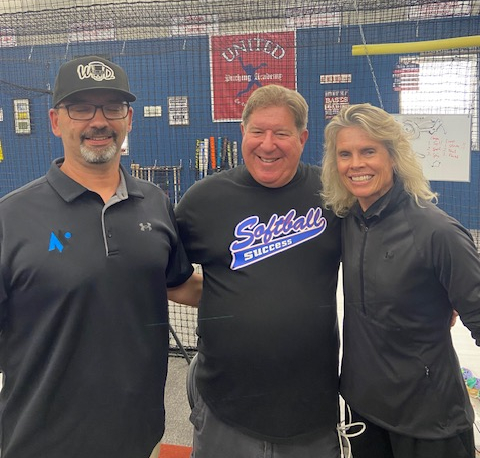
I’m not going to go into a lot of detail here, but I’m going to share some of these concepts to help you get a better feel for how learning about your players’ motor preferences can help you train them better.
One of the core concepts is that athletes can be classified into one of two groups: aerials and terrestrials. These are not black and white classifications but, as David told us, more 50 shades of gray.
So while some players may be totally aerial or terrestrial, most will fall somewhere along a spectrum in-between those two extremes.
Aerials tend to move rather light and bouncy, especially when they run. They like being up in the air, with their center of balance leaned more forward. Think of a kangaroo.

Terrestrials, as the name implies, tend to be more earthbound. Their center of balance tends to sit further back, and they pull themselves forward rather than bound forward. Think more like an elephant.
Those are two very different movement patterns. So you can see why, if you tell an aerial to spring forward when they move you’ll get great results, while telling a terrestrial to spring forward will probably not get the success you’re looking for. One is designed to do it, the other is not.
Another key factor is which side of the body favors being in extension and which side favors being in flexion. All of us have one of each, and it’s built into our DNA.
So if you have, say, a catcher who can block well to her right but struggles to get to her left, it could be her left leg is her extension leg, which is good at pushing/extending, while the right flexion leg is not so much.
There are many other motor preferences, such as a preference for red or blue, that need to be taken into consideration to develop a complete, individualized profile of a player, but you get the idea. The more you understand how their body is designed from birth to move, the better you can train them to take advantage of what they can do easily while avoiding what will be more difficult for them to do..
Now, I don’t claim to be an expert in motor preferences. While I am now certified in motor preferences use by MPE as well as Volodalen, I am still very early in this journey.

But I have already seen results within a single lesson after testing a few students and making suggestions based on the outcomes. For example, a hitter who hitting pop flies on front toss suddenly started hitting bombs after we adjusted her swing to use her motor shoulder more effectively.
I’ve also seen a pitcher improve her stability and pick up a couple of mph in a lesson after changing how she launches. Several pitching coach friends who were at the clinic are reporting similar improvements just through understanding their students’ motor preferences better.
If you are serious about helping your players become the best they can be – whatever that ceiling is – I highly recommend signing up for a Motor Preferences Experts clinic. You can find a list the upcoming dates and locations here.
I will tell you it’s not cheap. Attending a clinic is a $900 investment, although you can then attend additional clinics for a refresher at no charge, at least as of this writing. But in my opinion it is well worth the expense, especially if you plan to keep coaching or teaching for a while.
If you want to get started but can’t make it to a live clinic right now you can also do the Volodalen online course as I did. That will be a $990 cost (which cannot be applied to the cost of live clinics in case you were wondering because they are offered by separate organizations). It is not as complete as the live training, nor as valuable in practical application in my opinion, but you do get videos you can refer back to again and again.
Either way you go, however, spread that cost out over a few years, and compare it to the benefits you and your players will receive, both in terms of improving their performance and helping them prevent unnecessary injuries, and I think you’ll find as I did that it is an incredible bargain.
And you’ll better understand not only why things that work with some players don’t work with others but also how to change what you’re teaching to what WILL for those players. You can’t put a price on that.
What’s the Deal with the Colored Tape on Catchers’ Chest Protectors?

If you were watching the Women’s College World Series in 2023 and/or 2024 you no doubt noticed that Oklahoma’s catchers had a piece of blue or red tape affixed to their chest protectors. I have heard some interesting explanations as to what it might be.
One is that it’s some sort of enlarged target for pitchers to throw to. If they’re having trouble seeing the glove, or if the catcher is trying to hide the pitch location, the pitcher can sight in on the tape and throw it there.
Another is that the tape is the pitcher’s favorite color, and it’s being used to help her feel more comfortable and confident. That’s more on the right track, but still not quite there.
Actually what it is has to do with something called motor preferences. You can learn more about it here, but I will provide a quick background of what it is and how it relates to the colored tape.
The concept of motor preferences began about 20 years ago with a French company called Volodalen. They were doing extensive research in how to help athletes in many different sports (but primarily in track and field and cycling, I believe) perform better.
Through this research they discovered that all of us have certain preferences baked into our DNA. For example, when some people run they tend to bounce or rebound lightly off the ground.
They classified these athletes as “aerial.” Others tend to be more earthbound, pulling and passing as they run, so they call them “terrestrials.”
There are other tendencies as well, which I’m not going to get into right now because while I have completed an online course I want to wait until I’ve attended the in-person training to go into it in more detail. So I don’t quite feel qualified yet to offer a deeper explanation.

Motor preferences have been used in Europe for about 20 years to determine an athlete’s natural preferences so he/she is being trained properly, both to enhance performance and prevent injury. It was brought to North America by Motor Preferences Experts, whose link I provided above.
Which brings us back to the tape on the chest protectors. The color and the orientation both have significance in how they affect the pitcher.
The color is determined by whether the athlete holds his/her breath in while performing an athletic movement or lets it out. In this case, an athlete who holds his/her breath in will have a preference for royal blue. (As I understand it not just any blue will do, it has to be royal blue.)
An athlete who empties his/her lungs during the act will have a preference for red. I’m told any general red will work. All of this has to do with the rods and cones in the eyes.
There is a test to determine whether an athlete is breath in/breath out You don’t want to just ask them. That test is proprietary so I can’t share how to perform it here but I will say it’s fairly subtle so you need to be trained in it anyway.
Once you know the color, you then test to see if the athlete’s brain organizes information horizontally or vertically. That will tell you whether to run the tape horizontally or vertically on the chest protector.
Getting back to our pitchers, if the pitcher tests breath in vertical, you would want to place a royal blue piece of tape on the chest protector in a vertical orientation. If she is breath out vertical you would place a red piece of tape vertically, and so on.
The purpose, at least as I understand it, is to help the pitcher feel more relaxed and confident before she goes into her pitch. Perhaps more focused as well, all of which will hopefully help her pitch better.
The colors and orientation isn’t just for pitchers, by the way. Hitters can put a piece of the correct tape on their bats before they get into position to help them prepare to hit. Teams can put stripes up in the dugout to help their fielders before they take the field, or fielders can put a piece of tape on their gloves.
The good news for those of us who are still learning how to test is that if you mess it up and get the color or orientation incorrect there is no negative consequence, at least as I understand it. You’re just not helping the athlete the way you were hoping to.
I hope that clears up some of the mystery around the tape. While the whole motor preferences concept has only been in the U.S. for a couple of years I think awareness is starting to grow and more organizations are starting to look into it.
Consider the colored tape the “gateway drug” into the deeper world of motor preferences and how they can help your athletes perform better and avoid significant injuries. More to come on this topic after I go through the training.






 Life in the Fastpitch Lane