Blog Archives
A $500 Bat Won’t Fix a $5 Swing

Softball bat technology has certainly come a long way from the days when an $80 Louisville Slugger burgundy bottle bat was what every fastpitch hitter dreamed of owning. (Linda Lensch I’m looking at you.)
The materials and construction of today’s bats are designed to maximize distance and power, turning even so-so contact into a potential dinger. At least that’s the promise.
Yet while it’s true that the stiffness of advanced carbon fiber or other materials and “trampoline effect” of the specially engineered barrels do tend to yield better results (all else being equal), there’s one thing they can’t make up for: a poorly engineered swing. That’s something to keep in mind as you start to look at where to spend your money to try to create better results at the plate this season.
I know that $500 bat sure looks tempting in the online ads. These days bat manufacturers are doing a great job of making their bats not only powerful but beautiful.
Heck, a lot of them will let you customize the colors and graphics yourself, which is a wonderful option if you have an eye for that sort of thing and can be a disaster if all your taste is in your mouth, as an old boss of mine used to say. Still, as long as it’s beautiful to you it’s the stuff dreams are made of.
But while they may make your socks roll up and down when you look at the bat, all the pretty colors and cool graphics in the world won’t help when you take it up to the plate and are staring down a pitcher. At that point you’d better know how to swing it.

It comes come down to which you think will work better: a great swing with a cheap bat or a great bat with a terrible swing.
Sure, it’s possible with today’s technology that you can get a few great or at least decent hits with any ol’ swing. All you need to do is get the bat on the ball and the bat will do the rest, right?
That, however, is more of a “hope” or a “law of averages” strategy. Swing it enough times and you’re bound to hit something sometime – or at least you’d assume so.
But the reality is you’ll probably do a lot better making sure your swing itself is in order – that it is sequenced properly, you understand how time a pitcher, you are capable of making the fine adjustments to the swing once you get a better look at the pitch, etc. – before you go spending your limited budget on the shiny new bat.
Think of it like a guitar player. If you go to hear someone play who hasn’t been at it that long, he or she may have a $20,000 Martin acoustic guitar but it’s still going to sound like someone hacking away at an instrument they don’t really know.
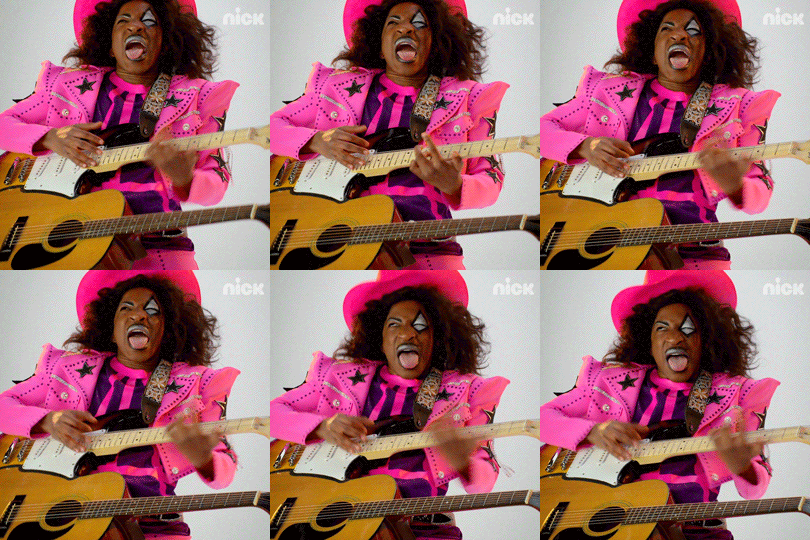
But if you go to hear a great guitarist, he or she will draw amazing, mesmerizing sounds out of a $200 special from Sweetwater. Because the tone and technique is in the hands of the player, not the instrument.
It’s the same with that $500 bat you’re coveting. The only way to get the results you want from that big ticket expenditure is to first make sure you know how to use it.
Rather than investing in that fancy new bat, first make sure you’re investing in yourself. Get some lessons from a qualified hitting instructor.
Put in time in the cages to work on what the instructor is telling you. Get comfortable with your swing mechanics and your approach at the plate.
See someone about your mental game if you find you’re great in the cage but struggle in games. In other words, get your house in order.
Then, when you’re sure you’re ready, have at it. Search the Internet or better yet go to a local store or facility where you can try out various bats to see which one feels and sounds best to you – there can be a huge difference even between bats with similar specs.
Then make your purchase knowing you not only have a $500 bat but a $1 million swing to go with it.
By the way, this thought also applies to pitchers and fielders too. Before you go spending money on new gloves or shoes or gimmicks, invest in yourself and what you’ll do with those things first.
You’ll probably like the results a whole lot better.
Don’t Pay a Coach to Watch Your Daughter Practice

The other day I was speaking with my friend James Clark (Coach James), a top-level pitching coach from Indiana. He is the owner and chief instructor at United Pitching Academy.
We were talking about some of the challenges of working with pitchers when he said something I thought was quite profound, and quite accurate.
James said, “Parents really shouldn’t be paying me to watch their daughter practice.”
I totally agree.
What he was talking about was the girl who comes in for a lesson, is given some homework to do to help her get better, then doesn’t pick up a ball again until her next lesson.
I always tell players and their parents that the time they spend with me is the least important part of the whole process. It’s the time they spend in-between visits to me that will determine their level of success.
The reason is they can really dig in and put in the quality reps, doing something specific over and over until they not only get it right, but can’t get it wrong. That’s not going to happen at a lesson.
Or at least it shouldn’t, which brings us back to today’s topic. If a player doesn’t work on whatever skill she’s supposed to work on in-between visits to the coach (and that includes team practice too, not just private lessons), she’s going to have to do it sometime.
So rather than mastering the skill on her own she’s going to have to try to learn it while she’s with the coach. Which (in the case of private lessons) the parents are essentially paying the coach to watch their daughter practice skills that already should have been acquired, or at least well on their way to being acquired.
That is a slow slog, and not a very efficient use of anyone’s time or the parents’ money.
So what should the coach be doing instead? Tweaking any little aspects of current skills that might not be where they should be then moving on to new concepts that will help a player continue to grow.
Let’s use the example of a beginning pitcher. The coach teaches her how to lead the upper arm down from the K position in a lesson, how to keep it relaxed, and how to let the ball go with a pronating motion (turning her hand inward) to maximize velocity.
At first she’s probably going to be a bit awkward with it. But as she goes she starts relaxing and getting better releases. Then the lesson is over.
There are two things that can happen from here. One is that she goes home, mindfully works on the things she learned in the lesson, and comes back to the next lesson with that motion looking pretty natural.
The other is she doesn’t work on it at all, or “pitches” during the week but doesn’t pay attention to HOW she’s doing, and then comes back to her lesson the following week with all the same issues she had at the start of the previous lesson. So the coach has to go over all the same material again, because what I described from the K position is pretty foundational to becoming a quality pitcher.
In the first case, where she has the K motion down pretty well, the coach moves her into full circles or other drills that will help her continue to advance her skills and get her ready to compete. In the second case, the coach is essentially paid to watch her practice to try to get that motion down.
Nothing new is introduced because you shouldn’t move on to part two until you can reliably execute part one.
Where it really becomes a problem is when the coach is being paid to watch the player practice the same things over and over. Every lesson (or in the case of a team every practice) that’s spent on going over the same thing is time that’s not being spent learning new or more advanced concepts.
It doesn’t take long until the player is pretty far behind where she ought to be. Then both player and parent are wondering why they’re spending all this time and money and not getting better.
It would be like a painter working on a painting all day. Then overnight someone covers it with white paint and she has to do it again. It won’t take long before she’s frustrated and wondering if it’s even worth doing.

Coach James is absolutely right. Don’t pay to have your coach watch your daughter practice.
Instead, make sure she’s practicing during the week so the coach can continue to help her move forward. It’s a far better investment for all involved.
Photo by Victor Freitas on Pexels.com






 Life in the Fastpitch Lane