Blog Archives
The Way You’re Training Your Players Could Be Hurting Their Performance – And Health

We’ve all been there. We have a player who turns out to be great, or we watch what great players do, and we study them intensely to figure out what they’re doing so we can replicate it with all our other players.
But then when we try to apply what we’ve learned we find it works really well for some, pretty well for others, and little or not at all for the rest. Some even see their performance level go down or even get hurt trying to implement what we’re telling them.
How can that be? we wonder. We did our due diligence and we know what we’re saying works. We’ve seen it work. So why isn’t it working here?
The answer is very likely to be related to something called “motor preferences®,” which can be simply defined as working with the way each body is designed to move from birth.
This is a concept I have been dabbling with for the last few months since learning about it from my friend and colleague Linda Lensch over at Greased Lightning Fastpitch. (If you’re in the Jersey Shore area she’s definitely the person to see about fastpitch pitching.)
I had previously taken an online course offered by Volodalen, a French organization that has performed 20 years of research into motor preferences and how they help athletes in all sports perform at a higher level while reducing injuries. But last weekend I had the opportunity to join a couple dozen of the best pitching coaches in the country for a two-day, in-depth, in-person training clinic hosted by James Clarke at United Pitching Academy in Centerville, Indiana. (Again, James is the guy to see in that area.)
The clinic was led by David Genest of Motor Preferences Experts, the only organization in North America authorized by Volodalen to teach how to identify and take advantage of motor preferences in this part of the world. To say it was mind-blowing and potentially game-changing is still greatly understating the impact that understanding your players’ motor preferences can have.
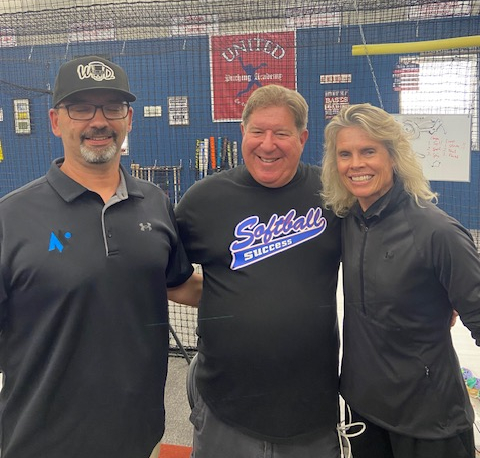
I’m not going to go into a lot of detail here, but I’m going to share some of these concepts to help you get a better feel for how learning about your players’ motor preferences can help you train them better.
One of the core concepts is that athletes can be classified into one of two groups: aerials and terrestrials. These are not black and white classifications but, as David told us, more 50 shades of gray.
So while some players may be totally aerial or terrestrial, most will fall somewhere along a spectrum in-between those two extremes.
Aerials tend to move rather light and bouncy, especially when they run. They like being up in the air, with their center of balance leaned more forward. Think of a kangaroo.

Terrestrials, as the name implies, tend to be more earthbound. Their center of balance tends to sit further back, and they pull themselves forward rather than bound forward. Think more like an elephant.
Those are two very different movement patterns. So you can see why, if you tell an aerial to spring forward when they move you’ll get great results, while telling a terrestrial to spring forward will probably not get the success you’re looking for. One is designed to do it, the other is not.
Another key factor is which side of the body favors being in extension and which side favors being in flexion. All of us have one of each, and it’s built into our DNA.
So if you have, say, a catcher who can block well to her right but struggles to get to her left, it could be her left leg is her extension leg, which is good at pushing/extending, while the right flexion leg is not so much.
There are many other motor preferences, such as a preference for red or blue, that need to be taken into consideration to develop a complete, individualized profile of a player, but you get the idea. The more you understand how their body is designed from birth to move, the better you can train them to take advantage of what they can do easily while avoiding what will be more difficult for them to do..
Now, I don’t claim to be an expert in motor preferences. While I am now certified in motor preferences use by MPE as well as Volodalen, I am still very early in this journey.

But I have already seen results within a single lesson after testing a few students and making suggestions based on the outcomes. For example, a hitter who hitting pop flies on front toss suddenly started hitting bombs after we adjusted her swing to use her motor shoulder more effectively.
I’ve also seen a pitcher improve her stability and pick up a couple of mph in a lesson after changing how she launches. Several pitching coach friends who were at the clinic are reporting similar improvements just through understanding their students’ motor preferences better.
If you are serious about helping your players become the best they can be – whatever that ceiling is – I highly recommend signing up for a Motor Preferences Experts clinic. You can find a list the upcoming dates and locations here.
I will tell you it’s not cheap. Attending a clinic is a $900 investment, although you can then attend additional clinics for a refresher at no charge, at least as of this writing. But in my opinion it is well worth the expense, especially if you plan to keep coaching or teaching for a while.
If you want to get started but can’t make it to a live clinic right now you can also do the Volodalen online course as I did. That will be a $990 cost (which cannot be applied to the cost of live clinics in case you were wondering because they are offered by separate organizations). It is not as complete as the live training, nor as valuable in practical application in my opinion, but you do get videos you can refer back to again and again.
Either way you go, however, spread that cost out over a few years, and compare it to the benefits you and your players will receive, both in terms of improving their performance and helping them prevent unnecessary injuries, and I think you’ll find as I did that it is an incredible bargain.
And you’ll better understand not only why things that work with some players don’t work with others but also how to change what you’re teaching to what WILL for those players. You can’t put a price on that.
Don’t Pay a Coach to Watch Your Daughter Practice

The other day I was speaking with my friend James Clark (Coach James), a top-level pitching coach from Indiana. He is the owner and chief instructor at United Pitching Academy.
We were talking about some of the challenges of working with pitchers when he said something I thought was quite profound, and quite accurate.
James said, “Parents really shouldn’t be paying me to watch their daughter practice.”
I totally agree.
What he was talking about was the girl who comes in for a lesson, is given some homework to do to help her get better, then doesn’t pick up a ball again until her next lesson.
I always tell players and their parents that the time they spend with me is the least important part of the whole process. It’s the time they spend in-between visits to me that will determine their level of success.
The reason is they can really dig in and put in the quality reps, doing something specific over and over until they not only get it right, but can’t get it wrong. That’s not going to happen at a lesson.
Or at least it shouldn’t, which brings us back to today’s topic. If a player doesn’t work on whatever skill she’s supposed to work on in-between visits to the coach (and that includes team practice too, not just private lessons), she’s going to have to do it sometime.
So rather than mastering the skill on her own she’s going to have to try to learn it while she’s with the coach. Which (in the case of private lessons) the parents are essentially paying the coach to watch their daughter practice skills that already should have been acquired, or at least well on their way to being acquired.
That is a slow slog, and not a very efficient use of anyone’s time or the parents’ money.
So what should the coach be doing instead? Tweaking any little aspects of current skills that might not be where they should be then moving on to new concepts that will help a player continue to grow.
Let’s use the example of a beginning pitcher. The coach teaches her how to lead the upper arm down from the K position in a lesson, how to keep it relaxed, and how to let the ball go with a pronating motion (turning her hand inward) to maximize velocity.
At first she’s probably going to be a bit awkward with it. But as she goes she starts relaxing and getting better releases. Then the lesson is over.
There are two things that can happen from here. One is that she goes home, mindfully works on the things she learned in the lesson, and comes back to the next lesson with that motion looking pretty natural.
The other is she doesn’t work on it at all, or “pitches” during the week but doesn’t pay attention to HOW she’s doing, and then comes back to her lesson the following week with all the same issues she had at the start of the previous lesson. So the coach has to go over all the same material again, because what I described from the K position is pretty foundational to becoming a quality pitcher.
In the first case, where she has the K motion down pretty well, the coach moves her into full circles or other drills that will help her continue to advance her skills and get her ready to compete. In the second case, the coach is essentially paid to watch her practice to try to get that motion down.
Nothing new is introduced because you shouldn’t move on to part two until you can reliably execute part one.
Where it really becomes a problem is when the coach is being paid to watch the player practice the same things over and over. Every lesson (or in the case of a team every practice) that’s spent on going over the same thing is time that’s not being spent learning new or more advanced concepts.
It doesn’t take long until the player is pretty far behind where she ought to be. Then both player and parent are wondering why they’re spending all this time and money and not getting better.
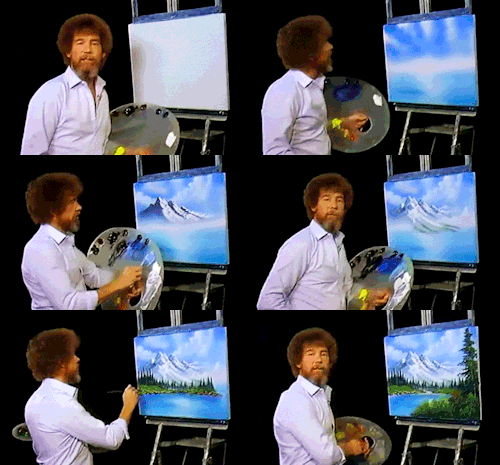
It would be like a painter working on a painting all day. Then overnight someone covers it with white paint and she has to do it again. It won’t take long before she’s frustrated and wondering if it’s even worth doing.
Coach James is absolutely right. Don’t pay to have your coach watch your daughter practice.
Instead, make sure she’s practicing during the week so the coach can continue to help her move forward. It’s a far better investment for all involved.
Photo by Victor Freitas on Pexels.com
Do’s and Don’ts for the Car Ride Home

Once again today’s topic is the result of a reader suggestion – this time from my friend and pitching coach extraordinaire Jamison (James Clark). James is a PaulyGirl Fastpitch Elite Level certified pitching coach in the Southeastern Indiana area – Richmond, specifically – so if you’re a pitcher in search of a great coach check his United Fastpitch Academy Facebook page.
James was going to do a presentation on how to handle the car ride home and asked me if I had ever covered this topic. I checked and surprisingly I had not, so here we are today.
Ah yes, the car ride home after a game. Few things in sports generate such a wide range of emotions in such a cramped space.
It’s been a while since I’ve taken one (my kids are all long grown and done with their sports careers) but I do remember those days. The time in the car before as well as after the games was some of the best time my kids and I spent (don’t worry, I checked with them).
Now, at this point you’re probably thinking my advice is going to amount to “don’t replay the whole game in the car” or something like that. While you may not to go over the whole game, that doesn’t mean you shouldn’t talk about it at all.
The truth is the car ride home offers ample learning as well as bonding opportunities. But it has to be handled carefully in order not to become contentious.
With that in mind, following are some carefully curated do’s and don’ts for the car ride home after a game or a long tournament weekend.
Do’s
- Keep it positive. It’s easy to launch into a diatribe about everything that went wrong, or wasn’t as good as it could have been. Resist that temptation, especially if it’s going to be a long ride. No one will benefit from an hour of unhappy silence.
- Take emotion out of it. Anger, frustration, disappointment and similar emotions are counter-productive. They’re also reactions to the moment – reactions you may regret later. You can talk about what went right or wrong in a calm way, with more of a focus on the facts instead of letting emotions get in the way.
- Listen more than you talk. It’s easy to fall into the trap of dominating the conversation about the game, especially if you feel like you have a lot to say. But remember you were just watching the game. Your favorite player was in the middle of it. Give her a chance to talk about what she wants to talk about – even if it’s something other than the game. Remember that youths of playing age often have a lot of hormones and other issues to deal with outside of the game. Give them the opportunity to share them – and respect them when they don’t want to share them. They’ll come around. I promise.
- Use the opportunity to talk strategy. One of the ways to keep emotion out of the conversation is to talk strategy rather than performance. For example, a pitcher’s parent can talk about pitch sequences or what can be done to attack a particular type of a hitter such as a slapper – especially if it’s the first time the pitcher faced one. A fielder’s parent can talk about what to do with the ball in certain situations, e.g., the value of going after the lead runner in the infield rather than automatically throwing every ground ball to first. For hitting, parents can talk about being more selective when ahead in the count, or ways to keep calm and focused when the hitter gets behind. Fastpitch softball is a complex game, and it’s impossible to anticipate every situation in practices. The aftermath of a game provides a great opportunity to cover some of them.
- Take a long-term view. Next week there will be another game or tournament with its own new challenges, and the frustrations of this one will forgotten. But the memories of those car rides home – whether they are good or bad – will last forever. Think about the way you want your daughter(s) to remember what it was like to ride home with you when they are long past their playing days.
- Stop for ice cream or another treat now and then. It’s easy to treat your favorite player when her team wins or when she did something great. But sometimes it’s needed even more after a tough loss or a poor performance as this old Lifesavers commercial demonstrates. A little detour to a favorite place might be just the thing to celebrate life’s triumphs or lift the spirits after a defeat – and secure the bond between parents and players.
Don’ts
- Trash the coach. You may not agree with all (or any) of the coach’s decisions or his/her approach to the game, but the car ride home from a game or tournament is not the time to share those opinions. Even if you know your player agrees. Try to decompress without getting into such a volatile issue. If you need to talk about how a coach is managing the game or treating players (especially your own) save it for another day. And if you really feel you can coach the team better – volunteer and prove it.
- Trash her teammates. Yes, #25 may have made three errors in the field and the entire last half of the lineup couldn’t hit water if they fell out of a boat. But it doesn’t do anyone any good for you to talk about it ad nauseum. Team chemistry is critical to high performance, yet it is also quite delicate. Don’t be the person who gets in the way of it. Besides, at least some of the girls you’re talking about may be her friends.
- Trash the umpires. As a group, umpires make easy targets for our anger and frustration. Yet the reality is (with very rare exceptions) the umpires aren’t out to “get” your player or your team. In 99% of the cases they couldn’t care less about who wins or what the outcome of a particular play is. Beyond that, no game outcome ever comes down to a single umpire’s call, because if your team had been up 11-0 no one would have cared about a blown call. They had ample opportunity to take the umpires out of it and didn’t. If you’re unhappy about the quality of officiating in your area don’t complain. Put in the work, get your certification, and DO something about it.
- Belittle or become hyper-critical of your player. It’s tough enough to be a young person these days, especially with all the expectations placed on them and all the pressures from coaches and outside factors such as social media. The last thing they need is one of the people they trust the most – you – adding to it when they are already feeling vulnerable and perhaps raw and exposed. This doesn’t just apply to the car ride home, by the way, it’s good advice for any time.
- Take it all too seriously. It may seem like life or death when you’re in the middle of it. But it’s really not. Fastpitch softball is a game, and games are supposed to be fun. Remember that and the car ride home will be a whole lot more enjoyable.
Photo by Taras Makarenko on Pexels.com






 Life in the Fastpitch Lane