Blog Archives
For Better Hitting You First Have to Set the Table

The other day I was trying to explain a concept in hitting that is pretty important – the need to get your body and bat into the proper position before actually taking a swing.
I asked the girl if she played chess – an obvious analogy about getting all the pieces in place. No she didn’t, she told me.
I asked about checkers, which is not quite as complex but still requires some strategic planning. That was a negatory as well.
So finally, with Thanksgiving just a couple of weeks away as I write this, I came up with what I think is an explanation any young person can relate to.
Basically, it’s that before you can enjoy the great Thanksgiving feast you first have to set the table. I guess you don’t absolutely have to, but if you don’t you’re pretty much looking at a messy Viking dinner.

For the civilized world, though, you want to be sure the plates, silverware, napkins, condiments, etc. are all on the table before you bring out the food. That way when everyone sits down you’re ready to gobble up the gobbler (or whatever is being served).
The same goes for hitting. When the ball is pitched you don’t want to just start flailing the bat at it.
Instead, you need to start moving body parts into place – setting the table as it were.
For example, you’ll want to load in plenty of time to set a nice rhythm. If you’re using a stride you’ll want to stride; if you’re doing a no-stride you’ll want to start shifting the weight/center of gravity forward.
You’ll also want to start gathering visual information about where the pitch is going, how fast it’s going to get there, and if you’re more advanced what type of spin it has.
All of this happens before what would be considered a swing by the rules, which is when the bat starts moving toward the ball.
If you take the opportunity to put all of these pieces in place, you stand a pretty good chance of being able to feast on the pitch when it comes.
If you don’t, and you just start bringing the bat when the pitch is released, the odds are you’re going to look like a turkey.
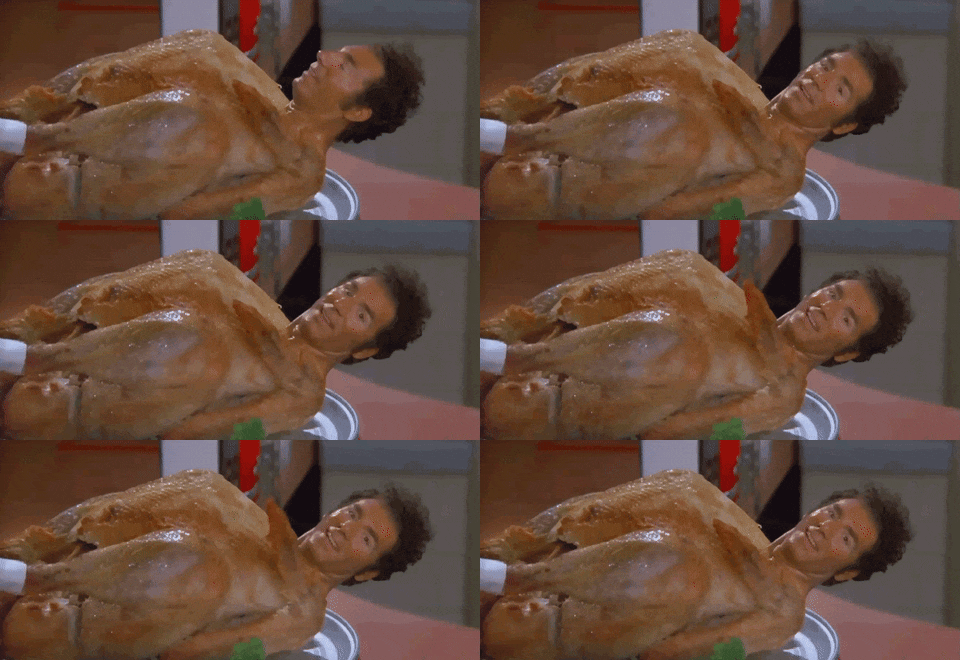
The key is you have to know what moves to make before bringing the bat – that is, which movements are table setting and which are the actual swing.
Using a stride-based swing as an example, everything that happens before the front heel drops and the hips start to fire is table setting. You haven’t committed to anything yet.
Once the hips start moving forward in a hips-shoulders-bat sequence, you’re now into the swing. You can still pull off if you recognize that the pitch isn’t going to be a good one to hit, but you are definitely going after it with the intention of hitting it hard somewhere.
If you have a player or son/daughter who is having trouble understanding the difference between the preparation phase and the execution phase of the swing, try this analogy on him/her. (It applies to all forms of hitting.)
With a little practice his/her hitting line will start to look like a cornucopia of excellence.
Getting the feel of the push off in fastpitch pitching
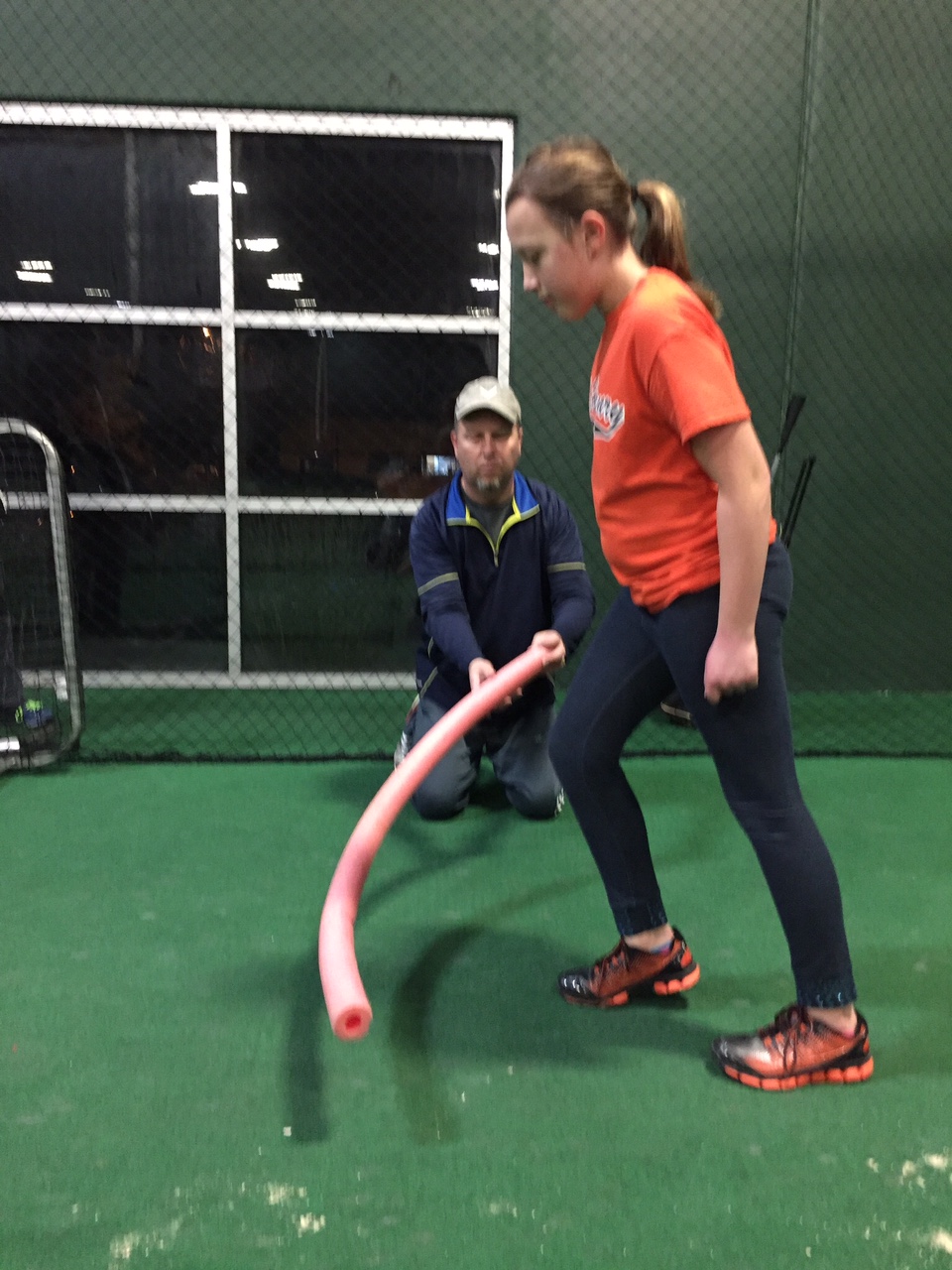
Getting a strong push-off is essential to maximizing speed for fastpitch pitchers. You need to develop a lot of forward momentum so that when your front foot comes down the stop is very sudden, which helps accelerate or sling the lower arm through the release zone.
Unfortunately, young pitchers often have trouble getting the timing down to create an early push. Instead, they will kick the stride leg forward while just sitting on the drive leg, and then try to push at the end, which is too late.
I’ve had pitchers skip before, because that mimics the sequence, i.e., push off first then reach with the leg. It works for some but not others. So if you or someone you know is still having trouble getting the feel, here’s something to try.


Place an obstacle out in front of her, very low to the ground like the swim noodle Alyssa’s father Tony is holding here. Then have the pitcher jump over it, using a normal forward jumping motion rather than thinking about pitching.
When she does it, ask her what she feels. If she isn’t sure, have her do it again. What she should feel is the drive leg pushing first, then the stride leg reaching out. If she does it correctly you’ll see it, as shown in the photos here.
Yes, this motion would be illegal for a pitch – big time illegal – but that’s not what you’re going for right now. Because if she could get the push legally you wouldn’t be doing this drill.
You just want her to feel the push first. After she does it a few times, have her go back and now try to copy that feeling with an actual pitching motion. If she’s gained the feel, and is driving her body forward first, the back foot should pretty much take care of itself.
So far, every pitcher I’ve tried this with has made an immediate improvement in her drive mechanics. I’m not quite ready to pronounce it foolproof yet, but it’s looking good.
If you’re facing this issue give it a try, and let me know in the comments how it works out. And if you’ve done this before, share your experience and whether it worked for you too.






 Life in the Fastpitch Lane