Blog Archives
Product Review: Portolite Signature Spiked Practice Mat
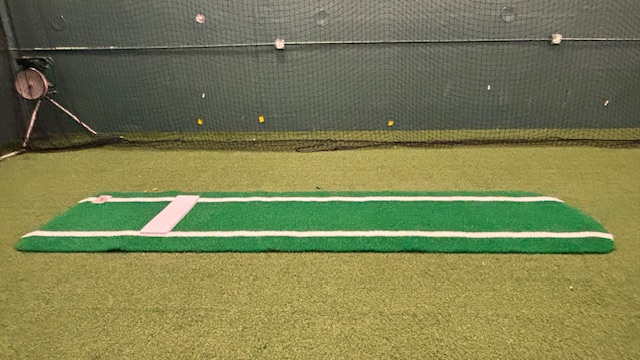
Having a good-quality practice mat for indoor pitching practice is an essential to me. It helps cut down on “gym stepping” (taking a step forward with the pivot foot before launch) and gives some good feedback about the direction the pitcher is going and distance the she is covering in the drive phase of the pitch.
For years I have used a mat designed for use on turf. It was good for two of the facilities I work at, both of which have very low-pile, carpet-like turf. But at the third, which has turf that is a little more grass-like, I found that the mat would slide forward and turn toward the throwing hand-side after two or three pitches for all but the smallest girls. Which meant that I would have to stop the lesson and readjust the mat pretty frequently.
The solution I came up with was to turn the mat backwards so the pitcher could use the pitching rubber to push off of but would then land on the regular turf. It solved the problem of the turning mat, but made it kind of pointless to have an 8 foot long mat since most of the mat would be in the opposite direction to which she was going.
Finally, I decided to do what we all do in these frustrating situations – search the Internet for a solution. I finally found one I thought would work: the Portolite Signature Spiked Practice Mat. I have used and liked Portolite products before, so it definitely caught my interest.
But the cost was a little high, which caused me to hesitate before pulling the trigger (more on that later). Finally, I saw a Black Friday sale and decided to roll the dice.

I’m glad I did, because it is definitely up to the task of staying in place on higher turf, even with the biggest/strongest/heaviest pitchers. No more turning, no more sliding forward, no more resetting the mat every few pitches.
You just lay it down wherever you want it and it stays there for hours or even days without having to touch it. Here’s a little more in-depth look.
(NOTE: There are no promotional considerations for this review. I purchased the mat as a consumer and am not being paid to write this review. Just thought you should know.)
Basic construction
The mat definitely features high-quality construction. The turf side is thick and built to hold up to heavy use, and the back side appears to be made of heavy-duty rubber. The two are attached seamlessly and look like they will hold up for years without splitting apart.
(For contrast, the turf and backing on my Jennie Finch mats began separating at the front edge shortly after I got them, and I occasionally have to glue them back together to reduce the chances of them coming apart completely or having a pitcher trip over them.)
The pitching rubber isn’t just glued to the mat – it is bolted on with four bolt and nut combinations that are incorporated somehow into the rubber then stick out of the bottom.
I don’t think that pitching rubber is going anywhere. This construction also means (according to the manufacturer) that you can replace the pitching rubber at a later date if it gets too worn or damaged.
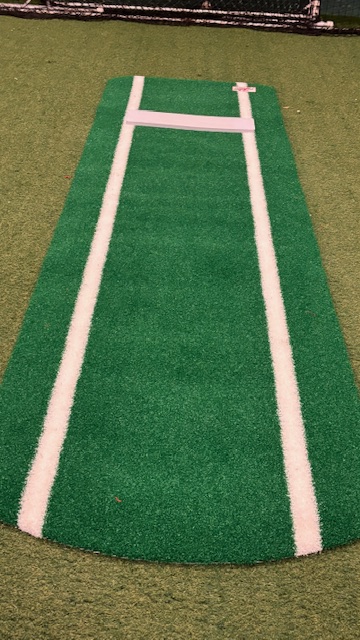
The overall length of the mat is 3 feet wide by 11 feet long, with 8 feet from the rubber to the end of the mat. That should be sufficient for most pitchers, while also leaving a generous 3 feet on the back side so both feet can start on the mat, even with a deep drop back.
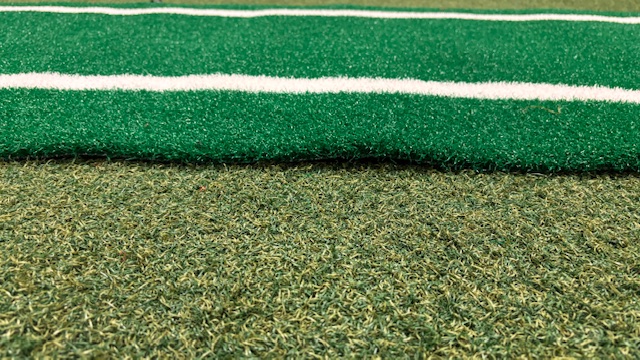
The lines appear to be deeply sublimated or otherwise embedded into the turf so I don’t think you I have to worry about them wearing away any time soon. I wish there was a center line instead of (or in addition to) the two lines extending down either side from the pitching rubber, since I think that makes a good reference for pitchers.
But it’s not a deal-breaker, and I suppose I’ll get used to it. You can also order the mat with no lines if you prefer.
The turf comes in three colors – green, red, and clay – so you can choose the one that suits you best. I’ve always had and liked green mats so that’s what I went with. It’s a bright green right now, but we’ll see how it holds up after hundreds of shoes have slid across it.
I can’t speak to the durability yet since I’ve only been using it a few weeks. But it looks like it ought to hold up for years.
One other thing that takes a little getting used to is that it feels a little spongier than the other mats when you walk or land on it. That’s probably good for young backs and knees versus landing on hard concrete with just a thin piece of carpet over it.
The Spiked Side
Here’s where the real magic happens, at least for me. As I said, the whole reason I purchased the mat was to try to solve the problem of the mat slipping on the turf. It has definitely done that.
The key is the 1,200 little spikes on the bottom side. They are molded as a part of the heavy-duty rubber backing, creating a plethora of individual grip points.
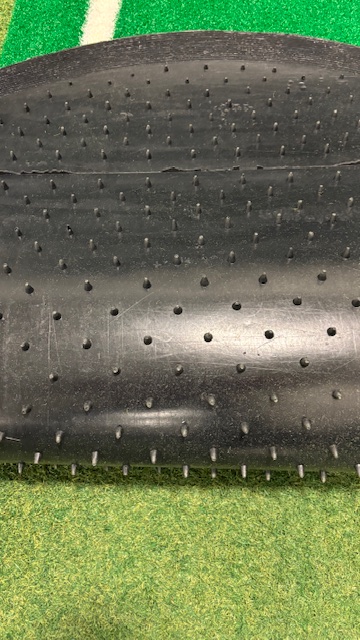
As pitching people know, the goal is to land into the front foot like an airplane rather than on top of it like a helicopter. That momentum is what can cause the mat to twist or slide forward.
With the Portolite mat, though, all those little spikes distribute the landing load throughout the mat so it stays in place easily. I have yet to have to make any adjustments, other than to change the distance for different age pitchers.
But once it’s down, it’s down until you pick it up and move it. So yes, total success for the goal I had.
And in case you were wondering, while it does leave a pattern of little indentations when you first pull it up to move it or put it away, those indentations go away quickly, leaving the base turf looking like it did before you laid the mat down. That’s important if you’re in a shared space like I am.
Heavy weight
Another reason I think it stays in place so well is that the mat itself is heavy – probably due to the molded rubber backing. It weighs 30 lbs., which is roughly 50% more than my other mats that clock in at 23 lbs.
That’s great for functional use, but it can be a challenge if you have to carry the mat for any distance. I’m a pretty big guy so I can handle it, but it’s definitely something to consider if you are on the smaller side or not particularly strong. It will give you a workout.

I wish it came with a little carrying pouch like other brands do, which I think would make it easier to transport. Then again, because of the construction the Portolite mat doesn’t roll up as tight without great effort so maybe it would be difficult to get one in an appropriate size.
Either way, right now I have to roll it up and grab it by either end to move it around the facility, It’s the one time when I miss the other mat.
The cost
Earlier on I mentioned that it’s not cheap. The current price on the Portolite website (as of January, 2026) is $999 USD.
When I first saw that I decided to roll the dice and see if there might be a Black Friday sale since it was getting close to the holidays. My gamble was rewarded, and I was able to purchase it for $799.. Add in the tax and shipping and it was $935 out the door – still expensive but every little bit helps.
Assuming it lasts for several years (as it appears it will), it’s not so bad. For example, at 5 years of use that $935 works out to $187 per year. Add in the savings on chiropractors for not having to constantly bend over to reset the mat and it’s a pretty good bargain.
More options
Portolite has some other mat options in addition to the one I purchased, including a shorter throw-down mat for $299 and their Pro Spiked Game Mat for $1,899. The short mat would be great, I suppose, if you don’t need the full length for your pitcher to land on (or you don’t want to carry a 40 lb. mat around).
The game mat is similar to the practice mat but I believe the turf is even heavier duty, it includes 1,700 spikes (versus 1,200 for the practice mat), and it weighs 60 lbs. Clearly it is made to hold up to heavy use and abuse, even on outdoor surfaces.
I know of at least one program that is planning to purchase a couple to use on dirt to try to eliminate the dreaded “pitcher’s trough” that happens after multiple games in a day.
The bottom line
When I was first looking at this mat I was concerned because it was a lot of money to pay for something that I wasn’t 100% sure would solve the issue. But I am happy to report that it did solve the sliding/turning problem, and my pitchers like using it.
So if you’re having similar issues, know that you can purchase this pitching mat with confidence. Time will tell how well it holds up (maybe I’ll share a report on that sometime in the future) but I can definitely recommend it as a solution for the immediate need.
Product Review: Portolite Short Spiked Softball Mat
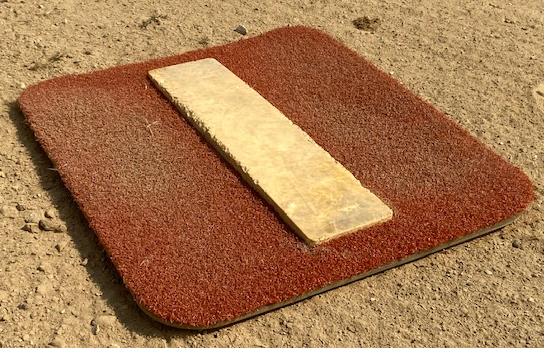
One of the things I have always found challenging when working with pitchers is getting a good surface to work from out on the field.
In a gym or practice facility you have a large selection of roll-up mats. But if there isn’t a permanent pitcher’s plate out on the field, what most people end up doing is throwing down a hunk of rubber purchased at the local sporting goods store. Or going without.
With those throw-down types of rubbers you either have to be willing to pound them in with stakes or nails and pull them out again or skip the stakes entirely. If you pound them in, the stakes that come with them last about three times (less if you’re trying to pound them into hard ground). Then you have to purchase long nails at the hardware store with big washers to keep them from going through the rubber.
Need to change distances to accommodate pitchers of different ages? You have to pull the stakes or nails up to move the rubber, then go through the entire process again.
Of course, if you decide not to stake the rubber down at all it will go slipping and sliding from under the pitcher’s feet, making matters worse, not better. Eventually the pitcher will probably just kick it out of the way.
That’s why I was excited to come across the Portolite company when I was helping at a Rick Pauly clinic in Minnesota put on by JohnnyO. Johnny had a couple of their products there, and said they had a few different models for softball, including one with short spikes on it.

This was the picture that convinced me it could work on dirt.
When I got home I checked it out and decided to give it a try. I needed one anyway for some indoor work on a turf field so figured that alone would be worth it. But I was really looking forward to trying it on the dusty fields I use during the summer.
First thing I wondered was would the spikes actually catch in the ground and hold it in place? The short spike mat isn’t cheap, so I was definitely rolling the dice on that count.
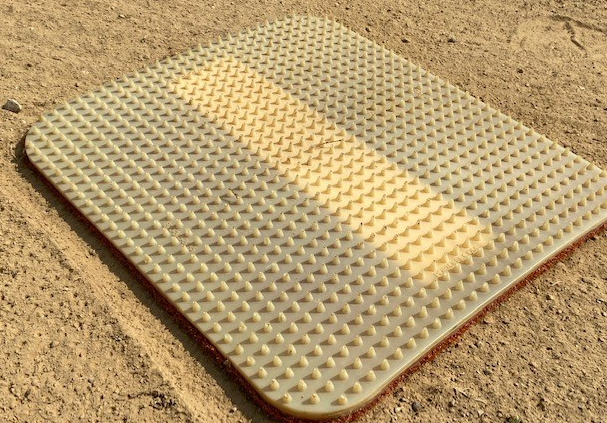
The website shows the bottom is green but this is how mine looks.
I am happy to report, however, that it actually holds pretty well, especially if the field isn’t rock-hard due to a lack of rain. Hard to say if all the little rubber (or whatever material they are) spikes catch, but certainly enough of them do to hold it in place even with strong, powerful pitchers. As they push in, the spikes dig in.
I was also concerned about how it would hold up with pitchers using metal cleats as many of my students do. As you can see, the mat isn’t necessarily pretty after a month’s worth of use, but I don’t need it for photographs. It actually seems to be holding up pretty well. I expect to get a few years’ worth of use out of it.

The edges of the rubber are a bit chewed up but the mat itself is holding up well.
Using a pitching mat like this one has some added benefits. For example, it’s easy to pick it up and move it when I have different age students come in. In just a few seconds I can go from being set up for a 10U pitcher at 35 feet to an 18U pitcher at 43.
This portability also helps in terms of giving my students a good overall surface to use.
One of the fields I camp out on regularly isn’t particularly well-designed or maintained. After a few lessons there can be a big hole at the permanent pitcher’s plate, with a trough leading away from it. (I doubt there are any bricks or anything else you’re supposed to use to stabilize the area.)
When that happens it can get pretty tough to pitch straight from the pitcher’s plate. I try to fill in the area by raking it out, but that doesn’t do a whole lot of good, especially when it might be a few weeks before it’s dragged again.
With the Portolite mat, however, I can either move the pitcher forward or off to the side where the ground is less worn. She gets a flatter surface to pitch from so she doesn’t have to worry about catching herself in someone else’s divot. Or trough.
And when I’m done for the day I can just pick it up, knock the dust off as best I can and throw it in the trunk for the next day.
The website says it can be used on turf, dirt or grass. I’ve done all three and can attest that it works equally well on all.
Again it’s not cheap at $235. But if you’re looking for a solution that helps provide a stable surface for your pitcher(s) in an easy-to-use, very portable format, be sure to check it out. I think you’ll be as pleased as I am.
Also available at:






 Life in the Fastpitch Lane