Blog Archives
A Quick Primer on Fastpitch Pitching Rules
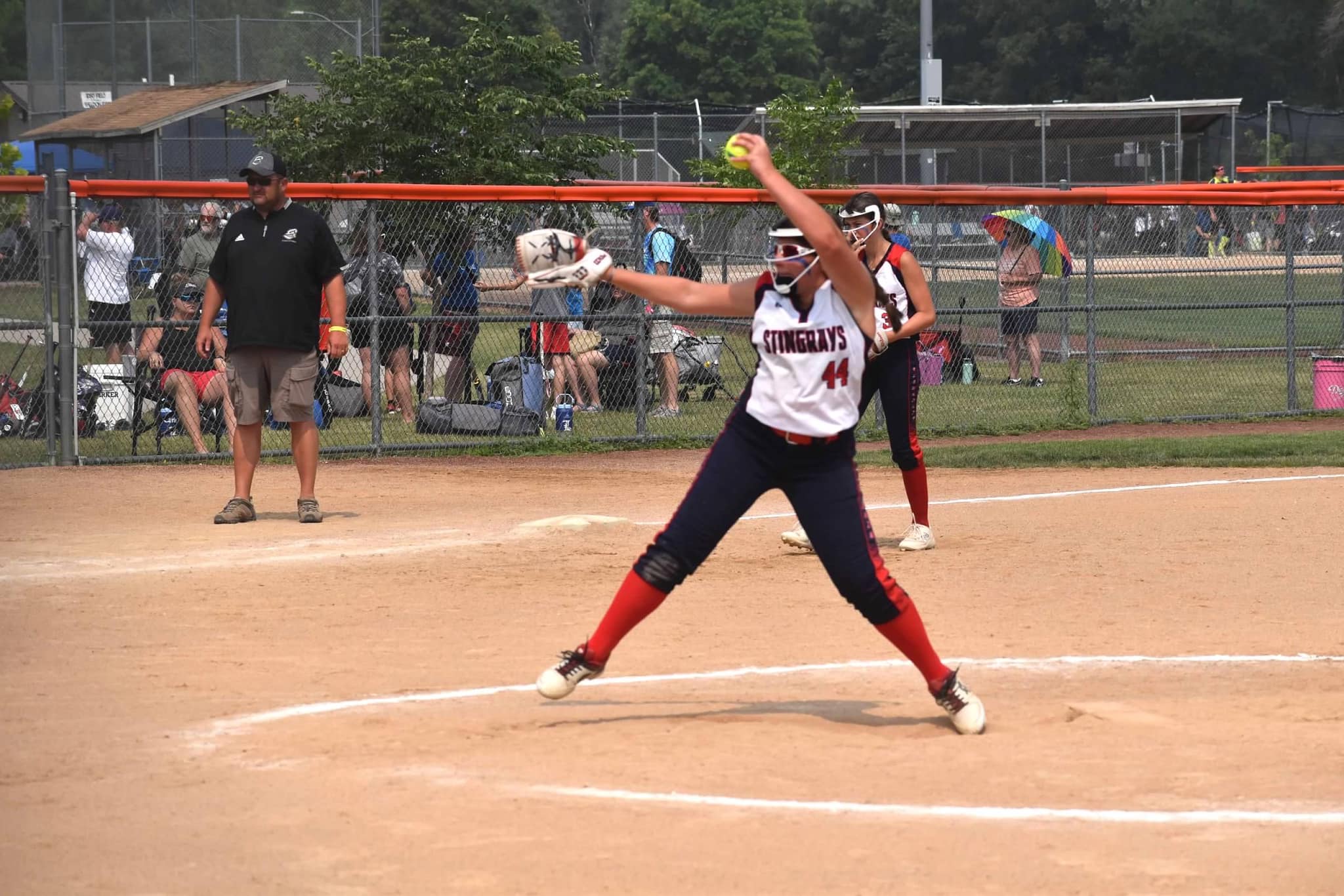
When you go to a game it often seems there are two kinds of people when it comes to the rules of fastpitch softball in general. One group feels like they know absolutely nothing and are often confused about why umpires made the call they made.
The other group is absolutely certain that they know everything there is to know about the rules and that, like the royalty, their word is sacred and indisputable. This post is for both of them.

It was actually spurred by a note from an old coaching friend who told me that after 10 years out of the game he is coming back to coach an 8U team and wanted to be sure he’s up-to-date on the latest pitching rules. Kudos, Ted, on looking before you leap.
We’re not going to get into the entire Rule 6 from the USA Softball rulebook, which covers everything. Instead, we’re going to focus on some of the recent changes as well as misconceptions that even some umpires may have.
Here we go.
Starting position (aka Start Back Rule)
Back in the old days of fastpitch, female pitchers were required to start with both feet in contact with the pitching rubber. That is no longer the case.
Pitchers must start with the foot on the throwing hand side (often referred to as the “pivot foot” or “drive foot”) in contact with the pitching rubber. That doesn’t mean it has to be sitting squarely on it; a heel barely in contact with the rubber is still considered to be in contact both by the rules of softball and the rules of physics.
But the other foot, popularly referred to as the “stride foot,” can be anywhere the pitcher wants as long as it is behind the rubber and within the 24 inch width of the rubber. That said, pitchers need to be careful about how far they set it.
Some will take this ability to the extreme, placing it far back even though it’s not right for them (although that placement can be correct for others). The easy way to figure out a good starting point is to step on the rubber and place your feet like you’re going to steal a base or run a race. Then make any minor adjustments from there.
Step Back Rule
Here’s a quick quiz: once pitchers place their feet and go into their motion are they allowed to take a step further back with the stride foot? The answer is it depends which rules body they are playing under.
A step back IS allowed under National Federation of High School (NFHS), USSSA Softball, Little League, National Softball Association (NSA, but Great Lakes Region only) and often many local rec leagues that are not affiliated with any national organization. If you are playing under a sanctioning body not listed here you may want to check their rulebook to see what is permissible.
A step back IS NOT allowed under USA Softball, PGF, Alliance Fastpitch, and some other organizations (check your local listings). If the pitcher steps back to begin the pitching motion an illegal pitch will be called.
So what does this mean for your pitchers? I teach my students to use a “start back” rather than “step back” technique. “Start back” is legal everywhere, so there are no issues with it.
On the other hand, if your pitcher is used to stepping back and then gets called for it when you play somewhere it’s not allowed, it’s totally going to mess her up for the rest of the game. She will be thinking about not stepping back instead of throwing the pitch, and even if she can block that out it will mess up her rhythm and her timing, resulting in a lot more balls and meatballs than you’re used to seeing.
Have her learn the “start back” and you’ll both be a lot better off.
Leaping (two feet in the air)
This is a fairly recent change. If you’ve been away for a while you remember when fastpitch pitchers were required to drag their pivot away from the rubber; if it came off the ground it was technically an illegal pitch, although this rule violation was rarely called for the most part. At least until you got into an important game and your pitcher was doing it.
This rule was changed a few year ago. Now it’s ok if the pivot leaves the ground and both feet are in the air. I don’t know this for sure but I have little doubt the change was made to eliminate coaches and parents from complaining constantly about an opposing pitcher their players couldn’t hit off of.
It was designed to get rid of all the ticky-tacky chirping when a pitcher’s foot was off the ground by a few inches so the kids can play the game. A good thing by my estimation, as I talked about here.
Of course, you know the story of “give a mouse a cookie.” Rather than simply being grateful that a minor irritation has been removed, some folks have decided to try to take advantage of the new rule by teaching their pitchers to leap like Johnny Lawrence in Cobra Kai.

The problem here is that when you leap that way you’re most likely to land on the foot you pushed from originally, particularly if you plan to maintain front side resistance when you land. If you push again, that’s a crow hop – which is still illegal.
Those who are teaching it claim there is no second push, they’re just landing on it. Either way, now an umpire once again has to watch closely to determine if a rule is being violated – the very thing the original rule was designed to eliminate.
That leaves us with a dilemma. Either the various governing bodies need to crack down on anything they even suspect is a crow hop or they need to eliminate the rule entirely so umpires can focus on the actual game action again. We’ll see what happens going forward.
The hands when taking your position on the rubber
Sometimes in their enthusiasm to throw a pitch young pitchers will develop a habit of stepping on the rubber with their hands together. This is illegal everywhere.
When a pitcher steps on the rubber she needs to have her hands separated. The ball can only be in one hand.
What some umpires don’t seem to understand is that it doesn’t have to be in the throwing hand. It can be in either hand when she steps on the rubber.
Unfortunately if you come across one of those rare folks in blue who don’t know the proper rule there isn’t a whole lot you can do about it. Bringing out the rulebook to prove you’re right is a big no-no.
Basically have your pitcher put the ball in her throwing hand to step on and get through the game. And secretly roll your eyes until next game.
Presenting the ball
I’m not quite sure what “presenting the ball” actually means, but whatever it’s supposed to be let me assure you there is no such rule. Case closed.
Moving the pivot foot prior to the pitch
While some people interpret the rule about keeping the “pivot foot” on the pitching rubber prior to the pitch as meaning it can’t move once it’s in place, that’s not true.
USA Softball rules (which all other rule sets are based on) specifically state the pitcher can slide her foot along the pitching rubber as long as said foot remains in contact with it. That also goes for other little wiggles or motions, including rocking back onto the heel – again, as long as contact is maintained.
What you do have to watch out for is the pitcher lifting her foot off the rubber (even slightly), or stepping forward off it (aka a “gym step”). In the case of the former it’s best to learn not to lift off, but there’s no need to go crazy if it’s coming up a little.
That’s really hard to spot from behind the plate or even from behind first base unless it’s egregious, and even then the umpire has to be inclined to watch for it and call it if he/she sees it. Most of them have more important things to do on the field than watch for that.
Read it, know it, live it
There are plenty of other rules in the rulebook, but these are probably the key ones every coach, parent, and player should know. That said, if you’re a coach playing in leagues or tournaments it behooves you to know ALL the rules, including any specialty rules that are specific to a particular tournament, so you can make sure your pitchers are prepared to succeed.
My good friend Jay Bolden and I have started a new podcast called “From the Coach’s Mouth” where we interview coaches from all areas and levels of fastpitch softball as well as others who may not be fastpitch people but have lots of interesting ideas to contribute.
You can find it here on Spotify, as well as on Apple Podcasts, Pandora, Stitcher, iHeart Radio, or wherever you get your podcasts. If you’re searching, be sure to put the name in quotes, i.e., “From the Coach’s Mouth” so it goes directly to it.
Give it a listen and let us know what you think. And be sure to hit the Like button and subscribe to Life in the Fastpitch Lane for more content like this.
Product Review: Portolite Short Spiked Softball Mat
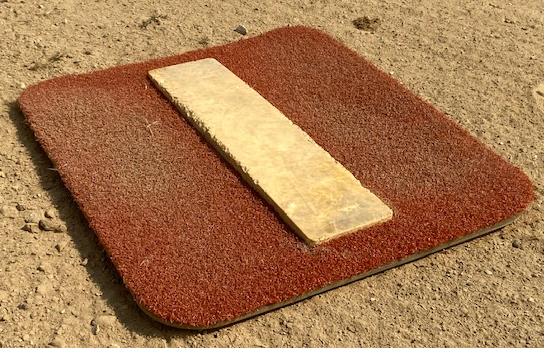
One of the things I have always found challenging when working with pitchers is getting a good surface to work from out on the field.
In a gym or practice facility you have a large selection of roll-up mats. But if there isn’t a permanent pitcher’s plate out on the field, what most people end up doing is throwing down a hunk of rubber purchased at the local sporting goods store. Or going without.
With those throw-down types of rubbers you either have to be willing to pound them in with stakes or nails and pull them out again or skip the stakes entirely. If you pound them in, the stakes that come with them last about three times (less if you’re trying to pound them into hard ground). Then you have to purchase long nails at the hardware store with big washers to keep them from going through the rubber.
Need to change distances to accommodate pitchers of different ages? You have to pull the stakes or nails up to move the rubber, then go through the entire process again.
Of course, if you decide not to stake the rubber down at all it will go slipping and sliding from under the pitcher’s feet, making matters worse, not better. Eventually the pitcher will probably just kick it out of the way.
That’s why I was excited to come across the Portolite company when I was helping at a Rick Pauly clinic in Minnesota put on by JohnnyO. Johnny had a couple of their products there, and said they had a few different models for softball, including one with short spikes on it.

This was the picture that convinced me it could work on dirt.
When I got home I checked it out and decided to give it a try. I needed one anyway for some indoor work on a turf field so figured that alone would be worth it. But I was really looking forward to trying it on the dusty fields I use during the summer.
First thing I wondered was would the spikes actually catch in the ground and hold it in place? The short spike mat isn’t cheap, so I was definitely rolling the dice on that count.
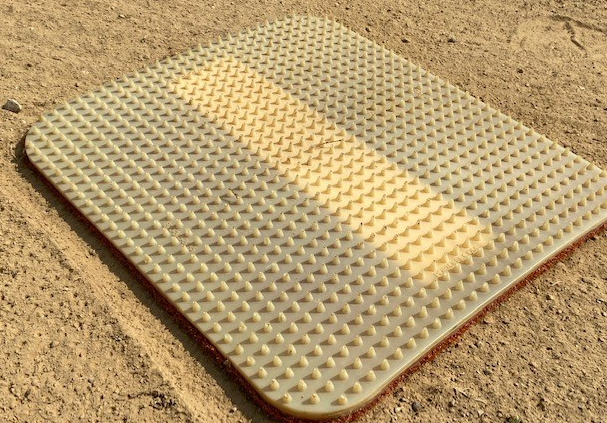
The website shows the bottom is green but this is how mine looks.
I am happy to report, however, that it actually holds pretty well, especially if the field isn’t rock-hard due to a lack of rain. Hard to say if all the little rubber (or whatever material they are) spikes catch, but certainly enough of them do to hold it in place even with strong, powerful pitchers. As they push in, the spikes dig in.
I was also concerned about how it would hold up with pitchers using metal cleats as many of my students do. As you can see, the mat isn’t necessarily pretty after a month’s worth of use, but I don’t need it for photographs. It actually seems to be holding up pretty well. I expect to get a few years’ worth of use out of it.

The edges of the rubber are a bit chewed up but the mat itself is holding up well.
Using a pitching mat like this one has some added benefits. For example, it’s easy to pick it up and move it when I have different age students come in. In just a few seconds I can go from being set up for a 10U pitcher at 35 feet to an 18U pitcher at 43.
This portability also helps in terms of giving my students a good overall surface to use.
One of the fields I camp out on regularly isn’t particularly well-designed or maintained. After a few lessons there can be a big hole at the permanent pitcher’s plate, with a trough leading away from it. (I doubt there are any bricks or anything else you’re supposed to use to stabilize the area.)
When that happens it can get pretty tough to pitch straight from the pitcher’s plate. I try to fill in the area by raking it out, but that doesn’t do a whole lot of good, especially when it might be a few weeks before it’s dragged again.
With the Portolite mat, however, I can either move the pitcher forward or off to the side where the ground is less worn. She gets a flatter surface to pitch from so she doesn’t have to worry about catching herself in someone else’s divot. Or trough.
And when I’m done for the day I can just pick it up, knock the dust off as best I can and throw it in the trunk for the next day.
The website says it can be used on turf, dirt or grass. I’ve done all three and can attest that it works equally well on all.
Again it’s not cheap at $235. But if you’re looking for a solution that helps provide a stable surface for your pitcher(s) in an easy-to-use, very portable format, be sure to check it out. I think you’ll be as pleased as I am.
Also available at:






 Life in the Fastpitch Lane