Blog Archives

Energy Creation: The Rolling Snowballs Corollary

This seems like an apt analogy since as I write this much of the USA is still dealing with a fair amount of snow, including many places that rarely get any. Welcome to my world, although we actually haven’t gotten much all winter.
Anyway, the other day I was trying to explain the concept of acceleration to a young pitcher. We were talking about the need for her arm to pick up speed down the back side of the circle instead of staying at one speed if she wants to throw harder.
Then an idea hit me, thanks to a childhood misspent watching Saturday morning cartoons.
“Think about a snowball rolling down a hill,” I said. “At first, the snowball is small. But as it rolls down the hill, the snowball starts picking up more snow, getting bigger and bigger. Then, when the snowball reaches the bottom and stops, the snow explodes all over the place!
“That’s what needs to happen with your pitching arm,” I continued. “As you come down the back side you start moving your arm faster, which gathers more energy like the snowball gathers snow, until the ball explodes out of your hand at the end.”

That made perfect sense to her. The more the snowball moves downhill the faster it goes and the more snow (energy) it picks up.
Ergo (love that word, rarely get to use it in a sentence), getting that arm to move faster down the back side of the circle is critical to maximizing speed. Logical, right?
But that doesn’t mean pitchers can always do it. Some will do it naturally. Others will do it once your bring it up. But some have to unlearn old movement patterns and replace them with new ones before they can execute it.
One of the best ways to help them learn that acceleration is by moving the pitcher in close to a net or tarp, having her stand with her feet and body at 45 degrees to the target, and then throwing with a full circle, emphasizing the speed on the back side of the circle. You can also do that with six or eight ounce plyo balls into a wall.
I also prefer they move their feet as they do it since body timing is also crucial to great execution.
The key here is feeling the arm moving as quickly as it can. But there’s another caveat.
To really make this work and get the acceleration, the arm has to be loose and the humerus (upper arm) has to be leading with the forearm trailing behind, i.e., throwing with whip. Moving the whole arm in one piece, as you do when you point the ball toward second base and push it down the circle, will not yield the same level of results. In fact, it could cause injuries.
Once the pitcher can execute this movement from in-close, start moving her further away and trying it again. Take your time with this process, because if you move her back too fast and she perceives the target is too far away she will start muscling it to make sure it gets there rather than letting it move naturally.
At each step, take a video and look to make sure there is at least somewhat of a bend or hook at the elbow instead of a straight arm. If not, move her back up or slow her down temporarily so she can get the proper mechanics.
Then speed it up and try again.
By the way, the energy snowball concept is not just for pitchers. This type of acceleration into release or contact is also critical for overhand throwing and hitting.
Or pretty much any other athletic skill requiring power.
Now, if you’re an adult with lots of real-world experience, all of this may seem obvious to you. You may even be wondering why I’m spending so much time on it.

But a young player, or even a young adult player, may not have the real-world understanding of basic physics or biomechanics to tie acceleration into energy production. For them, it’s helpful to put it in a context that they can easily comprehend based on what they have already seen.
Even if it comes from a Saturday morning cartoon.
If you have a player who’s struggling to understand the concept of acceleration into action, try talking about the rolling snowball. It just might break the ice with them.
My good friend Jay Bolden and I have started a new podcast called “From the Coach’s Mouth” where we interview coaches from all areas and levels of fastpitch softball as well as others who may not be fastpitch people but have lots of interesting ideas to contribute.
You can find it here on Spotify, as well as on Apple Podcasts, Pandora, Stitcher, iHeart Radio, or wherever you get your podcasts. If you’re searching, be sure to put the name in quotes, i.e., “From the Coach’s Mouth” so it goes directly to it.
Give it a listen and let us know what you think. And be sure to hit the Like button and subscribe to Life in the Fastpitch Lane for more content like this. Commercial over.
Snow roller photo by Perduejn, CC BY-SA 4.0 https://creativecommons.org/licenses/by-sa/4.0, via Wikimedia Commons
Is Better Technique Worth the Effort?

We’ve all seen it at one time or another.
A player comes in with lots of raw ability. She can throw harder, hit farther, pitch faster, etc. that the typical player her age. Yet she looks like an unmade bed when she executes those skills.
Ah, we think, if only she had better technique. Then imagine what she could do.
So, we begin working with her to clean up her mechanics and what happens? Her measurables drop.
The speed reading on overhand throws or pitches isn’t quite as high as it was when she walked in, and maybe she’s having more trouble hitting the target than she used to. Instead of hitting bombs she’s hitting pop-ups or ground balls – or even missing the ball completely.
At that point you begin to ask yourself whether all that time spent working on improving her did her any favors.
In the short term, the obvious answer would seem to be no. As ugly as her technique was it was working for her, while what she’s doing now doesn’t seem to be.
But those early impressions can be deceptive. And in the long term, especially as the level of competition increases, the work she’s putting in now is almost guaranteed to pay off well later.
How do we know? There are a few factors.
Physics and biomechanics
The laws of physics are immutable. Unless you’re this guy.

Which means if what you’re doing takes better advantage of the laws of physics, all else being equal the outcome will be better.
The same goes for biomechanics. If you use your body in a way more in line with how it’s designed to be used, again all else being equal, you will achieve better results.
The key is all else is rarely equal. Our bodies are marvelous things, capable of doing all sorts of things.
But they also prefer to be comfortable when doing them. So if you’re comfortable with bad technique you will tend to do it with more enthusiasm/energy than you will something new.
That additional energy is often more than enough to compensate for any lack of solid application of physics or biomechanics, especially in younger players. As a result, the measurables created with weaker technique will often outshine those of the new, better technique.
The trick here is to get comfortable enough with the new mechanics so you can execute them with the same energy and enthusiasm as the old ones. That takes time – time which impatient players, coaches, and parents are often unwilling invest.
They’re looking for the “get rich quick” scheme, and when one doesn’t pay off immediately they’re on to the next. But any smart investor knows your best path to getting rich is to make targeted investments now and let time take care of the rest.

Removing randomness
Another factor that plays into it is our memories tend to be selective. Sure, that player may hit a bomb with poor technique. But we tend to forget about all the popups and easy ground balls that come between those bombs.

One of the goals of better technique, however, is to remove the randomness from the performance. Players with poor technique are often all over the place with what they do. If you compare video from one swing or one pitch to the next you may see vastly different approaches.
The goal of improving technique is to lock the player into a single set of mechanics that are easily repeatable. Once she has mastered those mechanics it’s simply a matter of learning how to apply them in various situations.
That repeatable approach enables the player to adjust more easily to whatever happens because she’s always starting from the same baseline. This consistency in approach leads to consistency in outcomes.
Greater flexibility
We also tend to filter out other factors, such as the player with poor technique hits bombs against weaker pitchers but struggles against better ones – especially if the rest of the team does too. We often see only what we want to see.

Essentially, the player’s technique works up to a certain point, then fails her miserably (most of the time anyway).
With a more organized, disciplined approach, however, she will have the flexibility to apply the technique she has as the situation requires. She’ll be able to catch up to fast pitching, and wait on slow pitching, because she understands how to adjust her technique to each situation – as opposed to yanking the bat as hard as she can in the general direction of the ball and hoping for the best.
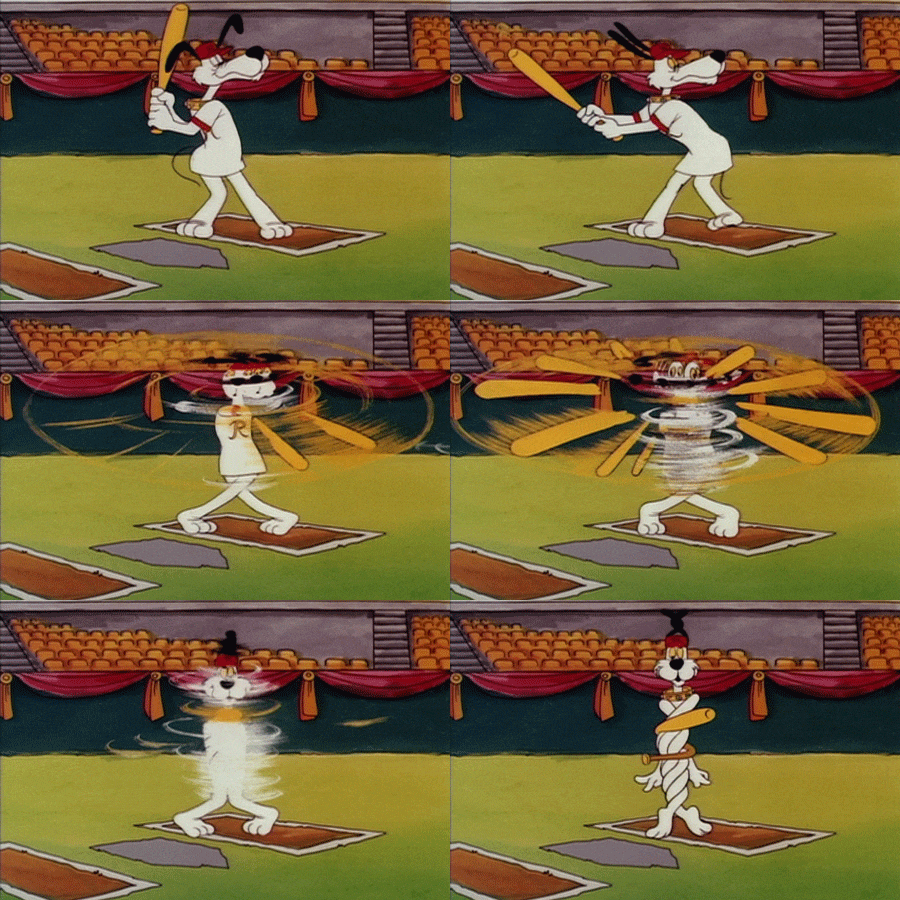
The more the player understands how to adjust her technique to each situation, the better chance she will have for success. A disciplined, informed approach will almost always yield better results in the long term.
You get out what you put in
With all of that said, it isn’t enough to have someone show you how to do something. No matter how famous they may be or how many social media followers they have.
The player has to put in the time to learn and internalize the new technique. Otherwise it’s not going to make her better, and may even make her worse since she’s now trying to walk in two worlds at the same time.
So is better technique worth the effort? In my opinion, yes – as long as you’re willing to change what you’re doing an embrace what you’re being taught.
It can offer a huge advantage to everyone from beginners to seasoned veterans. You just have to have the patience to work through the challenges, and maybe even accept lesser performance, until you reach the pot of gold at the end of the better technique rainbow.







 Life in the Fastpitch Lane