Blog Archives
Book Recommendation: “Crunch Time”
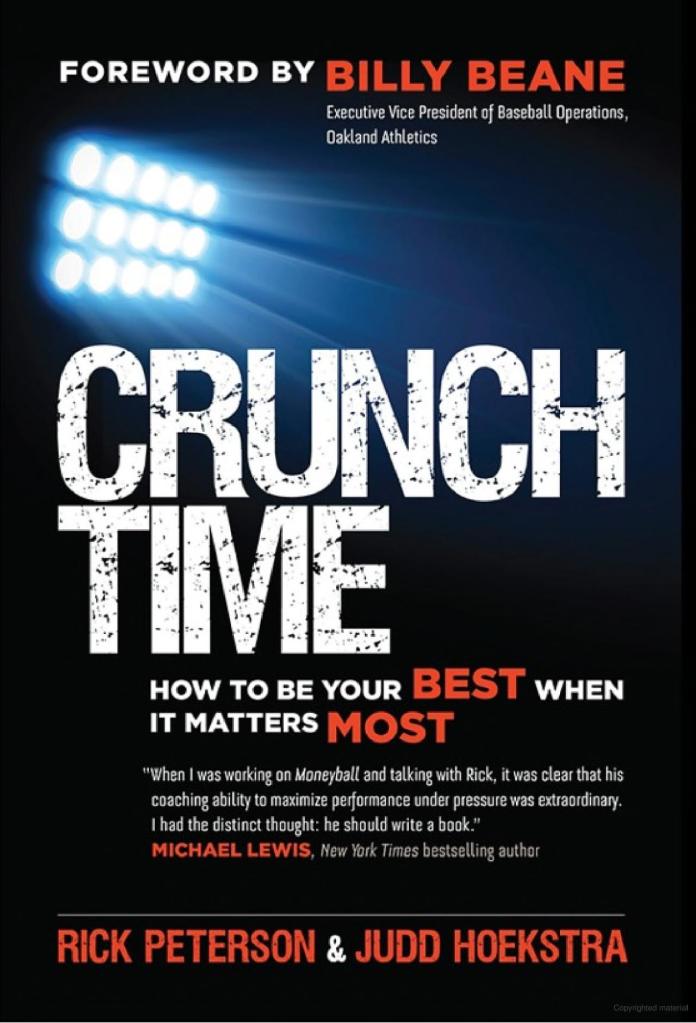
We’ve all seen it or experienced it: the player or coach who is great in practice (aka a cage warrior) and seems like he/she should be a star, only to struggle when they get into a game. It’s frustrating to watch, especially because the breakdowns often seem to happen at the worst possible time, yet helping them break free of that mindset can be extremely challenging.
Fortunately I recently read a book that addresses this very issue. It’s called, “Crunch Time – How to Be Your Best When It Matters Most” by Rick Peterson and Judd Hoekstra.
If you’re not familiar with them, Rick Peterson is currently Developer of Pitching Development for the Baltimore Orioles, was the pitching coach for the Oakland A’s during the “Moneyball” era, and is considered one of the top pitching coaches in all of Major League Baseball.
Hoekstra is a bestselling author of books on leadership as well as a vice president at The Ken Blanchard Companies, a consulting firm that specializes in training business leaders at organizations of all sizes. Pretty good pedigrees for both authors.
While the book’s lessons apply to a general audience rather than specifically to baseball or softball, it definitely speaks to the challenges players and coaches face when challenged to perform under extreme pressure. The nice thing is it’s a pretty quick read too; I finished it cover-to-cover while on a 4.5 hour flight coming home from vacation.

The central theme of the book is that when you are facing a difficult situation you need to reframe it in order to manage the stress and allow yourself to perform the way you know you can. In other words, instead of seeing that difficult situation (such as an at bat where the game is on the line) as a threat, view it as an opportunity.
So in that example, the immediate threat is losing the game if the player doesn’t perform well, i.e., get a hit. But the underlying threats are that coaches and teammates will be mad at the player, the player might get benched, teammates won’t want to associate with the player, one or more parents might be angry with the player, the player will be embarrassed, etc.
The result is the player gets so caught up in potential consequences (especially if he/she has faced this situation before and failed) that he/she freezes up and it becomes a self-fulfilling prophecy. It’s difficult to perform at a high level when you’re paralyzed with fear.
After explaining the need for reframing the authors then get into several techniques to accomplish this task in subsequent chapters, including:
- Reframing from trying harder to trying easier
- Reframing from tension to laughter
- Reframing from anxiety to taking control
- Reframing from doubt to confidence
- Reframing from failure to learning moment
- Reframing from prepared to overprepared
Each chapter not only talks about the techniques but offers anecdotes from the authors’ experience of how they were applied. For example, Peterson talks about making mound visits during MLB games where he used humor to help a pitcher put what was happening into perspective, allowing him to get past an initial walk and single in order to strike out the heart of the opposing lineup and get out of the inning.
One of the nice things is that unlike many “mental game” books, applying the lessons in “Crunch Time” doesn’t require going through a plethora of exercises in order to master the techniques. It’s more of a philosophical approach presented in a simple form that makes it easy to grasp the lessons so you can begin applying them right away.
While I’ve been talking about how coaches can use the lessons in “Crunch Time” to help players, they can also use it to help themselves become better coaches at critical points of the game.
In that way it reminds me of a story legendary football coach Bill Walsh told in his book “The Score Takes Care of Itself.” Walsh was one of the first if not the first to develop the laminated play calling sheets all football coaches now have with them throughout the game, and was lauded as an innovator for doing it.
Yet in his telling, the reason he did it wasn’t because of some stroke of genius. It was the result of him having trouble making quick decisions under pressure. By creating the play calling sheets when he was calm and reasoned, i.e., before the game, he could just look at what he figured out already and just follow it, relieving the pressure of those in-game, critical decisions.
The lessons of “Crunch Time” can help in the same way. Take the international tie breaker, probably one of the most high-pressure situations in softball coaching because often any minor miscue or poor decision can lead to the loss of the game and possible elimination from a tournament or conference championship.
Rather than viewing a loss as a threat, by reframing it as an opportunity (we’ve prepared well for this situation so we have an advantage over our opponents who are clearly nervous about it) coaches can make strategic decisions with confidence, knowing their teams will execute, and can convey that sense of confidence to the team to keep them from being rattled and making those types of mistakes.
As I said earlier it’s a pretty quick read but there’s a lot of great thinking contained within the content. If you’re looking for techniques to help your players perform better, and/or ways to help grow your own coaching abilities, I recommend you pick up or download “Crunch Time.”
You Have Stats – Use Them!

The movie and especially the book Moneyball details how the Oakland Athletics (A’s) helped pioneer the use of statistical data in making player decisions, from which players to acquire to who to play in the field on a daily basis. Their reason for doing it was primarily financial, i.e., they didn’t have the same kind of money to spend on well-known high-performers in order to compete so they had to look for the “hidden gems” – under-valued players who would deliver results while costing less.
The A’s had some very smart people (including a Harvard business grad) who wrote computer programs to help them parse through the mountains of data on every player in the league to find the ones who best fit the system they planned to use while still being within their price range. So you might think, well, ok for them but I don’t have those types of resources so what good does knowing all that do me?
In reality, though, most coaches today do have a lot of that type of information at their fingertips, at least about their own players. It’s contained within the GameChanger (or similar) apps the coaching staff or parents use to score and share game results with those who can’t be there.

On the home page for the team, the very last tab is labeled Stats. If you as a coach click on it you’ll see the cumulative statistics for all the games in hitting, pitching, and fielding.
Now, I understand that the stats aren’t always accurate since some people will score every ball that’s hit and gets someone on base a hit, even if an error was involved. But if you really want to take advantage of the value of stats, coaches, you can quickly train whoever is using on how to keep score properly so you can rely on the data that’s there.
The National Fastpitch Coaches Association also has online courses available for $9.99 that can teach this skill.
So how can having and using accurate statistical data help you as coaches win more games? Here’s an example, drawn from an actual team that apparently isn’t using the data at their disposal.
We will look at the hitting statistics for seven batters. We’ll just call them Player A, Player B, Player C, etc. We’ll look at batting average (BA), on-base percentage (OBP, which is how often they get on base through hits, walks, or hit by pitch), slugging percentage (SLG, the average number of bases a hitter gets each at-bat), and on base plus slugging (OPS, the sum of the on-base percentage plus slugging, which is a great measure of total productivity of the hitter).
Here are those stats for our seven players. The players are currently presented in a random order:
| Player | BA | OBP | SLG | OPS |
| A | .222 | .333 | .278 | .611 |
| B | .167 | .250 | .167 | .417 |
| C | .462 | .562 | .538 | 1.101 |
| D | .286 | .400 | .429 | .829 |
| E | .278 | .381 | .333 | .714 |
| F | .200 | .294 | .200 | .494 |
| G | .250 | .429 | .312 | .741 |
Ok, based on those numbers and a general understanding of how to put a lineup together (which I covered a couple of posts ago), how would you structure your batting order? Take a few moments to write it on a piece of paper without looking below; I’ll wait.
Let’s see how what you did compares to the actual lineup that was used when I pulled these stats. If you’re using a traditional lineup, it would probably look something like this:
- Player D
- Player E
- Player C
- Player G
- Player F
- Player A
- Player B
If you’re using a more modern approach that says put your best bats at the top so they come to bat more often, the lineup would probably look like this:
- Player C
- Player D
- Player E
- Player G
- Player A
- Player F
- Player B
Ok, now here’s what the actual lineup is:
- Player D
- Player A
- Player E
- Player G
- Player B
- Player F
- Player C
Do you see a problem here? The player with by far the highest batting average, on base percentage, slugging percentage, and on base + slugging (Player C) is hitting seventh, where she likely will get one at-bat per game, or two at most if the players ahead of her hit above their averages. In the meantime, Player B whose stats can only be called anemic at-best is hitting in the five slot, and Player A whose hitting line isn’t a whole lot better is in the two slot.
Is it any wonder that this team is struggling to score runs, much less win games?
Why would the lineup be structured this way? I can only guess, but that guess is the coach is relying on his “gut” or long-solidified impressions of who his top hitters are rather than taking the time to look at which players are actually producing statistically, game after game.
(It could also just be plain old playing favorites, but hopefully that’s not the case.)
If you want to win games you can’t and shouldn’t rely on your “gut” anymore. It’s like the the old scout thinking mentioned in Moneyball that so-and-so “looks like a ballplayer.”

That type of thinking is a dead end, whether you’re looking at the pro, collegiate, or youth level. You need instead to look at what is actually happening on the field, in the game, to determine which lineup is going to produce the most runs, which is a major key to winning ballgames.
The same is true for pitching and fielding too. You may think Pitcher A is your Ace, but if you look at the cold, hard stats you may find that Pitcher B does a better job of getting outs without giving up runs.
You may think Fielder A is your best bet at shortstop, but the stats could tell you Fielder B makes fewer errors while contributing to more “caught stealing” outs on throws from the same catcher.
All this information is there for you to use. All you have to do is click on it now and then to look at it.
Your eyes and your guts can lie. Statistics, if they’re properly kept, don’t.
Use the data you have to make better decisions and you’re likely to find you win more games. Or at least can justify your decisions should anyone ask, which in this day and age is a nice thing to have in your back pocket.
Statistics photo by Burak The Weekender on Pexels.com
Life’s Too Short to Play for (or Work for) Jerks

One of the most common tropes you’ll hear about the value of playing team sports like fastpitch softball is that they teach life lessons. You hear about learning how to work in a group, how to push yourself to the limit (and then get past it), how to be dedicated, how to set goals and work to achieve them, how to overcome adversity, blah, blah, blah.
All of that is true. But there’s another lesson waiting there for players that often seems to be ignored. And that lesson is that life is too short to play for (or work for) jerks.
What does that mean? Think of your softball career as a metaphor for your life. It has a beginning, a middle, and unfortunately an end.
It’s like this voiceover from the movie Moneyball says: At some point we’re all told we can’t play the game anymore.
So let’s say you start playing at the age of eight, and you play through high school. The majority of high school graduates are 18, so that’s 10 years.
Continue on through college and you can tack on another four years – or five if there is a global pandemic in the middle of your career and you decide to hang around for that bonus year. So in most cases 14 years at best.
If you spend four of those years playing for a coach who constantly abuses and belittles you, puts you down constantly and believes the louder he/she screams the better you will play that’s either 40% or nearly 30% of your career spent being anywhere from unhappy to miserable.
In work years, figuring a 45-year career, 40% would be 18 years and 30% would be 13.5 years (high school v. college) in a job you hate going to and that makes you feel bad about yourself every day. That’s a long time to be unhappy in your life.
So the lesson you should learn if you are faced with this situation on your team is that you don’t have to just suck it up and put up with it. You do have options, like finding another team.
Because believe me, if you’re in a job like that you’re definitely going to want to find a different one. We spend way too much of our lives working to be miserable the whole time.
Now, at this point I think it’s important to differentiate between the occasional outburst (or verbal kick in the pants) from a coach and an abusive situation. Anyone who ever played for me can tell you I wasn’t beyond bringing the hammer down now and then when my teams under-performed or just weren’t paying attention to what they were doing.
Sometimes that can be a good thing, especially if it is in contrast to a coach’s usual style. We all need a little motivation now and then.
But that’s different than the coach whose only volume in speaking to players is 10, and whose words only convey negative messages. To me, that’s basically a coach who has no idea what he/she is doing and figures if they spew enough venom everyone will be too busy licking their wounds to notice.
It’s like this one time when a team I was coaching took a tough loss in a big tournament, knocking us into the loser’s bracket. In the post-game meeting everyone was waiting to get pummeled I’m sure.
Instead, in an over-the-top voice that clearly showed I was joking I simply yelled “Play better” and made a “crack the whip” gesture. It was a parody of coaches they had seen and played for before – the ones who had no idea how to help their players play better but figured if they yelled enough it would happen as if by magic. They laughed and the tension was broken.
I’d love to say we went on to work our way back through the loser’s bracket and won the tournament, but no that didn’t happen. Not every story gets a fairy tale ending.
Back to the topic, coaches always like to talk about holding their players “accountable.” Another phrase I find simultaneously horrifying and amusing when you are talking about 10-12 year olds, by the way. Adults have a funny way of understanding how young kids think.
But if that is the case, players also need to hold their coaches accountable. Coaches need to lead, not just scream to play better. They should support their players when they are giving their all, even if the outcomes aren’t what they hoped for.
Coaches should understand that the pitcher didn’t walk three hitters in a row by choice, hitters didn’t intend to take that third strike, fielders didn’t plan on booting the ground ball or dropping the fly ball, baserunners didn’t intend to slide too far and get tagged out.
Most of all, that South Park episode aside, players don’t take the field with the intention of losing the game. That stuff just happens.
Instead of screaming insults, coaches should work with players to ensure it doesn’t continue to happen, or give them direction on how to work on it themselves. If that’s not happening, and the screaming continues, players shouldn’t put it up with it.
Instead, they should find another team where the atmosphere is better. Because someday, they may face the same choice with a job, and if they don’t learn to value themselves may find themselves doomed to spend a lot of time in a job they hate instead of one that inspires them and gets them excited to go to work every day.
You only have so much time to play competitive fastpitch softball. Use it wisely.
Photo by Karolina Grabowska on Pexels.com






 Life in the Fastpitch Lane