Blog Archives
Product Review: Cimmaron Safety Net and Frame Makes BP Safer
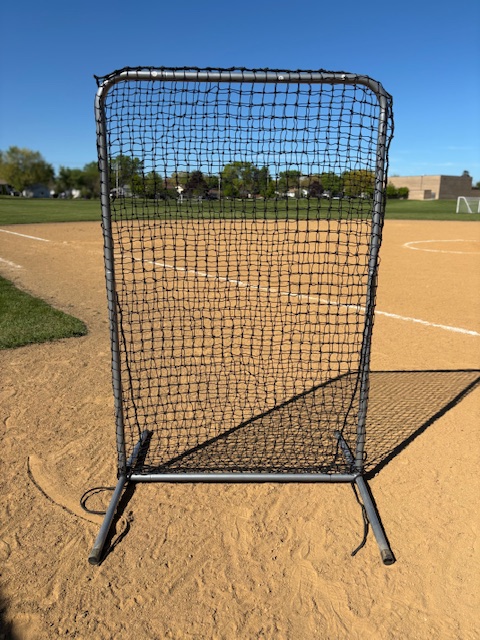
Whenever I see a coach doing front toss at practice from 15 feet away without a net to hide behind, my first thought is always “That coach must not have much faith in him/herself as a hitting coach.”
But the reality is (most of the time anyway) that they would use a screen if they had access to one. Sure, you could try using a Bownet or similar product but the blowback on a hard-hit ball directly into the net would probably negate any value in setting it up.
Effective protection, even from some 10 year olds, requires a much sturdier protective screen – the type you see at high schools, colleges, batting cages, and professional stadiums. The trouble there is your typical youth coach, or even a high school coach who has to practice at an off-campus field, can’t exactly cart around a heavy-duty screen with a heavy-duty net, nor do they have the time to assemble and disassemble it with all the nuts and bolts that are required.
For years I had that problem solved with the old Jugs Snap-Together Screen. It was the perfect solution – a heavy-duty net that slipped over a heavy-duty frame that was easy to put up and take down. The push–in snapping mechanism meant you could slide the pieces together, then have the snaps hold them in place. Then, when it was time to leave the field, I could quickly pull it all apart and put it back in the carrying bag, ready to transport anywhere I needed it.
All good things must come to an end, however, and last fall that screen gave up the ghost. Some of the snaps didn’t work anymore, and the net was beginning to fray, which increased the risk of a hard-hit ball breaking through.
Since Jugs doesn’t offer that product anymore I searched and searched for something similar to replace it, That’s when I came across the Cimmaron 6×4 #42 Safety Net and Screen at Epic Sports.
It’s a little smaller than the Jugs screen was, but it was still big enough to hide behind after throwing a pitch. (One time when it pays to be a little under 6 feet tall.)
The description mentioned a snapping mechanism but there weren’t any closeup photos to show if what they meant and what I thought of were the same. But with no other viable alternatives I figured I’d give it a try and made the purchase.
I’m happy to report it’s everything I hoped it would be.

The 1-1/2 inch steel tubular frame is lightweight yet very strong and confidence-inspiring. The net, made from #42 nylon, has held up well after take some direct hits; I have full confidence in it.
It’s also a little easier to assemble than my old protective screen was, probably because it’s a little smaller than the old one so there are fewer pieces to assemble. There are three pieces that comprise the bottom, two along the sides, and three that form the top and the upper part of the sides.
All parts have a number sticker on them that correspond to the supplied diagram that shows you how to put it together. The first time I did it I had a little trouble figuring out what went where but that was due to operator error.
I didn’t bring the diagram with me to the field, and I then assumed the two pieces that form the top corners worked the same way as the Jugs screen, i.e., the long part goes across the top and the short part goes down to join the side. When that didn’t work it was easy enough to figure out how to put it together properly and it’s been a breeze ever since.

The net is also easy to put on. It has a pillowcase-type of structure – the top and sides are closed while the bottom is open, so you can quickly slip it on and off the assembled frame. There is also a nylon rope at the bottom that allows you to secure the bottom of the net so you don’t catch a hard ground ball to the feet.
Unlike the Jugs net, there is no hole in center to pitch through. That’s ok, though, because I am used to turning L-screens with the tall side to the right and pitching around it, so it’s essentially the same.
It’s even a plus in some ways because a ball with a little tail to it won’t come across the frame, unlike the hole-type where I got clipped a few times with a line drive even though I swear I wasn’t standing in the hole.

The only downside I see to this product is that it doesn’t come with a carrying back. That seems like an oversight given that the quick up-and-down construction makes me think it was designed for portability.
Fortunately I still had the Jugs screen carrying bag so I’m using that. I also tried a speaker stand carrying bag from Sweetwater, which worked ok too. Neither one is quite deep enough to fully close because of the design of the two base pieces, but they are both wide enough and will both work as long as you’re careful getting it in and out of the vehicle.
I’m guessing the manufacturer opted not to offer a bag to keep the price down, but it sure would be nice for one to be offered even if it’s a separately purchased accessory for those of us who need to cart it in and out on a regular basis.
Speaking of price, the Cimmaron protective screen is relative bargain in my opinion. It’s just $179 for the frame and net. When compared to the cost (and time) of a visit to the emergency department or immediate care facility after taking a line drive to the head it’s definitely worth it.
And if you want to add padding around the frame it costs a little more but if your goal is to put it up and take it down the same day it feels to me like you’re better off without the padding.
So if you’re a coach who is pitching front toss with real balls to your team and want to feel a little safer while doing it, check out the Cimmaron 6×4 #42 Safety Net and Frame. In my opinion it’s worth every penny. And yes, I paid for my own.
My good friend Jay Bolden and I have started a new podcast called “From the Coach’s Mouth” where we interview coaches from all areas and levels of fastpitch softball as well as others who may not be fastpitch people but have lots of interesting ideas to contribute.
You can find it here on Spotify, as well as on Apple Podcasts, Pandora, Stitcher, iHeart Radio, or wherever you get your podcasts. If you’re searching, be sure to put the name in quotes, i.e., “From the Coach’s Mouth” so it goes directly to it.
Give it a listen and let us know what you think. And be sure to hit the Like button and subscribe to Life in the Fastpitch Lane for more content like this.
Ground balls v. line drives
For many of you this is probably old news. But I still hear it enough from my students and other players I know that it bears repeating. When it comes to hitting, the goal should not be a ground ball. It should be a line drive.
Back in the day, when the ball was white with white seams, college and HS age pitchers stood 40 feet away, fielders weren’t as athletic through the field, bats were made out of basic low-grade aluminum and hitters taking lessons were few and far between, ground balls were the goal. Well, to be honest putting it in play was the goal.
A lot of games wound up 1-0 or 2-1, so anything you could do to get the bat on the ball was acceptable. Hitting a ground ball stood you a good chance of getting on base too because many of the fielders didn’t have the range or arms that today’s players do. All you had to do was sneak it through and you were on base.
Not so today. Athletes of today, as a whole, train harder. They are bigger, stronger, faster. In nearly 20 years of coaching I’ve seen a definite upgrade in that area. So what used to get you on base back in the 1990s will probably get you thrown out today.
Then there’s the bat technology. They have big sweet spots with trampoline effects. If you time it just right, even a checked swing could end up going deep. That may be an exaggeration but not a big one. Better bats plus hitters who train as seriously in the off-season as pitchers do have had a huge impact on the game.
And that’s why your best strategy is a line drive – preferably one that finds a gap, although you can’t control that. A rising line drive that clears the fence is even better. Basically, why settle for one base when you can get two, or three – or four?
You don’t want to swing down on the ball. You don’t want to pound it into the ground. Instead, you want to get a little under it, get a little lift, and drive it hard into the outfield. That’s the way to win in today’s game.
Oh, and what about fly balls? That depends. If you can hit them 210 feet on a field with a 200 foot fence they’re perfectly fine. If you’re hitting them 180 feet, best to try to bring them down a bit unless the winning run is on third with less than two outs.
That’s my take on it. What about yours? Coaches, are you still stuck on ground balls or are you encouraging more line drives? Players, what are your coaches looking for out of you at the plate?






 Life in the Fastpitch Lane