Blog Archives
Weather Outside Frightful? You Can Still Practice Part 2

Last week we talked about how even though the weather outside may be bad it doesn’t mean you can’t practice your pitching.
Well, I must have called out the softball gods because wouldn’t you know it we got hit with a couple of rounds of snow. Nothing major, but enough for a potential white Christmas if it sticks around.

So since the point has been proven this week we’re going to cover a few indoor practice ideas for…
Hitting
- Dry swings – Millions, maybe billions, of words have been written about how to hit. We’re not going to add to that total today. This is more about taking whatever you’ve been taught and applying it in a way that can lock in muscle memory. All you need is a bat and enough space to swing it without damaging anything. (In a pinch, you can also use the core from a roll of wrapping paper.) Get in your stance and work on whatever you need to work on. Having trouble separating your hips from your shoulders or leading with your hips? Just do the first part of the swing. Working on your bat angle? Start from the point right before that and bring it in. Or go through full swings. If you can do it in front of a mirror without putting the mirror in danger even better.
- Tee swings – You’ll need a little more space for it, but if you the room to set up a tee and a net you can get a lot of quality practice time in working on your swing as well. A basement or garage is the obvious choice, but any empty or unfinished room that’s at least 10 x 10 will do. If you’re worried about stray balls doing damage get a set of foam balls or use some rolled up pair of socks in place of a regular ball. All you need is something to aim at and to see how the “ball” is coming off the bat.
- Throwing balls into a net – Bear with me on this one. All you need is a couple of balls, or a couple of rolled up pair of socks, and somewhere to throw them. Get in your stance holding a ball in either hand. Then go through your swing motion and as you get to the point where you would make contact, let go of the ball. I would recommend starting with the bottom hand but you do you. Try to make the balls go out as straight as you can. This exercise will help you with extension and getting the rhythm of the overall swing.
- Vision Training – One of the major contributors to quality hitting is your ability to see the ball well. If you can pick it up quickly and track it all the to the plate effectively you’ll have a much better chance of driving it hard on a regular basis. There are lots of things you can do to train your vision. There are commercial apps such as VizualEdge that enable you to train multiple parameters from the comfort and privacy of your computer or other device. If you prefer a more 3D approach, WinReality offers a virtual reality system that will put you right in the middle of the action as well. But there are other, less costly options as well. If you have a gaming system, first-person shooter games have been shown to improve peripheral vision as well as visual acuity (the ability to change focus quickly). They’re also a good way to blow off steam when you’re feeling pressured. You can even place red, yellow, and green beads along an 8 to 10 foot piece of string, tie one end to a doorknob or other object, and spread the beads out along the string. Then place the other end of the swing against your nose and focus on the different colored beads rapidly, starting with the farthest bead and working your way to the closest one. Find what works best for you and train your eyes just like you’d train your body – hard and often.
- Balance training – Hitting is tough enough without being off-balance on top of it. So the better balance you have, the better you’ll be able to control the bat through all the twisting and turning forces required to hit the ball hard. To help improve your balance, try going through the hitting motion (with or without a bat) while standing on an unstable surface such as a stability pillow or stability pad. Or anything you have laying around, like an old rug, that will challenge you to keep your balance. If you can groove your swing with one of those you’ll be well-prepared for when you’re on solid ground. Or one of those tournaments where the grounds crew leaves before the first pitch is thrown.
So there you go – five ideas on how to work on your hitting when you can’t go outside or get to an actual facility. Be a little careful with a couple of them, since they do involve creating actual projectiles.

But if you’re diligent you’ll be amazed at how much you improve. And delighted that you will have gotten all the basics out of the way so you can do more fun things at lessons or team practices.
Snowstorm photo by Jeffrey Czum on Pexels.com
12 Ways Fastpitch Softball Has Changed Over the Last 25 Years

It is always tempting to think that the way things are today is the way they have always been. After all, it can be difficult to imagine things being significantly different if you’ve never known anything else.
Well, I’m here to tell you that the game HAS changed significantly over the last (roughly) 25 years since I became involved with it. Sometimes for the better, sometimes for the worse, and sometimes somewhere in between, depending on your point of view.
So for those of you who enjoy a little history, or who wonder if things were better in the “good old days,” or would just like a little perspective on how we got to where we are today, here are X ways the game has changed over the last 25 or so years.
#1 – The Increase in Offense
If you look back at scorebooks, especially at the higher levels of play such as D1 college games, you would find a lot of games ended with a score of 1-0 or 2-1. You would probably also find that many of those games went into 8, 10, 12 or more innings to arrive at that finaly score.
There were a lot of reasons for that phenomenon, some of which we’re going to get into below. But regardless of the reasons, there typically wasn’t a whole lot of offense being produced back then.
Hits were a rarity – never mind the powerhouse slugfests we typically see today. Many of the “old school” types who played or coached in that era believe that’s when the game was at its best.
But the reality is unless you were a pitcher or a pitcher’s parents those games were kind of boring to watch, especially for the casual fan. So much so that on those rare occasions when ESPN would televise a game they would typically tape it, run it later, and edit out two or three innings where there were no hits or runs scored because they figured nothing happened so viewers weren’t missing anything.

That’s why many of the changes that follow were made – to make the game more accessible and interesting to the casual viewer so they could hike up ratings and capture those big TV dollars. Turns out that strategy was the right one because the 2024 Womens College World Series final games averaged 2 million viewers per game, and softball at all levels is more visible than ever on TV.
#2 – The Ball
This was one of the big changes made to try to increase offense.
The original ball for fastpitch softball was white with white seams. As a result, hitters would tend to see a screaming blur of white coming at them from a close distance, making it difficult to pick up on how the ball was spinning (which might give them a clue as to what it was going to do).
Today, of course, it is optic yellow with red seams. That makes it at least a little easier for hitters to pick up and follow to the plate overall, and gives them at least a shot at identifying the type of pitch being thrown so they can react accordingly.
That said, with all the bullet spin pitches being thrown these days picking up the seam direction is probably less important. Still, when facing pitchers who do have true spin on their balls it can help.
#3 – Pitching Distance
This was probably one of the biggest changes that helped the offense. Believe it or not, when I first became involved with the sport, the pitching distances were 35 feet up through 12U, and then 40 feet from 14U up.
That’s right – the college and international pitching distance was 40 feet!
Today, of course, only 11 and 12 year olds pitch from 40 feet. The extra three feet has helped older hitters gain a little more time to see the ball and execute their swings, resulting in more offense.
With so many more pitchers throwing at or near 70 mph, however, don’t be surprised if you start seeing a movement to push the pitching rubber back a little more in the near future.
#4 – More Offseason Training for Hitters
Today it’s almost a given that fastpitch softball players will go for hitting lessons pretty much year-round. That wasn’t always the case, though.
In fact, many players rarely picked up a bat when they weren’t in-season, or at least in the pre-season. Contrast that with pitchers training constantly in the offseason and you can see another reason why there was such an imbalance.
Today it’s pretty common to see players from 10 years old up either taking lessons or showing up to work on their swings in batting cages two or three times per week. They may not always have the greatest swings, but sheer repetition has helped them out-perform many of the players in the past.
#5 – The Proliferation of Facilities
The increase in the number of players who want to work out in the offseason has led to the growth of batting/pitching cage facilities throughout the U.S.
Back when my oldest daughter started playing you had to travel pretty far to find a space where you could pitch or hit in the offseason. And I live in a pretty high popular suburban area.
Today you can hardly swing a dead cat without hitting a high-quality facility that offers not only cage space but also a weight training area, speed and agility classes, and a host of other options to help youth players develop their games. Sure beats trying to sneak into the local high school so you can get a few reps in.
#6 – More Instruction
When my oldest daughter announced she wanted to start pitching I had no idea of what to do to help her. I felt lucky to come across a coach from another team who gave pitching lessons, and would drive an hour to take her to those lessons either at a field in the summer or in a middle school gym in the winter.
This was pre-Internet, by the way, so it’s not like I could have done a Google search to find someone. It was all pretty much word of mouth.

It’s not too hard to find an instructor today. They are in every local facility, and most can be found through social media or a quick search on “fastpitch pitching instruction near me.”
Now, that’s good and bad. Good because you can find them, but bad because it allows a lot of unqualified people to hang out a shingle and take your money while leading you down a rabbit hole.
Still, with a little due diligence you can find someone who can help your daughter develop faster than she would through the trial-and-error method on her own. Which is a good thing.
#7 – The Uniforms
Now we get to some of the fun stuff.
When my oldest daughter started playing, college teams and international teams wore shorts. So naturally all of the youth players wore or wanted to wear shorts too.
In fact, the travel program my daughter was in had pants and I had to fight on their behalf to get the standard changed to shorts.
Then college teams started going to pants, largely driven by Arizona who was a powerhouse at that time. And then everyone else went back to pants.
There is that saying that what goes around comes around, so I can’t help but wonder if one day shorts will make a comeback. I’m sure all the manufacturers who sold those calf-length sliding pads are hoping that’s the case.
The other significant change in uniforms is how many today’s players often have. Back in the day it was normal to have two, which meant if you had a three- or four-day tournament someone was going to be doing laundry at home or in the hotel.
Today, of course, teams can have four or five uniforms, plus maybe a specialty one for a cause, plus practice uniforms. The players of the past are likely pretty jealous of all the options today’s players have.
#8 – Time Limits
This may be hard for today’s players and parents to believe, but once upon a time EVERY game went a minimum of seven innings. Longer if there was a tie at the end of seven, because in fastpitch softball games could not end in a tie.
Nowadays it’s common in travel ball tournaments for there to be an 1:15 time limit. Sometimes that means no new inning, other times it’s that the game stops at 1:15 and if the inning isn’t over you revert back to the previous inning.
The addition of a time limit definitely makes it a different game. It’s critical for your team to start fast on offense and not make too many errors on defense early on, because you may not have the time to make up for any issues later.
It’s also a challenge for coaches who want to give all of their players ample playing time. One rough inning and those kids who started on the bench may not see the field. Or else the coach will have to put in subs in the middle of an inning, which usually doesn’t make anyone happy.
Time limits have also had a lot of other effects on the game. You can read more about my thoughts on this big topic here and here.
#9 – Offseason Training
For much of my early coaching career it was rare for teams in areas where there was a lot of cold and snow to do any practicing during the offseason. Dedicated facilities were rare, and local schools often didn’t like to rent out there gyms to outside programs so they’d charge an arm and a leg and then make it difficult to schedule times.
The program I was with was a rare exception. We worked out a deal with the local Park District to offer “open clinics” on Saturday mornings, which would give us an hour a week to work with our teams, plus any other players in the area who wanted to sign up. We’d actually draw a pretty good cross-section of dedicated players from various teams, essentially training our competitors.
Today it’s not uncommon for teams to practice two or three times a week in dedicated baseball/softball facilities, either their own or facilities they rent. It shows up in the way they play, which quite honestly is far better overall than many of the teams of yesteryear.
#10 – Winter Games
Readers in California, Florida, Arizona, and other southern states will have no idea what I’m talking about, but for those of us in cold weather states the addition of games and tournaments during the winter has been a huge change.
There are more domes and other large turf facilities than ever, which opens up the ability for teams to play two or three times a month if they choose. While I still believe there is more value to practice than games in terms of learning the sport, I will also admit that practicing all the time without any games to measure your progress can be boring.
Having the ability to mix games in with offseason practice has been a huge plus for today’s players.
#11 – The Technology
This has been a huge advance for today’s players over those in the past. Let’s start with bats.
Back in the day if you had a Louisville Burgundy bat (old timers, you know the one) you were highly privileged. Today most players wouldn’t use that for a practice bat.
Bat technology has advanced so much that now even a checked swing can result in a double if you hit a gap. One more reason scores now are more like 7-5 instead of 1-0.
But there is also technology like 4D Motion, Rapsodo, Blast, Pocket Radar and others than can deliver hard data instead of just having coaches eyeball a pitch or a swing and guess what’s going on. Not to mention high-speed video such as OnForm that lets you slow down the skill, mark it up, and really analyzed it to the Nth degree.
Finally, there is game scoring technology such as GameChanger that not only lets family and friends who can’t attend the game follow along (or see how their favorite players did afterwards) but also provide coaches with a lot of statistical data about how their teams are doing without all the hassle of transferring the information from a paper scorebook to a spreadsheet.
Of course, the data is only as good as the person who is keeping the book, but that was also true for a paper scorebook. The nice thing is it’s easier to pull it up when you want to get a feel for how your players are doing.
#12 – The Cost
Most of the changes we have talked about have been positive. This one might be more of a negative.
Back in the day, a typical team fee for a travel ball team was $400 – $800 dollars, either with or without uniform. Those fees would cover not only tournament and practice field fees but also team equipment such as bats, helmets, and catcher’s gear.
(Yes Virginia, in the old days teams would actually supply a few bats and helmets for shared team use. We’ve come along way since then.)
These days travel ball fees can run into the thousands of dollars. It’s not unusual for families whose daughters are playing on high-level teams to pay $10,000 a year or more, not counting travel fees which are additional.
Sure, we can talk about inflation and the numbers not quite being the same. But I guarantee even if you account for those differences the cost has gone up significantly.
The price of progress, I suppose. But it does mean young ladies who once might have been interested in playing fastpitch softball have now been priced out of the market, unfortunately.
Ok, those are some of the changes I have seen. What have I missed? What have you seen change within your time in the sport, whether that’s two years or 20 years? Leave your thoughts in the comments section below.
Product Review: Decker Weighted Softballs
Once a pitcher’s mechanics are strong, one of the most effective ways to improve speed is through long toss. The pitcher starts at her normal pitching distance, then moves back 5-8 feet and throws another pitch.
She keeps doing that until she can’t make it to the plate anymore, at which point she starts working her way back in. The goal, of course, is to get as far out as you can – eventually to the outfield grass. You need to be strong, with a quick, aggressive motion, to get there.
Of course, to perform long toss effectively you need to have the distance to throw it. Easy enough on the field, but not so easy when you’re in a 50′ batting cage or a gym with other players – as many of us in the Northern part of the world are right now.
That’s where having a set of properly weighted balls can come in very handy. With weighted balls, and a quality training program, you can work on both arm strength and arm speed where space is limited.
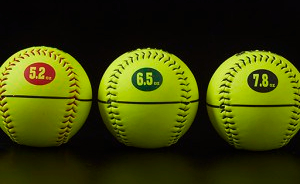
The key is having balls of the proper weight. In particular, you want to be sure the weighted ball isn’t too heavy – no more than 1.5 ounces more than a normal ball, which is roughly 6.5 ounces. Anything heavier and you risk putting undue stress on the shoulder.
That’s why I’ve come to like Decker Weighted Softballs from Decker Sports. The overload/underload variance is relatively small: 7.8 oz. for the heavy ball, 5.2 oz. for the light ball, plus a “normal” 6.5 oz. ball. Each ball is very clearly marked, with large numbers and color coding, so there is no risk of using the wrong ball for the particular purpose.
Another thing I like about the balls is they come with a line around the circumference going across the four seams, so you can easily see the spin on the ball. That will give you an idea of whether you’re maintaining good mechanics as you work with them.
I also like the feel of the balls. They have good “tack” on them with good seams. The previous set of weighted balls I had never had very good tack, and by now are positively shiny. It was definitely time to retire them. The Decker Sports balls feel more natural to the pitchers, helping them focus on what they’re doing rather than wondering whether the balls will slip out of their hands.
Decker Sports does more than sell you a product, however. The balls come with an off-season and in-season training program. You can see a preview here. There are also other training programs out there, so you can find one that fits your needs and time constraints.
That’s another good point to make. Working with weighted balls can take some time. In lessons, where we only have a half hour once a week, I will often expose players (and parents) to weighted balls but won’t continue to use them on a regular basis.
That’s the sort of thing that’s best done on your own. I feel the time spent with me can best be spent on other aspects – you don’t need a coach for that.
Studies have shown that using a good weighted ball protocol can help increase speed. If you’re looking to help your pitch pick up some velocity (and who isn’t), give these weighted balls a try. You may even want to carry on with them once you go back outside.






 Life in the Fastpitch Lane