Blog Archives
Product Review: Cimmaron Safety Net and Frame Makes BP Safer
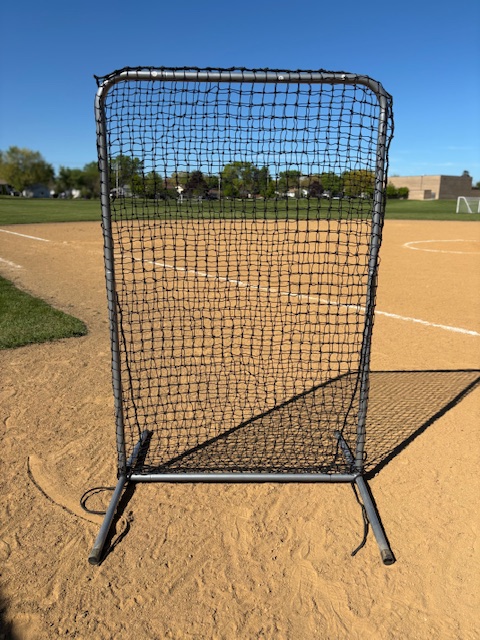
Whenever I see a coach doing front toss at practice from 15 feet away without a net to hide behind, my first thought is always “That coach must not have much faith in him/herself as a hitting coach.”
But the reality is (most of the time anyway) that they would use a screen if they had access to one. Sure, you could try using a Bownet or similar product but the blowback on a hard-hit ball directly into the net would probably negate any value in setting it up.
Effective protection, even from some 10 year olds, requires a much sturdier protective screen – the type you see at high schools, colleges, batting cages, and professional stadiums. The trouble there is your typical youth coach, or even a high school coach who has to practice at an off-campus field, can’t exactly cart around a heavy-duty screen with a heavy-duty net, nor do they have the time to assemble and disassemble it with all the nuts and bolts that are required.
For years I had that problem solved with the old Jugs Snap-Together Screen. It was the perfect solution – a heavy-duty net that slipped over a heavy-duty frame that was easy to put up and take down. The push–in snapping mechanism meant you could slide the pieces together, then have the snaps hold them in place. Then, when it was time to leave the field, I could quickly pull it all apart and put it back in the carrying bag, ready to transport anywhere I needed it.
All good things must come to an end, however, and last fall that screen gave up the ghost. Some of the snaps didn’t work anymore, and the net was beginning to fray, which increased the risk of a hard-hit ball breaking through.
Since Jugs doesn’t offer that product anymore I searched and searched for something similar to replace it, That’s when I came across the Cimmaron 6×4 #42 Safety Net and Screen at Epic Sports.
It’s a little smaller than the Jugs screen was, but it was still big enough to hide behind after throwing a pitch. (One time when it pays to be a little under 6 feet tall.)
The description mentioned a snapping mechanism but there weren’t any closeup photos to show if what they meant and what I thought of were the same. But with no other viable alternatives I figured I’d give it a try and made the purchase.
I’m happy to report it’s everything I hoped it would be.

The 1-1/2 inch steel tubular frame is lightweight yet very strong and confidence-inspiring. The net, made from #42 nylon, has held up well after take some direct hits; I have full confidence in it.
It’s also a little easier to assemble than my old protective screen was, probably because it’s a little smaller than the old one so there are fewer pieces to assemble. There are three pieces that comprise the bottom, two along the sides, and three that form the top and the upper part of the sides.
All parts have a number sticker on them that correspond to the supplied diagram that shows you how to put it together. The first time I did it I had a little trouble figuring out what went where but that was due to operator error.
I didn’t bring the diagram with me to the field, and I then assumed the two pieces that form the top corners worked the same way as the Jugs screen, i.e., the long part goes across the top and the short part goes down to join the side. When that didn’t work it was easy enough to figure out how to put it together properly and it’s been a breeze ever since.

The net is also easy to put on. It has a pillowcase-type of structure – the top and sides are closed while the bottom is open, so you can quickly slip it on and off the assembled frame. There is also a nylon rope at the bottom that allows you to secure the bottom of the net so you don’t catch a hard ground ball to the feet.
Unlike the Jugs net, there is no hole in center to pitch through. That’s ok, though, because I am used to turning L-screens with the tall side to the right and pitching around it, so it’s essentially the same.
It’s even a plus in some ways because a ball with a little tail to it won’t come across the frame, unlike the hole-type where I got clipped a few times with a line drive even though I swear I wasn’t standing in the hole.
The only downside I see to this product is that it doesn’t come with a carrying back. That seems like an oversight given that the quick up-and-down construction makes me think it was designed for portability.
Fortunately I still had the Jugs screen carrying bag so I’m using that. I also tried a speaker stand carrying bag from Sweetwater, which worked ok too. Neither one is quite deep enough to fully close because of the design of the two base pieces, but they are both wide enough and will both work as long as you’re careful getting it in and out of the vehicle.
I’m guessing the manufacturer opted not to offer a bag to keep the price down, but it sure would be nice for one to be offered even if it’s a separately purchased accessory for those of us who need to cart it in and out on a regular basis.
Speaking of price, the Cimmaron protective screen is relative bargain in my opinion. It’s just $179 for the frame and net. When compared to the cost (and time) of a visit to the emergency department or immediate care facility after taking a line drive to the head it’s definitely worth it.
And if you want to add padding around the frame it costs a little more but if your goal is to put it up and take it down the same day it feels to me like you’re better off without the padding.
So if you’re a coach who is pitching front toss with real balls to your team and want to feel a little safer while doing it, check out the Cimmaron 6×4 #42 Safety Net and Frame. In my opinion it’s worth every penny. And yes, I paid for my own.
My good friend Jay Bolden and I have started a new podcast called “From the Coach’s Mouth” where we interview coaches from all areas and levels of fastpitch softball as well as others who may not be fastpitch people but have lots of interesting ideas to contribute.
You can find it here on Spotify, as well as on Apple Podcasts, Pandora, Stitcher, iHeart Radio, or wherever you get your podcasts. If you’re searching, be sure to put the name in quotes, i.e., “From the Coach’s Mouth” so it goes directly to it.
Give it a listen and let us know what you think. And be sure to hit the Like button and subscribe to Life in the Fastpitch Lane for more content like this.
Teaching Hitters to Track the Ball More Effectively

Go to any facility where there are teams or individuals hitting in batting cages and sooner or later you’re likely to hear the phrase, “Track the ball all the way into the catcher’s glove.” While it’s doubtful that hitters can actually see the ball hit the bat at the point of contact, the idea of trying to track the ball as long as you can is a good one.
The problem most coaches face when trying to get their hitters to track the ball longer (instead of getting a glimpse then swinging) is that there are no consequences for not doing it. Well, other than not hitting well. But as soon as the coach’s back is turned, hitters are likely to go back to not following the ball all the way to the catcher’s glove.
But, dear blog follower, I have a solution for the dilemma. It actually came up by accident, but I noticed how the pattern had changed so I’m taking credit!

All you need is a batting cage with a tight protective net at the back of it.
For the past few months I’ve been throwing front toss to hitters in a cage that has a very tight net at the back. When one of my errant pitches (and there are many of them) would hit the net, it would bounce back at the hitter with enough velocity to be annoying.

What I noticed was a lot of the hitters would watch the ball all the way to that net so they could get out of the way when the ball bounced back. Some of them then made a game of trying to catch the ball when it popped up off the net, and they got pretty good at it.
Since their first priority was hitting any good pitches I managed to throw, it took some effort to see the ball coming back and catch it.
But today I was in a different cage that didn’t have such a tight net. And that’s where I saw the effect take place.
One of the hitters who liked to catch the ball was still following it to the back screen, even though it wasn’t going to bounce back. She’d built a habit of it in the other cage to the point where she now automatically watches the ball all the way back.
Between that and the Reynaldo drill, which she has become very good at, she is seeing the ball much better – and hitting the heck out of it.
So I guess the lesson here is if you want to encourage your hitters to watch the ball longer, find a nice, tight net and put it behind the plate when you front toss to them. They’ll definitely learn to keep an eye on it all the way in.
(And yes, I know the hitter in the top photo is hitting off a tee. It’s tough to throw front toss and take a picture at the same time. Deal with it.)
Hitters: Never Get Stuck on Your Back Foot

You see this all the time working with fastpitch hitters. They look great on the tee – good load and stride, good sequence of hips-shoulders-bat, and a powerful outcome.
Then you start front tossing to them, or having them hit off a pitching machine, and it’s as though some alien who has never swung a bat in its life has somehow possessed your hitters while you were setting up. They make short, jerky moves to stride and wildly swing their arms with barely any hip movement at all. You wonder what happened, and why they’ve lost everything you just spent so much time working on.
Actually, your hitters haven’t forgotten about all that hard work. They just don’t have time to execute that swing. Here’s what happens.
The “pitcher” gets ready to throw and the hitter loads. Then, since the pitch isn’t coming yet, she feels like she loaded too soon so she stops and stands on the back leg.
Then the ball comes and she starts to stride. But because the ball is coming from 20 feet away (on front toss) or at a high speed (since everyone cranks up the pitching machine to the max setting) it’s on her faster than she realized. So she just abandons all the body movement and just tries to get the bat to the ball any way she can, which usually produces some pretty poor results.
What really makes it tough is when the hitter realizes she was late getting to the ball so she starts even earlier! All that does is get her stuck on her back foot sooner, which only makes things worse.
Continuous motion
To truly be effective, hitters must remain in continuous motion. That means once the load happens, they must keep on going until that pitch reaches its conclusion with either a swing or take.
There is no hitting the pause button in the middle of the swing for everything to line up. Mostly because it won’t line up.
That pause on the back leg breaks the momentum that was being gathered with the load/negative move and essentially causes the hitter to have to break inertia all over again. That takes time, and when you’re dealing in hundredths of a second there is no time to waste trying to get the body going.
Hitting is about rhythm and timing. Putting in a pause in the middle of the swing throws that rhythm and timing out the window. You want to keep going in one smooth motion from beginning to end so you can reach that oh yeah moment.
Trust the swing
So, with that in mind, how do you break this vicious cycle of early-wait-late? It starts with getting the hitter to trust the swing, and the process of the swing.
I will usually tell a hitter that she needs to start her stride BEFORE I release the ball in front toss. (For machines it’s a little different, but I have some good tips on dealing with that in another blog post.)
Of course, just because I said it doesn’t mean it will happen. So I encourage her to trust the process, i.e., try to get that stride going early.
After a couple of attempts, she will usually start to get her front foot down on time, with enough time to fire the hips, bring the shoulders around and then launch the bat with confidence. She will find that anticipating the release, and trusting that it will happen, rather than waiting for visual confirmation that the ball is released enables her to execute the swing as we practiced it on the tee.
Verbal cue
While the above strategy works with most hitters it doesn’t necessarily work with everyone. Younger hitters especially may still have trouble figuring out when to start their positive move forward.
For them I have a simple solution: I just yell “Go!” as my arm comes down the back side of the circle. (I always use a full circle – because I can.)
They may be startled at first, but they’re usually obedient so they get started when I say. Again, after a couple of attempts they start gaining confidence in their approach, so when I say go they start attacking the ball.
Of course, I do like to point out to them that an actual pitcher isn’t going to tell them when to start their stride so they will have to learn to do it without the verbal cue. But if it helps them understand the concept and gain some experience with striding before the ball is released, I’m more than happy to do it for a little while.
Translating to an actual pitch
Right now there are probably some hitting fanatics who are saying “but high-level hitters don’t get their foot down before release.” That’s true.
But high-level hitters are also not hitting a pitch thrown from 20 feet away. Even with the new pitching rules.
When you’re throwing that short distance pitch to them, it’s the equivalent of the ball having traveled about 1/3 to 1/2 the distance from the pitching rubber to the plate. And that IS about the time high-level hitters get their front foot (feet?) down.
So once again, the idea of starting the stride before the pitch has been released is valid. You want to go calm-calm-explosion (aka load-stride-swing).
When exactly it happens depends on the pitcher, the hitter, and the hitter’s athletic ability. That last part is something to keep in mind too when you watch video of high-level hitters. The reason they’re high-level is they just might be able to do things, and get away with things, us ordinary mortals can’t do.
Keep it moving
Getting stuck on the back foot in the middle of the swing is just asking for trouble. It takes discipline and trust to break that habit but it can be done.
The more your hitters keep themselves in motion, from beginning to end, the more often -and the farther – they will hit the ball. Keep an eye out for the deadly pause and you’ll help your hitters succeed.






 Life in the Fastpitch Lane