Blog Archives

Little Things That Make a Big Difference
It seems like softball coaches, players, and especially parents are always in search of the “silver bullet” – that one technique or piece of knowledge or magic adjustment that will take an average (or below-average) player and turn her into a superstar.
That desire is actually what keeps a lot of what I would call charlatans – people who claim to have a “secret sauce” when really what they have is a knack for hyping otherwise very ordinary solutions – in business. It’s also what drives some of the incredibly crazy drills or controversial posts you see on social media.
Well, that and a need to constantly feed things into the social media machine so they can keep getting those clicks.
In my experience there is no single silver bullet or secret sauce drill that can turn an average player into a superstar overnight. There is no “next big thing” either.
But there are a lot of little things that can make a huge difference in your game if you learn to execute them properly. Here’s a little collection of some of them.
Pitching a rise ball
The rise ball is often the toughest pitch to learn. That’s because getting true backspin on a 12 inch softball (versus the typical bullet spin) requires the pitcher to do some things that work against the body’s natural tendencies.
One of the biggest has to do with what the hand and forearm do at release.
The natural movement for the hand and forearm as they pass the back leg is to pronate, i.e., turn inward. If you hold your arm up and let it just drop behind you, you’ll see that inward turn when you get to the bottom of the circle.
Try it for yourself, right now. Go ahead, I’ll wait.
When you’re throwing a rise ball, however, you have to keep the hand and forearm in supination, i.e., pointed outward, as you go into release if you want to be able to cut under the ball and achieve backspin. Otherwise you’re throwing a drop ball.
What often happens, however, is that in trying to keep the forearm and hand pointed out, the pitcher will cup her hand under the ball so the palm is pointed toward the sky or ceiling. That may work to impart backspin when doing drills from a short distance away, but it will also create a “big dot” spin instead of a more efficient and active “small dot” spin when thrown full-out.
So, to throw a true backspin rise the pitcher needs to learn to keep the palm of her hand pointed mostly out to the side, with just a slight cupping of the fingers. In other words, throw with more of a fastball-type orientation (fingers down) going into release, then angle the hand back up slightly so the fingertips are under the ball instead of to the side.
Do that and you have a much better chance of getting 6 to 12 backspin. (For those unfamiliar with that term, think of an analog clock, with the spin direction moving from the bottom at 6:00 to the top at 12:00.)

Another key is to freeze the fingers at release rather than trying to twist the ball out like a doorknob.
Again, twisting or “twizzling” the ball (as Rick Pauly calls it) will work when you’re self-spinning or throwing at a short distance. But once you try to put any energy into the ball, your hand’s natural tendency to pronate or turn in (remember that from a few minutes ago?) will cause you to turn the palm forward and create bullet spin.
Now, if you can throw the ball 70 mph or more, I suppose it doesn’t matter how your rise ball is spinning so you can get away with that. But if you’re not, forget the twizzling and make sure your hand simply cuts under the ball like a 9 iron hitting a golf ball onto the green and you’ll have a lot more success with it.
Bend in slightly to the curve ball
The curve ball tends to have the opposite problem. Here, you want your hand to be palm-up (if you’re throwing a cut-under curve) so the spin axis is on top of the ball.
The problem is many pitchers will tend to extend their spines a little as they go to throw the curve, which will naturally make the hand tend to sag down, turning the palm more out and away rather than up.
To avoid that issue, try bending in slightly over your bellybutton (on the sagittal plan for those who love the technical terms). That slight bowing in makes it easier to maintain a palm-up orientation, placing the spin axis on the top of the ball and creating a better chance for the fast, tight spin that enables a late break.
Get hitting power from your hips, not your arms
Look, I get it. You hold your bat in your hands, which are at the ends of your arms. So logically you would think to hit the ball harder you should use your arms more if you want to swing the bat harder.
And yes, that will work if you’re on a tee, where the ball isn’t moving. But if you’re not 7 years old, it won’t work so well when the ball is moving.
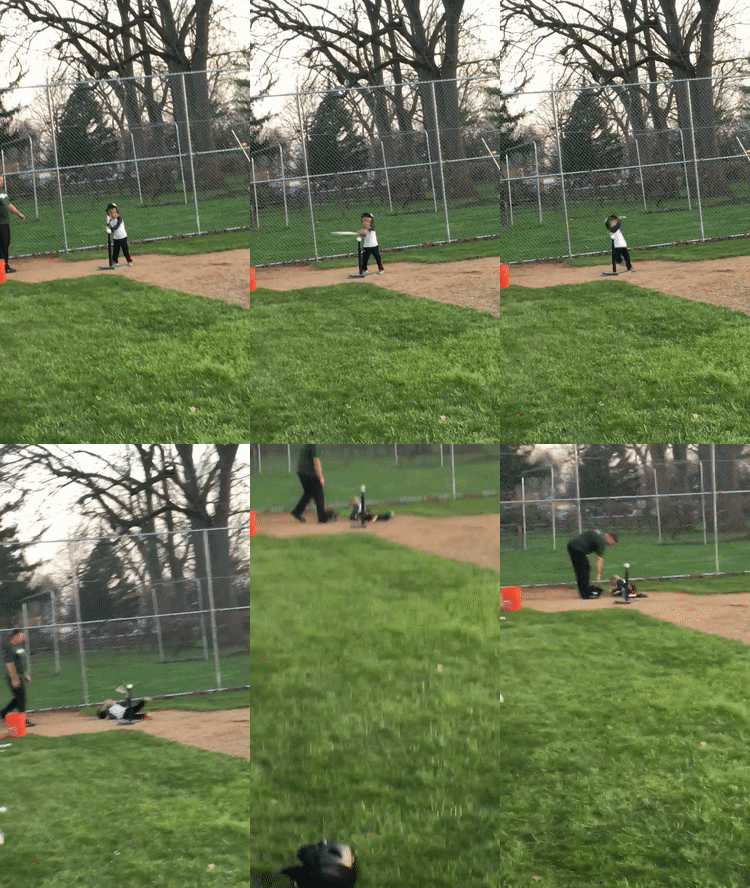
The reason is when you use the arms to create power, you give up control of the bat. You’re just yanking it wildly and hoping something good would happen.
The better approach is to use your hips (and core) to generate energy through body rotation. More energy, in fact, than you can create with your arms.
Then use the arms to easily direct that energy toward the ball. Approaching it this way will give you the adjustability you need to take the bat to where the ball is going instead of where it was when you first started the swing.
Generating power from the hips first also gives you more time to see the ball before you have to commit the bat, further allowing you to fine-tune the path of the bat to where the ball will be when it gets close to the plate.
Remember, the difference between a great contact and a weak one, or no contact for that matter, can be measured in centimeters (fractions of an inch for those who don’t remember the metric system from school). The ability to make fine adjustments during the swing is often the difference between a great hit and a poor one. Or none at all.
Shoulder tilt creates bat angle
While we’re talking hitting, another small adjustment has to do with the angle of the shoulders at contact.
We’ve all heard the instruction to “swing level” at some point or another. Many of you may have even said it, or say it now.
But if by swing level you mean having the bat parallel to the ground you’re just asking for a season filled with pop-ups and ground balls.
If you look at great hitters at the point of contact, you’ll see that 99 times out of 100 they have an angle on the bat that slopes down from the handle to the barrel. If you look a little further, you’ll see that the angle of the bat usually matches the angle of the shoulders.
So…if you want to get a great bat angle to hit rising line drives and other powerful hits, you don’t really need to manipulate the bat. You just need to let the back shoulder tilt downwards toward the ball. This preferably happens about halfway through the turn rather than dropping the shoulder first and then turning.
Think of the back shoulder as an aiming device. Once you see where the ball is headed, take the back shoulder in that direction and swing on a plane that matches the shoulder angle.
Before you can say “Bob’s your uncle” (always wanted to use that one) you’re crushing the ball deep – without having to do any crazy manipulations.
A better way to put on your glove or mitt
Given the power of the Internet to spread information I’m surprised that this little trick isn’t more well-known.
When most people put on a softball glove or mitt, they tend to put it on as they do a regular glove, i.e., one finger in each slot. I mean, it makes sense, right?
But that’s now how the pros do it. The problem with the one finger, one slot approach is that you ring and little fingers are your two weakest fingers. Far weaker than the index and middle fingers.
So when you go to catch the ball, your weakest (little) finger is trying to close at least half, if not more, of the glove by itself while the strongest part of your hand is closing the other half. You don’t have to be an anatomy expert to figure out why that can contribute to a lot more dropped or mis-handled balls.
Here’s a trick that can solve that issue: Take your ring and little finger, hold them together, and then slide them into the loop in the last finger stall. Then move each of the other fingers over one toward that end, leaving the area for the first finger open.
Now your two weakest fingers have combined to create one stronger finger, better balancing the closing power between the thumb and other side of your hand. You middle finger also gives somewhat of an assist to the other two.
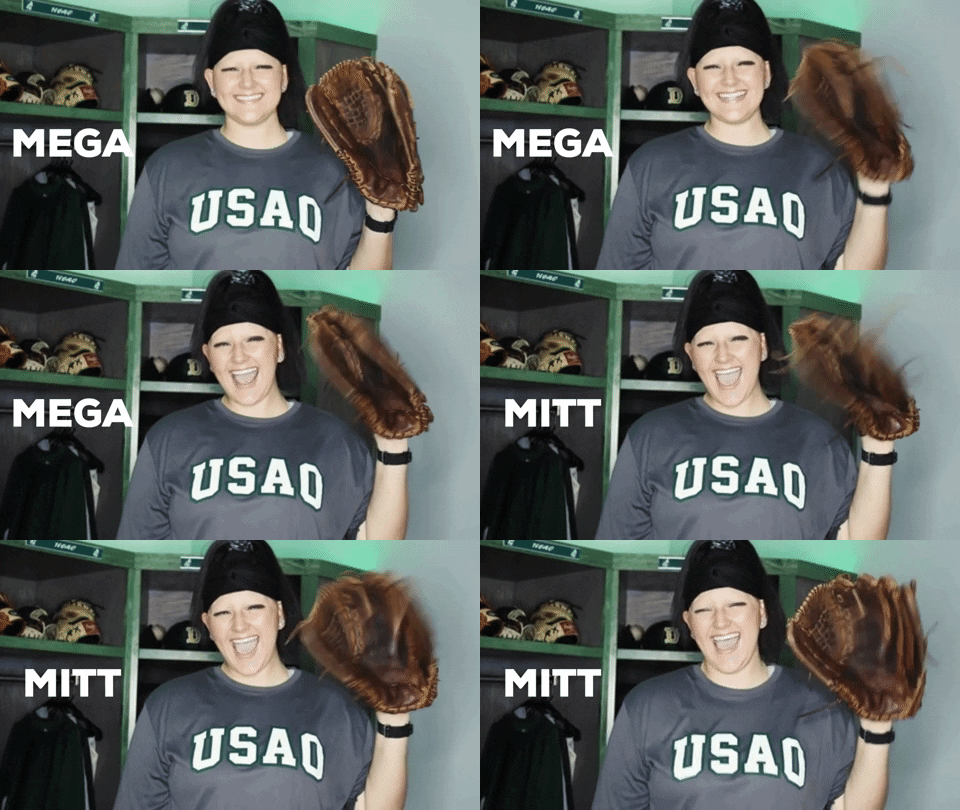
And bonus, you no longer have to leave your index finger out of the glove to keep it from hurting when the ball hits the palm of the glove because it’s not in that spot anymore!
It’s going to feel awkward at first, especially because your hand won’t go into the glove quite as deeply. But try it for a month. You’ll never go back to the old way.
Little things mean a lot
None of these little tips are earth-shaking or revolutionary. But each of them can make a significant difference in your performance.
If you’re struggling with any of these issues, give these tips a try. It’s amazing the difference a slight adjustment can make.
“Palm Eye” Helps Hand Orientation for the Curve

It seems like these days for me the “eyes” have it. (Sorry, couldn’t resist.)
Over the past few weeks I have talked about the use of the shoulder eye and the hip eye for hitting. But now I have a new one – this time for pitchers.
Unfortunately, given the nature of pitching my little stickers don’t work so well, I had to resort to a hand-drawn eye using a Sharpie. But it still got the point across. Here’s the story behind it.

Makayla is working on developing a curve ball, but was having trouble getting the proper spin orientation. (For those who don’t know, the spin axis should be on top, with the seams revolving around the ball horizontally, like a globe.)

Both the spin she was getting and the video I shot showed the palm of her hand was pointed out toward third base going into release rather than being cupped under the ball and pointing to the sky. She would try to get her hand into the proper position right before release but by then it was too late, and the ball would either have a bullet spin or the spin axis would be severely tilted. Either way, not good.
So, I brought out my trusty Sharpie, drew the eye on her hand, and told her to make sure as she approached release that the eye was pointed to the sky.
This is going to sound like I am making it up for the sake of the story, but I swear the very next pitch not only had the proper spin direction but a much faster, tighter rotation that it had previously. She proceeded to throw several in a row that were in the right range before I had to remind her again to keep the eye pointed toward the sky.
The smile on her face was beaming as she got good spin. I then asked her if the palm eye had helped and she said yes, absolutely. She didn’t know why (and neither did I), but that simple cue registered in her brain and helped her get into the position she needed to get the right spin.
The curve is still a work in progress for Makayla, but it took a giant leap forward that evening. So if you have a pitcher struggling to her hand under the ball, give your artistic skills a try and draw a palm eye. It just may work for her too.
Drill for helping softball pitchers learn to go inside and outside

It’s no great revelation to say that working the corners by being able to hit your spots inside and outside is a critical skill for fastpitch softball pitchers. The easiest pitches to hit are the ones down the middle, so once you can do that reliably the next step is learning to never throw there again (except maybe on a 3-0 count).
Of course, it’s easy to say “you have to hit your spots.” It’s another thing for fastpitch pitchers, especially younger ones, to be able to do it.
There are a lot of moving parts involved in fastpitch pitching, and going inside and outside reliably requires being able to make fine motor adjustments. Not every pitcher is able to do that on-command.
So with that in mind, here’s a quick video blog that shows a drill to help pitchers get the concept of making adjustments by starting broader and working their way back in. The drill will work no matter what technique you use to throw inside/outside.
It’s being demonstrated with an outside curve ball, by the way, but it will work for any pitch.






 Life in the Fastpitch Lane