Blog Archives
When Old Ways Become My Way or the Highway

I recently received a rather exasperating note from the mother of one of my catching students. She told me her daughter’s team coach is now insisting that their catchers rip off their hockey-style masks when going after foul balls and making other types of plays.
Neither her daughter or the other catcher is happy about it. They’ve both been taught (one by me, one by someone else) to leave the mask on.
But they are both concerned that if they don’t follow what the coach says they won’t get playing time. In my mind if they both band together and refuse what’s the coach going to do – pull in an outfielder to catch? But let’s table that discussion for now.
The coach’s admonition was, “You play for me and not your catching coaches,” thereby asserting the right of kings in making decisions regardless of the facts or the best information available. In other words, it’s the old coaching philosophy of “my way or the highway.”
From what I am told, this entire controversy cropped up when the other catcher missed a pop-up. The coach drew the conclusion the miss was caused by a lack of visibility within the mask without any real evidence to support it.
The reality is of the many things that could have caused the catcher to miss that pop-up, a lack of visibility caused by the mask is one of the least likely. That’s because the hockey-style masks are designed specifically to provide full visibility throughout the catcher’s field of vision.
Back when I was a catcher, in the days when dinosaurs roamed the earth, we used flat masks that were held in place by elastic straps on the back of your head. They provided good visibility straight ahead, i.e., in the direction the pitch would come from, but restricted your peripheral vision, making it difficult to locate pop-ups or see a ball coming in from the side on a tag play at the plate.
Additionally, those masks were easy to pull off and toss out of the way, so it made sense to remove them for anything that wasn’t a pitched ball coming from straight in front of you.
Today’s masks are large hunks of plastic designed to protect the catcher’s entire head. They are form-fitting and difficult to remove quickly. In fact, trying to remove the mask when doing something like chasing after a foul ball can become a huge and painful distraction if it gets caught on your nose or ears or forehead.
Ripping the mask off can also cause problems if you’re wearing sunglasses or even worse prescription glasses in order to see. The glasses get pulled off and now you’re far worse off than you would have been had the helmet remained in place.
Then there’s the problem of getting rid of it. The old flat masks were lightweight and easy to toss; a full-on hockey-style mask is much bulkier, making it harder to toss and creating more of a tripping risk because of its size. Tough to catch a pop-up when you’re lying flat on your belly, no matter how well you can see it.
Finally, we come to what happens on a play at the plate. When a runner is sliding into home (or worse, crashing into the catcher as she goes to apply the tag even though the runner is supposed to avoid contact) the catcher will be much better protected with the helmet on than the helmet off.
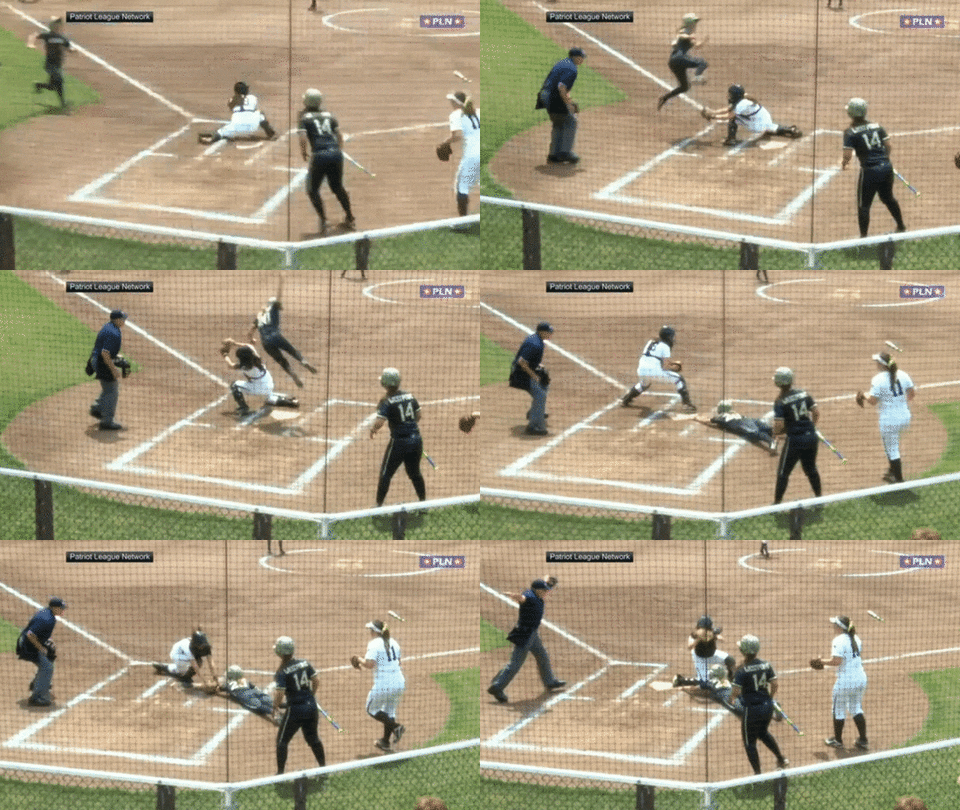
No cleats to the face, no banging your unprotected head on the ground if you’re knocked backwards.
By the way, this isn’t just me saying all this, although it is what I tell catchers. A quick Google or AI search will find pretty much all top-line catching instructors saying the same thing. Removing the catcher’s mask is both unnecessary and less safe.
So the only reason left to insist your catchers rip off their masks when making a play is because YOU ARE OPERATING OFF OF OLD AND OBSOLETE INFORMATION (saying it loud for the folks in the back), and you are letting your ego get in the way of doing what’s best for your players.
This is why it is so important for coaches to continue to seek out new information and learn. Not just about catcher’s masks but all aspects of the game.
The old ways may have worked, but there are a whole lot of smart people out there who have the time, tools, talent, and budget to research every aspect of the game more thoroughly. If new discoveries or information come along that can help your players do better why wouldn’t you want to take advantage of it?

I know some people hate to admit that they may have been wrong in what they were teaching, but they need to get over it. They need to understand it isn’t that they were wrong – it’s that they were using the best information they had at the time, and now they have new and better information.
As my buddy and podcast partner Jay Bolden says, as coaches we expect our players to be learning and improving all the time. Why shouldn’t we demand the same of ourselves?
The fact is we should be eager to learn more, because the smarter and more informed we are, the better chance we have of developing better players who will help us win more games. Sticking with something because that’s the way you’ve always done it is a very poor way to coach, and one that could hurt a player’s development – or even end up with her injured.
The catcher’s mask discussion is just a symptom of a larger issue. Before you insist on players doing something in cases where they’ve been taught something else, take the time to do a little research and see WHY it’s being taught differently.
You might just learn something that will help you not just now but in the future as well.
My good friend Jay Bolden and I have started a new podcast called “From the Coach’s Mouth” where we interview coaches from all areas and levels of fastpitch softball as well as others who may not be fastpitch people but have lots of interesting ideas to contribute.
You can find it here on Spotify, as well as on Apple Podcasts, Pandora, Stitcher, iHeart Radio, or wherever you get your podcasts. If you’re searching, be sure to put the name in quotes, i.e., “From the Coach’s Mouth” so it goes directly to it.
Give it a listen and let us know what you think. And be sure to hit the Like button and subscribe to Life in the Fastpitch Lane for more content like this.
7 Tips to Make 2022 Your Best (Softball) Year Ever

First of all, let me tell you I had quite a debate with myself on whether to write a New Year’s post or just go with a more general topic. But when the stars align – as in the last day of 2021 is also the day I usually put up a new post – it’s a good idea to just go with it.
So here we are. Hopefully 2021 was a great year for you.
We actually had somewhat normal high school, college, and youth softball seasons, although COVID-19 protocols often impacted the spectator part of spectators sports. At least the fans who got in didn’t have to wear a mask on 90-degree days.
Also in 2021, fastpitch softball temporarily returned to the Olympics, albeit in eerily quiet and empty stadiums and played on baseball diamonds. It was sort of like watching a dome game with a field set up for football. The fact that the oddly formatted mini-tournament was finished before the opening ceremonies took place tells you all you need to know about what the International Olympic Committee (IOC) really thinks about our sport.
The Women’s College World Series (WCWS) on the other hand was a TV rating juggernaut, averaging more than 1.2 million viewers per game. That’s 10% more than the 2019 WCWS.
The three-game championship series between Oklahoma and Florida State fared even better, drawing an average of nearly 2 million viewers per game. In the process, we got to see a lot of great softball.
Speaking of great softball, Athletes Unlimited entertained a lot of fastpitch softball fanatics with its playground-brand of choosing up teams and having no coaches on the sidelines. Maybe they’re on to something.
And hopefully you personally had a successful 2021 as well.
Of course, as the disclaimer on every “get-rich-quick” scheme quickly says, past performance does not guarantee future gains. So following are a few tips to help you make 2022 an even better year.
Tip #1: Practice with a purpose
Yes, I know many of you have t-shirts with that very saying on them. But how often do you actually take that approach?
It’s easy to get into the rut of “putting in time.” i.e., going off somewhere and going through the motions of a skill for a half hour or an hour or whatever, or coaches having players performing activities for two, or three, or four hours. None of which will actually help you get better, and could make you worse if the practice is sloppy enough.
If you’re going to practice, then have a goal and go after it wholeheartedly. For example, if you’re a pitcher working on leg drive, then work on getting yourself out faster each time rather than mindlessly doing the leg drive drill you were assigned.
Master the skill, not the drill, and you’ll be a lot better off.
Tip #2: Grow your knowledge
In today’s Internet-accessible world there’s no reason to do things a certain way because that’s how you’ve always done them. There is an incredible amount of research being done in our sport and an incredible wealth of knowledge being shared – if you will open your mind to it.
The National Fastpitch Coaches Association (NFCA) is one of the best. Right now they are in the midst of hosting a series of live coaches clinics around the country that enable top-level coaches to share their expertise with the rest of us.
If you want to go more in-depth on a topic, the NFCA also has its Master Coach program, which offers a combination of live and online courses. I took their very first online Coaches College course earlier in 2021 and it was well worth the time and money. Give it a shot.
There are plenty of private resources as well. PaulyGirl Fastpitch has its High Performance Pitching courses at the beginner, intermediate, elite, and pro levels.
You can learn all about great throwing mechanics from the High Level Throwing program. There’s a cornucopia of hitting courses out there as well.
Then there are resources such as the Discuss Fastpitch board and the Fastpitch Zone and The Bullpen Facebook groups that connect coaches from around the world with one another to share their knowledge and experience. And that’s the just the start.
If you want more knowledge it’s out there. Just be sure to come in with an open mind because some of what you hear may go against everything you’ve ever believed. And that can be a good thing.
Tip #3: Use video
This one doesn’t require a lot of explanation. There’s what we think we see or feel, and there’s what’s actually happening. They’re not always the same.
Virtually every mobile phone includes a high-definition, high-speed camera for free that would be the envy of coaches and players from just 10 years ago. Take advantage of it.
Video yourself or your players often, and see if what you think you’re doing is what you are in fact doing. Compare what you see to the best players in the world.
While you don’t have to match exactly, you should match in principle. If you’re not doing what you think you’re doing, adjust accordingly.
Tip #4: Work on your mental game
Ask any group of coaches or players “who thinks the mental game is a critical contributor to success?” and you’ll probably see every or nearly every one of them raise their hands. Then ask how many take the time during practice or during their free time to work on it and you’ll likely see few (if any) hands.
It’s sort of like Mark Twain’s famous admonition about the weather: everyone talks about it but no one does anything about it.
That is a mistake in my opinion. There are (again) plenty of books and other resources that focus on this aspect of sports. Here’s a list of a few:
- Head’s Up Baseball
- Mind Gym
- The Champion’s Mind
- Championship Team Building
- The Mindful Athlete
- Winning State
- Mental Conditioning for Softball
- The Energy Bus
Invest some real time in developing the mental game – especially the part about overcoming adversity – and you’ll be amazed at what you can do.
Tip #5: Make some time for recruiting activities
This is for those players who want to (or think they want to) play softball in college. If that’s not you, go ahead and skip to Tip #6.
For those still reading, playing softball in college at any level is an accomplishment – and ultra-competitive these days. You’re unlikely to be randomly discovered playing during a local tournament.
If you want to play in college, you need to make an effort to build a relationship with coaches at different schools, and at different levels.
One obvious way is to attend skills camps at schools where you might like to play. While some are just money grabs that have minimal involvement from the college coach, most are both an opportunity for coaches to give back to the game while checking out potential future talent. What better way is there to get them interested in you than to demonstrate your skills in their “house?”
Social media in general, and Twitter in particular, is another great way to establish and maintain contact with coaches. Follow coaches at schools you’re interested in and hopefully they will follow you back.
Share their Tweets with your followers. Send Tweets of your own about your/your team’s latest accomplishments and activities and tag the coach or the program. Be active and be visible.
Just one word of caution about social media: keep it positive at all times. The Internet is written in ink, and more than a few players have eliminated themselves from consideration by their dream schools because of things they’ve posted. That includes photos and negative comments about their parents or current coach.
Present yourself as if the coaches you want to play for are watching every post. Because they are.
Email is still a valid way to contact coaches too. Just keep it brief – they’re busy people and many get hundreds of emails a day. If you want to share a video, be sure the coach can see what you want him/her to see in ONE click. Any more than that and they’ll pass.
This isn’t just for high school players either. While the D1 rules changed and they can no longer contact players before September 1 of their junior years, it doesn’t mean they’re not paying attention to who can play and who is interested in their schools. And there are no such restrictions for D2, D3, and NAIA, although they tend to recruit later anyway.
Recruiting is a marathon, not a sprint, so get out there early and often if you think playing in college might be for you.
Tip #6: Make time for rest and recovery
When you’re dedicated to something it’s easy to overdo it. Don’t let that happen.
Rest and recovery is just as important to high performance as training. Your body needs time to build itself back up after intense activity. So does your mind.
It’s ok to take a day or two off each week during the season as well as during the offseason. Your body and your brain will tell you how much you need for peak performance. You should also plan on taking at least a couple of weeks off at some time during the year for deeper recovery.
Oh, and this applies to coaches too. You’ll find coaching is a lot more enjoyable if you let your batteries recharge now and then.
Tip #7: Resolve to have fun
This is probably the aspect that has been most lost over the course of the last 10-20 years. Yes, we have more technology that can tell us more things, and more practice facilities that enable us to keep working even when the weather is at its nastiest, and more opportunities than ever to take our game to a higher level.
But the tradeoff has been more pressure and more stress to the point where playing (and coaching for that matter) feels like a job. And not a particularly pleasant one.
It’s important to remember that softball is a game, and games are supposed to be fun.
That doesn’t mean it should be like a birthday party without the cake. But it shouldn’t be like studying for finals while waiting to see the dentist either.
Fun in most cases is what you make it. Some people enjoy really digging into things and pushing themselves to their limits. That’s right for them.
But it’s not right for everyone. Others will find their fun in getting a little better each day without killing themselves, competing (in a friendly way) with their teammates, or in being part of a team.
Understand what’s fun for you and then find/create a team with others who share your definition and goals. Like using the wrong pair of cleats, being on a team that isn’t a good fit can be painful.
Good luck to everyone, and I hope you make 2022 your best year ever!
Photo by Damir Mijailovic on Pexels.com






 Life in the Fastpitch Lane