Blog Archives
A Tribute to the Parents Who Show Up Just in Case their Daughter Plays

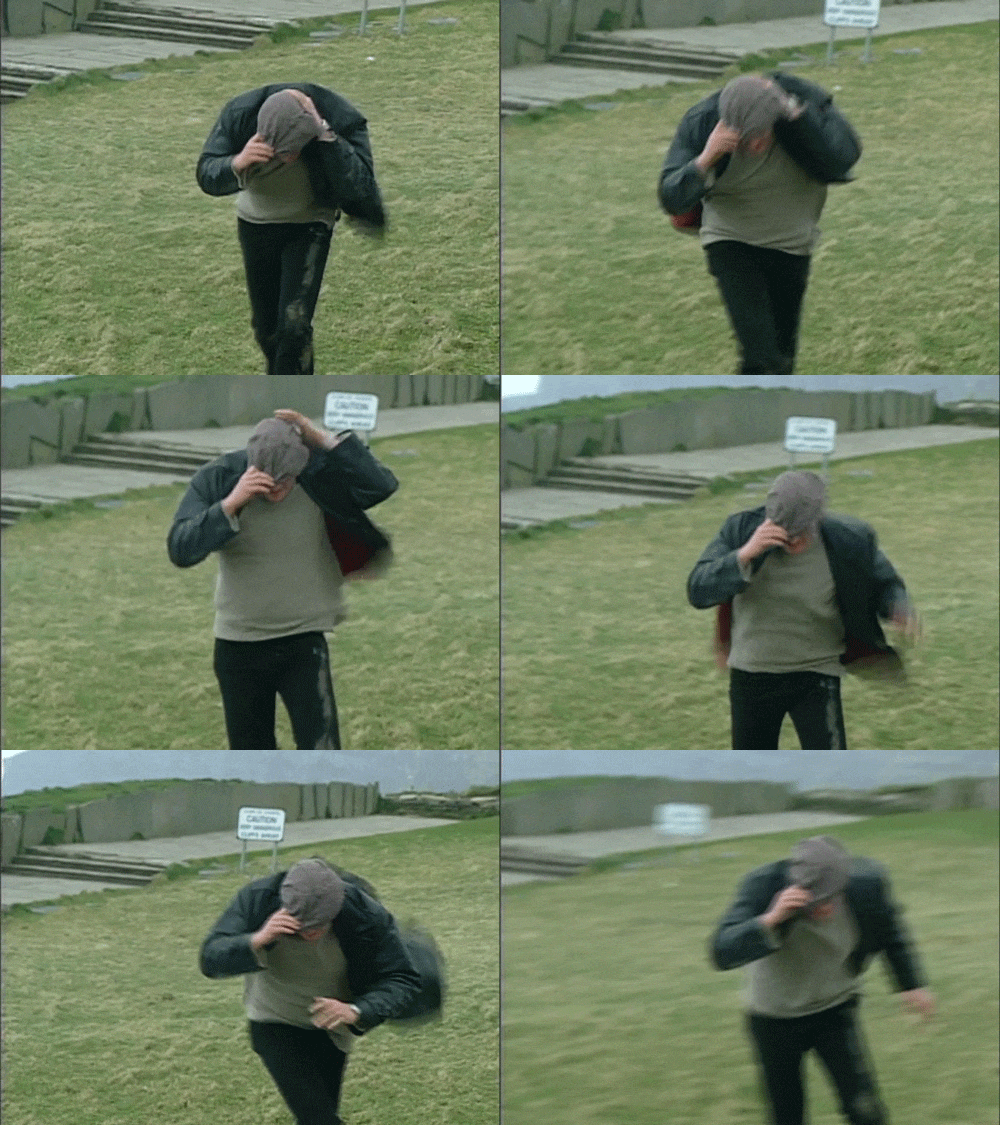
You see them at every high school (and sometimes college) ballfield. In cold weather climes they are bundled up in parkas, blankets, quilts, wool hats, mittens, and whatever else they can find to keep them warm, sitting in their camp chairs either alone or maybe in pairs, steeling themselves against March and early April winds that cut through all their layers like a knife.
In warmer climes they might have rain ponchos or even makeshift shelters to protect them against the showers that can crop up out of nowhere and drench them in a matter of minutes if they’re not prepared.
They do all of this without the assurance of a reward for their efforts. Because these aren’t the parents of the starters or regular players.
No, they’re the parents who show up game after game, putting up with the elements and the difficult conditions, hoping against hope they will get a chance to see their daughters get into the game for an inning or two.
I remember watching them when my daughters were playing high school softball. When I was at a game, no matter how cold or wet it was, I knew I would get the opportunity to see my daughters play the game they loved.
I could count on seeing them pitch, hit, play the field in just about every inning.
But then I would look at these parents and admire their fortitude. They had no such assurances their daughters would get into the game.
They could go days or weeks at a time and never see their daughters so much as pinch run. Their only real hope of seeing their daughters on the field was for their to be a blowout, i.e., their daughter’s team getting either so far ahead or so far behind that the coach would take the starters out and give an inning or two to the bench players.
But you know what? They showed up anyway, game after game, braving the cold, the wind, the occasional rain or even sleet, cheering for the team and just being there supporting their own daughters.
That, my friends, is love.
While honestly I was glad I wasn’t one of them, and even felt a little bad for them in a way, I also couldn’t help but be impressed by their dedication and their quality of character. It would have been easy for them to figure there’s not much point in going, especially when the team was playing against a close conference rival where one run might be the difference between winning and losing.
They could have easily thought, “She’s never going to get in so I might as well use the time more productively.” But they didn’t.
Instead, they showed up before the game started and hung around until the end, supporting their daughters in their sport of choice.
So here’s to all of you who make that choice and sit through all the weather and other challenges just on the off-chance your daughter gets an opportunity to play, even if just for an inning. You are good people, and your dedication hasn’t gone unnoticed.

Dress warm (if needed), keep dry, and I hope your patience is rewarded sooner rather than later.
My good friend Jay Bolden and I have started a new podcast called “From the Coach’s Mouth” where we interview coaches from all areas and levels of fastpitch softball as well as others who may not be fastpitch people but have lots of interesting ideas to contribute.
You can find it here on Spotify, as well as on Apple Podcasts, Pandora, Stitcher, iHeart Radio, or wherever you get your podcasts. If you’re searching, be sure to put the name in quotes, i.e., “From the Coach’s Mouth” so it goes directly to it.
Give it a listen and let us know what you think. And be sure to hit the Like button and subscribe to Life in the Fastpitch Lane for more content like this.
Top photo by Yakup Polat on Pexels.com
Weather Outside Frightful? You Can Still Practice Part 1

In my part of the world we are currently at the time of year when the weather outside is, as the song says, frightful. Cold, snow, high winds, icy ground, and more make going from the house to the car, much less trying to pitch, hit, field, etc., a rather unpleasant experience.
In other parts of the world you may be facing monsoons, or at least a rainy season that has turned everything to mud, dust/sand storms that make it hard to see your glove in front of your face (if that’s your idea of a good time), or other weather phenomena that make outdoor practice time a no-go fo a while.
Sure, you can go to an indoor facility where it’s warm (or semi-warm at least) dry, and reasonably well-lit. But that means there has to be one available in your area, paying a fee (which not all can afford), and having transportation to it – none of which is a given.

So does that mean you have an excuse to skip practicing entirely until the days start getting warmer/drier/less frightful and spend all your time watching Tik Tok videos or sending Snaps between your friends or whatever it is you spend your free time on? I’m not judging.

No, it doesn’t mean that at all. Hate to break it to you but there are plenty of ways to practice that don’t require a facility, or even fastpitch softball equipment.
A lot of these activities actually help break down the skills and let you focus on areas in which you’re weak. You know the kind of things you hate doing when you drag your way all the way to a training facility where you’re paying good money for cage time.
But think of it this way: if you put in the time now to work on these details, you’ll be that much further ahead when it’s time to take the field next spring.
Over the next few weeks we’ll look at options for at-home practice broken down by position or skills. Today, we’re starting with…
Pitching
- Brush contact and wrist pronation– If you’ve been paying attention at all you know you need brush contact that creates pronation (inward turning) of the wrist, not a forced upward wrist snap, to deliver the highest level of energy into the ball in order to maximize speed. But if you were taught to do wrist snap drills, either standing three feet in front of a cager and forcibly snapping or kneeling on one knee in front of a catcher or wall, putting your arm behind the other leg snapping from there, you know how hard it can be to retrain yourself to pronate. Here’s where a rolled-up pair of socks is your friend. Put those socks in your throwing hand, pull your lower arm back a bit while turning the palm of your hand outward, then let your hand and forearm come forward rapidly, brushing lightly against your hip while allowing (not forcing) your hand and wrist to turn inward. Do it over and over until it feels natural, then move further up the back side of the circle, and keep working your way back until you can make a full circle. The nice thing here is you can throw the socks into any wall in the house, or even a mirror, without doing any damage.
- Leg drive force – This is another thing that almost every pitcher can use more of. Yet most don’t focus on it as much as they should. But it’s another thing you can do at home. All you need is about 8-10 feet of space and a floor where you won’t slip, such as a concrete floor in a basement or garage or even a rec center. Take all the leg drive drills your coach has given you and do them without throwing. You can start by not using a throwing motion at all, then add a motion (but no ball) to it. Then take your rolled-up pair of socks and add them into the mix too. Keep working on maximizing how you’re using your legs, and how you’re stopping yourself, until you feel like you’re flying rapidly and weightlessly forward then stopping suddenly. Focus more on speed of movement than distance.
- Leg drive timing – One of the most important checkpoints for pitching speed is what happens with your drive foot when your arms are at 3:00, i.e., straight out in front of you. It should be detaching from the pitching rubber at that time. If it’s not, home-based practice is the perfect time to work on it. I recommend setting up your phone to record video so you can see if you’re getting off the rubber on time, because if you could feel it you’d already be doing it. Usually this problem occurs when you lead with your hands/arms instead of your legs/hips. So to address it, put your hands/arms behind your back and work on driving out with just your legs. Do that hundreds of times to get the feel of starting with your legs/hips, then slowly start adding your arms back in, stopping at 3:00 first, then 12:00, then all the way around. Check the video to make sure you’re doing it correctly and don’t move on until you can nail it every time at that point. Finally, add in the socks to make sure you can maintain the timing while actually throwing.
- Elbow bend – I know some of you were actually taught to make your arm long and straight, and then push the ball palm-down on the back side of the circle. But that’s not the way high-level pitchers pitch – even those who were taught (or teach others) to do it that way. Instead, you need to keep the ball facing either upward or slightly out to the side, and get some bend (flexion) in your elbow so that when you come into the release zone you can whip the forearm past the upper arm (humerus) in a series of decelerations and accelerations. It is one of the toughest corrections to make, but f you can’t do it you’ll never maximize your speed. To relearn this movement start by placing the little finger-side edge of your hand against a wall and then move around the circle keeping that edge against the wall until your forearm is forced to pronate naturally near the bottom of the circle. Rinse and repeat, being sure to keep your arm relaxed. Then move away from the wall, stand with your feet at 45 degrees to your “target” and take something that weighs around 16 oz. (a plyo ball is preferred but a can of green beans works too) and SLOWLY move your arm around the circle, paying attention to whether you can feel the bend. Be sure to keep your shoulders from moving forward as you start to pull the ball (or green beans) down the back side of the circle. Check yourself with video. The OnForm app can be helpful here, because ir will actually measure how much elbow bend you’re getting. It should be roughly 20-30 degrees as you get to about 8:00, although your results may vary depending on your motor preferences. Then get rid of the weight and use a faster throwing motion. Finally, start throwing the socks and again check with video to see if you’re maintaining the bend. If not, go back to the last step where you COULD keep the bend and work more from there before trying it again.
- Spins – For this one you’ll need a little more room and a foam ball. A regular Jugs Lite Flite softball will work for pretty much anything. An EZ Riseball is a great choice for the rise or curve. And no, I’m not getting any promotional consideration for either. Take your choice of ball and work up-close into a net or a tarp. You may want to mark the seams of the Lite Flite with a Sharpie marker to make it easier to see the spin direction or spin axis (whichever you prefer). Spending time on the spins at home will save you time during lessons or practice later, and will help ensure you’re getting the movement you’re looking for when it’s time to pitch to live hitters.
So there you go – 5 ideas of what to do to either correct pitching issues or enhance pitching performance. Next week we look at what hitters can do in the same situation.
Snowstorm photo by Jeffrey Czum on Pexels.com
Brrrr It’s Cold; Take Advantage of It

As I write this we are not only in the beginning of the Christmas/New Year holiday vortex but also an actual polar vortex. Winter Storm Elliott is hammering much of the U.S., including parts that aren’t used to it, with snow, gale force winds, and bitter cold of the type that makes you run right back inside as soon as you feel it.
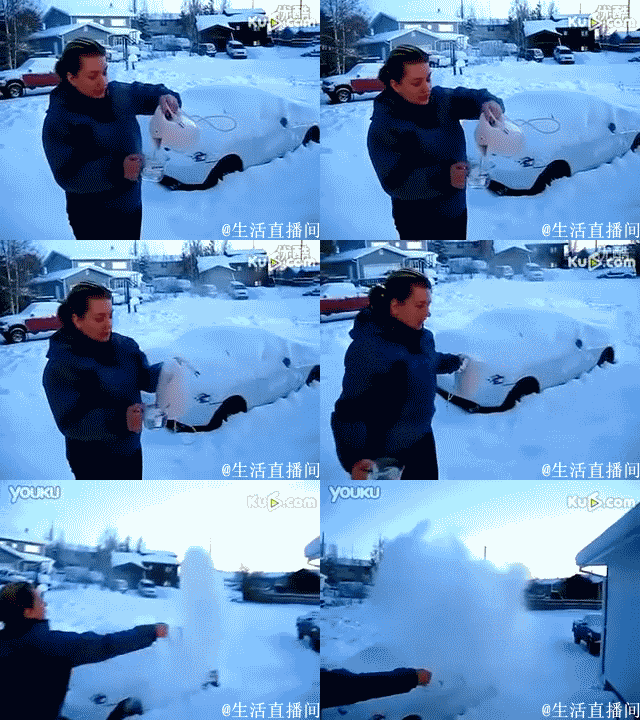
It’s so bad where I live that the facility I usually work out of has been closed for the last couple of days. No sense having people risk their health and/or their lives just to come to a lesson when there are no important games on the immediate horizon.
So does that mean all softball-related activities must come to a dead stop? Hardly.
In fact, times like this offer the perfect opportunity to really dig into mechanics and the mental game to work on the little things that can make a huge difference in a player’s overall performance.
It’s like when a player comes to a lesson and says they are feeling a little ill, or tired, or have an injury. I light up – not at their misfortune but at the chance to go deeper in aspects of the game that they might not want to spend so much time on ordinarily.
Not because it’s not necessary, but because it can be really boring to them. When it’s all they can do, however, those things become a lot more interesting.
So while it’s bitterly cold or snowy and you’re stuck at home (or even if it’s bright, sunny, and balmy for that matter) here are a few things to work on that don’t require a cage, a bat, a regular softball, or even much space.
Quick Pitching Release
I have yet to meet a pitcher who doesn’t want to be faster (including a few pretty famous ones). While speed alone isn’t everything, the more you have the better everything else seems to go. And the better you can get by until you can improve other aspects of your game.
One of the keys to speed is the ability to transfer as much of the energy the pitcher has generated through leg drive as possible into the ball. That requires a lightning-quick yet relaxed pronation of the forearm at release.
Building that pronation doesn’t require a lot of space or fancy equipment. You can:
- Throw a rolled up pair of socks into a wall or mirror
- Throw a plyo ball, foam ball, or regular ball into a net
- Walk around the house practicing releases, Ks, and full circles with nothing in your hand
- Perform various exercises (such as squeezing a stress ball) to build your grip strength
Focusing on that one little bit can pay huge dividends the next time you go to pitch at a full distance.
Leg/Body Drive and Timing Off the Rubber
Don’t worry non-pitchers, we’re getting to you. But this is another area that’s often under-trained when pitchers are left on their own.
A lot of pitchers have trouble generating effective leg/body drive off the pitching rubber. After they load they will start to reach forward with their stride (glove-side) leg while essentially standing on the drive (throwing-side) leg.
This type of movement is inefficient, even if it’s done quickly. To generate the kind of energy needed to throw hard you have to get the hips driving forward before the stride leg has gone out fully.
In other words, pitchers have to learn to use their legs together instead of one at a time. Fortunately, this is the same type of leg action used when you skip (or for you multi-sport athletes go for a layup).

Find a few feet of space and skip. Feel how the legs are working. Then try doing the same thing but adding a pitching motion to it.
Take video so you can see if you’re truly getting some spring in your step or if you’re just standing on the pitching rubber as the stride leg goes out.
You can also just stand on the ball of the foot of your drive leg, push forward, then “catch” yourself with your stride leg. This should all occur in a quick, short motion rather than trying to get out far.
Feel the legs working together, then start extending it until you can do it full speed, just as you would in a game.
Swing Mechanics
You probably know from endless hours of lessons what you’re supposed to do at each phase of the swing. But are you actually doing those things?
Here’s a way to find out. Set yourself up in front of a full-length mirror and watch yourself take a swing. If space is limited substitute a curling iron or a short pool noodle for the bat.
Go through it slowly and see what position your body is in at each phase. Check to see that you are:
- Getting positive movement forward
- Leading with your hips
- Getting separation between your hips and shoulders
- Keeping your hands up instead of dropping them to launch the bat
- Driving your back side around your front side
Do it slowly, over and over, checking each aspect. Then do it a little faster, then a little faster, each time checking all those aspects.
While this doesn’t do much for your timing, it ensures that if you are on time you’ll greatly increase your chances of hitting the ball hard.
Ball Transfers
While this applies to any position, it especially applies to catchers. The faster you can transfer the ball from your glove to your throwing hand, the sooner you can get the ball on its way so you can throw out even the fastest of rabbits.

This is a skill that can be practiced in a bedroom or living room.
Start out barehanded, with the ball in your glove hand. Then transfer it to your throwing hand by slamming it from one to the other.
Then add a glove, doing the same thing. Do it over and over, each time trying to go a little faster.
Before you know it you’ll be able to move that ball from one hand to the other with the best of them.
Mental Game
Ask any coach or player how important the mental game is and they’ll likely tell you it’s hugely important. Then ask them what percentage of their practice time is spent on the mental game and, if they’re honest, they will probably tell you little or none.
That’s because physical practice seems like practice. Mental game practice feels like you missed something you should have been working on.
This is your chance. While you’re stuck inside, do some visualization, seeing yourself making great plays or slamming great hits.
Work on your positive self-talk. A kind word from yourself at the right time can work wonders.
Look online for various stress-relieving techniques you can use during a game. Examples include:
- Squeezing a stress ball or other device
- Grabbing a handful of dirt, squeezing it tightly, then throwing it away
- Inhaling deeply through your nose and blowing the air out slowly through your mouth
- Washing your hands with water
- Creating a pre-pitch routine or ritual
Turn on loud music or a talking podcast then try to do something unrelated such as a reading or math problems. It’s amazing what this exercise can do for your ability to focus.
Time invested now in your mental game can pay big dividends when it’s actually time to play.
No Justification Needed
Really, these things aren’t just for bad weather. They are things you should be doing any time if you want to get better.
But bad weather provides the perfect opportunity because there is little else you can do.
Don’t waste this chance. Get on it now and you’ll find you’re than much farther ahead in your goals once you hit the field again.
Photo by Ir Solyanaya on Pexels.com






 Life in the Fastpitch Lane