Blog Archives
6 Ways to Take Advantage of the New Year

The holidays are over and the calendar has flipped back to January. I would say people are stressing over writing the wrong dates on their checks but who writes checks anymore?
Except the little old lady in front of you in line at the grocery store when you just want to buy a loaf of bread or a half gallon of milk and get on your way?
While in reality New Year’s Day is just an arbitrary date (as evidenced by the many different calendars, each with their own first day of the year), the idea of a new year does provide an extra incentive to think about doing things a little differently going forward.
So with that in mind, here are a few ideas of how you can shake things up a bit and make this your best softball year ever.
1. Get New Batting Gloves
I actually see this one a lot. Hitters go to put on their batting gloves and half their fingers are sticking out, or the palm looks like a surface map of the moon. Or the stench is so bad it hits from 15 feet away.

Batting gloves aren’t that expensive, at least relative to most equipment in fastpitch softball, yet they can save you from a lot of blisters and other issues during long practice sessions. Sure, your daughter should have asked for them for the holidays but she didn’t, because the only time anyone thinks about batting gloves is when they go to put them on.
Don’t be cheap. Pony up a few bucks and replace them. If your daughter is superstitious, tell her she can keep the old gloves in her bag, or her back pocket. Preferably in a sealable plastic bag.
2. Clean Out Bat and “Go” Bags
Over the course of a season, bat bags quickly become a dumping ground for old water and sports drink bottles, half-eaten fruit rollups, used bandages, team handouts, the occasional extra shirt or shorts, miscellaneous plastic wrappers and other detritus of the sport. Not to mention field dirt and those little rubber pieces from turf fields.
With games at a minimum right now, this is a good time to completely empty out the ol’ bat bag, throw or put away everything that doesn’t need to or shouldn’t be in there, and give the inside of the bag a thorough scrubbing to boot. Maybe at a car wash.
The same goes for parents’ gameday “go” bags and coolers. There’s a pretty good chance you have a few science experiments running in there at the moment.
Clean them out before the season starts to crank back up in earnest. Not only will it be healthier (and smell better). It might even make everything a whole lot lighter.
3. Do Some Research about Doing Research
There is a metric crap ton of information about how to pitch, hit, throw, run the bases, warm up, and perform a variety of other fastpitch softball-related skills on the Internet and in social media. Some of it is great, but quite frankly a lot of it is useless at best and garbage at worst.
How do you tell the difference?
Well, rather than just jumping on to the first thing you come across in a search (or while scrolling), do some research about who is putting out the information, such as:
- What is their background?
- How long have they been teaching?
- Do they seem open to new information or are they stuck in their ways?
- How do their students do overall? Not just their one or two best students but across the spectrum?
- Does what you’re reading/watching make sense to you? (You’d be surprised how many videos, especially on apps such as Instagram, actually seem counter-productive when you think about them, even if you don’t have any expertise.)
- Does what the source is espousing match up to what you see the best players in the world doing?
Taking the time to check the source and evaluate what he/she is saying can save you from taking a long, frustrating trip down the road to nowhere.
4. Challenge Your Current Beliefs
It’s very easy to fall into a rut, or assume that you already know everything (or at least enough) about a topic. Taking that attitude can prevent you from discovering a whole other world of knowledge that can make you even better.
Every now and then it’s important to look at information that challenges what you already believe. Especially when it comes to mechanics and general approaches to the game.
You may end up right back where you started, Which is ok – it’s confirmation you’re already on the right track.
But you may also discover techniques or approaches you’ve taken for granted, or that you learned when you were a player, are not quite as beneficial as you thought they were. You can then decide whether to continue blindly following what you’ve always done or make a change that will help you going forward.
Either way, you’ll have made an informed choice.
5. If You’re Taking Lessons, Attend a Non-Affiliated Clinic or Camp
Taking private lessons is a wonderful thing. Obviously I highly recommend them as the best way to make progress toward improvement.
But after a while even the best-designed lessons can get a little dull. They also usually have a limited perspective, even if you’re in a group lesson with 2-4 other players.
Going to a clinic or camp with a different instructor(s) can help in a few ways. Not the least of which is a different instructor may see something your current instructor doesn’t because of familiarity. After a while, we all tend to see what we’re used to seeing.
It also gives you a chance to see how you compare to others. That’s especially important for those who are really driven to be the best.
Sometimes in the drive to get to the next achievement we forget how far we’ve already come. A large group setting can show that while you’re still working on things, you’re actually ahead of the curve overall.

It can also show if you’re behind the curve, which may be an inspiration to those who maybe have trouble getting themselves up for practice sessions. Nothing like seeing where others are to get a player to say “I’d better get after this.”
Many of these clinics and camps are just one day, so it’s not a huge time commitment. But they can be enlightening.
Just be sure to do your research again before just signing up for any old camp or clinic. Make sure the instructors are going to be teaching solid mechanics and approaches or you could end up going backward instead of forward.
6. Do Some Non-Softball Stuff
These days all competitive sports seem to take up a LOT of your time. While you no doubt love it, and wouldn’t trade it for anything in the world, there IS more to life than softball.
This is the time of year to find out what the rest of life is all about. Read a book. Go to a museum or a concert or a dance performance. Watch a completely different sporting event, either live or on TV. Go bowling or ice skating or to a trampoline park (just be careful not to get hurt).
Doing something just for the fun of it will clear your head, reset your spirit, and help you get ready for the long grind ahead.
Make It a Good Year
None of what’s listed here is likely to cost you very much. But the return on investment will be huge.
There’s a reason the windshield is much larger than the rear view mirror. This time of year provides a great opportunity to leave the past behind, symbolically as well as literally, and focus on the road ahead.
Doing these little things will help you do just that.
New Year’s photo by Karolina Grabowska on Pexels.com
8 Tips for Getting the Most Out of Skill-Specific Clinics

I recently had the privilege of working with Rick and Sarah Pauly (Pauly Girl Fastpitch), along with several of the top pitching coaches in the U.S., at a pitching clinic hosted by Jay Bolden. There were two sessions: the first for beginning/intermediate pitchers that focused on the fundamentals of good mechanics, and a second for more advanced pitchers where we did a lot of data measurement using various technologies such as 4DMotion for overall mechanics and kinetic sequence, Diamond Kinetic Balls for spin direction and rates, Pocket Radar for speed, as well as stations that focused on improving the rise and drop.
It was quite an opportunity for the participants to learn about pitching. Yet when it was all over a few of us had a discussion about how some of them had squandered that opportunity.
So that’s what today’s blog post is about: some tips that will help future campers ensure they get the most from the time they spend. And their parents get the most from their investment.
Tip #1: Come with an open mind
Perhaps the most frustrating comment any instructor in a situation like that can hear is “I don’t do it that way.” Basically that says “I have my way of pitching, hitting, etc. and I don’t want to make any changes.”
Ok fine, but then don’t bother signing up for the clinic. If you’re already doing what you want to do you and have no interest in hearing other perspectives, or perhaps finding a better approach, then there’s no point in driving all that way and taking up three hours of your time.
Stay home and play like you want, and leave the spot open for someone else.
But really the value in a clinic like this is hearing perspectives and learning techniques that could help you become better than you already are. If you listen with an open mind, and try new things even if they’re different from what you’ve done before, you may find you like the new things better. And that they work better for you.
The more open you are to different techniques, or even different cues, than you’ve heard in the past, the more likely you are to find what works best for you.
Tip #2: Sign up for the right level
This one comes from my friend Shaun Walker, an innovative pitching coach with Next Level Softball in Bruno, West Virginia. When you’re signing up at a clinic that offers different levels, it’s important to be honest about your level of accomplishment in the skill being taught.
It’s not just about age. It’s also about what you can do with the ball in your hand. If you’re a 14U pitcher throwing 45 mph who has trouble hitting her spots even though you’ve been pitching for four years, the beginner/intermediate clinic will likely suit you better.
Because pitchers who struggle with control on their fastballs or can’t at least reach the average speeds for their age levels probably don’t need advanced instruction on the rise and drop. They need to improve their fundamentals first.
If you’re going to sign up for an advanced clinic, you should be able to throw decently hard (55+ mph), have a reliable offspeed pitch, and at least have a start on a movement pitch or two. You need a fairly high degree of proprioception (fancy word for body awareness) because the subtle adjustment required to spin the ball in different directions will be tough to accomplish without it.
If you sign up for an advanced clinic and are completely lost and unable to do the things that are required you’ve just wasted three hours of time (plus travel) along with the money you invested. Take that same time and money and invest it in the beginning/intermediate session and you’ll get a lot more out of it.
Tip #3: Use it to see if you/your daughter likes pitching
Becoming a fastpitch pitcher requires a lot of time and effort, and in most cases a significant investment in pitching lessons. Why go down that road if it turns out the player doesn’t actually like it?
Keeley Byrnes, a great pitching coach with Key Fundamentals in Oviedo, Florida says that the beginning clinics are a great way to find out if the player likes and wants to become a pitcher. You can go through some instruction, find out just how challenging it can be to become a pitcher, and determine if it’s a path you want to try without the huge time and money investment of private lessons.
The clinic structure is also more conducive to “sampling” because with multiple players there isn’t as much direct one-on-one contact – particularly important to those kids who are a little more shy. They can give it a try and see if it’s for them without drawing too much attention to themselves.
Tip #4: Pace yourself
The structure of a three-hour clinic is unlike most typical practices. I have seen so many kids come out like a bright comet in the sky, only to burn themselves out quickly and have nothing left by the end.
It gets even worse if you’ve signed up for both sessions at a multi-level clinic like the one last weekend. That’s six hours of pitching. Who does that on a regular basis?
Don’t feel the need to get as many reps in early as you can. Take your time and pace yourself. Your future (six hours from now) self will thank you.
Tip #5: Understand it’s ok to fail
We all hate to fail, especially when standing in a room filled with our peers (or competitors). Yet a clinic is the place to try out new things.
The problem with new things is we’re not good at them, so you’re probably going to fail more often than you’re used to.
That’s ok. This is the place to do it.

If the clinic is any good at all, the instructors will understand and will try to help you get better. They will love your willingness to put yourself out there and do the hard work required to change.
Do that, and the most likely result is that you walk out knowing how to become a better pitcher than you were when you walked in. And you’ll be more ready to try new things as they come along.
Tip #6: Parents should be curious – but resist the urge to interfere
We get it. It’s tough for parents to watch their kids struggle, and it’s tough to resist the urge to step in when it happens.
But don’t.
Shaun says the ideal parents at clinics are those who listen so they can help their kids later, but who don’t get in the way of the learning process during the clinics. They certainly don’t say, “Ah, don’t listen to her, just keep doing it the way I showed you after searching on “fastpitch pitching” on the Internet.
Instructors at a quality clinic will not only tell you what to do but why it’s important. I know Rick Pauly is a master at this.
How much to participate can be a challenge, especially for some parents. You’re going to know your kids better than the instructors do, and will spend a lot more time with them than the clinic instructors will.

But land the helicopter anyway. Listen and learn along with your player, ask questions if you don’t understand something, but otherwise stay out of the way. It’s the best value for your entertainment dollar.
Tip #7: Embrace the different ways of teaching from different instructors
Keeley correctly states that one of the challenges of one-on-one instruction is that they player is only hearing things from one person. That instructor has his or her way of teaching things, but there are many ways to say the same thing.
One of the advantages of a clinic with multiple instructors is the opportunity to hear different explanations for the same thing. While one may not resonate with a particular player, the next one might.
And even if none of them is exactly on the mark for how that player needs to learn, the combination of statements, as long as they’re all basically saying the same thing in different ways, will help the player translate the instruction into a form she can use.
The other advantage of the clinic setting is learning from other players.
The participants are likely to be broken into groups. If there is a group of three, for example, and only one of them understands the instruction, she can also help explain or demonstrate it to the other two.
I’ve seen plenty of great examples of one clinic participant helping another to learn. Both of them benefit.
Tip #8: Gain more exposure to new things
While this sounds similar to Tip #1, it’s more about learning about things or taking in feedback you’ve never received before.
A good case in point is the technology we used at the last pitching clinic. You may think you have a great rise or curve. But the Diamond Kinetics ball will measure and show exactly what spin speed and direction you have.
If your rise is working pretty well but you discover you have a 10:00 spin, you’ll know you have more work to do to get it closer to a 12:00 spin. Make that change and it will be even more effective.
The 4DMotion technology is also incredible. It can measure all types of parameters from simple sequences (are you decelerating Hips-Chest-Arm?) to the speed at which your forearm is decelerating as you release the ball (which indicates the efficiency of your energy transfer).
With hard data in hand you can make improvements that may not have shown up to the naked eye, or even on high speed video. All of which will lead you to becoming the best pitcher you can be.
Get the most out of it
Attending a quality clinic can be great, or even a game-changer, if you approach it with the right mindset. But it can also be a giant waste of everyone’s time and energy if you don’t.
In other words, you’ll want to do more than simply get the t-shirt as Ken Bergren, a pitching coach in Oregon says.
Follow these tips and you’re far more likely to walk out thinking “That was fantastic.” And inspired to go out and work even harder.
Return of the Indiana United Fastpitch Elite/Rick Pauly Clinics
Earlier this year I blogged about a fantastic fastpitch pitching event held, of all places, in Southeastern Indiana. Put on by Rick Pauly, hosted by Indiana United Elite Fastpitch and Coach James Clark, and featuring an array of top-level pitching coaches, it was an incredible learning experience for players, parents and coaches alike.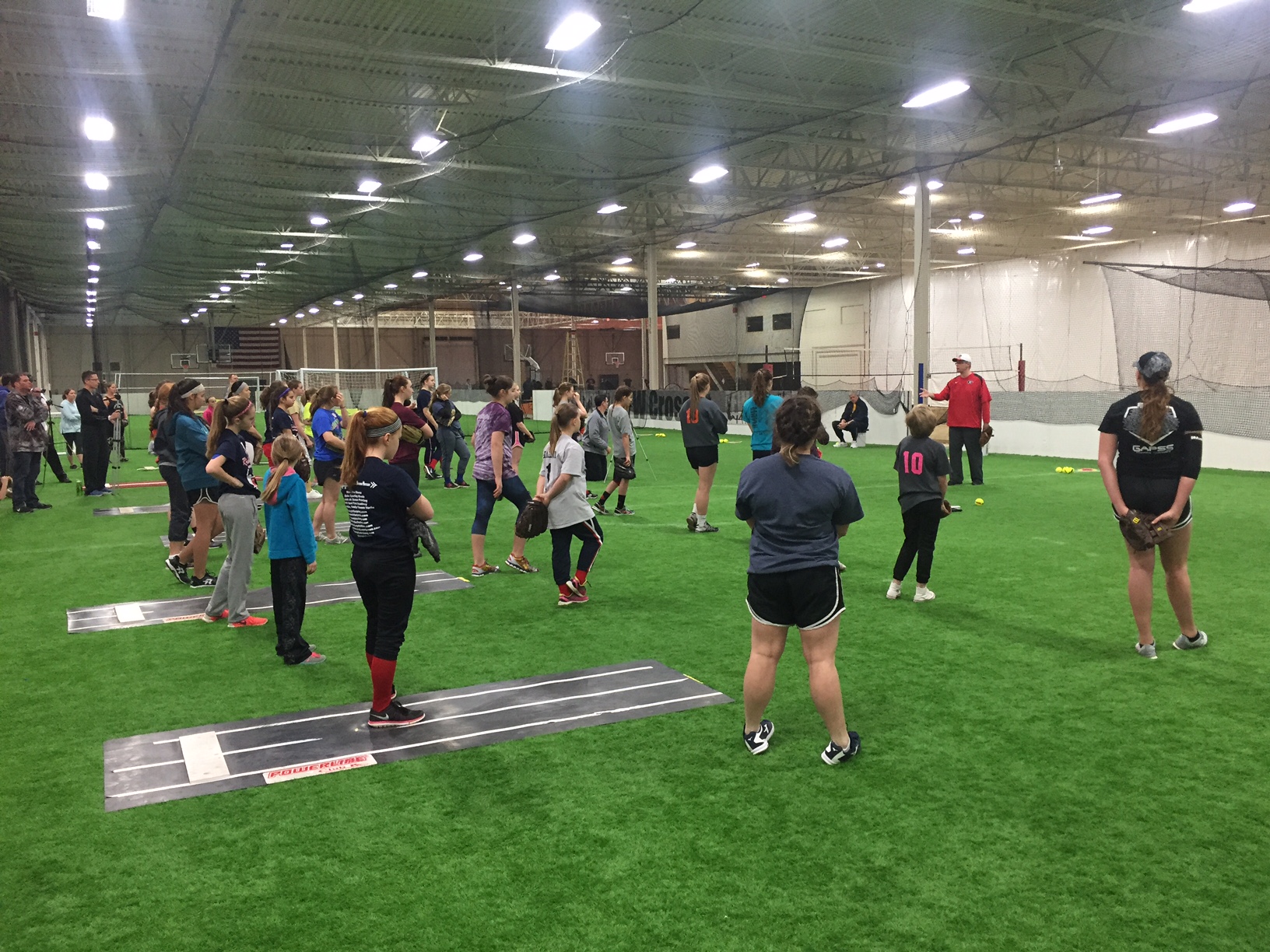
Never one to be content to rest on his laurels, Coach James has outdone himself with the latest iteration. The 2017 clinic, again in Richmond, Indiana, has expanded in its scope to not only offer top-level pitching instruction but also clinics on hitting, catching, the short game/slapping and defense.
This year’s instructor lineup is impressive once again, with college coaches and former college and NPF players offering hands-on instruction. The nice thing about these clinics is they’re not like so many, where they show a big name who is the “face” but then have very little interaction. The faces you see on the flyer will all be actively participating in or leading the instruction.
Throughout the weekend there will be plenty of time for discussions and questions too. One of the highlights for me last time was many of the instructors gathered together in a room tossing around ideas and opinions until the wee hours of the morning – all part of an impromptu session that began with a simple question. Those little side conversations alone are worth the price of admission.
Coach James promises it will be bigger and better than ever, and I believe it! The clinic runs the weekend of January 6,7 and 8, 2017 – timed this time to both make sure it didn’t interfere with high school and college seasons and to give players time to lock down what they learn before tryouts begin for spring high school ball.
Click here to register, and here to schedule the sessions you want and to pay. Most sessions are $70 each and run an hour and 15 minutes. The exceptions are the recruiting discussion that costs $25, and the beginning and advanced pitching sessions with Rick and Sara Pauly which cost $150 and are scheduled for 3 hours, although last year Rick was having such a great time he ran a bit long on both sessions.
Download the flyer for complete information, and then be sure you sign up now. Slots are filling fast. I’m sure you’ll find it’s a great investment in your softball future.






 Life in the Fastpitch Lane