A great story of redemption
Long-time readers know I love stories where a fastpitch softball player who is overlooked or dismissed by a coach comes back to have some success. So today I’m sharing one that was in the newspaper recently. It was about a girl who played for me in 2010 and 2011 — Erin Pauly. Thanks to her mom Jan for pointing it out to me. 
I don’t know how long the link will stay live, so just in case you can’t read it anymore here’s the short version — plus a little extra background.
First of all understand Erin is a great a kid — sweet, polite and a good teammate to all. She’s also a fierce competitor. She had kind of a rough year in 2010, but experienced a lot of success last year in the summer,
This spring she made varsity at Carmel Catholic High School as a sophomore but couldn’t quite seem to get on track. According to the story her 16U travel team tried to turn her around as a slapper, but she struggled with it when she got a chance to play. She was benched, then eventually she was demoted to the JV team.
The newspaper says she was sent down to rebuild her confidence, but having heard how it was handled — no conversation or explanation, just you’re not on varsity anymore — I think it’s safe to say she was demoted. She played JV until the end of the season, when she was brought back to varsity with a handful of other call-ups. This time, however, things were different.
Her confidence was back and she started playing like the Erin I know. She started ripping the ball from the right side, and in the last couple of playoff games got some good hits, including a big double in a losing cause in Carmel’s last game.
If you don’t get to see it, the newspaper story I’m referring to the cool thing is she got the headline and was the focus of the story. That’s a pretty cool redemption for someone who was pretty much forgotten and dimissed in mid-season.
In Harold and Kumar Go To White Castle one of the characters says “The universe has a way of working out the way it should.” In this case that was true.
Come back again soon for another story of the triumph of an underdog. In the meantime, what did you think of this story? And if you have your own story of redemption, please share it in the comments.
Congratulations to Grayslake North High School
Had a chance to watch another great high school playoff game today. This time it was Grayslake North and Prairie Ridge high schools squaring off for a Sectional title.
The game featured two of the top pitchers in the area — Kristi Gandy for Grayslake North and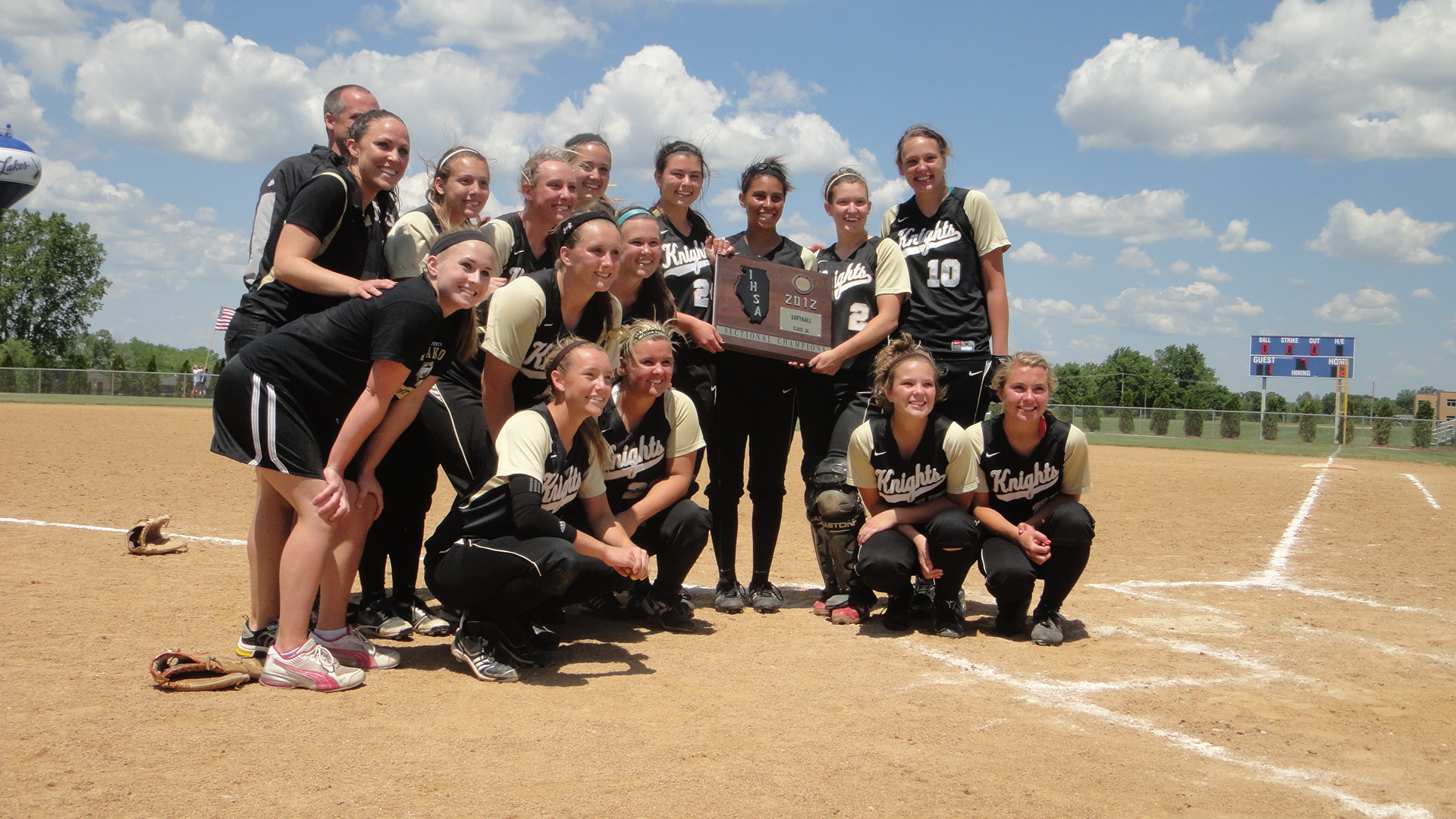 Kirsten Stevens for Prairie Ridge. Both are dominant pitchers and leaders on their teams (along with being strong hitters as well), and today was no exception. Hits were tough to come by all day on both sides.
Grayslake North prevailed by a score of 2-1. The difference was a couple more timely hits for Grayslake North, and some outstanding defensive plays when they needed it.
In the top of the sixth, trailing 2-1 with two outs and a runner on second, one of the Prairie Ridge hitters stroked a single to medium deep left. Knowing how tough runs had been to score all day, the Prairie Ridge coach sent his runner home. Left fielder Courtney Peterson scooped up the ball and fired a perfect strike home. The ball didn’t make it on a fly — it actually rolled for the last part — but catcher Brooke Tracy dropped to her knees, fielded the ball, leapt to her feet and made a very sure tag to cut down the runner at home to end the inning.
Then in the top of the seventh Kristi, who was getting squeezed on the inside corner according to several observers (including Lake Forest College pitching coach Laura Matthews), issued a walk to the leadoff hitter — never a good idea in a tight game. Especially when the leadoff hitter for the inning was also the leadoff hitter for the game. But I saw Kristi and her teammates communicating something prior to facing the next hitter.
As he had throughout the game, the Prairie Ridge coach had his hitter lay down a sacrifice bunt with a runner on first. But there’s a problem when you’re predictable. Grayslake North was ready for it. When the bunt went down, instead of taking the sure out at first, third baseman Kelsey Borders fired the ball to second baseman Jessica Davis covering second, erasing the lead runner. One out.
The next hitter grounded to first baseman Christina Freese; again, instead of taking the automatic out at first she wheeled and fired to shortstop Jordyn Bowen covering second, nailing the lead runner again. Two outs. A couple of pitches later the cleanup hitter hit a short pop to Borders at third, who ran in, squeezed the ball and secured the victory.
One other effort worthy of note. I saw in the newspaper this morning that Stevens struck out 15 North hitters. That seems like a strong but not particularly remarkable performance until you realize that was in six innings since they were the visitors. So out of 18 possible outs, her left arm was responsible for 15 of them. Sounds like she’s ready to pitch for the Cubs!
It was an action-packed, tense but well-played game. Both sides are to be commended for a great job. It was everything we love about softball.
Excellence in sports doesn’t have to be miserable
My friend and co-worker Tim Boivin pointed me toward this story today from the Wall Street Journal. It’s about Olympic swimmer Missy Franklin, and her coach Todd Schmitz.
One of the interesting things in the article covered her training routine. Unlike many high-level athletes who train constantly, Missy’s coach actually has her train less than most, and even gives her weekends off. His rationale is — wait for it — he doesn’t want her to burn out.
Amazing isn’t it? A coach who doesn’t believe you have to spend every waking moment working on your skills.
The other part of the story I personally found interesting was when they talk about her relationship with her coach. Her parents say many people tried to tell them over the years that they should take Missy to a more “high level” coach.
Todd Schmitz is not an international superstar coach. In fact, the swimming club he works through, the Colorado Stars out of Denver, doesn’t even have its own pool. But Missy’s parents resisted the pressure to have her move to a “name” coach because of the excellent relationship she had with Schmitz — and the fact that she kept getting better under his instruction. It seems to have worked.
Give the article a read. It’s worth it as a reminder that excellence doesn’t have to miserable. You CAN be a world class athlete and still have a life.
Watched a great fastpitch softball game today
Just had to comment on this one. Today I watched Carmel Catholic High School v Mundelein High School in a Regional championship game here in Illinois. For those who don’t know, both schools are in Mundelein so it was a true cross-town rivalry.
The play on both sides was impressive. Lots of great defensive plays supporting strong pitching. Carmel was able to put a few more legitimate hits together, though, and ultimately won 2-0.
One of the great plays I saw was Mundelein pitcher Molly Ellett (one of my pitching studnets) fielding a suicide squeeze and getting the out at home. She also took on another bunt and got the out at first. Those were big outs.
On Carmel’s side, one of the memorable plays was shortstop Kathleen Felicelli fielding a ground ball that had first hit pitcher Nicole Bitter’s glove, grabbing it on the run and throwing for the out.
Have to admit I was proud of my hitting student Amy Abel as well. She hit a timely single for Carmel, and later laid down a perfect sac bunt (although I would’ve rather seen her swing away as she has had a hot bat lately).
Baserunning was good on both sides as well. I saw a couple of runners take advantage of balls in the dirt, aggressively taking the base even though the ball didn’t get far from the respective catchers. Each team was looking for every edge it could get.
The only shame was the way the game ended. Molly was rung up looking on a pitch that was clearly mid-shin high. I hate when that happens, but such is life.
Both teams are to be commended on a great game. I’ve seen a lot of badly played HS games this year, so it was fun to see such a good one. Congrats to both sides.
No magic bullets in fastpitch softball instruction
It often seems like fastpitch softball players (and their parents) come to lessons seeking a magic bullet — a tip or hint that will turn them from average to awesome. I wish that was a possibility, because if it was my teams would win a lot more games. It’s as simple — and as difficult — as that.
But the truth is that the only real “magic bullet” in fastpitch softball is hard work. And that isn’t very magical, because it takes a long time and many correct repetitions to make the leap players are looking to make. It is possible in time, however.
This is a theme that’s explored to great length in The Talent Code, an incredible book that every coach, parent and player should read. As I’ve written previously, it explores the myth of being born with “talent” and shows how the people we perceive as talented were actually just more single-minded in their pursuit of excellence. When others would normally quit to do other things, they’d continue on with borderline (or sometimes over the border) obsession.
Of course, those are the ones who are driven to the highest level of whatever they do. Not every fastpitch softball player aspires to play on a National Team or at a top D1 college. Many just want to play and be successful at whatever level they’re at now. But you can’t get there by showing up for a lesson once a week, or once every weeks, and then practicing either not at all or very little in-between.
The most successful players I’ve worked with do the same things:
The other thing they do is give themselves time. They realize that while they can make small improvements over a short period of time, more long-lasting and better-impacting changes take time to sink in during game situations.
With the pressure on it’s all too easy to fall back on old habits, no matter how hard you try not to. But given sufficient time you can replace old habits with better ones, so that’s what you go to when the heat is on. And that’s when real softball success occurs.
In my experience it takes about a year of dedicated effort for real, permanent improvement of a particular skill to set in. What about you? Do you agree? Do you think that’s too long, or too short? Share your thoughts.
And while you’re at it, be sure to subscribe to Life in the Fastpitch Lane so you’re always on top of new posts as they come out. The easiest way is to leave a comment and check the box. Otherwise, choose the RSS feed you like and it to your reader!
Interesting info on moms for Mother’s Day
Not really fastpitch softball-related, but I got an email today that led me to an interesting infographic on moms and the sacrifices they make for their kids. You softball parents no doubt know all about this, but it’s interesting to see it in hard financial figures. And this doesn’t even count all the time that goes into driving to games, lessons, practices and all the other stuff.
In any case, enjoy! And happy Mother’s Day.
Fastpitch hitting: that magical moment
The other night I was doing a fastpitch softball hitting lesson with a high schooler named Becky. She has developed a nice swing overall, but I wasn’t quite seeing the pop I was looking for. She was trying, but it just seemed a little off.
Then all of a sudden it happened. Her timing was right, and she just turned like heck on the ball, and the ball really jumped off her bat! Like Lucy instructing Schroeder on how to play the piano I got all excited and said “That’s it! Keep doing what you did there.” And she did.
And that’s the thing sometimes with fastpitch hitters (and their instructors). We all get so caught up in trying to perfect the mechanics that sometimes we don’t put enough emphasis on just plain being aggressive. So what you wind up with is a swing that looks awesome when played back at 60 or 120 frames per second on video, but that doesn’t deliver a particularly well-struck ball.
That whole idea of being aggressive, or swinging with enthusiasm as I like to put it, is very important. As I’ve said many times there are no style points when you’re hitting in a game. On a tee, or in a drill, we’re going to work on getting the mechanics as close to what we think is perfect as possible. But when you’re in a game, or facing live toss or a machine, you need to forget about all that, go with what you have, and hit with the intent of driving the ball.
It’s an awesome sight when it comes together. With Becky I could just see the magic happening. She’d gone through her load, had gotten to toe touch at just the right time, and at that point she was able to let go and just finish the swing with a determination to hit the ball hard. If you’re not trained to it you may not know exactly what you’re seeing, but you just know it’s right. And it’s a beautiful thing.
What has your experience been? Have you seen a “magic moment” like that from a hitter, where it all just comes together?
Fastpitch softball coach’s guide to scoring a game
In talking to some of my fastpitch softball students and former players in the past few weeks it seems like there is a lot of confusion among coaches as to how to score a game. In particular, I’m hearing some very interesting interpretations as to what is a hit versus what is an error. I think that covers it. But may not. Anyone have any more situations like this to add to the list?
So, as a public service to those who don’t seem to quite get it (or who are making up their own rules as they go along), I offer the following guide. This ought to clarify things, and make it easier for them to keep an honest book that tells them how their players are actually doing — good and bad. You’re welcome.
Fastpitch competitors know how to deal with adversity
Tonight I had the opportunity to watch one of my fastpitch pitching students, Tayler Janda, and her Grayslake Central High School team demonstrate what it means to be a competitor.
It’s rained a lot in the past 24 hours, so I texted Tayler’s mom to make sure the game I’d planned on going to was still happening. It was, she said, and then a few minutes later she texted that it started out ugly.
From all reports (not just Tayler’s mom Jennie) the umpire had a strike zone the size of a loaf of bread. Tayler isn’t a big girl, so she relies a lot on movement and finesse to get hitters out. But the umpire was having none of that, forcing her to leave the ball on the plate when the hitters didn’t swing. By the time I got there, she had given up five runs in the first and three in the second, and her team was down 8-1.
But in the top of the third, she didn’t give up any runs, and from then on started to cruise. She only gave up one more run for the rest of the five innings (which meant the game I saw was pretty awesome). Instead she was inducing easy outs from the hitters, along with a few strikeouts.
What I liked about what I saw was watching a competitor in action. Rather than complaining about the umpire or continuing to throw the same pitches that weren’t working for her, Tayler adjusted. She figured out how to adapt her pitches to get the results she wanted. Yes, she had to leave the ball on the plate more than usual, but she did it in a way that didn’t allow for the big hits the opponents had gotten earlier.
Now, she may have been stoked by the comeback efforts of her team at the plate. They chipped away at the lead, and went on to win it in the bottom of the seventh on a short sacrifice fly to right and some heads-up baserunning. But I think a lot of it was her own inner fire.
When I work with pitchers we talk about the mental game, and what you can control versus what you can’t control. Tayler was the epitome of that tonight.
She couldn’t control the umpire’s miniscule strike zone, so instead she controlled her own frustration and instead decided to work with it. That’s what a competitor does. And knowing how these things go, I’ll bet she inspired her team to go out and snatch a victory from the jaws of defeat.
I know Tayler doesn’t plan to play softball in college. But a competitive spirit like that is sure to serve her well no matter what she does in life. Kudos to her, her teammates and her coaches. It was a fun game to watch!
Rolling bats no substitute for hard work
Got an interesting text today from the mom of one of my fastpitch softball hitting and pitching students. She was out at a game, and her daughter was apparently putting on quite a hitting display. Someone else there was impressed and thought that she had a doctored bat. He was talking about getting his daughter’s bat “rolled” to help her out.
The mom had no idea what it was, and asked if she should get her daughter’s bat rolled too.
Of course I immediately answered no and explained it is illegal. (That’s right, it is against the rules for those of you considering it.) That was enough for her, and she was glad she checked. But as she explained why she was asking it brought up an interesting point.
There are no shortcuts on the road to success, but people still continue to look for one. Rolling the bat is one of them. I’m sorry, but there’s no substitute for quality teaching coupled with hard work.
That’s what the girl whose mom contacted me has done. We’ve worked together for three years, ever since she was 10, and during that time she has made amazing strides — a little bit at a time. The display she put on today was the result of all that time and effort she put in, not a bat that had been doctored.
Yes, it can be tempting to try to get that quick edge. But rather than paying someone to treat a bat, instead invest that time, money and effort in actually learning how to hit. The results will be a lot more satisfying.
As for the mom, if you knew her you’d know how horrified she was to find out she’d even considered doing anything illegal. As she said, she and daughter want no part of cheating. Glad she asked before she did it!






