At tryouts, there’s always someone watching
We’re smack dab in the middle of the fastpitch softball travel ball tryout season right now. For the next couple of weeks, players will be heading to tryouts to show their stuff, and coaches will be trying to determine which players will give them the best chance of achieving their goals next season.
I’ve provided some hints to successful tryouts in the past, both here and in my Softball Magazine articles. But there’s one I haven’t covered before (at least that I remember) that players trying out should keep in mind: at a tryout, there’s always someone watching.
What I’ve noticed over the years is that when you’re running players through a drill, most will give 100%. Let’s take fielding fly balls in the outfield. Coaches hit the ball, or fire one out of a pitching machine, and players run after it. Normally what you’ll see is what you’d expect — good hustle, a sprint to it, and maybe now and then even a slide or a dive.
Really, though, those are table stakes. What I want to see is what players do when they aren’t being given a specific test. Like when they’re sent out to shag balls during batting practice.
I don’t know about other coaches, but when a ball is hit well, I usually want to give the fielders time to catch it before bringing the next pitch. So what do I do? I turn around and watch the fielders.
It’s amazing how many of them laze after the ball, sort of trotting to it and letting it drop in front of them instead of bringing that great effort they showed a few minutes before in the outfield portion of the tryout.
That tells me a lot about their attitude and makeup as a player. You know what I’d love to see? The kid who sprints full out to try to get to the ball, and maybe slides in or dives to get one that might seem out of reach. I see that and it’s going to catch my attention. I now know that player is serious about her game, and will play hard all the time. Because if she’ll go for it while “just” shagging BP, imagine what she’ll do when the game is on the line.
One of the big keys to tryouts is to do something memorable. You want to find a way to separate yourself from the pack. Especially at the older ages, everyone has skills. Or at least nearly everyone does. The way to stand out is to show you have something extra, a fire inside you that inspires you to always do your best, not just when you think someone is watching.
That’s my story and I’m sticking to it. Let’s hear from some other coaches. Do you watch what happens away from the main action? How much does this sort of thing influence your decision, especially when you’re coming down to the last couple of roster spots?
10U team looking for players
Just got a note this morning from a guy I know who is looking for 10U players in the far Northwest suburbs of Chicago. He is dropping down to coach his younger daughter after several years coaching his older one, who has decided not to play her last year of travel ball.
The team is part of the Crystal Lake Tidal Waves organization, and the coach’s name is Steve Kram. He’s a good coach with plenty of experience, and someone I know will do right by the girls. If anyone is looking for a team, or knows a 10U player looking for one, tryouts are Wednesday, August 8, 2012 at 5-6:30pm and next Saturday the 11th at 8am-10am. Tryouts are held at Prairie Ridge High School.
If you’d like more information, you can contact Steve directly at s_m_kram@yahoo.com.
Fastpitch ability is also in the eye of the beholder
Regular readers know how much I love a good fastpitch softball success story. With the tryout season upon us I have a great one to share.
This one involves one of my pitching students, a girl who was 10U eligible but played up on an 11U or 12U team. (I’m old school, so I don’t really buy into the odd-numbered levels, but they seem important to others.)
Anyway, she isn’t the biggest kid in the world, so pitching at 40 feet instead of 35 and throwing a 12 inch ball instead of an 11 inch one was a bit challenging. She probably could’ve dominated hitters in 10U ball. She worked hard in lessons throughout the off-season, though, and got herself prepared.
Unfortunately, the season didn’t go quite as expected. Although the coach recruited her hard during tryouts, convincing her parents to have her play up and not even try out for the 10U team, when the season rolled around he just didn’t seem to have much use for her. I saw her pitch a game and she actually did her job. But her team had trouble making basic fielding plays, and struggled more than they should have. They won, as I recall, but it was tough.
After that she had a tough time getting playing time, either in the circle or on the field. Weekend after weekend she’d come to the games only to watch most of them from the bench. She was very discouraged, and her mom told me she was in tears on a regular basis. She even thought about giving up.
The last two weekends she’s been trying out with some new teams, and it’s been a completely different story. In fact, both teams she’s worked out for so far made offers right away, and are very interested in having her pitch for them next year. She’s gone from unappreciated and discouraged to having her choice of teams for which to play.
There’s a lesson in there for other players, and for all of us, really. While you always want to be working on your game, sometimes it isn’t you. It’s just someone else’s perception of you. Keep working hard, keep battling, and you’ll come out ahead in the end.
Sad news: Mary Nutter passes away
Heard some sad news today, first from Cindy Bristow on Facebook and then later confirmed by the NFCA. Mary Nutter, an NFCA Hall of Famer and the creator of the National Sports Clinics, has passed away.
Anyone who ever went to the NSC knows who Mary was. She was a quite a character and a force to be reckoned with. She ran her clinics with an iron fist (and about as much passion as anyone could muster).
It was always amusing to see Mary when one session was scheduled to end and another to begin. She didn’t care if you were a D3 assistant coach, a former player or the head coach of the National Team. When it was time to get off, she’d cut you off and keep things moving.
That being said, Mary was always looking out for her attendees. Inevitably there will be mix-ups or things missed when human beings are involved. But Mary made sure her people were trained to handle them quickly. And quite frankly, if you could catch her in the hallway she was a blast to speak with.
I attended many National Sports Clinics sessions here in the Chicago area, and much of what I know today I learned there. Mary always brought in the most interesting speakers and had the most interesting topics. Yet even in a large lecture format, where there might be 600 people in a hotel ballroom, you never felt remote. Because Mary always encouraged the speakers to hang out in the hallways and talk to people individually. If it was good enough for Mary herself, it was good enough for the presenters.
Hopefully the National Sports Clinics will continue to bring great softball information to new generations of coaches. But they’ll never quite be the same.
Mary Nutter, thanks so much for all you gave all of us. I think we can say you’re now safe at home.
Do you have any memories about meeting, talking to or seeing Mary Nutter? Add them in the comments section!
Product Review: Personal Pitcher pitching machine
One of the challenges fastpitch hitters often face is getting the opportunity to get in a lot of quality swings outside of practices. While you can go to the batting cages to work with a live tosser or off a machine, that isn’t always possible — especially for younger players who don’t drive yet. So many players are limited to working off a tee in the back yard or garage.
Don’t get me wrong. Tee work is great for working on your mechanics, and I highly recommend a lot of it. Still, at some point you have to make the transition from a static to a moving ball, to work on your timing and ability to track the ball.
One product that makes it possible (and within reach of the average softball family) is the Personal Pitcher pitching machine from Sports Products Consultants. For $119 for the standard version or $149 for the deluxe version you can get a machine that shoots dozens of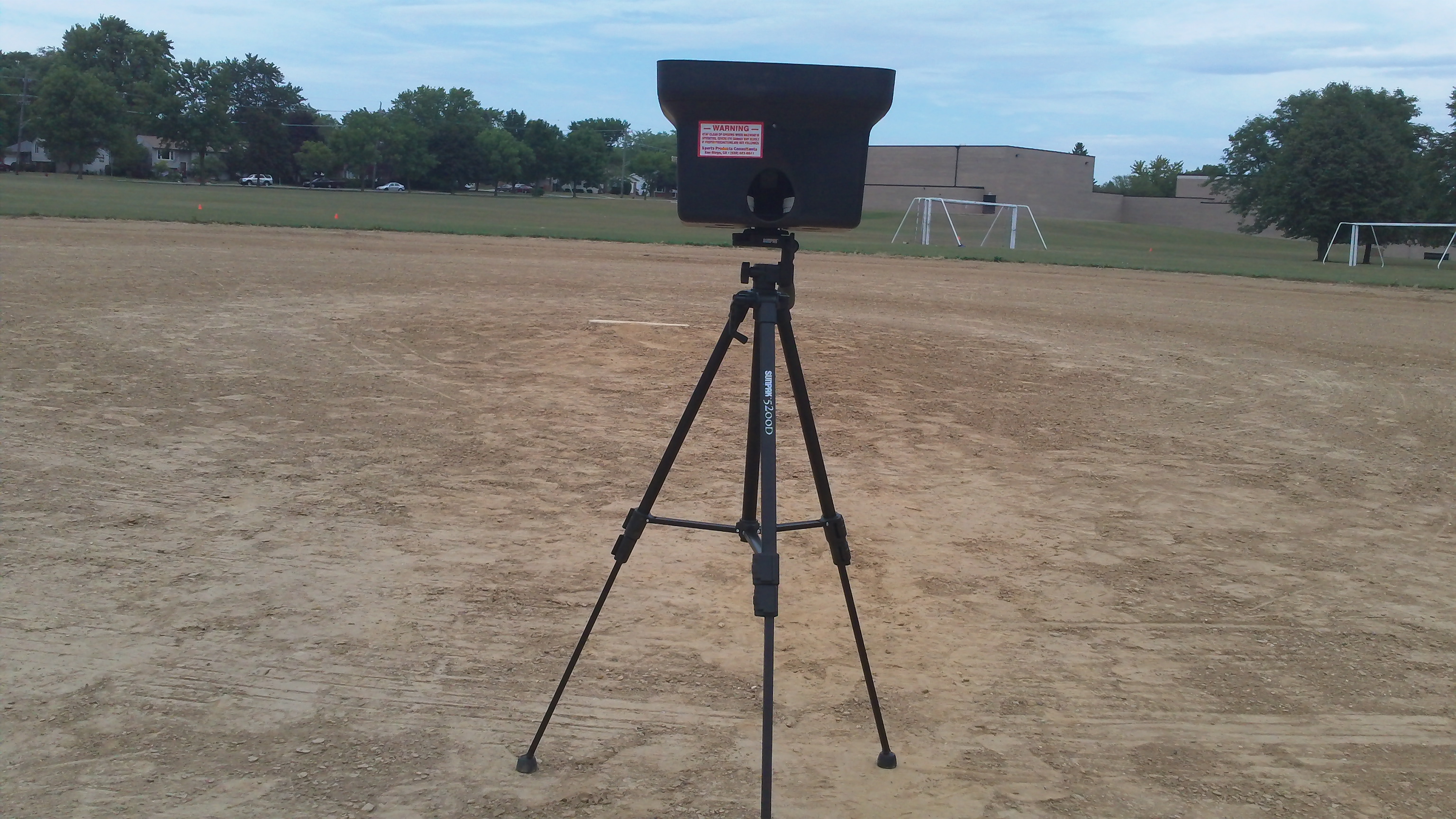 plastic golf balls in a timed progression to give you an opportunity to work on your vision, timing and swing. It’s like the best of pitching machines and soft toss with small objects.
I recently had the opportunity to test the deluxe version with some of my students, from age 10 through 16. (Full disclosure: the machine was sent to me to test by the manufacturer, although with the understanding that my review was my review, whether I liked it or not.) They definitely found it challenging. More on that in a bit.
The Personal Pitcher is a fairly simple machine. A wheel on the top drops balls into the delivery area one at a time. You can set the interval between balls for five or eight seconds, I used eight seconds, and wouldn’t recommend going less than that unless you’re trying to get a workout instead of work out your swing. 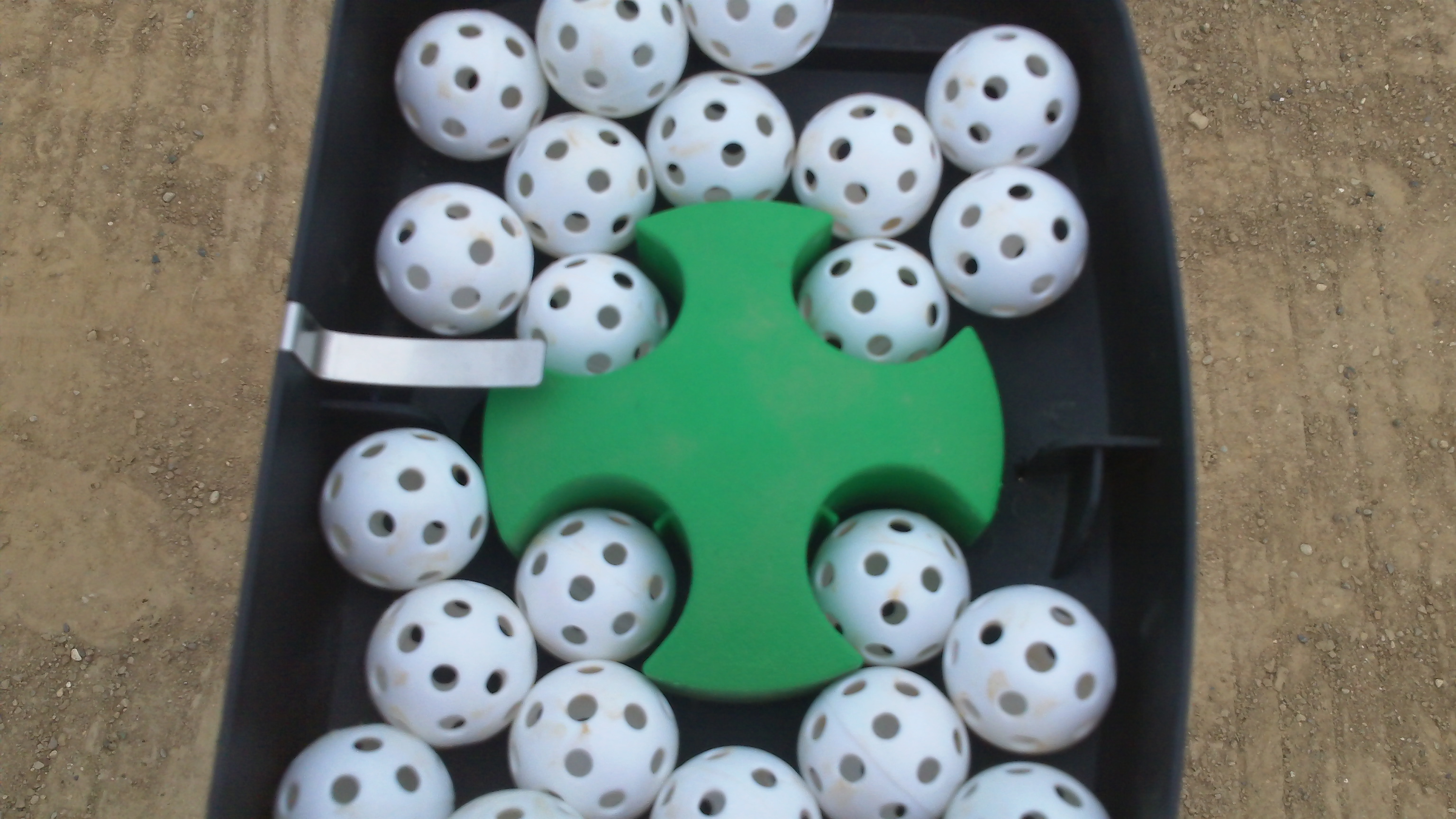
Inside the lower area are two wheels that catch the ball that’s been dropped and shoot it out a hole in the front. According to the manufacturer you can set the speed for 35, 45 or 55 mph. Considering you need to set the Personal Pitcher up about 15-20 feet from the hitter that’s plenty of speed. You can also set the unit I had to throw curve balls, sliders and screwballs, although I didn’t have the opportunity to play with those.
The Personal Pitcher mounts onto any standard camera tripod, allowing you to adjust the height to suit the hitter, and make up for non-level ground. The entire unit with the tripod is very light weight, making it easy to move around a field. It operates on a battery that carries a roughly four-hour charge, making it perfect for setting up as a hitting station at a team practice as well as setting up and taking down around the house. You can use it in the back yard, on the driveway, in the garage or even in the basement if you have the space.
While the unit comes with an instruction sheet that tells you to check for some things shifting during shipping, mine was perfectly set up and charged, so it was almost ready to go out of the box. The only things I had to do were connect the wires for the circuit board and battery — simple operations that require no technical expertise.
So, what did I think about it as a hitting device? Well, my first recommendation is the hitter should already have good swing mechanics before moving to the Personal Pitcher. Hitting those little golf balls, especially when they start veering off in different directions, isn’t easy. A hitter with poor or under-developed mechanics will probably abandon any sense of having a good swing in order to try to make contact with the ball. That will be counter-productive to your goals.
Once good mechanics are in place, however, it is definitely challenging. One of the toughest parts for hitters, at first, was getting the timing down. The Personal Pitcher has a green LED light on the front that glows brighter as it gets ready to deliver the ball, then goes dim right before it shoots out. For the first three trials, however, we used it in bright sunlight, making it difficult to see the changes in the LED. On the last one we tried it in the evening, when it was still light out but the sun was low. Definitely easier to see changes in the LED that way.
Not knowing when the ball was going to come out made it difficult to get the “load” part of the swing down. Since I emphasize load it threw everything else off. However, after a little while I would watch the balls get ready to drop into the lower chamber and say “load.” That helped the hitters figure the timing better. An audible alert, such as a click or electronic “beep” before delivery, would be a nice enhancement.
Once they got the timing down the Personal Pitcher really helped the hitters to learn to focus on seeing the ball. You would also see their determination go up after the first few misses, which was a positive in my book as well. The more hitters can learn to focus and concentrate at the plate the more their performance will improve. The Personal Pitcher definitely helps on that score.
I believe the more hitters work with the Personal Pitcher, the better they’ll get at dealing with its nuances, such as timing issues, which will allow them to take more quality swings. That was certainly my experience with it. Each hitter struggled at first, but improved as the session went on and they figured out how to work with it.
One other improvement I’d like to see made is a battery meter or some other type of warning that lets you know the battery needs recharging. If you’re using it at home it’
s probably not that big a deal. But if you’re using it in a team practice it would really be helpful to know how much time you have left on that charge, so you don’t show up to a field and have it shut down 10 minutes into practice. Of course, that would probably shoot the price tag up as well.
The standard version comes with 24 balls, while the deluxe version comes with 48 balls. Two loads of 48 balls is just shy of 100 swings, which is a pretty good workout. At eight second intervals you can hit 48 balls in roughly six minutes. That’s a lot of swings in a short period of time — as long as they’re good swings.
For more help with vision drills you can also purchase a dozen Focus Balls — a set of plastic golf balls with different colored stripes on them. Hitters can either stand and call out the color of each ball, or do so while trying to hit them. Use them alone or mix them in with standard white balls to help train hitters to see the ball better.
The construction of the Personal Pitcher is mostly plastic, but it seemed sturdy enough for normal use. If you treat it with the same care you would use for a camera or porcelain bowl (set it down, don’t throw it around) it should last a long time.
All in all, I think the Personal Pitcher is a great investment for serious fastpitch hitters and teams. It breaks up the monotony of endless tee work, and the different variations provide plenty of challenges to keep things interesting. The best part is hitters don’t need anyone else around to use it. They can set it up and get it going all by themselves.
If you’re looking for a device that gives the feel of hitting a moving ball with some speed yet is still affordable, check out the Personal Pitcher. At half the cost of a good bat it’s definitely worth the investment.
Something to keep in mind as the season winds down
Hard to believe the summer softball season is nearly over. Seems like it was getting started just yesterday.
As the number of games grows shorter, I have a suggestion for coaches. I know how tempting it is to narrow the number of players you’re using in a game, especially if you’re desperately trying to win something big before it’s all over. But remember why your players signed up in the first place.
Be sure to continue using your bench, and finding every opportunity to get all your players in the game. You are building memories for them — and what you choose to do now will determine whether they are happy or unhappy ones.
Long after the results of games have been forgotten and trophies are tucked in a box in a crawlspace somewhere, your players will still remember their teammates, their coaches, and time spent hanging out together between games. They’ll also remember whether they were on the field or always watching from the sidelines.
Do them a favor. Make sure those memories are good ones. Find a way to make it happen for them all.
Stuff fastpitch softball coaches say
There’s a big ASA softball tournament coming up this weekend, one of those that carries a lot of prestige for being successful.
One of my students told me her coach is very uptight about it, and has been telling his team “There are no bad teams in this tournament. Pitchers, you can’t walk anyone. Fielders, you can’t make any errors.”
Gee, I thought that was always the goal, no matter how good or bad the other teams are!
Lesson learned: why it’s important to use video
I’m never shy about pointing out problems with things other fastpitch softball coaches do or say. So it’s probably about time I told a story on myself which illustrates a great point: no matter how good you think you are, it never hurts to shoot a little video to check on what you’re saying.
Last year I was working with a girl named Megan in a lesson. She had a good swing overall, but when she finished I could see that she hadn’t gotten off her back side enough. At least that’s what I thought I saw. Instead of having her toe down, heel up and an L in her back leg, her heel was pointed backwards and her back leg was pretty much straight.
She wasn’t feeling the lack of drive, so I pulled out my trusty Kodak Playsport video camera and shot a swing off a tee at 60 frames per second (fps for those who don’t know video shorthand). I figured if I could show her what she was doing wrong she’d be able to correct it.
By now you’ve probably guessed what happened. I stepped through the video frame-by-frame, and everything looked good. When she got to contact her hips had come through, she was up on her toe, and her back leg was in a lovely “L.” Continuing through she held that position until after extension, then sort of settled back into what I’d seen to catch her balance.
“Hmmm,” I said. “I guess I suck. Remember everything I told you about finishing? Forget it. You’re doing fine.”
Since that time I’ve learned a valuable lesson about the importance of shooting video whenever possible. Most of the time I’m right, and can use it to illustrate the point. After all these years I’ve gotten pretty good at diagnosing skills in real time.
But every now and then it shows me that what I think I see, and what is actually happening are two different things.
Footnote: Little pocket videos such as the Kodak Playsport are pretty cheap, and make a good investment. Yes, you can also shoot video on your iPhone, iPad or Android device, and even telestrate it, but usually there are a couple more steps before you can use it. That’s why I like the dedicated video camera. You can shoot it and show the video right away, saving time that can be applied into working on the skills.
So how about you? Ever have an experience where you’ve believed one thing but video told you something else? Go ahead and share — you’re among friends.
Fastpitch hitting: sometimes you just have to say huh?
Last night I was doing a hitting tune-up with one of my students. She’d been hitting the ball pretty well, but over the weekend she struggled a little bit. She told me her coaches told her she was dropping her back shoulder and her hands.
I just sort of rolled my eyes because usually when people say that they don’t know what they’re looking at. But then, before she stepped up to the tee I discovered the cause of the problem. She quietly said to herself “Hands to the ball.”
“Where did you get that?” I asked. “Did those knuckleheads tell you that?”
“Yes,” she answered.
“Ok then riddle me this,” I said. “If you take your hands to the ball, what are you going to do?”
She thought for about a second, went through the motion of doing it and the lightbulb came on.
“I’m going to drop my hands,” she said.
And there you have it. Her coaches were telling her to do the exact thing they were saying was a problem. It’s no wonder so many players have trouble hitting.
This is why you have to be careful about what you say as a coach. It also helps to actually know what you’re doing instead of repeating the same bad advice that limited your own playing career.
Most importantly, when you’re instructing a skill, listen to what you’re saying. You just may find what you’re saying, and the result you’re trying to achieve, are at odds with each other.
An unusual fastpitch softball Father’s Day
Today was a bit of an unusual day for me. It’s the first time in 16 years that I haven’t been coaching a fastpitch softball team in a tournament on Father’s Day. I don’t have a team this year due to some circumstances not worth going into here, so the day (and the weekend, of course) was free.
That’s not to say there wasn’t any softball in my day. I did get out to say a game where several students (one on one team, the others on the other) were playing, so at least I got my fix. Still, it’s definitely different being in the stands instead of the dugout.
I started coaching when my oldest daughter, who is now 28, was a second year 12U player. Little did I know back then how much the game would come to be a part of my life. I remember one year coaching my younger daughter’s team when the whole family came out to watch the game at an away tournament, just so we could be together.
After I watched the game I came back and did what ordinary fathers do. Went with my wife to the grocery store, did some yard work, ran some errands and grilled some Italian sausages. It’s been so long since I’ve had the chance to do that it seemed a bit surreal.
Will I get back into team coaching? Perhaps, if the right opportunity comes along. I do miss the whole team dynamic. In the meantime, today was a most interesting and unusual day. Happy Father’s Day to all you dads (and dad substitutes) who spend your days at the ballpark and the practice field. You are a big part of what keeps this game going.






