Softball hitting: being early to be late
In the past I’ve written about the need to get your front foot down on time when hitting. It’s critical to ensuring you can drive through the ball, because if you’re late you end up defending against the ball instead of attacking it. Which is pretty common, especially when the pitcher can really bring it.
Funny expression
Today I heard a very funny expression from one of my students. She told me her high school coach says it all the time.
When they’re in practice, if they start overthrowing the ball back and forth he’ll yell “It looks like you’re having a snowball fight.” What a great description! Made me laugh when I heard it.
It may not be new to some of you, but it sure was to me and I just had to share it.
One other funny line I heard a while back comes from former Olympic hockey coach Herb Brooks. When his players were struggling he’d yell, “You guys are getting worse every day, and right now you’re playing like it’s next month.” Again, very funny but it gets the point across.
As a coach it always helps to have a few one-lines handy to get attention and break the tension at the same time. So what are your favorite (serious but funny) things to say to your players when they need to be brought back on track?
Product Review: Pocket Radar Ball Coach
If you are into pitching at all, or work with pitchers, you’ve probably heard about the Pocket Radar. It’s a device about the size of a mobile phone that makes it easy to gun pitch speeds, overhand throws, exit speed of the ball off the bat and (allegedly) the speed of car w hizzing through your neighborhood.
I recently upgraded from the original Pocket Radar to the new Ball Coach version. While it’s an $100 more expensive than the original, I feel like it’s worth the extra money. The Pocket Radar Ball Coach retails for $299, which is still considerably less that a Jugs or Stalker gun – and it does a very comparable job.
The thing that got me to upgrade (other than a $100 rebate being offered for sending the old one back) was the ease of use. With the original Pocket Radar you had to time pushing the button just right to get the maximum speed. It was as much an art as it was a science.
The new version takes that timing issue out of it. In other words, it’s radar speed measurement for dummies. With the Ball Coach version, you point the unit at the source of the pitch, hold down the big blue button (as opposed to a red button on the original) and keep holding it until you get a speed reading. Nothing could be simpler.
When I first got the new version I immediately tried it next to my Jugs gun. While they didn’t always match exactly, they were always within 1 mph of one another. Sometimes the Pocket Radar read higher, sometimes the Jugs gun did. But close enough for my purposes.
The real acid test, though, came this past weekend when I took it to a couple of games and (somewhat) discretely timed the pitchers from behind the backstop. In one case I was well behind it. But it seemed to give me good readings on all the pitchers.
Another advantage to the Pocket Radar Ball Coach is the ability to have it automatically take up to 25 reading in automatic mode. You can set it up on a tripod or a mobile phone holder, click through to automatic mode, and it will give you the readings. You can then page through to see what the player got – which is great for batting practice, pitching practice or whatever.
If you’re reading this in Canada, or anywhere else that uses the metric system, you’ll be glad to know the Pocket Radar Ball Coach can be switched to read in kilometers per hour. The instructions explain how.
The Pocket Radar Ball Coach comes with a handy soft shell pouch that clips onto your belt. That’s another nice upgrade over the original, which came with a hard shell case you had to keep in your pocket. I still kept mine in my pocket, but it takes up less space. In addition to the case it also comes with a wrist strap and a pair of AA batteries (Eveready alkaline batteries, not those cheap no-name ones that often come with many electronics these days.
If you’re at all interested in measuring speed I can highly recommend the Pocket Radar Ball Coach. With its (relatively) low cost, high accuracy and ease of use it’s a great investment.
What a difference a good bat makes
Last night I was working with a 12U player named Grace on her hitting. We’ve been working together for a while now and she has developed a very nice, powerful swing. But it wasn’t until last night that she really got to enjoy the fruits of her labors.
You see, her old composite bat has been on its last legs for the last few lessons. In fact, in the previous lesson she wasn’t getting much pop on the ball at all, despite using a technically solid swing. Her dad mentioned he thought it might be cracking, and sure enough when we looked at it there was a small crack that got larger as the lesson went on. The decision was made right there for Grace to get a new bat.
And there it was last night – a brand new bat, still in the wrapper. It was an inch longer than her old bat, and I also recommended she move from a -11 to a -10, mostly because no one should use anything lighter than -10 unless they’re really small or really young (in my opinion). So now in addition to having a brand new bat, she was swinging an extra couple of ounces.
The difference was immediately noticeable. On her very first swing she drove a line drive that, had we been outside instead of in a cage, would’ve gone into a gap in left center. She continued popping them that way – even catching me in the leg once when I didn’t jump behind the protective screen right away.
There’s no doubt that Grace and her dad feel like they got their money’s worth in investing in this new bat. The same swing mechanics are delivering much better results.
Can a new bat deliver better results even without a good swing? Sure, sometimes. But when you combine today’s technology with solid fundamentals you get the kind of hits that make it fun to go to the plate.
What about you? Do you have any new bat stories to tell? Have you ever experienced that instant upgrade in the quality of hits?
Where to go to choose your hitting models
It’s often been said, here and elsewhere, that one of the most important things you can do during lessons is compare what you (or your daughter, player, etc.) is being told to do against what the best players in the world do. If it doesn’t match it, it’s probably not the way to go.
For hitting, one obvious place to go for comparison is Major League Baseball (ML . The best hitters there are paid millions of dollars by willing owners who compete for their services, so there’s a good chance those hitters know what to do. (Whether they know what they’re doing is a debate for another day.)
Still, it can be difficult for some players to relate to baseball players. And there are always some coaches who think baseball and softball are two different games that only look similar, which means they think what works in baseball won’t work in softball. Not true, but it’s hard to change a mindset. So with that in mind, another good place to look for models of how to swing the bat is college softball.
How do you know which softball players (or teams) to follow? A good place to start is with the statistics.
This area on the NCAA website shows the stats for the top hitters in college. As I write this it’s late March 2014, so the link may have moved for 2015. But poke around a bit and you should be able to find it. You can who is leading in batting average, on-base percentage, home runs, slugging percentage and a whole bunch more. (It also shows some pitching stats.) Look at the leaders in various categories and the odds are you’ll find some hitters who really know what they’re doing.
There is also a team section that shows which teams are leading in various categories. Not surprisingly, Arizona is leading in batting average and slugging percentage, and #3 in home runs per game and overall scoring.
Now, we can debate all day long as to how much actual impact the coaching staff has on how their players hit. Unless you’re on the inside it’s tough to know for sure, although my guess is they work with them a lot. But if nothing else, a team with great hitting stats shows the coaching staff knows what to look for in hitters. So there’s a good chance those are again some good models to follow. Put the two together – the best hitters on the best hitting teams – and you’ve likely found some great players to use as models.
The other good thing about using college players as a model is their results are probably closer to their reality of what you can achieve. Although it’s good to look at MLB hitters, keep in mind there is a HUGE difference in game experience, practice time put in, athletic ability, strength, and learning abilities between a 28 year old MLB professional in the prime of his career and, say, a 12 or 14 year old girl who is still learning the game.
There is also a HUGE difference in the access to top-level facilities, video of every swing, access to coaching and, quite frankly, time and incentive to work on their swings between these two groups. A high-level MLB player has literally million$ of reasons to spend hours studying his swing and working to improve it. A young girl, even the most dedicated of them, is trying to work in hitting practice between school, homework, family obligations, other activities and all the challenges that go along with adolescence.
But a college player, while more accomplished and with more access to facilities, still has many other things happening in her life and competing for her time. And she’s not that far removed from being that 12 or 14 year old player. So while the college player’s swing may not be ideal just yet, it may also be more achievable.
The bottom line is don’t just believe what someone calling him or herself a hitting coach tells you. As Ronald Regan liked to say, trust but verify. (Side note: Regan said it about the Soviet Union, which was ironic because it’s an old Russian proverb.) Use those resources to see who the best college softball hitters are right now and compare what they’re doing to what you’re hearing. It could save you a lot of work heading in the wrong direction.
3 Strikes scripted softball comedy series premiering 3/26
A while back I wrote about a new online scripted comedy series called 3 Strikes that was being developed by a former player named Sarah McLean. I received a notice the other day that it is premiering March 26, 2014. You can watch the first episode here: 3 Strikes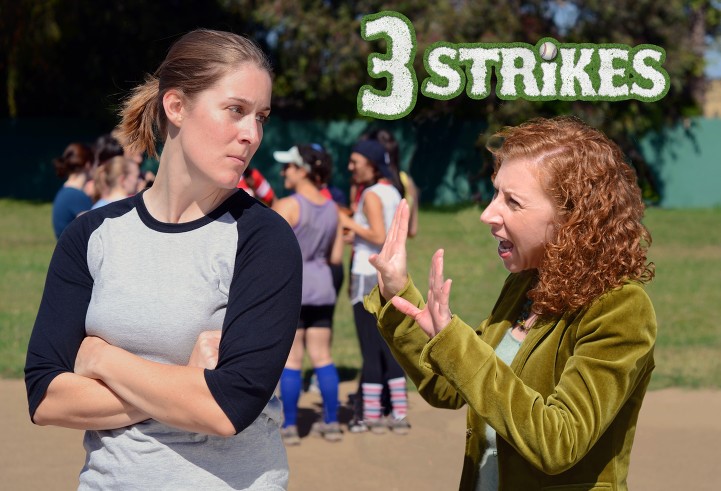
http://www.3strikestheseries.com/episodes/4578067429
And here’s a quick, one-line description from the press release:
They go on to say it’s a little bit A League of Their Own and a little bit Bad News Bears. It also sounds like it has a bit of the first Mighty Ducks to it too.
In any case, it’s great to see someone putting this much effort and love into something connected with softball. Be sure to check it out. I know I plan to! And after you do, be sure to leave a comment to let us know what you think.
Sometimes you can outsmart yourself with changes
This afternoon I had the opportunity to watch the University of Arizona v. UCLA softball game. It was the second game of their three-game series and a lot of fun to watch.
U of A was behind for most of the game. Despite all the offense they’ve been putting up against non-Pac 12 teams, they seemed to struggle against UCLA. They were shut out in yesterday’s game, and were down 3-1 until the top of the seventh.
The Wildcats had a runner on first and no outs when one of their hitters hit a comebacker to pitcher Jessica Hall. She wheeled around to throw to second and — threw the ball away. Runners were safe at first and second. At that point, despite the fact that Hall had been pitching lights-out, Coach Inouye-Perez decided to make a pitching change, bringing in Ally Carda who had shut U of A out the day before. (Carda and Hall switched positions.) After a sac bunt to waste an out, Kellie Fox hit a three-run home run to put Arizona up 4-3. They were three outs from evening the series at 1-1.
SPOILER ALERT: If you have the game on DVR stop reading here until you’ve watched it.
Ok, everybody else. In the bottom of the seventh, Coach Candrea decided to replace Kenzie Fowler, who had had some troubles but pitched her way out of them, with Estella Pinon. She immediately got into trouble, giving up a solo homer to leadoff hitter Mysha Sataraka. She then walked two batters and hit one to load the bases. At that point she appeared to have heat exhaustion and was lifted in favor of Nancy Bowling. Bowling promptly surrendered a walk off grand slam homer to Gracie Gould.
Knowing when to replace a pitcher is always a tough call. There may have been factors influencing things that we TV viewers don’t know. But from the outside it sure appears both coaches may have outsmarted themselves, and one wound up paying for it.
For those of us coaching on lesser stages there are a couple of lessons to be learned here. First is that even the highest-level coaches can make mistakes, or at least decisions they regret later. So when you do it – and we all do – don’t beat yourself up too badly.
The second lesson, in my opinion, is when you have a pitcher on a roll, go with it. Wait until she shows she can’t handle things before you decide to take her out. She may not be on top of her game, but she has a feel for what’s going on. Unless you have a pitcher whose actual role is to be a closer – and softball teams rarely do — it’s tough to come in cold. You may be better off sticking with what you’ve got rather than taking a chance with someone new. Better the devil you know!
What’s your story? Have you ever taken out a pitcher based on what you thought what might happen only to have it blow up in your face? I sure have! Share your stories in the comments.
NOTE: Edited to reflect what actually happened.
Gorilla Gold now approved for high school play
Hard to think of outdoor high school games with all the snow on the ground in much of the country, but sooner or later the temperatures will get warmer and the snow will melt. Right? The National Federation of State High School Associations (NFHS) has included Gorilla Gold Grip Enhancer, the world’s leading producer and marketer of resin-tackified grip towels, as an approved drying agent that can be kept in a pitcher’s pocket. The approval aligns the organization with the majority of softball governing bodies including the NCAA, the American Softball Association (ASA), the International Softball Federation (ISF), as well as others. The NFHS has also approved Gorilla Gold for use by baseball pitchers.
When the games do start, pitchers now have another option for improving their grip. I received a notification that Gorilla Grip has now been approved for play by the National Federation of State High School Associations (NFHS). From their press release:
So there you go. Hopefully pitchers all over the country will get a chance to try it out soon.
In the current ruling, pitchers cannot have residue on the ball. Like rosin, Gorilla Gold does not affect the ball, only the fingers or hands to which the drying agent is first applied.
Keeping softball from turning into Space Armada
Back in the mid-1980s, I owned an early video game console from Mattel called Intellivision. Extremely primitive by today’s standards, I still managed to waste many an hour playing it. This was long before I started coaching softball, obviously.
My favorite game was one called Space Armada, basically a knockoff of Atari’s Space Invaders. The object was to kill off all the invaders while avoiding being hit by bombs dropped by a flying saucer that went back and forth across the screen. If one of the invaders reached the bottom of the screen, the game was over.
Why tell you about an ancient video game in a softball blog? Because there were a lot of similarities between that game and what can happen to softball players when they start to panic.
You see, as hard as it may be for today’s young games to understand, in Space Armada there was no way to “win.” You didn’t beat a level boss to move up, and you could never reach an end. In Space Aramada, every time you cleared the aliens a new group would appear. Each new screen would work faster and faster, while the pulsing “music” behind it would go from thump…..thump……thump to thump…thump…thump and ultimately thumpthumpthump. In the meantime, your heart would race and your brain would be, shall we say, over-stimulated.
That’s the way it can feel in a softball game or even a practice too. We often hear players who are “in the zone” say the game slowed down while they were in there.
Well, the opposite can happen when things don’t go well, such a pitcher not making the pitches (or getting the calls), or a hitter struggling through a slump. The player starts to press, and you can almost hear the background sounds going thumpthumpthump. At that point it’s going to be tough to recover. Usually the biggest sign is that the player starts to work faster, such as a pitcher trying to throw the next pitch as soon as she gets the ball back.
If you feel that happening (or you’re a coach and you see it happening to a player or the team) you need to try to get them to chill out, slow it back down and relax.
The best way to do it is to take some time to breathe. Not just any breath, though. Take a deep cleansing breath or two – in through your no se, out through your mouth, slowly and taking in as much oxygen as you can. You’d be amazed at how that deep breath can help you calm down and relax.
You want to clear your brain and quit over-thinking — especially of the consequences of failure. Trust your training and focus on the task at hand.
If you’re a coach, you may want to take this opportunity to call a timeout and talk to the player or team. Tell a joke, comment on what a nice day it is, remind the player or team that they’re playing for the love of the game, and perhaps a little plastic trophy or medal, not world peace. Do whatever it takes to slow those aliens down and keep the game at a pace they can handle.
When I played Space Armada I knew it was just a game. But the competitor in me couldn’t help but get wrapped up in the pressure to perform. It’s the same for your team. Help them keep the game from getting out of control and you’ll like the results a whole lot better.
New softball tournament resource
A few days ago I received an email with some information I thought I’d pass along. It’s about a new website called mySoftballTournament that allows tournament directors to post information about their tournaments and coaches to search the site for tournaments that match. 
It looks pretty simple. Everything is pretty much run on dropdown menus. You pick your State or Province, fastpitch or slow pitch, gender, age group, etc. and then hit the Search button. The site then returns any tournaments they have that fit your search. (I’m presuming this site is out of Canada, by the way, because the listing asks for Province rather than State.)
It doesn’t look like there is a whole lot out there yet. I searched for tournaments in my home state and received no tournament listings, but hopefully that will change.
I hope this site gets filled with tournaments quickly. Finding the right tournaments for a team is always a challenge, so having a good resource that has decent information is something that’s needed. I know that eTeamz (or whatever they’re called now) has this service, but it’s been a bit spotty the last couple of years. Hopefully an organization with some enthusiasm can make this work and become a great resource for coaches.
If you have a tournament to post give it a try and let us all know how it goes. If you have a team and are looking for tournaments, give it a look as well. Maybe you’ll find something that fits your needs.
Updated 3/9/14 to align with changes to the site.






