Some ideas are universal
Had dinner with my daughter Kimmie and her boyfriend Timmy (I’m not kidding) tonight. Timmy is a competitive paintball player who competed at the national level in 2007, so I’m assuming he’s pretty darned good.
While we were eating he mentioned that he had read one of my Softball Magazine articles — the most recent on making the most of what you have instead of fretting over what you don’t. He told me it had actually helped him in his approach to paintball.
You see, Timmy is short and rather slightly built. He said he would often wish he was taller so he could shoot over the barriers, and that it bothered him he wasn’t. After reading the article, though, he started thinking about it and realized he is very fast, and can move low to the ground — two assets in the level of paintball he plays. He said he’s learned to embrace those things, and not worry about the height thing.
Now, sure, he could’ve just been kissing the ass of the father of his girlfriend. But he seemed sincere. In any case, many of us spend a lot of time worrying about what we don’t have instead of working with what we do and creating opportunities with it. It was great to see an example of someone who took that advice to heart and used it to improve his game.
Strength of the arms v. the legs
Last week my friend (and former assistant) John Parssinen sent a link to an article from the NY Times (I think) that explained an important consideration in both hitting and pitching. The article was about some advice that new Cub Kosuke Fukudome was giving to players in the Japanese industrial league as part of his farewell tour.
He was talking about how important it is to use the legs instead of the arms alone. He was talking about hitting, but it applies to pitching and throwing as well. Fukudome told them to imagine someone told them to stand on their hands. How long do they think their arms would support them? Then he said think about standing on your legs. You can do that all day, because they’re much stronger.
Hitters develop more power when they get their legs and torsos involved than when they just swing with their arms. I’ve never understood why anyone would think arm swinging is a good idea, but there are still plenty of fastpitch coaches who teach it.
It’s even worse for pitchers. It frustrates me to watch an otherwise good pitcher throw all arm. Some can throw hard for a little while, but they tend to tire easily. The arms are just not made to carry that kind of load. Pitchers’ arms need to be fast and loose, not tight and muscled up. That’s not to say they don’t need to be strong – they do — but the arm’s strength is needed to transfer power, not create it. That’s basic physiology. At best they can only add to power over the long term.
One last thing to keep in mind: Fukudome was talking to a group of men. Men’s upper bodies are far stronger than women’s. So if men need to use their legs to create power, it’s even more important for women.
Take a cue from Fukudome. Use the strongest parts of the body to create power and you’ll throw/hit harder and last longer. That’s the way Nature planned it.
You can never hear this enough
Tonight at lessons two of my students were very excited. Both had pitched in a tournament over the weekend and couldn’t wait to tell me how they did.
They’re both very talented so I expected they would do well. But what really got them going was the success they had throwing the changeup. In each case they got several hitters with it. One even said she was striking girls out with it despite the fact that everyone was yelling to watch out for it. I reminded the other one that a couple of years ago when she was learning it she said she couldn’t do it. She sure can now!
Pitchers tend to spend a lot of time in the gym. Sometimes they find it hard to focus, or to remember exactly why we’re doing it week after week. But after a weekend like they had I can tell you both girls were primed, up, and ready to work.
As an instructor there’s nothing better than hearing all the hard work paid off. It’s what keeps everyone going when there’s a foot of snow on the ground and summer seems a long ways away.
The three-legged stool
There is a fairly standard analogy in the business world called the “three-legged stool.” The basis of it is there are three elements that are important to whatever it is you’re trying to accomplish, and all three must be both present and in balance. If you put too much or too little emphasis on any one area, or even two areas, the stool will not be stable and will not be able to fulfill its purpose.
In softball the three legs of the stool are physical skills, the mental game, and conditioning. You need all three to be successful.
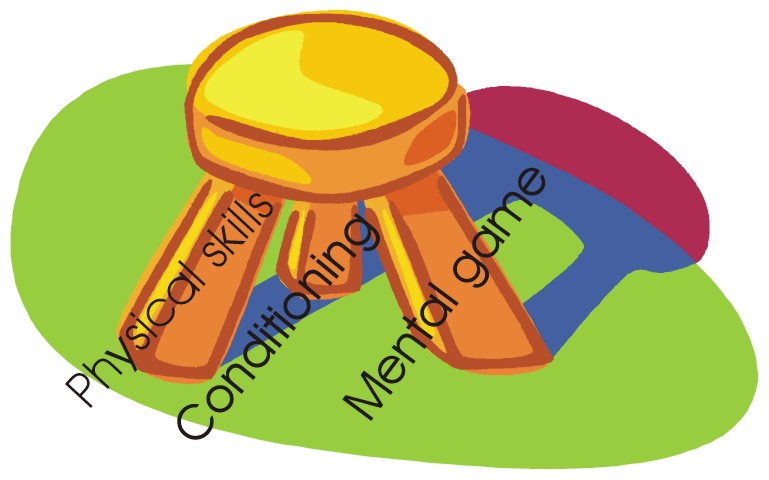
Unfortunately, that’s not always the path that coaches follow. Many will over-emphasize one aspect to the detriment of the others.
Some will spend all their time working on physical skills. They will hit, field ground balls, chase fly balls, pitch, etc. until the cows come home. They may run a few random sprints at the end of the practice, but that’s about all they do. They won’t spend much time at all on the mental game — visualizing success, building confidence, controlling emotions. They may have success against lesser teams but they have a hard time winning the big games. Instead, they blame the field conditions, the umpires, the luck of the draw, or random events for their losses.
Then there are the conditioning fanatics. They read somewhere about the conditioning programs elite athletes go through and decide that they’re going to make their players elite athletes by following the same routine. Never mind that the elite athletes already had the skills before they got to the elite level, which is why strength, agility and conditioning makes such a difference. Of course, some coaches don’t know how to teach the skills, so they default to general conditioning drills and hope it will make the difference. It won’t. Conditioning may help you hit the ball an extra 20 feet, but first you have to be able to hit the ball at all. If you can’t do that, all the conditioning drills in the world won’t matter.
You rarely hear about coaches over-emphasizing the mental game. In fact, when you hear a mental game expert such as Jeff Janssen speak, you’ll hear that most coaches believe that confidence and a positive mental attitude are highly important to winning, yet they will spend very little time on it. That makes one of those legs very short.
If I were taking over a new team, and had limited time to get them ready, the first thing I would want to assess is their physical skills. Do they know how to throw, hit, field a ground ball, etc. If not, that’s where I would start. That’s kind of the survival level. I would also use that skill building time to start boosting confidence and an a believe that if we all do our jobs and work together we can have a successful season.
Once the skills were starting to come along, I’d start working with them on understanding the game better — what happens in various situations, how you make decisions, when to throw the ball and when to eat it, etc. We’d be moving from basic individual skills to using those skills in a team setting. That’s where I’d start introducing softball-specific conditioning. There are plenty of drills you can run, including those that combine two or more skills, that will help drive conditioning without sacrificing other aspects of the game. For example, you could have a player hit off a tee and run to first. A coach standing at first would say whether to run through the base or round it. If the player rounds it, the coach would say whether to continue or come back. If the player continues she goes hard and slides into second. Do that enough times and you’re building endurance, agility, and quick decision-making along with the physical skills of running through or rounding the base.
Should we get to the point where everyone on the team has built the skills and understands the game we could spend more team time on conditioning. At that point it could be the difference. Still, I’d probably expect more of that to be done away from the field than on it. Of course, at that point it would likely be a given that those athletes would understand the importance of training and would come to practice already in excellent physical condition.
Where coaches get themselves in trouble is when they do things out of order. They’ll focus on “brutal conditioning” first and foremost, then lament that they can’t hit. Of course they can’t — they haven’t emphasized it. What they miss is that softball is not a game like soccer or basketball where you can wear out the other team by running on them. There’s a lot of standing around in softball, and most plays are over in three to ten seconds. As my friend and fellow coach Rich says, on a home run you don’t get to keep running around the bases until the other team finds the ball.
Another thing they’ll do is push the skill level training beyond what the athletes can do, with no regard as to whether they are losing confidence in the process. Or they’ll believe they can berate players into executing the skills better. When was the last time you did something better because a boss yelled at you unmercifully while you tried to do it? It just doesn’t happen. Coaches ignore the mental state of their players at their own peril. Especially with girls. They have to feel good to play good. If you make them feel bad, don’t be surprised by the results.
Finally, coaches will separate conditioning from the other two legs — or use it solely as a punishment for infractions real and imagined. The right conditioning program can actually help build confidence and encourage competition. My preferrence is to include elements of speed and agility in skills drills, and then set up a competition at the end that has an element of fun. Last year our girls loved to see the agility ladders come out because they knew we were gong to have some sort of race or skills competition, and it would help end practice on a high. Sometimes those races involved running home-to-home while performing various drills. Separated from a context they would’ve brought groans. But because it was presented as an activity rather than a punishment the players pushed themselves to the limit to “win.” And that’s what conditioning is all about.
Again, it’s important to remember that the stool has three legs. The more uneven the stool becomes the harder it is to use it. Make any one leg too long and the stool falls over. Then it’s no good to anyone.
Knuckles to nose
One of the challenges of throwing the backhand change is getting rid of the hump in the pitch — the tendency for the ball to go up slightly before dropping down on its way to the plate. The hump causes two big problems — it hangs it up high, where it’s easier to hit, and it also makes it easier to see.
The basic cure is to not let the ball go all the way to the bottom of the circle. Instead you want to finish flat, or parallel to the ground. Easier said than done.
Once cue I’ve found that works pretty well is to tell the pitcher to take her knuckles to the catcher’s nose, or knuckles to nose for short. As she comes into the last part of the pitch she should take her knocking knuckles in a straight line as though she’s trying to punch the catcher in the nose. The nose is generally about the height the hand will come through if it raises slightly above the bottom of the circle. You can even bring her up close to the catcher and show the difference between a straight in “punch” and an uppercut to the chin, which would require the hand to go all the way to the bottom of the circle.
It seems to be pretty effective, and is fun for the pitcher too.
More clues on getting rid of bat drag
I know it seems like an obsession, and perhaps it is. But I am bound and determined to rid the fastpitch softball world of the scourge of bat drag. It has been an iterative process but I think we’re getting closer to an answer.
After watching a number of videos in slow and step motion, both with and without bat drag, two items seem to stand out above the others. The first is the shoulders starting rotation before the hips. Standard hitting canon says the hips start before the hands, or the shoulders. But to some hitters that is counter-intuitive. The bat is in the hands, so they think they should start the swing with the part of the body that’s holding the bat.
The problem is they also have been told to keep the hands back at the launch of the swing. There are even expensive hitting devices to help them learn that. So what winds up happening is that the shoulders turn and the elbow pulls down while the hips hesitate, then follow. So the elbow winds up getting in front of the hands and voila! You have bat drag.
Another problem comes with the hands themselves. During the load or negative move phase, the hands get pushed back too far. The symptom you will see is barring out or straightening of the front arm. Many coaches know that barring out is bad, as it can lead to casting the hands out. But it’s also bad even if there’s no casting, because once again that elbow will pull down and start moving forward, even while the hands are moving (or staying) back. Once again the result is bat drag — the elbow leading the hands and the bat coming through the hitting zone late.
The cure for the first condition is obvious, though not always easy to execute. The hitter must learn to start the hips rotating ahead of the hands as well as the shoulders. A lower body, or more accurately center of the body first movement will get things working in the right order. At that point, the hands should stay tied to the back shoulder until it’s time to start making contact.
The cure for the second condition is to cut the negative move way down. A slight push back of the hands is all that is needed to overcome inertia and prepare for the swing. A big windup will simply cause problems. Again, keeping the hands tied to the back shoulder is the key.
Much of this is best learned on a tee. Taking ball movement out of the picture allows the hitter to focus on the mechanics. Once they have the general idea, it’s time to apply movement, either with side toss, machine hitting, or live pitching. That doesn’t mean the tee work is over, though. It takes many good repetitions to overcome old habits, and the tee is the best place for it. The other stuff is merely the level check to see if it’s taking.
One last thought. A lot of this is difficult to see, even if you’re used to looking for it. If you’re not, it gets even harder. Invest in a good video camera and analysis software such as MotionView or V1 Home(or RightView Pro if you have more money than you need) and you’ll make it easier to make corrections for both yourself and your players.
The tragedy at NIU
Normally this is not the sort of thing I would write about here. But as a graduate of Northern Illinois University and the father of two sons now in college at Eastern Illinois, the events of last Thursday have left a pretty marked impression.
I can’t help but think about the families of those victims and how difficult it must be to deal with the randomness of it all. I picture the families excitedly opening the acceptance letter when they found out they’d gotten into NIU. I picture them, like us, helping their kids move into their dorms or apartments to begin another semester, or celebrating the holidays not know that it would be their last together. And I picture students getting ready to go to class Thursday morning, perhaps wondering if they should blow it off for the day, and thinking about weekend plans that would never be.
In the softball world we often put way too much importance on which teams our kids make, where they’re hitting in the batting order, or whether they win a particular game. This is one of those reminders that all those things are minor in the big picture.
Hug your kids tonight.
The Bob Knight school of coaching
The other day on the radio I heard a heated discussion about former Indiana University and Texas Tech basketball coach Bobby/Bob Knight. Much of it surrounded the validity of his coaching methods.
On the plus side, he produced three national champions and went to the NCAA tournament often. On the downside, not much of that happened in his last few years.
While it’s debatable whether that “break them down and get them to comply” approach was ever really a good one, it became pretty obvious that it was not working anymore. Today’s athlete is smarter and more independent, and is thus not as willing to take the grief in order to play on the team. They’d rather go somewhere else, or do something else if they can’t move, than sit there and be belittled all the time because a coach feels he/she needs to show who’s boss.
This is probably even more true in softball, where an even keel is far more important than getting “up” for a game. An excess of adreneline tends to degrade performance, not enhance it. The sports psychologists and their studies have shown that a calm approach is required for optimum play in a precision sport such as softball. The same can be said for golf and tennis, two other sports that require on timing and hand/eye coordination far more than brute force.
Softball coaches who stand in the third base coach’s box and scream at hitters, or stand behind players at practice and berate them to the point of tears for not fielding ground balls up to their standards are only hurting themselves. Well, that’s not true. They’re also hurting the players and the team.
This is not to say poor play should be tolerated or coddled. But there’s a difference between a lack of effort, a lack of ability, and a lack of execution. The first is more of a reason to yell. The other two are opportunities to teach, either physical (in the case of lack of ability) or mental (in the case of lack of execution) skills.
Setting up a positive atmosphere where players feel comfortable pushing their current limits helps build strong teams. Setting up a negative atmosphere where players feel they have to constantly look over their shoulders for fear of being belittled in front of their teammates creates a climate for failure.
And speaking of doing things in front of teammates, I once learned the hard way about singling out a player, especially a girl, in front of the team — even if she deserves it. I had a player (who was a team leader) lose her temper, throw her helmet, mouth off to an umpire, and generally conduct herself in a way that was unacceptable. After we lost the game, I sat the team down and tore into her for her behavior. It didn’t really help at all. If anything it made things worse, both with the rest of the team and that player. I eventually worked it out with her — I apologized not for what I said but where and how I said it — and she apologized for the behavior, which she came to realize was inappropriate. Since that time, if I’ve had anything like that to say again I’ve done it in private. It’s made a huge difference for me and my teams. That girl continued to play for me, and would run through a wall if I asked her to because we got past the problem and gave each other mutual respect.
That’s the point. Berating players in any sense may make a temporary adjustment, but it degrades trust. If you want more long-term success, take the time to build a relationship and a positive atmosphere and you’ll create a legacy that lasts long after the last pitch is thrown.
Confidence game
Coaching 101 dictates that a coach’s job is to help his/her players build their confidence. This is true in any sport, but it’s especially true in softball. The game is built on failure — as the saying goes, a hitter who fails 7 out of 10 times is an all-star — which means there is already a huge potential for negative feelings to brew. Coaches are supposed to build their players’ confidence to help them get through the tough times, and perhaps even avoid some of them. As they say, whether you think you can or your think you can’t, you are correct.
Not every coach seems to get that, however. Some seem not to know better, some have their own personal agenda, and some, well, I have no idea why they do what they do, but they seem to go out of their way to undermine their players’ confidence.
Bobby Knight is a good example of a coach who didn’t seem to know any better. From the outside it seemed like he thought that by constantly railing on his players he could drive better performance out of them. It worked to some extent, no doubt. But you have to wonder if maybe some of those players would’ve been even better if they had been built up instead of torn down. Even the Navy SEALs have abandoned the “tear them down and build them up” training for one that is based on confidence.
Then there are those with their own personal agenda. They will put down players not with a goal of trying to get more out of them or because they think it will be good for the team long-term, but because of some personal need or grudge they hold.
A good example is something that happened to one of my pitching students with her travel team last summer. This is a girl who is both very talented and very dedicated, by the way. She had joined the previous Fall, with promises of the opportunities this “higher level” team would provide. She did the training and conditioning with them, traveling roughly two hours each way a couple of nights a week plus weekends. She also came for lessons one a week and made great improvements there too. It looked like she was all set for a great summer. Then came the other shoe.
Turns out the team’s “pitching coach” was also the father of another pitcher. The other kid didn’t throw quite as hard as my student, nor was she able to throw anything other than a fastball as I understand it. So the “pitching coach” started setting up a situation where his daughter could succeed and my student would fail.
He made hitting spots with the fastball the main criteria for success. Not whether the pitcher could strike people out, get people out, keep them off the bases, or win ballgames. It was about hitting the exact location he called.
Now, hitting your spots is important to be sure. But it’s not the be-all and end-all of pitching. Just as their are no style points for hitting, throwing to a specific location in and of itself doesn’t guarantee success. Speed, movement, and cleverness all play into it too.
In any case, my student would have what most would consider a successful outing — 1 to 2 strikeouts per inning, few runs allowed. But instead of being congratulated for doing well she was being put down for not hitting the locations the pitching coach had called. (The fact that she was successful without hitting the locations probably indicates the pitch calls weren’t necessarily great ones, but that’s a story for another day.)
After a while, the pitcher lost confidence. She became very discouraged and by the end of May was ready to quit. The end of May, not even the summer! Her dad told her to hang in there, and did his best to bolster her confidence. He’d bring her to me for an occasional lesson too, not so much for the physical side but so I could help her rebuild her confidence too. The upshot is, when they got to Nationals, the team found that the pitchers they’d been using no longer could get the job done, they called upon my student, and she wound up doing very well. If she was good enough to win at Nationals, why not the rest of the season?
Today she is playing for a different team where they know how to handle players. By the way, she was 13 at the time all the negative stuff was going on. Hope that “pitching coach” felt like a big man, lording it over a 13 year old.
It is difficult to fathom why some coaches feel the need to destroy confidence but they do. Maybe they weren’t hugged enough as children. Maybe they’re unhappy and feel the need to let that unhappiness trickle down. Maybe putting others down builds their own egos. Who knows?
Whatever it is, it’s detrimental to their teams, and against the basic mission of being a coach — especially a coach of teens and younger players. A smart coach will do all he/she can to build player confidence and help them become the best they can be. He/she will look for the good in each player and build on it, rather than always looking for what’s wrong and putting them down. That’s the way you win games. And championships.
Managing v. leading
This is a subject that probably doesn’t get covered enough. It cuts right to the core of what a coach can do versus what coaches often limit themselves to doing.
There is a big difference between managing players and leading them. Managing players involves setting up tournaments, setting up practices, making sure everyone knows the team rules, putting together a lineup, changing players, and other tactical types of tasks. It is a very valuable function to be sure, and many coaches put their emphasis on trying to do those tasks well. But it isn’t leadership.
Leadership is about motivating players, getting them to believe in themselves, teaching them to do the right things (even if it means you might lose a game), and generally how to conduct themselves as human beings. Think of it this way: management is putting players in the positions where they can make the best contributions. Leadership is helping them find a way to improve their games to increase their contributions to the team.
A manager will remove a pitcher when she starts to get a hit. A leader will make sure that when she leaves her confidence remains high.
When they’re playing poorly, a manager will try to get his team going by yelling at them to “get their attention.” A leader will work hard to make sure that players understand it’s the responsibility of each player to do her very best every time she steps out on the field.
A manager will teach her players her “system” and try to get them to fit into it. A leader will adjust what she does on the field to suit the players she has. For example, a manager will place a lot of importance on pitchers getting strikeouts, even if she doesn’t have a dominant pitcher. A leader will recognize she doesn’t have a dominant pitcher and will come up with a new strategy to help the team win — usually shoring up the defense and/or putting extra time into hitting.
A manager see his players as chess pieces to be moved around the board. A leader sees his players as human beings, each with her own hopes, fears, desires, and goals. He will do his best to figure out what each player needs, and will work to build a relationship with each one.
A manager usually has a coaching style. A leader has as many coaching styles as she has players. This is not to say she favors one over another. To the contrary, she treats each one equally, according to her needs. Those who need positive reinforcement get it. Those who need an occasional kick in the pants get it. Those who need things explained in depth get it, while those who just need quick marching orders get what they need and are sent on their way.
The long and short of it is, every team has a manager. But not every team has a leader. To determine which you are, think about your relationship with your players. Do they comply with what you say because they have no choice, or do they look to you for guidance? The former is a manager, the latter is a leader. Do your players tolerate you the way they do hot and humid weather, or do they genuinely enjoy playing for you? The former is the sign of a manager. The latter is the sign of a leader.
It’s a lot tougher to be a leader than a manager. Being a leader means you need to question yourself constantly, and be aware of what’s happening around you. Being a manager only requires fulfilling the tasks that are part of your job. Being a leader, however, is much more rewarding in the long run, because while managers can help their teams win, leaders help the individuals on those team grow — both as players and as human beings.
So which are you?






