Category Archives: Hitting
To Get Power, Blow Out the Candle

Fastpitch softball players sometimes struggle with how to get that extra burst of power at the moment it matters the most. Whether it’s whipping the arm into release for pitchers, or accelerating the bat before contact for hitters, or some other skill requiring a ballistic final movement, instead of looking powerful they look anemic.
One of the biggest reasons for this, of course, is the fear of failure. Pitchers focused only on throwing strikes or not walking anyone will slow down when they should be speeding up.
Hitters focused on not striking out or just making contact will do the same. Catchers focused on throwing to the base rather than doing all they can to get the runner out will do it, and so on.
You can try telling them they need to be more energetic in their movements, but while they will nod their heads they will often not really understand what you mean. So here’s a quick way to explain what you’re going for.
Ask them “how do you blow out a candle?” If they give you a blank stare offer them two options: do you do it with a gentle letting out of air, like you’re trying to cool a spoonful of hot soup, or in one quick burst.

Since they’ve probably been blowing out birthday candles since the age of two or three they will tell you in one quick burst. Then ask them why they do it that way. (You can even have them demonstrate both to you, which will force them to demonstrate the principle to themselves.)
They will tell you because without the burst nothing much happens. The flame may dance a little with a reverse sip of air, but it won’t go out.
You can then explain that’s what power does. That one quick burst concentrates the air so it has an effect on the candle.
It’s the same with that final, critical movement in softball. Without that one quick, focused final burst of energy you can’t throw hard or hit hard.
While it may seem obvious to you, you’d be surprised at what isn’t so obvious to your players. Even experienced ones sometimes.

The focus on not failing, usually based on someone else’s description of what failure is, rather than succeeding or excelling, As long as they’re in that mindset it will cause them to hold back from becoming the best versions of themselves on the field.
Use the candle analogy to help them understand the importance of getting that final, powerful concentration of energy and you just may help them unleash the larger beast within them.
Birthday party photo by Alexander Mass on Pexels.com
You Can Never Break the (Kinetic) Chain
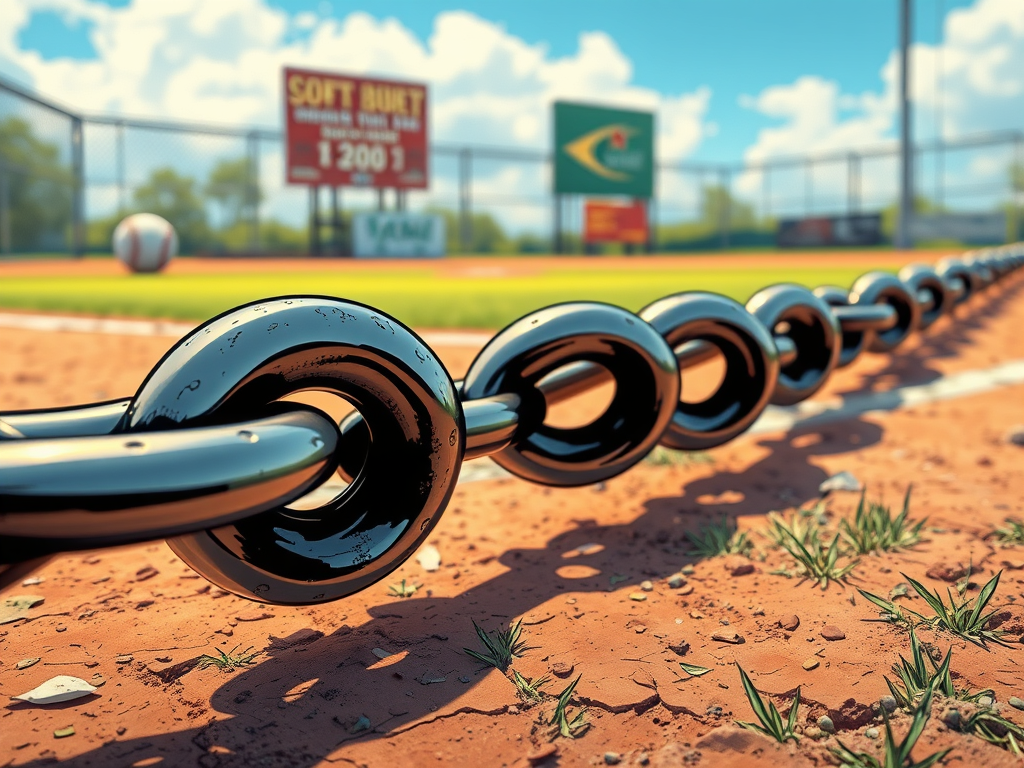
A term that has grown in popularity lately in the fastpitch softball world is the “kinetic chain.” If you’ve seen any of the many “how-to” posts or videos on Facebook groups, Instagram, Tik Tok, or other social media outlets you’ve no doubt come across the term.
You may have even nodded along as the creators talked about the importance of maintaining the kinetic chain even though you weren’t actually sure what it is. If you’re nodding along with this one you’re in luck because we’re going to define it before we get into the meat of today’s topic. You’re welcome.
Basically, the kinetic chain is an instance where the body’s muscles, joints, and nerves all work together as interconnected links to produce a complex movement. Each link works with the others to transfer energy through the body, creating a multiplying effect that improves the result of the final, intended action, such as swinging a bat or throwing a ball.
The key here is that each link in the chain has to work with the others in the context of the overall movement, and it has to do its job at the right time, i.e., in the proper sequence. If any link in the chain acts independently, or at the wrong time, it reduces instead of enhances the overall outcome.

Ok, I know that was a little complex and abstract, but I think it’s important to establish the science first so this isn’t just one of the many millions of random opinions out there masquerading as fact. Now let’s get to the fun stuff – how it applies practically to fastpitch softball.
The kinetic chain and hitting
The basic kinetic chain for quality hitting involves moving the hips first (using the big muscles in the core, the abdominals, etc.), followed by the shoulders, and finishing with the arms to deliver the bat to the ball.
Yet what you see many young and even some older hitters doing is initiating the swing with their arms and then yanking on the bat for all they’re worth to try to hit the ball hard. That works off the tee, and can even work in games at times if the hitter is reasonably strong.
But when you do that, you’re basically putting the cart before the horse. The arms are supplying the bulk (if not all) of the energy that is going into the ball, essentially choking off any energy the big muscles in the legs and torso are trying to produce.
Rather than moving a lot of energy up through the chain, that arms-based swing is limiting how much of that energy can be used – by a lot. It also reduces the body’s ability to adjust to the pitch as it’s coming in because the arms are creating an early path that gathers momentum as the bat moves forward.
It’s like firing an arrow and then trying to aim the bow. It just doesn’t work.

By keeping the kinetic chain intact the hitter has time to see the ball while she’s generating larger energy than she can with her arms alone, gathering information about where the ball is headed, and is then in a better position to direct that energy when the ball gets to her.
The same limiting factor comes into play when hitters spin their back leg in place (the old “squish the bug” cue) rather than engaging the hips. While it may appear to the naked eye that some high-level hitters do that, if you look at high-speed video you’ll see that they actually turn the hips into the ball then fall back into the “turned” position after contact.
Honestly, I’ve been fooled by that before myself, thinking that a hitter didn’t use her hips enough. But a quick video shows she actually did what she was supposed to – it just happened so quickly it was difficult to see in real time.
The kinetic chain in pitching
There are a lot of similarities between hitting and pitching as far as the kinetic chain goes. You are still doing a ground-up movement, with a firing order that moves from the hips to the shoulders to the arms.
The difference here, though, is that you’re focused on one arm, and that arm has two pieces that need to fire in order to maximize the transfer of energy (and thus ball speed). So the full sequence is hips-shoulders-upper arm-forearm.
Notice I didn’t say anything about the wrist. It does contribute to the overall pitch, but not forcefully as some people still believe.
The wrist is more of a “let it happen” than a “make it happen” contributor on most pitches. The exception, in my opinion, is the curve ball, where it does have to do a little bit of work to put the hand under the ball properly to achieve the correct spin.
After that, though, it’s still more of a “let it happen.”
What trips up many pitchers trying to achieve speed is muscling up at the shoulder, or forearm, or trying to do a hard snap upward with the wrist. Those actions may feel powerful, but not only do they not add anything to the energy transfer to the ball, they actually take away from it.
When you muscle up on any of the downstream segments it chokes off at least a part of the flow of energy. Less energy into the ball = reduced speed.
What you want instead is to allow the joints to move freely in a quick acceleration/deceleration sequence that moves the energy from one segment to another until it reaches the ball. Muscling up slows the individual piece that’s being used down, which means it has less energy to pass along to the next one.
This relaxed flow of energy is especially true for what happens with the arm. Once the hips and shoulders have stabilized (stopped turning forward), the upper arm uses the energy from the body to begin accelerating toward release.
This movement will happen much faster if it’s allowed to happen rather than the pitcher trying to force it to happen by consciously muscling the arm downward. Just accept the energy and direct it downward until the upper arm comes into contact with the ribcage.
If that happens, the sudden stop of the upper arm transfers the energy down into the lower arm, causing the forearm to accelerate suddenly until it reaches brush contact/brush trigger – the light contact of the forearm (not the elbow!) against the hip. This action causes the forearm to decelerate suddenly, delivering all that energy that was created throughout every phase of the pitch and transferring it into the ball through the fingers.
Again, any attempt to force these movements by muscling up will have the opposite effect to what is desired – it will break the kinetic chain and reduce the speed.
You see this reduction a lot with pitchers who are trying to force strikes. They slow their arms down to get the ball over the plate and then can’t figure out why they’re not throwing faster.
Then, of course, they try to muscle up the finish and not only are they throwing slower, they’re now less accurate as well. It’s a vicious circle.
By the way, all of these principles apply to overhead throwing as well, although in a slightly different manner. The concept is the same though – if you want to throw hard, you have to let the chain happen instead of trying to force movements.
Better by design
The human body is an entire system designed for one primary purpose: to keep us safe. Each movement has a particular purpose that was developed to work in concert with other movements to create the optimal whole.
So you can see why breaking the kinetic chain by imposing unnatural movements on it isn’t a great idea. Let the body work the way it’s designed to work and you’ll achieve much better results – with less wasted effort to boot!
The Odds Are Stacked Against You in Fastpitch Hitting
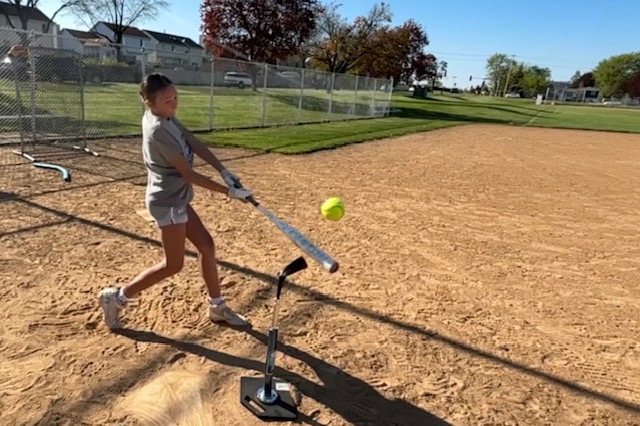
A few days ago I was doing a hitting lesson with one of my students, a young lady named Avery. We got to talking about why the success rate for hitting in fastpitch softball is generally so low.
That’s when she said something profound that her mom Abbey had told her that I hadn’t really thought about in that way: Hitting is 9 on 1.
I think most of us tend to think about the battle between the pitcher and the hitter, i.e., how the pitcher is trying to get the hitter to miss the ball or at least mis-hit if she does make contact so doesn’t go too far. But while the hitter is up at the plate standing alone, the pitcher has one other person in front of her and seven others behind her to help her get the out on that weak hit.
That’s a pretty unfair advantage, don’t you think? Picture a basketball game, or a soccer match, or hockey game, or pretty much any sport where scoring means getting the object at the center of the game into the other team’s goal.
You don’t have to be Mr. Vegas to figure out who is going to win that contest, no matter how skilled the player on the one side is.

Yet when the scoring opportunity comes up for a player in fastpitch softball (or slow pitch, or modified pitch, or baseball, etc.) she’s facing a whole phalanx of opponents whose only goal is to prevent her from achieving her goal. Seems pretty unfair, doesn’t it?
And that’s why the stats of a game, even if kept honestly (versus the person who scores every contact as a hit or anything close as an error, depending on whether his/her team is at bat or in the field), don’t always tell the whole story.
For example, a hitter can slam a screaming line drive directly at the face of the opposing shortstop, who throws her glove up in instinct to protect herself. If said screaming line drive goes into the glove and the shortstop’s palmar grasp reflex (yes that’s a real thing) causes her hand to contract around the ball, the hitter is out.
Never mind that she smoked the pitch that the pitcher mistakenly threw over the heart of the plate. One of the seven fielders happened to be in the way of the ball as it was on its way to being a double and turned that great contact into a drop of a few percentage points in her batting average.
Or what about the well-hit ball to the outfield that goes to the person the other team is trying to hide? She puts her glove up over head to make sure the ball doesn’t hit her, and instead it nestles softly in the web like a bird landing in its nest.

The hitter did nothing wrong, and the fielder, quite frankly, didn’t do anything intentionally right, but the fielder gets high fives while the hitter gets nothing except another ding against her batting average. And those are just the extreme examples.
During the course of the game most times there are seven fielders behind the pitcher, plus the pitcher herself, whose job it is to make sure the hitter doesn’t reach base. And then you have the catcher whose job it is to clean up anything around the plate. That’s a pretty stacked deck.
The only way the hitter can be absolutely assured of not being out after contact is to drive the pitch over the fence. And while the number of hitters doing so has increased dramatically over the last several years, those are still a low percentage of all contacts made.
So the next time you’re wondering why failing 7 out of 10 times at the plate makes someone an all-star, remember that the odds are stacked against the hitter from the beginning. And beating 9 on 1 odds is a pretty good reason to celebrate no matter how it happens.
Hitters, Math, and Being Prepared

Since a lot of the U.S. has either gone back to school or is about to, I thought it would be a good time to talk about math. Specifically, the math of hitting in a game and why letting a good pitch go by early may not be such a good idea.
At its most basic, hitters are given a maximum of 5 pitches that count in each at bat. (Yes, you can get more if you’re fouling off pitches, but for the most part the goal is to hit the ball fair rather than foul it off so let’s stick with that.)
If you just stand there and get to a 3-2 count, that means 3 of the pitches were judged not good pitches to hit by the umpire and 2 were determined to be good. Again, you can debate umpire strike zones all day but for this argument we’ll assume the blue has a good zone.
So that means you had 2 out of 5 opportunities to get a good hit by swinging at a good pitch. Put another way, less than half the pitches were good ones.
Now let’s bring in those foul balls. Maybe they were good pitches you missed, or maybe they actually weren’t good pitches but they were close enough that you (rightfully) felt compelled to swig.
If you had 5 foul balls and 3 of them were borderline. you now had a total of 10 pitches, of which 4 were good and 6 were not. You’re still at the same 40% mark as before.
On the other hand, if one more of those pitches was borderline, you now had 3 good and 7 not-so-good pitches and your percentage of good pitches to hit dropped from 40% to 30%.
Ah, but we’re not done yet.
It’s pretty rare for hitters to hit pitches in all zones equally well. Most have zones where they hit better – say up and in and up and out – and zones where they don’t hit the ball well at all, even though they are legitimate strikes.
So now, of those 3 or 4 good pitches we outlined earlier, maybe only one was in a zone you liked. Which means out of the 10 pitches in that at bat, you only got 1 truly good pitch to hit.
No wonder hitting is so difficult.
Now stretch that across an entire game. If you get 3 at bats, you may only have gotten 3-6 pitches out of 30 that were where you can be confident you could hit the ball hard somewhere.
Pretty low odds, wouldn’t you say? Add in that a hard-hit ball could still be fielded for an out by a fielder and it is amazing anyone has a decent batting average.
The point of all of this is, as a hitter, there is a pretty good chance you’re only going to see 1 truly good pitch per at bat, so you’d better be ready when it comes.

Keep in mind the pitcher’s goal is to not throw you ANY good pitches to hit. At the college level and even high school or higher travel ball levels the opposing team may have a book on your that shows where you like the ball and where you don’t. Guess where they’re going to try to throw it?
At the younger levels, many of the pitchers don’t have full command of their pitches yet so their locations may be a little to a lot erratic. The forgiving term for that is “effectively wild,” i.e., they can’t hit a location reliably, but even if they’re off they’re close enough to the strike zone that it works for them anyway.
We’ve all known pitches like that.
Whatever the case with the pitcher, again, when she does throw a pitch you can hit well you have to be ready to hit it. For me, that means you have to assume EVERY pitch is going to be that pitch, load up and start your swing as if that’s true, and then hold up if you see it’s not.
After all, you don’t want to waste the very few really good pitches you’re going to see by realizing too late that you should be swinging. If you’re only going to see 2 or 3 hittable pitches in a game, you need to make the most of them when they come.
That includes the first pitch you see, by the way. I know some hitters don’t like swinging at the first pitch, and some coaches preach letting the first pitch go by so you can get a look at how the pitcher is throwing. I’m not a fan of either approach.
Keep in mind pitchers are coached to get ahead in the count. Many teams place a lot of emphasis on first pitch strikes and track that stat religiously.
It would be a shame to let the best pitch you’re going to see in that at bat go by automatically just because, don’t you think? At the very least, on that first pitch you should be looking for a particular pitch and your best location to hit, and if you see it go ahead and swing with enthusiasm.
It will take a lot of pressure off of you and keep you from having to go into survival mode later in that at bat. If your coach insists on no swinging at the first pitch you have to abide by that, of course, but hopefully he/she can be convinced to at least green light a pitch that’s in your happy place.
The math is the math. Hitters usually don’t get a lot of opportunities to hit good pitches, so you need to be ready when they do come along.
Take advantage of good pitches when they come and you can make the math work for you.
Teacher photo by Andrea Piacquadio on Pexels.com
Product Review: Cimmaron Safety Net and Frame Makes BP Safer
Whenever I see a coach doing front toss at practice from 15 feet away without a net to hide behind, my first thought is always “That coach must not have much faith in him/herself as a hitting coach.”
But the reality is (most of the time anyway) that they would use a screen if they had access to one. Sure, you could try using a Bownet or similar product but the blowback on a hard-hit ball directly into the net would probably negate any value in setting it up.
Effective protection, even from some 10 year olds, requires a much sturdier protective screen – the type you see at high schools, colleges, batting cages, and professional stadiums. The trouble there is your typical youth coach, or even a high school coach who has to practice at an off-campus field, can’t exactly cart around a heavy-duty screen with a heavy-duty net, nor do they have the time to assemble and disassemble it with all the nuts and bolts that are required.
For years I had that problem solved with the old Jugs Snap-Together Screen. It was the perfect solution – a heavy-duty net that slipped over a heavy-duty frame that was easy to put up and take down. The push–in snapping mechanism meant you could slide the pieces together, then have the snaps hold them in place. Then, when it was time to leave the field, I could quickly pull it all apart and put it back in the carrying bag, ready to transport anywhere I needed it.
All good things must come to an end, however, and last fall that screen gave up the ghost. Some of the snaps didn’t work anymore, and the net was beginning to fray, which increased the risk of a hard-hit ball breaking through.
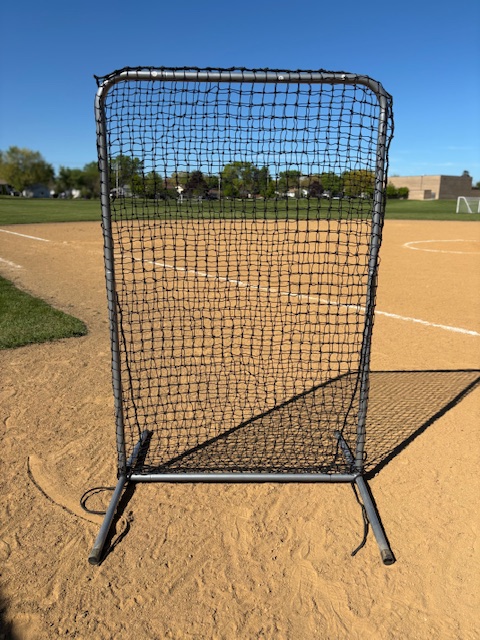
Since Jugs doesn’t offer that product anymore I searched and searched for something similar to replace it, That’s when I came across the Cimmaron 6×4 #42 Safety Net and Screen at Epic Sports.
It’s a little smaller than the Jugs screen was, but it was still big enough to hide behind after throwing a pitch. (One time when it pays to be a little under 6 feet tall.)
The description mentioned a snapping mechanism but there weren’t any closeup photos to show if what they meant and what I thought of were the same. But with no other viable alternatives I figured I’d give it a try and made the purchase.
I’m happy to report it’s everything I hoped it would be.

The 1-1/2 inch steel tubular frame is lightweight yet very strong and confidence-inspiring. The net, made from #42 nylon, has held up well after take some direct hits; I have full confidence in it.
It’s also a little easier to assemble than my old protective screen was, probably because it’s a little smaller than the old one so there are fewer pieces to assemble. There are three pieces that comprise the bottom, two along the sides, and three that form the top and the upper part of the sides.
All parts have a number sticker on them that correspond to the supplied diagram that shows you how to put it together. The first time I did it I had a little trouble figuring out what went where but that was due to operator error.
I didn’t bring the diagram with me to the field, and I then assumed the two pieces that form the top corners worked the same way as the Jugs screen, i.e., the long part goes across the top and the short part goes down to join the side. When that didn’t work it was easy enough to figure out how to put it together properly and it’s been a breeze ever since.

The net is also easy to put on. It has a pillowcase-type of structure – the top and sides are closed while the bottom is open, so you can quickly slip it on and off the assembled frame. There is also a nylon rope at the bottom that allows you to secure the bottom of the net so you don’t catch a hard ground ball to the feet.
Unlike the Jugs net, there is no hole in center to pitch through. That’s ok, though, because I am used to turning L-screens with the tall side to the right and pitching around it, so it’s essentially the same.
It’s even a plus in some ways because a ball with a little tail to it won’t come across the frame, unlike the hole-type where I got clipped a few times with a line drive even though I swear I wasn’t standing in the hole.
The only downside I see to this product is that it doesn’t come with a carrying back. That seems like an oversight given that the quick up-and-down construction makes me think it was designed for portability.
Fortunately I still had the Jugs screen carrying bag so I’m using that. I also tried a speaker stand carrying bag from Sweetwater, which worked ok too. Neither one is quite deep enough to fully close because of the design of the two base pieces, but they are both wide enough and will both work as long as you’re careful getting it in and out of the vehicle.
I’m guessing the manufacturer opted not to offer a bag to keep the price down, but it sure would be nice for one to be offered even if it’s a separately purchased accessory for those of us who need to cart it in and out on a regular basis.
Speaking of price, the Cimmaron protective screen is relative bargain in my opinion. It’s just $179 for the frame and net. When compared to the cost (and time) of a visit to the emergency department or immediate care facility after taking a line drive to the head it’s definitely worth it.
And if you want to add padding around the frame it costs a little more but if your goal is to put it up and take it down the same day it feels to me like you’re better off without the padding.
So if you’re a coach who is pitching front toss with real balls to your team and want to feel a little safer while doing it, check out the Cimmaron 6×4 #42 Safety Net and Frame. In my opinion it’s worth every penny. And yes, I paid for my own.
My good friend Jay Bolden and I have started a new podcast called “From the Coach’s Mouth” where we interview coaches from all areas and levels of fastpitch softball as well as others who may not be fastpitch people but have lots of interesting ideas to contribute.
You can find it here on Spotify, as well as on Apple Podcasts, Pandora, Stitcher, iHeart Radio, or wherever you get your podcasts. If you’re searching, be sure to put the name in quotes, i.e., “From the Coach’s Mouth” so it goes directly to it.
Give it a listen and let us know what you think. And be sure to hit the Like button and subscribe to Life in the Fastpitch Lane for more content like this.
The Power of a Kind Word (or Two)

A couple of nights ago one of my hitting students, we’ll call her Persephone (for no reason other than it amuses me), came in for her first lesson in a few weeks. She is playing high school ball right now and has been tearing it up for the most part, but Persephone has had a little less success lately and decided it was time for a tune-up.
Her dad walked in before her and gave me a heads-up that Persephone had had a rough game that night, going 0-3, and was also having a little family-based teen angst on top of it. Always nice to have some warning in those cases.
When Persephone came in (wish I’d picked a name that is easier to type) I could see her mental state was no minor issue. She was an emotional pot ready to boil over.
She was trying to keep the lid on it, but it was rattling pretty hard. Most of the time she is a pretty even-keel, laid back young woman but even the toughest among us can get overwhelmed at times, and that’s what was happening here.
We started into the lesson and I asked her about the game. She told me she just couldn’t hit the pitcher, and in particular was unable to touch her curveball. Persephone told me she was swinging and missing it by quite a bit.
Her dad had told me in the beginning that it wasn’t just Persephone who had that trouble that night; the opposing pitcher was one walk shy of a perfect game. But Persephone is a team leader who sets high standards for her performance, so it didn’t matter to her that everyone else struggled; she felt she could have and should have hit that girl anyway.
I talked to her some about the mental game, staying focused on the process instead of outcomes, keeping it simple, how to relieve stress at the plate, all of that. It helped somewhat.
When I went to front toss I identified a mechanical flaw too – she was pulling her front side out instead of hitting around it, so it’s no wonder she couldn’t touch those outside curveballs. She made the correction and started hitting a little better, but I could see she was still in her own head too much.
Then the miracle happened.
There was another hitting instructor doing a lesson in the cage next to us. His name is Dave Doerhoefer, and we have known each other for more years than either of us probably cares to admit.
Dave is a friend as well as a great coach, and we often have chats about the current state of the sport, especially when it comes to teams playing too many games and not practicing and teaching enough.
He was working with his student on firming up her front side as she went into rotation instead of letting it collapse but she was having trouble grasping the concept. His line of sight took him directly toward our cage and he saw how hard Persephone was swinging the bat and how sweet her technique was, so he asked Persephone if his student could watch her a few times because she has such a nice swing.
It was literally like the clouds had parted and the sun was doing a happy dance in her heart.

Dave’s question totally pulled Persephone out of her self-inflicted funk and her face just lit up. Then she started lighting up my front toss pitches too – including the outside ones.
That one simple question, which was also in effect a great, unsolicited compliment from someone that had no stake in the process but just liked what she was doing, turned Persephone’s entire approach around.
Later I thanked Dave for his kind words and told him what it had meant to Persephone. He shrugged and thanked me for telling him that, but admitted he had no motivation in it other than wanting his student to see another hitter doing what he wanted her to do in real time.
Now, I will say Dave may come to regret his kindness because in addition to being a hitting instructor he is also a varsity softball coach at Vernon Hills High School, and his team may play Persephone’s somewhere along the way – perhaps the State playoffs. But I’m sure he’s ok with it because Dave’s #1 focus is on helping fastpitch softball players get better, no matter if they are his or his opponents’.
The point here is it didn’t take much to make Persephone’s day and help her go from feeling bad about herself when she came in to walking on air with a big smile on her face when she left. You have the power to do the same.
When you’re at the field and you see someone do something great, whether it’s a driving big hit or making a diving catch or throwing a knee-buckling changeup or making a heads-up slide, don’t just admire it to yourself. Find that girl after the game and tell her – even if she’s on the opposing team. That goes for parents as well as coaches.
You never know what someone else has been going through, and those few kind words may be just the inspiration they need to keep fighting and overcome their struggles. It only takes a few seconds, but the ripple effect from that encounter might just alter the trajectory of a life in a positive way, even if just by a few degrees.
And the best part? Offering up a sincere compliment now and then doesn’t cost you anything but a little thought and time.
I know some of the happiest stories my students tell me are when an opposing coach or parents tells them they did a great job. So this weekend, get out there and if you see something good say something good about it.
You never know who needs to hear it.
My good friend Jay Bolden and I have started a new podcast called “From the Coach’s Mouth” where we interview coaches from all areas and levels of fastpitch softball as well as others who may not be fastpitch people but have lots of interesting ideas to contribute.
You can find it here on Spotify, as well as on Apple Podcasts, Pandora, Stitcher, iHeart Radio, or wherever you get your podcasts. If you’re searching, be sure to put the name in quotes, i.e., “From the Coach’s Mouth” so it goes directly to it.
Give it a listen and let us know what you think. And be sure to hit the Like button and subscribe to Life in the Fastpitch Lane for more content like this.
Lead photo by Pixabay on Pexels.com
Checkmate! Why Fastpitch Hitting Is Like a Chess Match

Ok, before we begin I am going to flat-out admit I am not much of a chess player. I never liked it as a kid – too slow and boring for me – and can’t remember the last time I played a full game.
Probably when I was in high school, which was a very looooooong time ago.
But I do know enough about it to understand how it’s played from a macro level. Especially after watching The Queen’s Gambit series.
At its core, chess is a game of strategy and anticipation. You don’t go for the kill right away.
You make certain moves in a particular order to put yourself in a position to strike when the chances of success are highest. And you anticipate what your opponent is going to try to do to disrupt that strategy.
In that way it’s a lot like hitting.
The instinct of many young hitters (and more than a few older ones if we’re being honest) is to attack the ball with their bat as soon as it’s pitched. In other words, they initiate the swing with their hands and let the body follow that lead.
That can work sometimes. After all, a broken clock is right twice a day (unless it’s digital, in which case it probably doesn’t work at all) and a blind monkey can find a banana now and then.
It is not, however, an approach that is going to yield regular success, especially in higher levels of play.
Just like in chess, the first move shouldn’t be the main attack. It should be to get the pieces in place so when you do attack the ball you stand a better chance of hitting it.
That’s why a sequence of hips-shoulders-bat after the front foot lands is so important.
The hips have two jobs. The first is to generate power.
The largest and strongest muscles in the body are located in the lumbar-pelvic-hip complex (LPHC). The rotational movement of the hips and core muscles get the body moving in a manner that accelerates as it goes, creating power that can then be transferred up the chain when those same muscles suddenly decelerate the hips.
By delaying the shoulders momentarily, instead of allowing them to ride along with the hips, you create a stretch from the front hip to the back shoulder that acts as a rubber band, helping accelerate the shoulders and ultimately the bat forward rather than using the arms to do it. This frees the arms and hands to focus on directing the bat to the ball rather than yanking it wildly to try to increase the energy.
But it’s not just about power. That same movement also helps position the upper body, bringing it to the launch position without having to commit the arms and bat to the ball.
This delay give the hitter more time to see the ball and brings the bat closer to it so the actual launch of the bat occurs over a shorter distance, increasing the chances of making good, hard contact. After all, it’s easier to hit a target from close-in than far away, particularly if it’s not exactly coming in on a straight line.
And that’s where the chess analogy comes in. Rather than rushing the swing, an effective, quality hitter will first get all the pieces in place, then unleash the swing with a controlled explosion when the time is right.
Whereas a weaker hitter will place all her focus on simply getting the bat to the ball from the beginning of the swing.
The other part is the strategic element, the cat-and-mouse game between the hitter and the pitcher. A good pitcher will either be trying to pitch to her strength or the hitter’s perceived or known weaknesses so the hitter must understand what those are and adjust accordingly.
For example, if the pitcher is heavily dependent on her riseball to get hitters out, the hitter must have a strategy to deal with it. That can be to try to stand a little taller and stay on top of it, or look down and lay off those riseballs entirely while hoping the umpire doesn’t have a high strike zone.
The hitter can also look for patterns in the pitch caller’s pitch sequences. For example, if the pitcher is throwing changeups consistently in 0-2 counts, the hitter should be looking for a changeup if she goes 0-2.
In fact, against a tough pitcher she may concede the first two strikes to get to that easier to hit changeup. I’ve seen that work.
Hitters need to be aware of their own weaknesses as well. If a hitter has trouble with outside pitches, and is playing against an opponent who knows that, she should expect a steady diet of outside pitches until she proves she can hit them.
In that case, the strategy might be to crowd the plate and turn the outside pitch into more of a middle pitch – particularly if the hitter is strong on inside pitches. Doing that might even bait the other team into throwing inside to try to handcuff her – at which point she can turn on a pitch she likes and send it off like a rocket.

This is what makes fastpitch softball hitting so interesting and challenging. While it definitely requires a high element of physicality, there are also strategic elements built in that will affect and are affected by the physical components.
No wonder hitting has been called the most difficult feat in all of sports.
So keep that in mind when you’re working with hitters of all ages, levels, and abilities. Have a strategy for how you’re approaching each pitch, and a plan for how you’ll move the pieces in place to execute that strategy, and you’ll greatly increase your hitters’ chances of success.
Checkmate!
My good friend Jay Bolden and I have started a new podcast called “From the Coach’s Mouth” where we interview coaches from all areas and levels of fastpitch softball as well as others who may not be fastpitch people but have lots of interesting ideas to contribute.
You can find it here on Spotify, as well as on Apple Podcasts, Pandora, Stitcher, iHeart Radio, or wherever you get your podcasts. If you’re searching, be sure to put the name in quotes, i.e., “From the Coach’s Mouth” so it goes directly to it.
Give it a listen and let us know what you think. And be sure to hit the Like button and subscribe to Life in the Fastpitch Lane for more content like this.
Chess photo by Gladson Xavier on Pexels.com
A $500 Bat Won’t Fix a $5 Swing

Softball bat technology has certainly come a long way from the days when an $80 Louisville Slugger burgundy bottle bat was what every fastpitch hitter dreamed of owning. (Linda Lensch I’m looking at you.)
The materials and construction of today’s bats are designed to maximize distance and power, turning even so-so contact into a potential dinger. At least that’s the promise.
Yet while it’s true that the stiffness of advanced carbon fiber or other materials and “trampoline effect” of the specially engineered barrels do tend to yield better results (all else being equal), there’s one thing they can’t make up for: a poorly engineered swing. That’s something to keep in mind as you start to look at where to spend your money to try to create better results at the plate this season.
I know that $500 bat sure looks tempting in the online ads. These days bat manufacturers are doing a great job of making their bats not only powerful but beautiful.
Heck, a lot of them will let you customize the colors and graphics yourself, which is a wonderful option if you have an eye for that sort of thing and can be a disaster if all your taste is in your mouth, as an old boss of mine used to say. Still, as long as it’s beautiful to you it’s the stuff dreams are made of.
But while they may make your socks roll up and down when you look at the bat, all the pretty colors and cool graphics in the world won’t help when you take it up to the plate and are staring down a pitcher. At that point you’d better know how to swing it.
It comes come down to which you think will work better: a great swing with a cheap bat or a great bat with a terrible swing.
Sure, it’s possible with today’s technology that you can get a few great or at least decent hits with any ol’ swing. All you need to do is get the bat on the ball and the bat will do the rest, right?
That, however, is more of a “hope” or a “law of averages” strategy. Swing it enough times and you’re bound to hit something sometime – or at least you’d assume so.
But the reality is you’ll probably do a lot better making sure your swing itself is in order – that it is sequenced properly, you understand how time a pitcher, you are capable of making the fine adjustments to the swing once you get a better look at the pitch, etc. – before you go spending your limited budget on the shiny new bat.
Think of it like a guitar player. If you go to hear someone play who hasn’t been at it that long, he or she may have a $20,000 Martin acoustic guitar but it’s still going to sound like someone hacking away at an instrument they don’t really know.
But if you go to hear a great guitarist, he or she will draw amazing, mesmerizing sounds out of a $200 special from Sweetwater. Because the tone and technique is in the hands of the player, not the instrument.
It’s the same with that $500 bat you’re coveting. The only way to get the results you want from that big ticket expenditure is to first make sure you know how to use it.
Rather than investing in that fancy new bat, first make sure you’re investing in yourself. Get some lessons from a qualified hitting instructor.
Put in time in the cages to work on what the instructor is telling you. Get comfortable with your swing mechanics and your approach at the plate.
See someone about your mental game if you find you’re great in the cage but struggle in games. In other words, get your house in order.
Then, when you’re sure you’re ready, have at it. Search the Internet or better yet go to a local store or facility where you can try out various bats to see which one feels and sounds best to you – there can be a huge difference even between bats with similar specs.
Then make your purchase knowing you not only have a $500 bat but a $1 million swing to go with it.
By the way, this thought also applies to pitchers and fielders too. Before you go spending money on new gloves or shoes or gimmicks, invest in yourself and what you’ll do with those things first.
You’ll probably like the results a whole lot better.

Energy Creation: The Rolling Snowballs Corollary

This seems like an apt analogy since as I write this much of the USA is still dealing with a fair amount of snow, including many places that rarely get any. Welcome to my world, although we actually haven’t gotten much all winter.
Anyway, the other day I was trying to explain the concept of acceleration to a young pitcher. We were talking about the need for her arm to pick up speed down the back side of the circle instead of staying at one speed if she wants to throw harder.
Then an idea hit me, thanks to a childhood misspent watching Saturday morning cartoons.
“Think about a snowball rolling down a hill,” I said. “At first, the snowball is small. But as it rolls down the hill, the snowball starts picking up more snow, getting bigger and bigger. Then, when the snowball reaches the bottom and stops, the snow explodes all over the place!
“That’s what needs to happen with your pitching arm,” I continued. “As you come down the back side you start moving your arm faster, which gathers more energy like the snowball gathers snow, until the ball explodes out of your hand at the end.”

That made perfect sense to her. The more the snowball moves downhill the faster it goes and the more snow (energy) it picks up.
Ergo (love that word, rarely get to use it in a sentence), getting that arm to move faster down the back side of the circle is critical to maximizing speed. Logical, right?
But that doesn’t mean pitchers can always do it. Some will do it naturally. Others will do it once your bring it up. But some have to unlearn old movement patterns and replace them with new ones before they can execute it.
One of the best ways to help them learn that acceleration is by moving the pitcher in close to a net or tarp, having her stand with her feet and body at 45 degrees to the target, and then throwing with a full circle, emphasizing the speed on the back side of the circle. You can also do that with six or eight ounce plyo balls into a wall.
I also prefer they move their feet as they do it since body timing is also crucial to great execution.
The key here is feeling the arm moving as quickly as it can. But there’s another caveat.
To really make this work and get the acceleration, the arm has to be loose and the humerus (upper arm) has to be leading with the forearm trailing behind, i.e., throwing with whip. Moving the whole arm in one piece, as you do when you point the ball toward second base and push it down the circle, will not yield the same level of results. In fact, it could cause injuries.
Once the pitcher can execute this movement from in-close, start moving her further away and trying it again. Take your time with this process, because if you move her back too fast and she perceives the target is too far away she will start muscling it to make sure it gets there rather than letting it move naturally.
At each step, take a video and look to make sure there is at least somewhat of a bend or hook at the elbow instead of a straight arm. If not, move her back up or slow her down temporarily so she can get the proper mechanics.
Then speed it up and try again.
By the way, the energy snowball concept is not just for pitchers. This type of acceleration into release or contact is also critical for overhand throwing and hitting.
Or pretty much any other athletic skill requiring power.
Now, if you’re an adult with lots of real-world experience, all of this may seem obvious to you. You may even be wondering why I’m spending so much time on it.

But a young player, or even a young adult player, may not have the real-world understanding of basic physics or biomechanics to tie acceleration into energy production. For them, it’s helpful to put it in a context that they can easily comprehend based on what they have already seen.
Even if it comes from a Saturday morning cartoon.
If you have a player who’s struggling to understand the concept of acceleration into action, try talking about the rolling snowball. It just might break the ice with them.
My good friend Jay Bolden and I have started a new podcast called “From the Coach’s Mouth” where we interview coaches from all areas and levels of fastpitch softball as well as others who may not be fastpitch people but have lots of interesting ideas to contribute.
You can find it here on Spotify, as well as on Apple Podcasts, Pandora, Stitcher, iHeart Radio, or wherever you get your podcasts. If you’re searching, be sure to put the name in quotes, i.e., “From the Coach’s Mouth” so it goes directly to it.
Give it a listen and let us know what you think. And be sure to hit the Like button and subscribe to Life in the Fastpitch Lane for more content like this. Commercial over.
Snow roller photo by Perduejn, CC BY-SA 4.0 https://creativecommons.org/licenses/by-sa/4.0, via Wikimedia Commons
Weather Outside Frightful? You Can Still Practice Part 2

Last week we talked about how even though the weather outside may be bad it doesn’t mean you can’t practice your pitching.
Well, I must have called out the softball gods because wouldn’t you know it we got hit with a couple of rounds of snow. Nothing major, but enough for a potential white Christmas if it sticks around.

So since the point has been proven this week we’re going to cover a few indoor practice ideas for…
Hitting
- Dry swings – Millions, maybe billions, of words have been written about how to hit. We’re not going to add to that total today. This is more about taking whatever you’ve been taught and applying it in a way that can lock in muscle memory. All you need is a bat and enough space to swing it without damaging anything. (In a pinch, you can also use the core from a roll of wrapping paper.) Get in your stance and work on whatever you need to work on. Having trouble separating your hips from your shoulders or leading with your hips? Just do the first part of the swing. Working on your bat angle? Start from the point right before that and bring it in. Or go through full swings. If you can do it in front of a mirror without putting the mirror in danger even better.
- Tee swings – You’ll need a little more space for it, but if you the room to set up a tee and a net you can get a lot of quality practice time in working on your swing as well. A basement or garage is the obvious choice, but any empty or unfinished room that’s at least 10 x 10 will do. If you’re worried about stray balls doing damage get a set of foam balls or use some rolled up pair of socks in place of a regular ball. All you need is something to aim at and to see how the “ball” is coming off the bat.
- Throwing balls into a net – Bear with me on this one. All you need is a couple of balls, or a couple of rolled up pair of socks, and somewhere to throw them. Get in your stance holding a ball in either hand. Then go through your swing motion and as you get to the point where you would make contact, let go of the ball. I would recommend starting with the bottom hand but you do you. Try to make the balls go out as straight as you can. This exercise will help you with extension and getting the rhythm of the overall swing.
- Vision Training – One of the major contributors to quality hitting is your ability to see the ball well. If you can pick it up quickly and track it all the to the plate effectively you’ll have a much better chance of driving it hard on a regular basis. There are lots of things you can do to train your vision. There are commercial apps such as VizualEdge that enable you to train multiple parameters from the comfort and privacy of your computer or other device. If you prefer a more 3D approach, WinReality offers a virtual reality system that will put you right in the middle of the action as well. But there are other, less costly options as well. If you have a gaming system, first-person shooter games have been shown to improve peripheral vision as well as visual acuity (the ability to change focus quickly). They’re also a good way to blow off steam when you’re feeling pressured. You can even place red, yellow, and green beads along an 8 to 10 foot piece of string, tie one end to a doorknob or other object, and spread the beads out along the string. Then place the other end of the swing against your nose and focus on the different colored beads rapidly, starting with the farthest bead and working your way to the closest one. Find what works best for you and train your eyes just like you’d train your body – hard and often.
- Balance training – Hitting is tough enough without being off-balance on top of it. So the better balance you have, the better you’ll be able to control the bat through all the twisting and turning forces required to hit the ball hard. To help improve your balance, try going through the hitting motion (with or without a bat) while standing on an unstable surface such as a stability pillow or stability pad. Or anything you have laying around, like an old rug, that will challenge you to keep your balance. If you can groove your swing with one of those you’ll be well-prepared for when you’re on solid ground. Or one of those tournaments where the grounds crew leaves before the first pitch is thrown.
So there you go – five ideas on how to work on your hitting when you can’t go outside or get to an actual facility. Be a little careful with a couple of them, since they do involve creating actual projectiles.

But if you’re diligent you’ll be amazed at how much you improve. And delighted that you will have gotten all the basics out of the way so you can do more fun things at lessons or team practices.
Snowstorm photo by Jeffrey Czum on Pexels.com






 Life in the Fastpitch Lane