Category Archives: General Thoughts
Congratulations to Mary Chamberlain
Sibling rivalry can be an interesting think. A few weeks ago I wrote about Chrissy Chamberlain setting the RBI record at the University of Dubuque. She was also named the team’s most valuable pitcher in a season where she originally wasn’t expected to pitch at all.
Well, not to be outdone I found out her sister Mary (who is also a student of mine) was recently named to both the all-conference and all-academic teams for the Fox Valley Conference in Illinois. She was also named her team’s most valuable player for the second year in a row.
With all those honors you would expect to find Mary to be some 6’2″ stud just dripping with athleticism. In truth, though, Mary is closer to 5’2″ or 5’3″. To look at her just standing around you wouldn’t think “this is the team’s MVP.” She doesn’t have that build. But what Mary has going for her is an exceptional work ethic and as much mental toughness as you will ever find. (She’s obviously smart, too.)
Mary doesn’t have overpowering speed, but she can make a ball move all over the place. More importantly, she knows how to set up a hitter to keep her from getting comfortable. That ability has served her well over the past few years, and will continue to next year playing for Blackburn College.
So congratulations, Mary. She’s yet one more great example of how being successful isn’t just about talent. It’s about desire and love of the game. A strong will can lead you to great heights.
Another story with a happy ending
Yesterday I heard from another former player who achieved some post-season honors. Her name is Lindsay Meverden, and she’s a sophomore at Lakes Community High School. She told me that she was named a North Suburban Conference all-conference honorable mention. 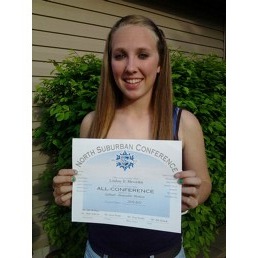
What’s cool about this (to me) is she then asked me what that meant. So many players these days are focused on their personal accolades and achievements instead of team goals. It’s nice to see one who is simply playing her heart out for the love of the game.
There’s also another bit of inspiration here. At the beginning of the season Lindsay was pretty much a bench player — a backup catcher in her first year on varsity. She was struggling a bit at the plate too. But we got together and worked on getting her hitting back on track. I told her if she could hit that the coaches would find a place on the field for her.
Sure enough, she started hitting, and then she started playing more. She was eventually installed at first base, learned the position (she hadn’t played there since 10U ball) and now has received some post season honors.
Once again it points out that it doesn’t matter where you start the race, only where you finish it. Work hard, persevere and good things will happen.
Congratulations, Lindsay. You’ve earned it.
Congratulations to Stephanie Youngman, all conference
Got some more good news today. One of my former players, Stephanie Youngman, was named to the all conference team for her play at College of Lake County, our local junior college.
The cool thing about this is Steph is one of those players whose high school coach never seemed to think much of her. She was overlooked her first couple of years, then made varsity as a junior. But she always seemed to struggle to perform, and to get playing time. That lasted throughout her varsity career. In her final game as a senior, at Regionals, the coach suddenly decided to sit her out in favor of a freshman. Not exactly the time to be experimenting.
For us, Steph always played well. After starting slow her first couple of years she found her rhythm hitting, and ultimately became one of our leading hitters. She was also an excellent fielder, particularly in the outfield. She could play extra shallow to cut off the Texas Leaguers because she was so good at going back on a ball.
I share her story for two reasons. One, obviously, is that I am happy for her that she finally has received the recognition she so richly deserves. The other is an inspiration to other players. This is the time of year when many players seem to be feeling a lack of love from their high school coaches. (Their feelings about their travel coaches come later.)
So I want to show that no matter what, it’s only one person’s opinion. Keep playing and perhaps someday you too will be all conference in college.
Superstars v team players
We’ve all been on (or coached) teams that have had one or two players who were just flat-out better than everyone else. They were more athletic, better-skilled, more driven, more whatever than everyone.
It would seem like those teams would have a natural advantage over those that don’t have any superstars or standouts. They should be the X Factor that drives the team to success. Yet more often than not those teams never quite seem to reach their potential and everyone is left scratching their heads wondering why. Except, of course, the dad or mom of the superstar(s) who just figure the problem is that everyone else isn’t good enough to play with their daughter.
Yet to really understand what causes it, think about competitive rowers. Let’s say you have eight people rowing in the boat, and one of them is clearly better than all the others. If they all row in synch, that star rower will provide an advantage to the team.
But what if he isn’t rowing in synch with the others, because he’s capable of maintaining a faster pace than they can and he wants to row to the best of his own abilities, with no concern for everyone else? At that point the superstar is working against the efforts of everyone else, and the boat will actually go slower as a result.
Now imagine two superstars in that boat. They’re both rowing together with each other, but against everyone else. The boat goes slower still.
In order to maximize a team’s performance, everyone has to be working together for a common goal. It doesn’t matter if you/your daughter is a better player than the others. The minute she starts to think so, and sets herself apart from the team or works against the team’s efforts, the team will never perform up to its capabilities.
The truth is a true superstar makes everyone around her better. If she isn’t doing that she’s not a superstar, just a skilled player. And part of making everyone around her better is picking up others when they’re down, offering encouragement and standing up for their teammates if anyone gets on them. At that point, the sky’s the limit for the team.
Last thing to keep in mind is Michael Jordan was in the NBA for several years before he won his first title. He was a standout player for sure, and everyone marvelled at how great he was. He was a difference-maker on the court. But he didn’t become a champion until he became a true part of a team, willing to give up the big shot to someone else in order to move the team’s goals forward. Today, he has six rings to prove the wisdom of that concept.
Coaching, playing and the success delusion
Funny how sometimes fastpitch softball and my day job in PR coincide. I was just reading an article in the journal of one of our clients — HRPS (HR People & Strategy) talking about neuroscience research into the brain and how it affects leadership when I came across a description I thought is worth sharing with the softball community. It’s about a phenomenon many of us fall victim to at one time or another — the success delusion.
According to the article, the success delusion follows this line of thinking: I am successful. I behave this way. Therefore, I must be successful because I behave this way.
We see this all the time, especially on discussion boards. Someone will post the results of research that has been completed recently that says the optimum way to perform a particular skill is to do X. Then someone else will get on and comment “I’ve been doing it the old way for 20 years. I’ve had many students/players get colleges scholarships and be the best player on their team. Therefore, I’m not going to change no matter what the science says.”
That’s the success delusion. You ignore the facts because you believe what you’ve been doing has been the key to your success, without a thought that perhaps your players/students would’ve been even more successful had you taught them differently.
Players fall victim to it too. I’ve certainly seen this as an instructor. A parent will bring his/her daughter in for a lesson and I will recommend some changes that will help her reach her potential. But she’s already the best player in her rec league, or on her travel or HS team, so she doesn’t want to make any changes. She has confused success with excellence and therefore has shut the door on making any changes. That’s fine — it’s her option — but she shouldn’t be surprised when one day in the not too distant future some of the kids she used to be above are suddenly passing her. Or that despite her awesome record, college coaches aren’t interested in looking at her.
Success is a good thing. We all like to get that rush from winning; it’s what keeps us going. But it’s also easy to assume a particular behavior is the reason for that success when it could actually be a barrier to greater success.
Never be so caught up in what you’ve done that it prevents you from doing what you can do. Keep learning, keep striving and be open to change. You’ll be amazed how much farther it will take you.
First-ever wounded warrior softball game slide show
With seasons getting under way it’s easy to let emotions get the best of us and forget what it’s all about. So I thought I’d pass along this link to an online slide show of the first-ever wounded warrior softball game, which was played at Hillenbrand Stadium in Tuscon, AZ.
This was a game pitting two teams of soldiers, veterans of the Iraq and Afghanistan conflicts, who are recent amputees. I found out about it through the Candrea on Coaching emails I receive from Liberty Mutual’s Responsible Coaching program.
The short version is Coach Candrea was approached about setting up the game, and he enthusiastically agreed. He also lined up Mizuno and Lousiville Slugger to provide uniforms, bats, gloves and more.
The game was played Friday, March 18 after the Arizona-Baylor game. Players from those teams acted as base coaches, and were there for support. When someone hit a home run, they all joined in the celebration at the plate.
We owe much to our veterans, not the least of which is our ability to spend our weekends in the sunshine coaching, watching or playing the game we love. Take a look at the slide show to see some true American heroes playing despite their disabilities. And be sure to thank a veteran when you see him or her.
An unfortunate “experience”
One of the things that’s always been great about fastpitch softball has been how fan-friendly it’s been at the highest levels. I’ve watched as members of the Chicago Bandits stood in the rain to sign autographs and talk to fans for as long as those fans wanted to be there. I’ve seen examples of well-known players (at least in the softball world) make themselves very accessible no matter where they are or what else they happen to be doing.
So it was disappointing to hear the stories of two of my students who attended a recent clinic in Wisconsin. It was billed as an “Experience” and featured a famous player who also happened to be someone both of them admired greatly. Yet it seems like her fame has gone to her head, as her behavior seemed more like a Major League Baseball star rather than a softball player.
My students (and their mothers) told me the famous player spent the entire time talking or texting on her mobile phone. She had no time for the girls, didn’t interact with them, and essentially acted the diva. When one of the moms stopped her between calls to thank her for sending some autographed materials to her daughter a couple of years previously, after her daughter had survived a vicious attack by a dog, she said “Oh, my mom did that. I don’t get into that stuff” or something to that effect.
Unbelievable. Even if that’s true, you smile gracefully and say you were glad to do it. Instead, she treated the encounter more like an inconvenience.
The word from the parents is several people left the clinic before it was over, complaining about the attitude of the star player and asking for their money back. They were completely dissatisfied, and doubtless will tell their friends and teammates to avoid it in the future. That’s a shame, too, because I understand there were two other national team players there plus a young lady from the NPF, and all were terrific. But…
The fact is people came because of the star’s fame, and her refusal to be a part of her own clinic tainted the experience for many.
Hopefully, that was just an aberration. I’d hate to think our sport is going the way of so many others, where players feel they’re too good to mix with the fans who ultimately pay for all they have. If that is the case, imagine what it will be like if and when the players ever start being paid real money instead of the token salaries they get now. We may wish for the good old days of salaries that are less than your typical fast food worker makes.
As for the star, hopefully she was just having a bad day. But I get the feeling that wasn’t it. I just hope she realizes the error of her ways before she disappoints any more youngsters who look up to her.
To the guy who called about his coaches newsletter
Hopefully you will be checking back. Your email to me got caught in my spam filter, and I didn’t look closely enough at the messages before I emptied it. I recognized what it was just in time to not be able to stop it.
So please, if you’re reading this, send it again. I promise I’ll look more carefully this time. Thanks.
Tips for a successful tryout
High school tryouts are coming up in a few short weeks, and with them often come a lot of nerves. (Also a lot of sore muscles as many schools seem to be obsessed with trying to run the not so serious players out of the program before they contaminate the rest of the players).
Sure, you want to show well in a tryout. Who wouldn’t? If you’re an incredibly talented player with monster skills, odds are you’re going to show well no matter what. For the rest, however, you need to put a little extra effort into standing out above the crowd. That’s what this post is about — some ways to make your tryout a little more successful. There are no guarantees, of course, but at least you’ll know you took your best shot.
- Hustle everywhere, all the time. Think of how most players are. They drag themselves from station to station, doing what’s required — and no more. If you hustle everywhere, you’ll look more like a player, the type the coaches can work with and who will find a way to make a contribution.
- Show 10X enthusiam. Ok, I admit I stole that one from Dale Carnegie, via my friend (and Carnegie trainer) Mary Eggert. That doesn’t mean you have to jump up and down and act like a fool. But it does mean paying attention when the coach talks, giving your all with each repetition, encouraging other players, and generally looking like you’re happy to be there and love the game. If it comes down to a choice between a player with 10X enthusiasm and one who’s moping around, which one do YOU think the coach will take?
- Show all your skills. Let’s say you’re hitting, and the coach says to start with a few bunts. Lay down three or four, and then ask if he/she would like to see your slug bunt, or drag bunt, or push bunt, or whatever other bunt you can do. If you’re swinging away, demonstrate your bat control by saying you’re going to hit to the opposite field now, and then do it. Pitchers should always show the pitches they can throw, starting with the changeup. Sure, at a lot of high schools they just line everyone up and pick the fastest one. But you never know — you may leave an impression that helps for the future. Having skills but keeping them in your pocket does you know good. Demonstrate your versatility, and perhaps the coach will see the possibilities adding you to the roster brings.
- Say hello to the coaches. Most players, especially high school age ones, tend to be very tight-lipped around the coaches. So a simple “Hi Coach!” can help you stand out without looking like a big brown noser. Despite what people think, coaches are people too. They might keep you around just so they have someone to talk to on the bus.
- Do something memorable. That doesn’t mean drop your pants or anything like that. But if you’re in a scrimmage situation, look for an opportunity to make something happen. Laying down a surprise bunt, or better yet pulling off a slug bunt, is a good one. If you’re on base and can do it, steal a base. On defense diving for a ball always looks good. Just make sure you’re diving to give extra effort, and not because you were late going after the ball.
Those are my ideas. How about you? Do you have any tips to add for players? I have just one more piece of advice.
Think of tryouts as an opportunity to succeed rather than to fail and you’ll do just fine. Especially if you get some practice time in before the actual tryout date. Good luck!
16U team in southern Wisconsin looking for players
Received a note the other day from a 16U coach who is suddenly finding himself in need of a couple more players for the 2011 season, so I told him I would pass the word along. The team is the Wisconsin Lightning, who are based out of Salem, WI on the border of Illinois and Wisconsin.
He says they have a combined 14U/16U team that plans to play at the B level in 15U or 16U. It could be a great opportunity for either a 14U or 16U player looking to have fun while playing at a competitive level.
Here are a few more details from the coach:
“We are presently @ 9 players. We practice 2-3 times a week and have our own indoor hitting/Pitching facility. I’m not looking for “Studs” ( wouldn’t turn them down though) just girls with potential and a good work ethic”.
If that sounds like a fit for you, or someone you know, contact Pat Saltzberry at psaltzbe@gmail.com for a tryout.






 Life in the Fastpitch Lane