Category Archives: General Thoughts
Not fastpitch softball, but evidence that things are improving for women in sports
This morning I was reading the newspaper (yes, an actual paper newspaper) when I came across a very interesting article. Now, I will admit I am not really a NASCAR or auto racing fan, but something caught my eye about this story. And not just the picture that went with it.
The story was about how several well-known drives and champions on the NASCAR circuit were bringing their young daughters to meet driver Danica Patrick in the pits. Patrick, of course, is know both as being the first woman to drive Indy cars and for the commercials she does for GoDaddy.
All I could think of was how times have changed for women in sports since Title IX came into being. Back then, mostly male-run academic institutions has to be forced by law into offering athletic and other opportunities to women. Many men either thought that women were too delicate to play competitive sports or that they were taking away money that ought to go to men.
Now fast forward to today, and not only is Danica Patrick allowed to race, but the good ol’ boys of NASCAR are bringing their daughters to her as a role model. How cool is that?
There may be hope for us as a society yet.
Training v practice
Saw this post the other day on The Talent Code blog and thought it was something fastpitch softball players (and their parents) would find worthwhile. It’s on the negative connotation of the word “practice.”
According to the post when players hear the word “practice” they think of boring repetition – something to be avoided if at all possible. Yet we all know those boring repetitions are necessary to learning our sport.
What author Dan Coyle suggested is replacing the term “practice” with “training.” Here’s the thinking.
Practice sounds like something you do for its own sake. You practice to learn, but you don’t necessarily have a specific goal.
But training is something you do in preparation for a something. Prize fighters train. Olympians train. Everything they do is aimed at a specific endpoint.
I happen to like the term “training” (this is a new concept for me), but what do you think? Is there a real difference? Does training sound better than practicing? Or does it not matter what you call it as long as it gets done?
Taking a break is a legit way to spend time now
These days fastpitch softball (like so many other sports) has become a year-round commitment. And because of it there is a tendency to want to keep pushing, pushing, pushing all the time.
While it’s important to be dedicated, there is also some value in shutting down for a little while after the season.
The season is long, whether you’re a younger player who’s been playing games and tournaments since January in the South, or April in the North, or an older player who has done a school team followed by a summer season.
During that time even the toughest get injuries, get tired, lose their enthusiasm, etc. Shutting down for a few weeks is a great way to recover, both physically and mentally.
Some may be afraid to shut down because they’re worried about losing ground on the competition. Don’t be. Two, three, even four weeks between seasons isn’t enough time to lose everything. There might be a bit of rust at first, but it will fall away quickly.
The physical aspect of taking some time off is important. But it’s the mental part that’s likely to do the most. Walking away from something you spend so much time on, even something you love, for a little while will help recharge the ol’ batteries and help your player see the game with fresh eyes. It’ll also help put a little separation between seasons so this one isn’t just a continuation of the last one, but a fresh, new opportunity.
It’s tempting to go, go, go. But take a little time for R&R. You’ll find it makes a huge difference in the long run.
10U team looking for players
Just got a note this morning from a guy I know who is looking for 10U players in the far Northwest suburbs of Chicago. He is dropping down to coach his younger daughter after several years coaching his older one, who has decided not to play her last year of travel ball.
The team is part of the Crystal Lake Tidal Waves organization, and the coach’s name is Steve Kram. He’s a good coach with plenty of experience, and someone I know will do right by the girls. If anyone is looking for a team, or knows a 10U player looking for one, tryouts are Wednesday, August 8, 2012 at 5-6:30pm and next Saturday the 11th at 8am-10am. Tryouts are held at Prairie Ridge High School.
If you’d like more information, you can contact Steve directly at s_m_kram@yahoo.com.
Fastpitch ability is also in the eye of the beholder
Regular readers know how much I love a good fastpitch softball success story. With the tryout season upon us I have a great one to share.
This one involves one of my pitching students, a girl who was 10U eligible but played up on an 11U or 12U team. (I’m old school, so I don’t really buy into the odd-numbered levels, but they seem important to others.)
Anyway, she isn’t the biggest kid in the world, so pitching at 40 feet instead of 35 and throwing a 12 inch ball instead of an 11 inch one was a bit challenging. She probably could’ve dominated hitters in 10U ball. She worked hard in lessons throughout the off-season, though, and got herself prepared.
Unfortunately, the season didn’t go quite as expected. Although the coach recruited her hard during tryouts, convincing her parents to have her play up and not even try out for the 10U team, when the season rolled around he just didn’t seem to have much use for her. I saw her pitch a game and she actually did her job. But her team had trouble making basic fielding plays, and struggled more than they should have. They won, as I recall, but it was tough.
After that she had a tough time getting playing time, either in the circle or on the field. Weekend after weekend she’d come to the games only to watch most of them from the bench. She was very discouraged, and her mom told me she was in tears on a regular basis. She even thought about giving up.
The last two weekends she’s been trying out with some new teams, and it’s been a completely different story. In fact, both teams she’s worked out for so far made offers right away, and are very interested in having her pitch for them next year. She’s gone from unappreciated and discouraged to having her choice of teams for which to play.
There’s a lesson in there for other players, and for all of us, really. While you always want to be working on your game, sometimes it isn’t you. It’s just someone else’s perception of you. Keep working hard, keep battling, and you’ll come out ahead in the end.
Sad news: Mary Nutter passes away
Heard some sad news today, first from Cindy Bristow on Facebook and then later confirmed by the NFCA. Mary Nutter, an NFCA Hall of Famer and the creator of the National Sports Clinics, has passed away.
Anyone who ever went to the NSC knows who Mary was. She was a quite a character and a force to be reckoned with. She ran her clinics with an iron fist (and about as much passion as anyone could muster).
It was always amusing to see Mary when one session was scheduled to end and another to begin. She didn’t care if you were a D3 assistant coach, a former player or the head coach of the National Team. When it was time to get off, she’d cut you off and keep things moving.
That being said, Mary was always looking out for her attendees. Inevitably there will be mix-ups or things missed when human beings are involved. But Mary made sure her people were trained to handle them quickly. And quite frankly, if you could catch her in the hallway she was a blast to speak with.
I attended many National Sports Clinics sessions here in the Chicago area, and much of what I know today I learned there. Mary always brought in the most interesting speakers and had the most interesting topics. Yet even in a large lecture format, where there might be 600 people in a hotel ballroom, you never felt remote. Because Mary always encouraged the speakers to hang out in the hallways and talk to people individually. If it was good enough for Mary herself, it was good enough for the presenters.
Hopefully the National Sports Clinics will continue to bring great softball information to new generations of coaches. But they’ll never quite be the same.
Mary Nutter, thanks so much for all you gave all of us. I think we can say you’re now safe at home.
Do you have any memories about meeting, talking to or seeing Mary Nutter? Add them in the comments section!
An unusual fastpitch softball Father’s Day
Today was a bit of an unusual day for me. It’s the first time in 16 years that I haven’t been coaching a fastpitch softball team in a tournament on Father’s Day. I don’t have a team this year due to some circumstances not worth going into here, so the day (and the weekend, of course) was free.
That’s not to say there wasn’t any softball in my day. I did get out to say a game where several students (one on one team, the others on the other) were playing, so at least I got my fix. Still, it’s definitely different being in the stands instead of the dugout.
I started coaching when my oldest daughter, who is now 28, was a second year 12U player. Little did I know back then how much the game would come to be a part of my life. I remember one year coaching my younger daughter’s team when the whole family came out to watch the game at an away tournament, just so we could be together.
After I watched the game I came back and did what ordinary fathers do. Went with my wife to the grocery store, did some yard work, ran some errands and grilled some Italian sausages. It’s been so long since I’ve had the chance to do that it seemed a bit surreal.
Will I get back into team coaching? Perhaps, if the right opportunity comes along. I do miss the whole team dynamic. In the meantime, today was a most interesting and unusual day. Happy Father’s Day to all you dads (and dad substitutes) who spend your days at the ballpark and the practice field. You are a big part of what keeps this game going.
A great story of redemption
Long-time readers know I love stories where a fastpitch softball player who is overlooked or dismissed by a coach comes back to have some success. So today I’m sharing one that was in the newspaper recently. It was about a girl who played for me in 2010 and 2011 — Erin Pauly. Thanks to her mom Jan for pointing it out to me. 
I don’t know how long the link will stay live, so just in case you can’t read it anymore here’s the short version — plus a little extra background.
First of all understand Erin is a great a kid — sweet, polite and a good teammate to all. She’s also a fierce competitor. She had kind of a rough year in 2010, but experienced a lot of success last year in the summer,
This spring she made varsity at Carmel Catholic High School as a sophomore but couldn’t quite seem to get on track. According to the story her 16U travel team tried to turn her around as a slapper, but she struggled with it when she got a chance to play. She was benched, then eventually she was demoted to the JV team.
The newspaper says she was sent down to rebuild her confidence, but having heard how it was handled — no conversation or explanation, just you’re not on varsity anymore — I think it’s safe to say she was demoted. She played JV until the end of the season, when she was brought back to varsity with a handful of other call-ups. This time, however, things were different.
Her confidence was back and she started playing like the Erin I know. She started ripping the ball from the right side, and in the last couple of playoff games got some good hits, including a big double in a losing cause in Carmel’s last game.
If you don’t get to see it, the newspaper story I’m referring to the cool thing is she got the headline and was the focus of the story. That’s a pretty cool redemption for someone who was pretty much forgotten and dimissed in mid-season.
In Harold and Kumar Go To White Castle one of the characters says “The universe has a way of working out the way it should.” In this case that was true.
Come back again soon for another story of the triumph of an underdog. In the meantime, what did you think of this story? And if you have your own story of redemption, please share it in the comments.
Congratulations to Grayslake North High School
Had a chance to watch another great high school playoff game today. This time it was Grayslake North and Prairie Ridge high schools squaring off for a Sectional title.
The game featured two of the top pitchers in the area — Kristi Gandy for Grayslake North and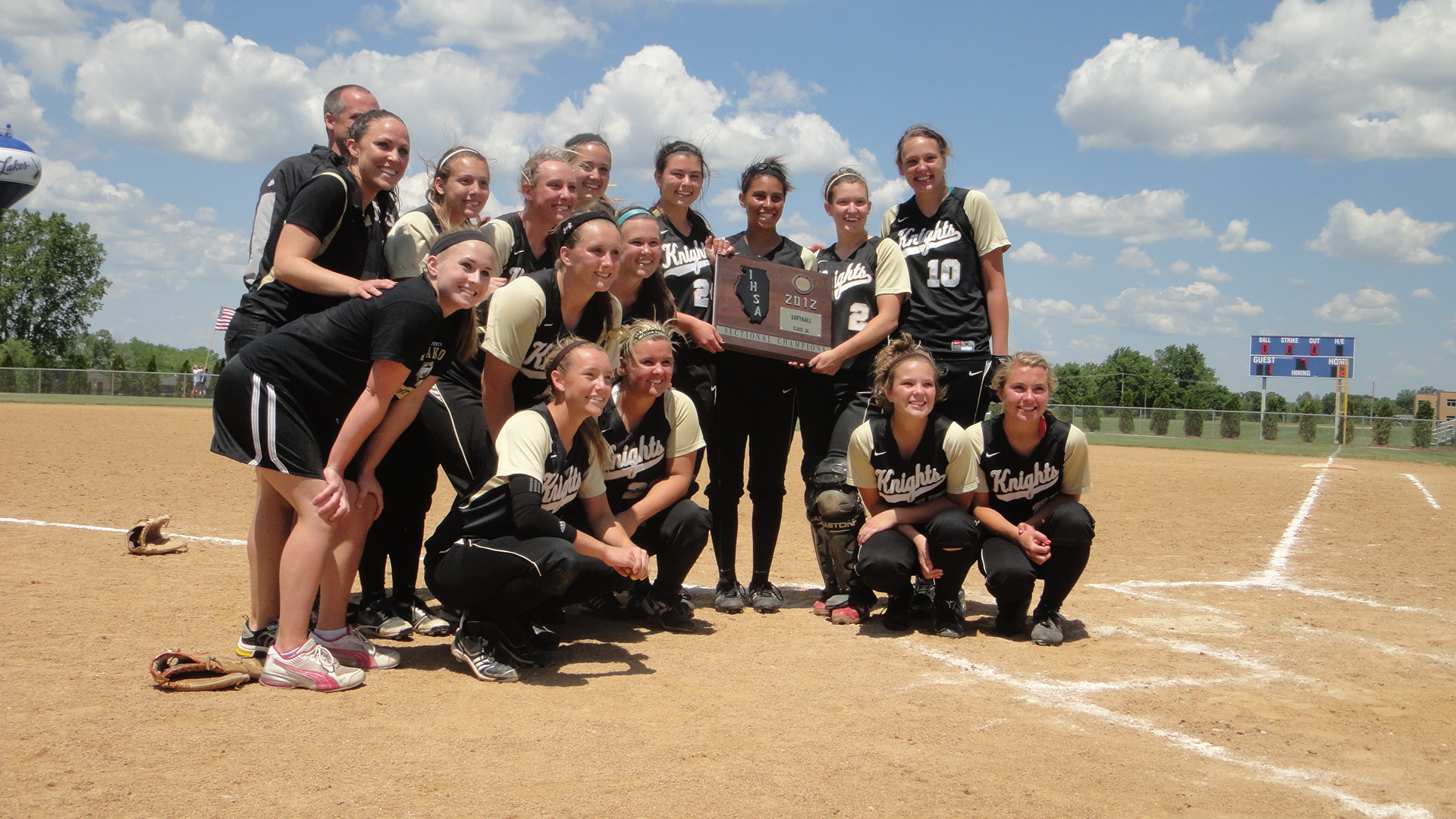 Kirsten Stevens for Prairie Ridge. Both are dominant pitchers and leaders on their teams (along with being strong hitters as well), and today was no exception. Hits were tough to come by all day on both sides.
Grayslake North prevailed by a score of 2-1. The difference was a couple more timely hits for Grayslake North, and some outstanding defensive plays when they needed it.
In the top of the sixth, trailing 2-1 with two outs and a runner on second, one of the Prairie Ridge hitters stroked a single to medium deep left. Knowing how tough runs had been to score all day, the Prairie Ridge coach sent his runner home. Left fielder Courtney Peterson scooped up the ball and fired a perfect strike home. The ball didn’t make it on a fly — it actually rolled for the last part — but catcher Brooke Tracy dropped to her knees, fielded the ball, leapt to her feet and made a very sure tag to cut down the runner at home to end the inning.
Then in the top of the seventh Kristi, who was getting squeezed on the inside corner according to several observers (including Lake Forest College pitching coach Laura Matthews), issued a walk to the leadoff hitter — never a good idea in a tight game. Especially when the leadoff hitter for the inning was also the leadoff hitter for the game. But I saw Kristi and her teammates communicating something prior to facing the next hitter.
As he had throughout the game, the Prairie Ridge coach had his hitter lay down a sacrifice bunt with a runner on first. But there’s a problem when you’re predictable. Grayslake North was ready for it. When the bunt went down, instead of taking the sure out at first, third baseman Kelsey Borders fired the ball to second baseman Jessica Davis covering second, erasing the lead runner. One out.
The next hitter grounded to first baseman Christina Freese; again, instead of taking the automatic out at first she wheeled and fired to shortstop Jordyn Bowen covering second, nailing the lead runner again. Two outs. A couple of pitches later the cleanup hitter hit a short pop to Borders at third, who ran in, squeezed the ball and secured the victory.
One other effort worthy of note. I saw in the newspaper this morning that Stevens struck out 15 North hitters. That seems like a strong but not particularly remarkable performance until you realize that was in six innings since they were the visitors. So out of 18 possible outs, her left arm was responsible for 15 of them. Sounds like she’s ready to pitch for the Cubs!
It was an action-packed, tense but well-played game. Both sides are to be commended for a great job. It was everything we love about softball.
Watched a great fastpitch softball game today
Just had to comment on this one. Today I watched Carmel Catholic High School v Mundelein High School in a Regional championship game here in Illinois. For those who don’t know, both schools are in Mundelein so it was a true cross-town rivalry.
The play on both sides was impressive. Lots of great defensive plays supporting strong pitching. Carmel was able to put a few more legitimate hits together, though, and ultimately won 2-0.
One of the great plays I saw was Mundelein pitcher Molly Ellett (one of my pitching studnets) fielding a suicide squeeze and getting the out at home. She also took on another bunt and got the out at first. Those were big outs.
On Carmel’s side, one of the memorable plays was shortstop Kathleen Felicelli fielding a ground ball that had first hit pitcher Nicole Bitter’s glove, grabbing it on the run and throwing for the out.
Have to admit I was proud of my hitting student Amy Abel as well. She hit a timely single for Carmel, and later laid down a perfect sac bunt (although I would’ve rather seen her swing away as she has had a hot bat lately).
Baserunning was good on both sides as well. I saw a couple of runners take advantage of balls in the dirt, aggressively taking the base even though the ball didn’t get far from the respective catchers. Each team was looking for every edge it could get.
The only shame was the way the game ended. Molly was rung up looking on a pitch that was clearly mid-shin high. I hate when that happens, but such is life.
Both teams are to be commended on a great game. I’ve seen a lot of badly played HS games this year, so it was fun to see such a good one. Congrats to both sides.