Category Archives: Coaching
A Quick Guide to Working With the Littles

Congratulations! You missed your rec league’s organizational meeting and somehow got volunteered to coach an 8-10 year old team.
Or maybe you were once a player and thought it was important to give back to the game you loved so much growing up so you volunteered yourself. Or you’ve started doing private lessons and were looking to fill up your schedule.
Whatever the situation, you’re now faced with the challenge of trying to help one or more kids who just learned how to tie their shoes a couple of years ago now use a windmill motion to throw a ball 35 feet into a strike zone that feels like it’s the size of a baby’s shoe box, hit said pitch with a bat, throw a ball more than 20 feet and get it in the general vicinity of the target (who is hopefully paying attention), catch a ball thrown at them without running away screaming, and learn all the rules, strategies, and general requirements they need to know to play this complex game. Whew!
As someone who has done this for more years than some of the parents of those kids have probably been alive, I can tell you it can be quite challenging. But it can also be quite rewarding, especially when you see those kids’ eyes light up as they do something they’ve never done before, and hear them asking their parents when the next practice is because they can’t wait to come back.
So with that in mind, here are a few suggestions that can make your path to working with the littles a little easier and more comfortable – for you and for them.
Get used to stooping down or kneeling
There is a scene in the movie Hook where Peter Pan first wakes up to the fact that he is Peter Pan. He looks at Captain Hook and says, “I remember you being a lot bigger.”
To which Hook replies, “To a 10 year old I’m enormous.” Or something like that.
That’s how you look to the littles. Even if you’re considered to be short or even very short in the adult world, you’re still likely to loom tall over most of your players, which can make you seem scary. Double that if you’re male.

Squatting, stooping, or kneeling down can put you at their eye level, making you seem less intimidating and more friendly. It can quickly put your players at ease.
On the other hand, when you squat down don’t be surprised if at least some of your players do it too, thus taking away the purpose of squatting down in the first place. Just enjoy the cuteness overload of it and know that if they are reacting that way they’re already starting to see you as one of them.
Try to understand how they see the world
This goes double if you were a college player in my opinion, because like any human being your perspective of something is most likely to be colored by your most recent experience with it.
The most important takeaway you can have here, and probably from this entire blog post, is that kids are not just short adults. That is true of any kids, but especially the littles.
Some probably still believe in Santa or the Tooth Fairy. They’re barely out of their Paw Patrol phase and may still play with dolls or unicorns or trucks or simple video games, or have rich fantasy lives full of imaginary adventures.

In other words their life experiences are very limited, as are the reasoning skills for most of them. You really need to get out of your own head, with all you have learned over a lifetime, and see things from their perspective.
Assume they know nothing about fastpitch softball or its skills and strategies, not to mention life for the most part, and proceed from there.
Speak in words they understand
You may have a great vocabulary and lots of technical knowledge about softball, human anatomy, movement patterns, etc. Good for you, great job on improving your education!
But if you’re going to work with the littles you need to set all of that aside and speak to them in a way they understand. Use small words and keep explanations short and simple.
Instead of saying “Move on the frontal plane” tell them to go sideways. If you’re instructing them on throwing, call the upper arm the upper arm instead of the humerus. Say “see it in your head” instead of “visualize it.”
The more you talk to them with words or concepts they already understand the faster they’ll learn – and the less frustrated you will get.
Fit the drills to their skills – and size
You may be all excited about teaching your players your favorite hitting drill from high school or college, or a new throwing drill you learned from a college coach at a coach’s clinic. But before you trot it out, take a good look at your players and see if it’s a fit, figuratively and literally.
Here’s an example of NOT doing that. At a facility where I give lessons, the last two weeks I’ve watched the cutest little 8U (I presume) team doing hitting drills where they get down on one or both knees and hit off a tee.
Nothing wrong with that in theory. But in practice the problem is when they are on one or both knees the ball is about nose-high even with the tee all the way down. So all they’re really being taught is to swing at pitches out of the zone.
Making things worse, at times they are doing one-handed drills. Most of those girls can barely hold their bats up with two hands, much less one. And yes, they are choking up on the bat when they’re doing it.
They’d be much better off standing up and learning the basic sequence of how to move first. Then, when they get a little bigger, stronger, and more accomplished, they can work on isolating different parts of the swing.
The same goes for many other parts of the game. Think of it as a pyramid.
Start with the very general as the foundation, then work your way up to more narrow and advanced components as they master the basics. They’ll learn better, and your team will perform better while having more fun.
Exercise – or learn – patience
This is probably the most important skill you can develop as a coach. Not just for the littles; for everyone, but especially for the littles.
Remember their brains are still in the process of forming, and it will be a long time before they’re fully formed. Like their mid-20s.
Also remember that everyone is an individual, so the pace of their development in various areas will be different. Some will be able to do things right away, others will struggle, no matter how hard they try.
Be patient with all of them and meet them where they are. Praise progress, not just success.
When you get frustrated, take a deep breath and maybe try to explain things in a different way. Find something they can relate to and use that to help explain what you want to them. A great coach will have 100 different ways to say the same thing.
You’ll also need patience when it comes to their attention spans. Some littles are really good at paying attention. Others have a circus going on in their heads at all times so it can be a little tougher to keep them on-task.

I’ve had some of those. One in particular I can think of is a girl named Katie, who was a pitching and hitting student.
She was a good athlete, even at that age, but at any given time her brain could turn on a dime and she’d be far away from what we were trying to do, and I’d have to try to corral her back again. Her mom was a teacher, too, so she’d get aggravated when Katie wouldn’t pay attention.
I, on the other hand, chose to find it amusing and would laugh at her flights of fancy, which I think helped build the relationship.
As she got older, her focus got better and she turned out to be a terrific pitcher, the kind that typically didn’t need to throw more than 10-12 pitches to get through an inning. Although she eventually gave up pitching she went on to play high-level travel ball and become a high school varsity starter as a freshman in both softball and basketball. (I had nothing to do with basketball, just pointing it out for accuracy’s sake.)
Again, everyone develops at their own pace, and the weakest or least attentive player today may go on to become the best player on her team down the road. With a little patience you can help get her there.
CAVEAT: The one area where that doesn’t work is the kid who is purposely being disrespectful or disruptive or uncooperative. I have no patience for that. If they clearly don’t want to be there nothing wrong in my opinion with telling them to get on board or get out. It’ll save everyone a lot of heartache.
Be kind
I shouldn’t have to say this but again, based on my extensive experience watching how the littles are treated in games and practices, it needs to be said anyway.
None of your players are purposely trying to walk every hitter, strike out, drop easy pop-ups, boot grounders, forget to tag up, throw the ball into the parking lot, or commit any of the other basic softball sins. That stuff just happens.
When it does, you don’t have to scream at them or berate them or call them names. Instead, help them learn from their mistakes in a kind and respectful way.
Be encouraging. Tell them you believe in them, and that they should believe in themselves.
Give them corrections when and where needed without belittling them (no pun intended). You may have to do that a few times before it really sinks in, but keep doing it.
Years down the road they will remember you fondly, and may even invite you to their wedding! Help them feel good about themselves, even when you’re secretly mad as heck at them, and you’ll not only help them become winners as ballplayers; they’ll become winners as human beings.
Have realistic, age-appropriate expectations
Even though I’ve been doing this a long time I’m still shocked at some of the stories I hear about the expectations coaches can have of their littles.
Pitching is a good example. There are coaches of 8U and 10U teams that insist their pitchers have to “hit their spots” or throw a certain velocity if they want to pitch for the team.
First of all, at those ages “hit your spots” should mean throwing strikes enough of the time to keep the game moving. To expect kids who are just learning how to pitch to throw to an exact spot with precision is simply ludicrous.
Expecting certain velocities is silly too given how much of a size difference there can be as kids develop. To think a pitcher who stands less than 5 feet tall and weighs 70 lbs. will throw as hard as a pitcher who is 5’4″ and weighs 120 lbs. is unrealistic, to say it kindly.
These ages (and I will include 12U in this one as well) are about development and gaining experience, not meeting certain “minimum standards.” That extra small little will grow someday, in her own time, and my actually pass by all the girls who started with greater physical advantages because she wanted it more.
You just never know. Your job as the coach is to encourage and create opportunities for every kid on the team so they develop a love for the sport and go on to become the best they can be. The rest will sort itself out down the road.
The rewards are there
I won’t kid you. Working with the littles isn’t easy; it definitely has its challenges with coordination and attention spans being at the top of the list.
(On the other hand, when they get to be teens with attitudes and petty squabbles you may long for the days when your biggest coaching challenge was getting them to keep their elbows up when they throw.)
Just keep in mind you have the unique opportunity to shape the next generation of fastpitch softball players, and perhaps coaches after that. What you do matters than you may realize.
Thank you for taking on this important challenge. Now go get ’em, coach!

Energy Creation: The Rolling Snowballs Corollary

This seems like an apt analogy since as I write this much of the USA is still dealing with a fair amount of snow, including many places that rarely get any. Welcome to my world, although we actually haven’t gotten much all winter.
Anyway, the other day I was trying to explain the concept of acceleration to a young pitcher. We were talking about the need for her arm to pick up speed down the back side of the circle instead of staying at one speed if she wants to throw harder.
Then an idea hit me, thanks to a childhood misspent watching Saturday morning cartoons.
“Think about a snowball rolling down a hill,” I said. “At first, the snowball is small. But as it rolls down the hill, the snowball starts picking up more snow, getting bigger and bigger. Then, when the snowball reaches the bottom and stops, the snow explodes all over the place!
“That’s what needs to happen with your pitching arm,” I continued. “As you come down the back side you start moving your arm faster, which gathers more energy like the snowball gathers snow, until the ball explodes out of your hand at the end.”
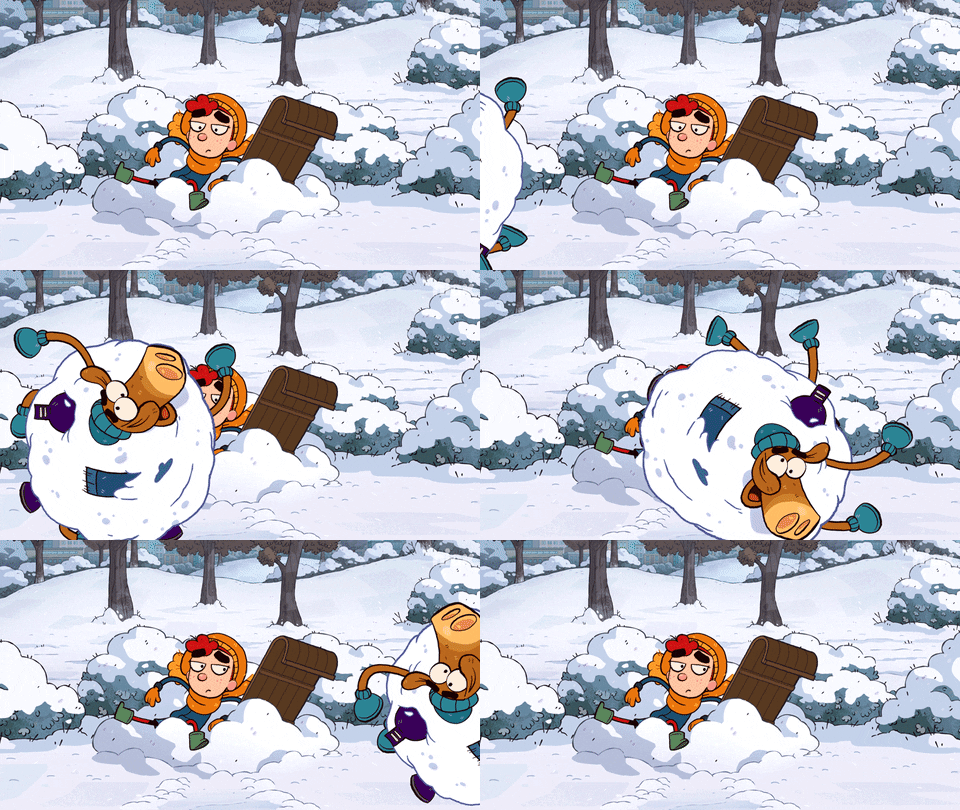
That made perfect sense to her. The more the snowball moves downhill the faster it goes and the more snow (energy) it picks up.
Ergo (love that word, rarely get to use it in a sentence), getting that arm to move faster down the back side of the circle is critical to maximizing speed. Logical, right?
But that doesn’t mean pitchers can always do it. Some will do it naturally. Others will do it once your bring it up. But some have to unlearn old movement patterns and replace them with new ones before they can execute it.
One of the best ways to help them learn that acceleration is by moving the pitcher in close to a net or tarp, having her stand with her feet and body at 45 degrees to the target, and then throwing with a full circle, emphasizing the speed on the back side of the circle. You can also do that with six or eight ounce plyo balls into a wall.
I also prefer they move their feet as they do it since body timing is also crucial to great execution.
The key here is feeling the arm moving as quickly as it can. But there’s another caveat.
To really make this work and get the acceleration, the arm has to be loose and the humerus (upper arm) has to be leading with the forearm trailing behind, i.e., throwing with whip. Moving the whole arm in one piece, as you do when you point the ball toward second base and push it down the circle, will not yield the same level of results. In fact, it could cause injuries.
Once the pitcher can execute this movement from in-close, start moving her further away and trying it again. Take your time with this process, because if you move her back too fast and she perceives the target is too far away she will start muscling it to make sure it gets there rather than letting it move naturally.
At each step, take a video and look to make sure there is at least somewhat of a bend or hook at the elbow instead of a straight arm. If not, move her back up or slow her down temporarily so she can get the proper mechanics.
Then speed it up and try again.
By the way, the energy snowball concept is not just for pitchers. This type of acceleration into release or contact is also critical for overhand throwing and hitting.
Or pretty much any other athletic skill requiring power.
Now, if you’re an adult with lots of real-world experience, all of this may seem obvious to you. You may even be wondering why I’m spending so much time on it.

But a young player, or even a young adult player, may not have the real-world understanding of basic physics or biomechanics to tie acceleration into energy production. For them, it’s helpful to put it in a context that they can easily comprehend based on what they have already seen.
Even if it comes from a Saturday morning cartoon.
If you have a player who’s struggling to understand the concept of acceleration into action, try talking about the rolling snowball. It just might break the ice with them.
My good friend Jay Bolden and I have started a new podcast called “From the Coach’s Mouth” where we interview coaches from all areas and levels of fastpitch softball as well as others who may not be fastpitch people but have lots of interesting ideas to contribute.
You can find it here on Spotify, as well as on Apple Podcasts, Pandora, Stitcher, iHeart Radio, or wherever you get your podcasts. If you’re searching, be sure to put the name in quotes, i.e., “From the Coach’s Mouth” so it goes directly to it.
Give it a listen and let us know what you think. And be sure to hit the Like button and subscribe to Life in the Fastpitch Lane for more content like this. Commercial over.
Snow roller photo by Perduejn, CC BY-SA 4.0 https://creativecommons.org/licenses/by-sa/4.0, via Wikimedia Commons
Be the River, Not the Rock

Here’s a simple question for you today: which is strong, the river or the rock that sits in the middle of it? The answer is it depends on your point of view.
Taken at a glance, a snapshot in time if you will, it appears the rock is stronger. After all, the rock stands steadfast, unmovable, while the river must divert around it.
But if you take a longer-term view, the answer is the river, because over time it will erode the rock until the rock is no longer an obstacle to its path.
I know, very Kung Fu of me (which is probably where I got the idea). You can hear the pan flutes even as you read this.

That doesn’t make it any less true, however. Which is a good lesson for playerstrying to learn or improve a challenging skill such as pitching or hitting, as well as for coaches trying to get the best out of their teams.
Players
Let’s start with players. They can take the rock approach to learning new skills or improving/revamping current ones for a variety of reasons, including:
- What they’re currently doing has worked for them before. For example, a 12 year old pitcher who is used to pushing or lobbing the ball toward the plate instead of using her whole body to throw. She threw more strikes than the other pitchers she knows and if that’s her only measurement of success why change? .
- They’re not comfortable doing something new. With minor exceptions, who is? It’s a lot easier to do what you’ve always done than to change it.
- When they try something new their performance goes down (in their mind). Such as a hitter who used to make weak contact but is now swinging and missing while trying to learn a new way to swing the bat.
- They just don’t want to change. Typically seen with players who are forced to take lessons by their parents or players who believe they are better than they actually are (big fish in a small pond).
The problem here, as they say, is if you do what you always did, you’ll get what you always got. But if others around you are improving their games, what you always got may not be good enough anymore and you’ll find yourself sinking down the batting order or the pitching rotation – or maybe even out of the starting lineup.
The important thing to remember when players make a change is that it doesn’t have to be permanent. Try something for a little while and see if it works. If it doesn’t, you can always try something else.
I do that a lot with my students. I have an idea, based on science and experience, of what will work, but I’m not omniscient. (That means all-knowing for those who don’t feel like looking it up.)
Try it and see how it feels. Sometimes you’ll hit farther or throw faster.
Sometimes it will throw you off your game completely. But you don’t know until you try it.
Remember, as the rock wears down the river changes its course. Be the river.
Coaches
Coaches, too, can benefit by taking the river approach instead of being the rock.
We see the rock approach a lot. Something new will come along and you’ll have a percentage of the coaching popular who will say “I’ve been doing it my way for 10/20/30 years and have had success. Why should I change?”
The answer, of course, is because new discoveries are being made all the time – data-based discoveries that can help players get better, shortcut the learning process, overcome deep-seated challenges that are built into the DNA, or otherwise improve.
It’s the same with game strategies. You may have followed the same playbook for X number of years, but what if there is information out there that could turn a few more of those losses into wins because you knew how to use it?
The best coaches I know are constantly scouring every source they can find to obtain new information in the hopes that it might help them. They are moving their knowledge forward like the river instead of standing in one place like the rock.
Imagine if you could discover just one little tip or trick or way of looking at things that would give you a significant advantage over your rivals. That’s the premise of the book and the movie Moneyball.

The Oakland Athletics used data to find players others didn’t value very highly to help them field a team that could win 100 games while fitting their very limited budget. It was a game-changer for them, and for the rest of Major League Baseball who followed that example.
Besides, learning new things is fun. Again, you may try something only to find it doesn’t work for you.
That’s ok. Now you know more than you did before.
But if you do discover some new strategy or approach that pays dividends you’ll be glad you gave it a try. Even if you had to change your world view a little.
It’s easy to be the rock, staying in one place while the world rushes past you. But eventually it will wear you down too. Be the river.
Check Out Our New Podcast
Speaking of learning new things, my good friend Jay Bolden and I have started a new podcast called “From the Coach’s Mouth” where we interview coaches from all areas and levels of fastpitch softball as well as others who may not be fastpitch people but have lots of interesting ideas to contribute.
Our first two episodes are in the books. In the first we spoke with pitching guru Rick Pauly of PaulyGirl Fastpitch, and in the second we heard from Coach Sheets (Jeremy Sheetinger), head coach of the Georgia Gwinnett College baseball program.
You can find it here on Spotify, as well as on Apple Podcasts, Pandora, Stitcher, iHeart Radio, or wherever you get your podcasts. If you’re searching, be sure to put the name in quotes, i.e., “From the Coach’s Mouth” so it goes directly to it.
Give it a listen and let us know what you think. And be sure to hit the Like button and subscribe to Life in the Fastpitch Lane for more content like this. Commercial over.
River photo by Matthew Montrone on Pexels.com
Book Recommendation: “Crunch Time”

We’ve all seen it or experienced it: the player or coach who is great in practice (aka a cage warrior) and seems like he/she should be a star, only to struggle when they get into a game. It’s frustrating to watch, especially because the breakdowns often seem to happen at the worst possible time, yet helping them break free of that mindset can be extremely challenging.
Fortunately I recently read a book that addresses this very issue. It’s called, “Crunch Time – How to Be Your Best When It Matters Most” by Rick Peterson and Judd Hoekstra.
If you’re not familiar with them, Rick Peterson is currently Developer of Pitching Development for the Baltimore Orioles, was the pitching coach for the Oakland A’s during the “Moneyball” era, and is considered one of the top pitching coaches in all of Major League Baseball.
Hoekstra is a bestselling author of books on leadership as well as a vice president at The Ken Blanchard Companies, a consulting firm that specializes in training business leaders at organizations of all sizes. Pretty good pedigrees for both authors.
While the book’s lessons apply to a general audience rather than specifically to baseball or softball, it definitely speaks to the challenges players and coaches face when challenged to perform under extreme pressure. The nice thing is it’s a pretty quick read too; I finished it cover-to-cover while on a 4.5 hour flight coming home from vacation.

The central theme of the book is that when you are facing a difficult situation you need to reframe it in order to manage the stress and allow yourself to perform the way you know you can. In other words, instead of seeing that difficult situation (such as an at bat where the game is on the line) as a threat, view it as an opportunity.
So in that example, the immediate threat is losing the game if the player doesn’t perform well, i.e., get a hit. But the underlying threats are that coaches and teammates will be mad at the player, the player might get benched, teammates won’t want to associate with the player, one or more parents might be angry with the player, the player will be embarrassed, etc.
The result is the player gets so caught up in potential consequences (especially if he/she has faced this situation before and failed) that he/she freezes up and it becomes a self-fulfilling prophecy. It’s difficult to perform at a high level when you’re paralyzed with fear.
After explaining the need for reframing the authors then get into several techniques to accomplish this task in subsequent chapters, including:
- Reframing from trying harder to trying easier
- Reframing from tension to laughter
- Reframing from anxiety to taking control
- Reframing from doubt to confidence
- Reframing from failure to learning moment
- Reframing from prepared to overprepared
Each chapter not only talks about the techniques but offers anecdotes from the authors’ experience of how they were applied. For example, Peterson talks about making mound visits during MLB games where he used humor to help a pitcher put what was happening into perspective, allowing him to get past an initial walk and single in order to strike out the heart of the opposing lineup and get out of the inning.
One of the nice things is that unlike many “mental game” books, applying the lessons in “Crunch Time” doesn’t require going through a plethora of exercises in order to master the techniques. It’s more of a philosophical approach presented in a simple form that makes it easy to grasp the lessons so you can begin applying them right away.
While I’ve been talking about how coaches can use the lessons in “Crunch Time” to help players, they can also use it to help themselves become better coaches at critical points of the game.
In that way it reminds me of a story legendary football coach Bill Walsh told in his book “The Score Takes Care of Itself.” Walsh was one of the first if not the first to develop the laminated play calling sheets all football coaches now have with them throughout the game, and was lauded as an innovator for doing it.
Yet in his telling, the reason he did it wasn’t because of some stroke of genius. It was the result of him having trouble making quick decisions under pressure. By creating the play calling sheets when he was calm and reasoned, i.e., before the game, he could just look at what he figured out already and just follow it, relieving the pressure of those in-game, critical decisions.
The lessons of “Crunch Time” can help in the same way. Take the international tie breaker, probably one of the most high-pressure situations in softball coaching because often any minor miscue or poor decision can lead to the loss of the game and possible elimination from a tournament or conference championship.
Rather than viewing a loss as a threat, by reframing it as an opportunity (we’ve prepared well for this situation so we have an advantage over our opponents who are clearly nervous about it) coaches can make strategic decisions with confidence, knowing their teams will execute, and can convey that sense of confidence to the team to keep them from being rattled and making those types of mistakes.
As I said earlier it’s a pretty quick read but there’s a lot of great thinking contained within the content. If you’re looking for techniques to help your players perform better, and/or ways to help grow your own coaching abilities, I recommend you pick up or download “Crunch Time.”
Captain Picard’s Lesson on Winning, Losing, and Errors

Sorry to nerd out on this one, but there is a great Star Trek: The Next Generation episode called Peak Performance that puts some perspective into the challenges of competing in fastpitch softball. Even if you’re not a fan you might one to check this one out.

The part that’s interesting here is a side story involving Commander Data, the highly advanced android crew member. An outsider named Kolrami who is a grandmaster at a game called Strategema (sort of a holographic version of Space Invaders) comes on board and quickly irritates the crew with his arrogance.
A couple of crew members encourage Data to use his computer brain to take Kolrami down a peg by challenging him to a game of Strategema. At first reluctant, Data finally does it to defend the crew’s honor – and promptly gets his butt kicked by his flesh-and-blood opponent in about a minute.
Shocked, Data immediately surmises there must be something wrong with his programming and tries to take himself off duty until he figures out where the “problem” is. Captain Picard, who is captain of the ship, rather harshly tells him no he can’t do that, he needs Data, and that Data should quit sulking even though Data has no emotions and so presumably no capacity to sulk.
Then Picard tells Data something that every fastpitch softball coach, players, and parent needs to hear: It is possible to make no errors and still lose.
In our case I’m not talking only about the physical errors that get recorded in the scorebook. Playing error-free ball and losing happens all the time.
I’m talking more about the strategic decisions and approaches to the game that seem like they’re sound but still don’t produce the desired results (a win). Here’s an example.
There are runners and second and third with one out in the last inning of a one-run game. The defensive team opts to intentionally walk the next hitter to load the bases in order to create a force at home and potentially a game-ending double play at first if there’s time. They also pull their infield in to give them a better shot at that lead runner.
The next batter after that hits a duck snort single behind first base that takes a tough hop and rolls to the fence after landing fair and two runs end up scoring.
No errors were made, and the strategy was sound. But the result is still a loss.

Here’s another one from my own experience. Down one run with no outs in a game where they have been unable to hit the opponent’s pitcher, the offensive team finally gets a runner on first.
She’s a fast, smart, and aggressive baserunner, so putting the ball in play somehow could go a long way toward tying the game. The obvious solution would be a bunt to advance the runner to second, giving the offense two shots to bring her home from scoring position.
But the defense knows that and is playing for the bunt. So the offense opts for a slug bunt (show bunt, pull back, and hit the ball hard on the ground) combined with a steal of second. If the hitter can punch it through the infield the runner on first, who already has a head start, will likely end up on third and might even score, depending on how quickly the defense gets to the ball. Best case the batter will end up on second, as the potential winning run, worse case with good execution she’s on first.
Unfortunately, the batter does the one thing she can’t do in that situation – hit a weak popup to the second baseman. The batter is out and the runner who was on first gets doubled off.
Now, you can argue that the failed slug bunt was an error, but was it really? It was a failure of execution but not necessarily a mistake in the classic sense. It was just one of those cases where the hitter lost the battle to the pitcher.
The point is that sometimes, despite our best efforts and doing all we can to play the game correctly, things don’t work out the way we’d like. There are things that happen beyond our control that can influence the outcome of a play, an inning, or a game.
We can’t beat ourselves up over it or spend endless time second-guessing ourselves. We learn what we can from the experience and move on.
Sometimes we make different decisions the next time – and sometimes we don’t – and hope for a different outcome.
In case you’re wondering about Data, at the end of the episode he requests a rematch. This time he keeps the game going until Kolrami finally gives up in frustration.
When asked about it, Data explains that Kolrami entered the second game assuming both he and Data were trying to win and played accordingly. But Data’s strategy was to play not to lose, basically playing defense the whole time, until his opponent essentially forfeited the game, giving Data the victory.
Anyone who has played an international tie breaker can relate.
Not every decision you make on the field is going to work out the way you hoped, even if you’re making it for the right reasons. All you can do is learn from the experience and hope it works out better the next time.
Captain Picard photo by Stefan Kühn, CC BY-SA 3.0 https://creativecommons.org/licenses/by-sa/3.0, via Wikimedia Commons
The Risks and Rewards of Playing on the Edge

We all love watching those SportsCenter highlights where outfielders dive for balls in front of them or go flying over the fence to rob a hitter of a home run. Or the ones where a pitcher strikes out a hitter with the bases loaded, a hitter comes through with a clutch hit on a pitch that should be out of her reach, an infielder tosses the ball straight from her glove to get a baserunner out by inches, and so on.
The reason they’re so exciting is that they are unusual because every one of those players is playing to the edge of their abilities. They’re leaving nothing on the field, as the old cliche goes, risking it all to get the biscuit, holding nothing back.

While it’s fun to see when it works, there is also a dark underbelly to these spectacular plays. Take the outfielder who dives head first for a sinking line drive.
If she gets it, great! She’s on SportsCenter. If she misses, however, the ball could squirt behind her and go all the way to the fence, scoring a run or three in the process.
That’s why so many youth and even college players are reluctant to get out there and play to the edge of their abilities. They simply don’t want to deal with the aftermath if something goes wrong – basically getting yelled at by a coach or parent for making a mistake that cost a game.
As they adopt that mentality, they start to play it more and more safe. They’ll pull up on that sinking line drive and let it drop in for a hit that could have been an out.
They will let a close strike go by rather than taking a chance on swinging at a “bad pitch.” They won’t throw a changeup when the situation demands it because they’re afraid it won’t work and they’ll look bad.
As a result, teams lose opportunities to win close games because their players have become conditioned to play it safe.
It’s understandable. No one likes to look bad if they mess up.

But if that’s how they’re thinking, how are they ever going to find out how good they can become?
If coaches really want to see their players develop to their full potential it’s important to create an environment where players feel comfortable and support taking chances that place them at the edge of their abilities.
Maybe it’s a catcher trying a quick pickoff on a runner on third. If she makes a good throw it’s an out that takes a potential scoring chance off the board, and maybe gets the team out of an inning. But if she misses, that run scores, and maybe another if there was a fast runner on second.
Create an atmosphere where that throw is never allowed because of the risk and you could stunt the development of a potentially great catcher. Give the catcher some leeway and you could end up with a stud behind the plate. Even if that particular play doesn’t work.
Just be sure your catcher also understands there’s a time to try it and a time not to. Risk and reward.
Or perhaps you have a pitcher who is working on a new pitch. She can practice it all she wants, but sooner or later she has to throw it in a game for it to have any value.
At first, you’ll throw it in a safe situation, such as a 1-1 count with no one out. That way if she sails it to the backstop it’s not big deal.
Eventually, though, you may need her to throw it even if you’re not sure it will end up somewhere the catcher can reach it. Showing the confidence in her now could pay off today, or it could pay off down the road as she gets more comfortable throwing that pitch in tight situations. Risk and reward.
These opportunities crop up all over the field in all aspects of the game. If you never let your players face the risks of a mistake they will never develop the aggressiveness to take the kind of chances that lead to big rewards.
Yes, it can be tough to see an individual game lost because someone took a risk. But if that loss helps you develop a player who can consistently play to the edge of her abilities without fear, you’ll most likely find that the rewards greatly outnumber the risks.
One last thought in this area. You also have to make sure that when players are given this leeway they are able to understand when the risks outweigh the rewards. Taking chances just for the sake of taking chances or looking cool or building your own personal stats isn’t good either.
Arm them with that ability to make decisions quickly, however, and you’ll have the best of both worlds.
Playing it safe is one way to go. But if you truly believe your mission is to develop your players (versus that just being a statement that looks good on a recruiting post) give your players the permission and support to play at the edge of their abilities.
And maybe one day you’ll see one of them on SportsCenter.
There’s More to Calling Pitches than Calling Pitches

One of my favorite jokes is about a guy who goes to prison for the first time. As he’s being walked to his cell by a guard he hears a prisoner yell “43!”, which is followed by howls of laughter from the rest of the population.
About 20 seconds later someone else yells out “17!” and again there is laughter. After a couple more numbers are called out the new guy asks his escort what that’s all about.
“A lot of our population has been here a long time and has heard the same jokes over and over,” the guard explains. “To save time, each joke has now been assigned a number. Someone yells the number and the rest react to the joke.”
“Hmmm,” the new guy says to himself, “seems like a good way to try to fit it on day one.” So he takes a deep breath and calls out “26!”, which is followed by silence.
“What happened?” he asks the guard. “Why didn’t anyone laugh?”
To which the guard replies sadly, “I guess some people just don’t know how to tell a joke.”
The same can be said for pitch calling in fastpitch softball. While it might seem straightforward, especially with all the data and charts and documentation available (including this one from me), it’s actually not quite that simple.
The fact is pitch calling is as much art and feel as it is science and data, and like the newbie prisoner trying to fit in, some people have a natural knack for it and some don’t.
That can be a problem because nothing can take down a good or even great pitcher faster than a poor pitch caller.
Here’s an example. There are coaches all over the fastpitch world who apparently believe that pitch speed is everything. As a result, they don’t like to (and in some cases refuse to) call changeups because they believe the only way to get hitters out is to blow the ball by them.
But the reality is even a changeup that’s only fair, or doesn’t get thrown reliably enough for a strike, can still be effective – as long as it’s setting up the next pitch. And if that changeup is a strong one, it can do more to get hitters out than a steady diet of speed. Just ask NiJaree Canady, who can throw 73 mph+ through an entire game but instead leaned heavily on her changeup during the 2024 Women’s College World Series.
The reality is the ability to change speeds, even if it’s going from slow to slower, will be a lot more effective in most cases than having the pitcher throw every pitch at the same speed no matter how fast she is. Sooner or later good hitters will latch onto that speed and the hits will start coming.
There’s also the problem of coaches falling into pitch calling patterns. Remember that great change we were just talking about?
If you’re calling that pitch on every hitter and hitters are having trouble hitting your pitcher’s speed, the hitters can just sit on the changeup and not worry about the rest. It gets even worse if you’re calling a particular pitch on the same count all the time.

A truly great pitch caller is one who can look at a hitter and just feel her weaknesses. That great pitch caller can also see what the last pitch did to the hitter and call the next pitch to throw that hitter off even more.
I’ve watched it happen. When my younger daughter Kim was playing high school ball she had an assistant coach who was a great pitch caller.
She was never overpowering, but she could spot and spin the ball. The coach calling pitches knew her capabilities, and when they went up against a local powerhouse team that had been killing her high school the last few years he used those capabilities to best advantage.
The team lost 2-1, due to errors I might add, but that was a lot better than the 12-1 drubbings they were used to. The coach called pitches to keep the opposing hitters guessing and off-balance all game, Kim executed them beautifully, and they almost pulled off the upset.
The coach didn’t have a big book of tendencies, by the way. He just knew how to take whatever his pitchers had and use it most effectively.
And I guess that’s the last point I want to make. All too often pitch callers think pitchers need to have all these different pitches to be effective.
While that can help, a great pitch caller works with whatever he/she has. If the pitcher only has a fastball and a change, the pitch caller will move the ball around the zone and change speeds seemingly at random.
The hitter can never get comfortable because it’s difficult to cover the entire strike zone effectively.
Add in a drop ball that looks like a fastball coming in and you have a lot to work with. In fact, for some pitch callers that’s about all they can really handle; throw in more pitches and they’re likely not going to understand how to combine them effectively to get hitters out.
Some people have the ability to call pitches natively. They just understand it at the molecular level.
For the rest, it’s a skill that can be learned but you have to put in the time and effort to get good at it, just like the pitchers do to learn the pitches.
Watch games and see how top teams are calling pitches. Track what they’re throwing when – and why.
Look at the hitters, they way they swing the bat, the way they warm up in the on-deck circle, the way they walk, the way they stand, the way they more. All of those parameters will give you clues as to which pitches will work on them.
Then, make sure you understand how they work together for each pitcher. For example, maybe pitcher A doesn’t have a great changeup she can throw for a low strike, but the change of speed or elevation may be just enough to make a high fastball harder to hit on the next pitch.
Your pitchers aren’t robots, they are flesh and blood people. So are the hitters. If you understand what you want to throw and why in each situation you’ll be on your way to becoming a legend as a pitch caller – and a coach your pitchers trust to help them through good times and bad.
Remember to Celebrate Progress and Successes

The other day I went to visit a healthcare professional (HP). Nothing serious, just basically checking a box for the insurance company.
Anyway, we were talking about some lifestyle changes I’ve made to try to stay healthier longer. Yet it seemed like every time I told the HP about some improvement I’d made she countered with I should be doing this or that too.
It was kind of frustrating, because rather than feeling encouraged to continue doing better I was made to feel like no matter what I did it would never be good enough. The focus would always be on what more I could do or should be doing.

That experience got me to thinking about how we coach our fastpitch softball players. (Take that Google algorithms.)
Often times we coaches are so focused on trying to get our players ready for “the next level” (whatever that is) or trying to make them look just like the players we see on TV that we fail to acknowledge all the great work they’ve done to get themselves to this point. And that can be just as discouraging as my experience with the HP.
That’s why it’s important every now and then along the journey to stop and take a look backward even as you’re trying to look ahead to the next goal. Showing a player how far she has come can give her a real boost to continue putting in the work to keep moving forward.
Let’s take a hitter who has been working on her swing. Honestly, I get a fair amount of students whose only goal (or their parents’ only goal for them) is to not strike out every time they come to bat.
Mom and/or Dad aren’t looking for little Amelia to hit home runs or have the highest batting average on the team. They’re simply hoping she doesn’t get totally discouraged from playing because she wouldn’t hit water if she fell out of a boat.
They don’t want to have to cringe every time she comes to the plate, but that’s another story.
So Amelia gets help from a coach or instructor, fixes whatever was causing her to just randomly swing the bat and hope she hit something, and now she’s making contact with greater regularity and getting on base now and then. At which point the goal becomes to start hitting the ball to or over the fence.
That’s great that everyone wants Amelia to keep growing and improving. But maybe in the midst of all that take a step back to appreciate the fact that the original goal has been met and let Amelia feel good about what she has accomplished so far – at least for a few minutes.
Video is great for that, by the way. Even if Amelia isn’t quite getting on base often enough, showing her a video of how she used to swing the bat versus how she is swinging it now will probably help her build confidence and continue to focus on the process instead of the outcomes.
Then let the law of averages take care of the rest.
It’s the same for pitching. Maybe you have a goal of having a pitcher throw faster, or throw more strikes. Or both.
Regardless of the goal, the path to achieving it starts with improving her mechanics.
So perhaps when she started out she looked less like she was trying to pitch and more like she was trying to fold a fitted sheet.

Showing her a video of how she used to look versus how she looks now might give her some encouragement that she’s on the right track, even if the radar isn’t reflecting it or she’s still throwing a few too many in the dirt. That doesn’t mean you still don’t want to hold her to a higher standard.
But you can acknowledge the fact that she is improving so she has something to feel good about while she works toward the bigger payoff.
All of this doesn’t mean you should provide false praise just to spare the player’s feelings. If she’s not putting in the work and showing improvement that needs to be called out. Otherwise, what’s the point?
Often, however, we are in such a hurry to get to the ultimate goal (being names an MVP, making a particular team, winning a scholarship, etc.) that we don’t take the time to appreciate the progress that’s already been made.
So think about that today. If you’re a coach, what can you do to recognize how much better your players are today than they were a month ago, or three months ago, or a year ago, etc.?
If you’re a parent, what can you point to that lets your daughter know you are proud of how far she has come so far? Even if she still has a ways to go.
That little bit of encouragement may be just the thing your player needs to keep grinding – and build a level of confidence that will carry through not just her softball career but her whole life.
Thank You and Farewell to Retiring Coaches

As the travel ball season winds down (that went fast!) some of you out there are coaching your final games. Whether your daughter is done with her fastpitch softball career, is going to a team with so-called “professional” coaches, your organization is making a change in how it selects coaches, you’ve just decided coaching is something you no longer want to do, or there is some other reason, the next couple of weeks (or so) will no doubt be bittersweet.
Well, I for one, want to thank you for taking on what is often a thankless job and doing your best to help the players you served as either a head or assistant coach.
As your last team plays its last few games, be sure you take a little time to reflect on the journey that brought you here. Because coaching youth sports is both one of the most difficult and most rewarding ways an adult can spend his/her time (if you are truly in it for the right reasons).
You’ve weathered countless storms of parents angry about their daughter’s playing time, the position she’s played, where she is in the batting order, decisions you made on the field, the caliber of teams you’ve played (either too hard or too soft), when and where you set up practice, some random comment you made that someone took personally, your selection of white pants, and how you enforced the team rules that were CLEARLY spelled out at the parent meeting you held right after tryouts were held and offers were accepted.
You’ve endured countless sleepless nights the night before the start of a tournament, going over batting orders, field lineups, contingency plans, and other things no one else had to worry about. You got to the hotel before everyone else so you could drive from the hotel to the tournament site to make sure the time Google maps says it will take your team to get to the field is the time it will actually take.

You’ve made sure someone is arranging meals and snacks. You’ve checked and re-checked the med kit to make sure you have everything you may need in case of injury.
You’ve carried around a 20 lb. bag of miscellaneous objects such as glove lace (and glove lacing tools), duct tape, spare sunglasses, a measuring tape, drying towels, cooling towels, and more to ensure you’re ready for every contingency. You’ve say through countless pre-tournament meetings while everyone else was off having a meal and/or an adult beverage or swimming in the pool.
And now that part is all over, and you may feel a little sense of relief. But you’re feeling something else too.
You know you’re going to miss working with your team, running drills and walking through situations to help your team learn this very complex and often heartbreaking game. You’re going to miss the challenge of facing an opponent that on paper looks to be better than you but that somehow your team manages to overcome.
You’re really going to miss the thrill of seeing a player who came to you barely able to put her glove on the correct hand suddenly blossom into regular contributor to your team’s success. And you’re going to miss the camaraderie that comes with spending so many hours with a group of people you really like as you work toward a common goal.
Come this fall if you don’t have a daughter playing anymore it’s going to feel strange to wake up at 8:00 am on a Saturday morning with nowhere to be and nothing to do.
If you do have one playing for someone else, it will still be odd to be sitting on the sidelines in your camp chair drinking coffee instead of tossing batting practice, fungoing ground and fly balls, or sitting in the dugout agonizing over a lineup.
So thanks for the hundreds of hours you’ve spent working with your players, attending live clinics and online classes to learn how to coach your players better, and missing out on events with family and friends because your team had a game to play. Thanks for always looking out for your players’ best interests, even when it felt like they may have conflicted with your own.
And most of all, thanks for caring about your players as people rather than just chess pieces to be pushed around a board. You may not realize it now, but the impact you made on at least some of their lives is probably immeasurable.
So as things wind down, take a moment to savor all that was great about being a coach. Linger a little longer after practice, and especially after your last game, and think about the good times you’ve had and the lives you have touched by saying “yes” when many others would have said and did say “no.”
Thank you Coach and farewell! You have made a difference in a lot of lives.
Main photo by Kindel Media on Pexels.com
What’s the Deal with the Colored Tape on Catchers’ Chest Protectors?

If you were watching the Women’s College World Series in 2023 and/or 2024 you no doubt noticed that Oklahoma’s catchers had a piece of blue or red tape affixed to their chest protectors. I have heard some interesting explanations as to what it might be.
One is that it’s some sort of enlarged target for pitchers to throw to. If they’re having trouble seeing the glove, or if the catcher is trying to hide the pitch location, the pitcher can sight in on the tape and throw it there.

Another is that the tape is the pitcher’s favorite color, and it’s being used to help her feel more comfortable and confident. That’s more on the right track, but still not quite there.
Actually what it is has to do with something called motor preferences. You can learn more about it here, but I will provide a quick background of what it is and how it relates to the colored tape.
The concept of motor preferences began about 20 years ago with a French company called Volodalen. They were doing extensive research in how to help athletes in many different sports (but primarily in track and field and cycling, I believe) perform better.
Through this research they discovered that all of us have certain preferences baked into our DNA. For example, when some people run they tend to bounce or rebound lightly off the ground.
They classified these athletes as “aerial.” Others tend to be more earthbound, pulling and passing as they run, so they call them “terrestrials.”
There are other tendencies as well, which I’m not going to get into right now because while I have completed an online course I want to wait until I’ve attended the in-person training to go into it in more detail. So I don’t quite feel qualified yet to offer a deeper explanation.

Motor preferences have been used in Europe for about 20 years to determine an athlete’s natural preferences so he/she is being trained properly, both to enhance performance and prevent injury. It was brought to North America by Motor Preferences Experts, whose link I provided above.
Which brings us back to the tape on the chest protectors. The color and the orientation both have significance in how they affect the pitcher.
The color is determined by whether the athlete holds his/her breath in while performing an athletic movement or lets it out. In this case, an athlete who holds his/her breath in will have a preference for royal blue. (As I understand it not just any blue will do, it has to be royal blue.)
An athlete who empties his/her lungs during the act will have a preference for red. I’m told any general red will work. All of this has to do with the rods and cones in the eyes.
There is a test to determine whether an athlete is breath in/breath out You don’t want to just ask them. That test is proprietary so I can’t share how to perform it here but I will say it’s fairly subtle so you need to be trained in it anyway.
Once you know the color, you then test to see if the athlete’s brain organizes information horizontally or vertically. That will tell you whether to run the tape horizontally or vertically on the chest protector.
Getting back to our pitchers, if the pitcher tests breath in vertical, you would want to place a royal blue piece of tape on the chest protector in a vertical orientation. If she is breath out vertical you would place a red piece of tape vertically, and so on.
The purpose, at least as I understand it, is to help the pitcher feel more relaxed and confident before she goes into her pitch. Perhaps more focused as well, all of which will hopefully help her pitch better.
The colors and orientation isn’t just for pitchers, by the way. Hitters can put a piece of the correct tape on their bats before they get into position to help them prepare to hit. Teams can put stripes up in the dugout to help their fielders before they take the field, or fielders can put a piece of tape on their gloves.
The good news for those of us who are still learning how to test is that if you mess it up and get the color or orientation incorrect there is no negative consequence, at least as I understand it. You’re just not helping the athlete the way you were hoping to.
I hope that clears up some of the mystery around the tape. While the whole motor preferences concept has only been in the U.S. for a couple of years I think awareness is starting to grow and more organizations are starting to look into it.
Consider the colored tape the “gateway drug” into the deeper world of motor preferences and how they can help your athletes perform better and avoid significant injuries. More to come on this topic after I go through the training.






